pdfNARA / Historical⌕ Searchable transcript
65 HS1-834228961 62-HQ-83894 Serial 164
65 HS1-834228961 62-HQ-83894 Serial 164 — a NARA / Historical document from the U.S. Government's AARO / PURSUE UAP disclosure releases. Hosted here in full.
Page-by-page transcription
Searchable text extracted from the original 137-page scan. The page images are the authoritative source; the text is machine OCR and may contain artifacts. Also available as downloadable JSON.
137 pages · machine OCR from the original scan
PAGE 1 / 137
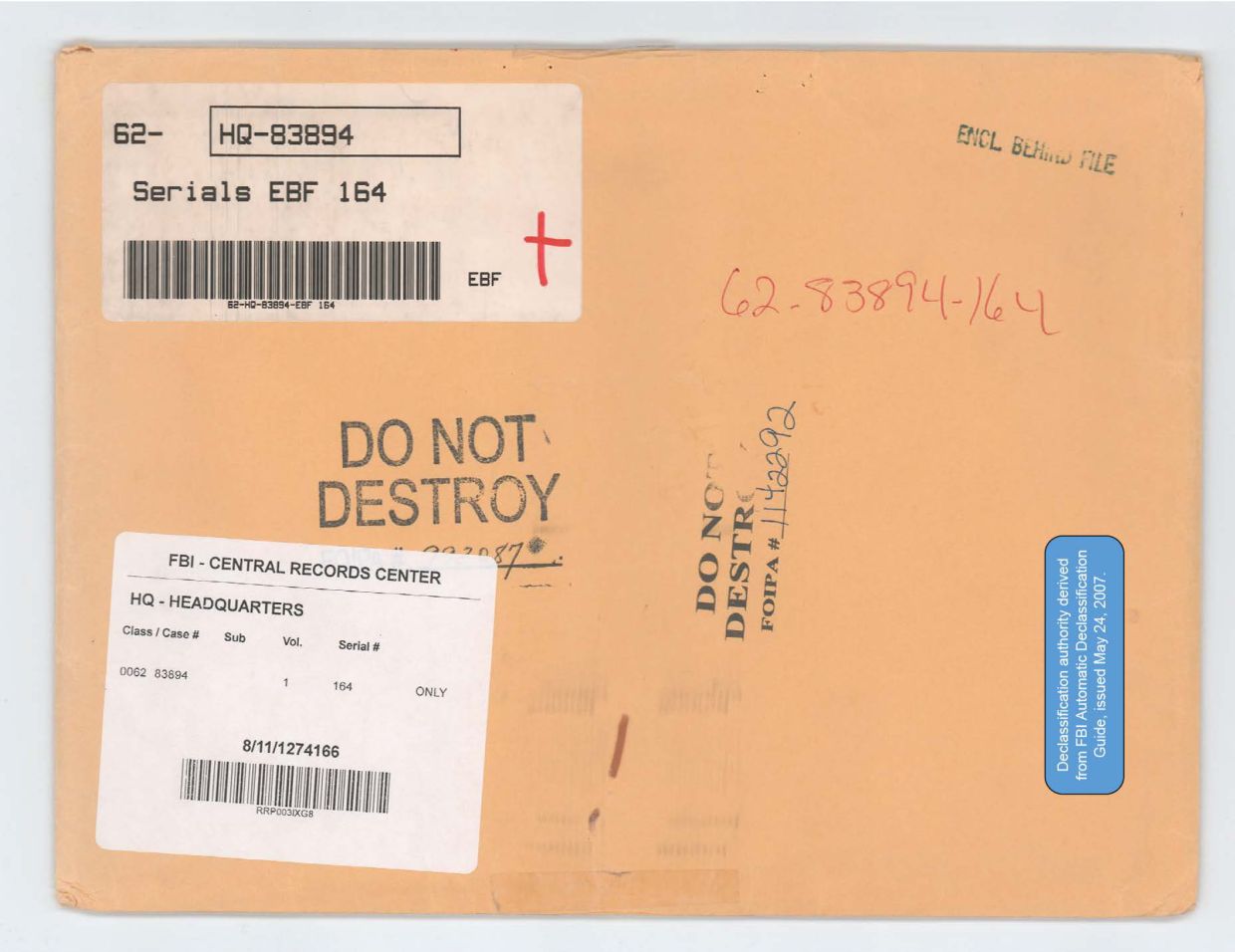
1
11 I I
I
.
'
'
62-
IHC-83894
I
Serials EBF 154
~ ~ 1111 I11111 IH~ llm
EBF t
62-HCl-83894-ESF" 164
DO NOT·
DES.fRO)'
•• ~
U
l t7{iJ;; +•
_
FBI - CENTRAL RECORDS CENTER
_ _ .
HQ - HEADQUARTERS
.
Class / Case #
Sub
Vol.
Serial #
0062 83694
1
164
ONLY
8/11/1274166
I
11 1/IIIHIIMIIIIIIIIIIIIlllllllllll~IIII
RRPO031XG8
PAGE 2 / 137
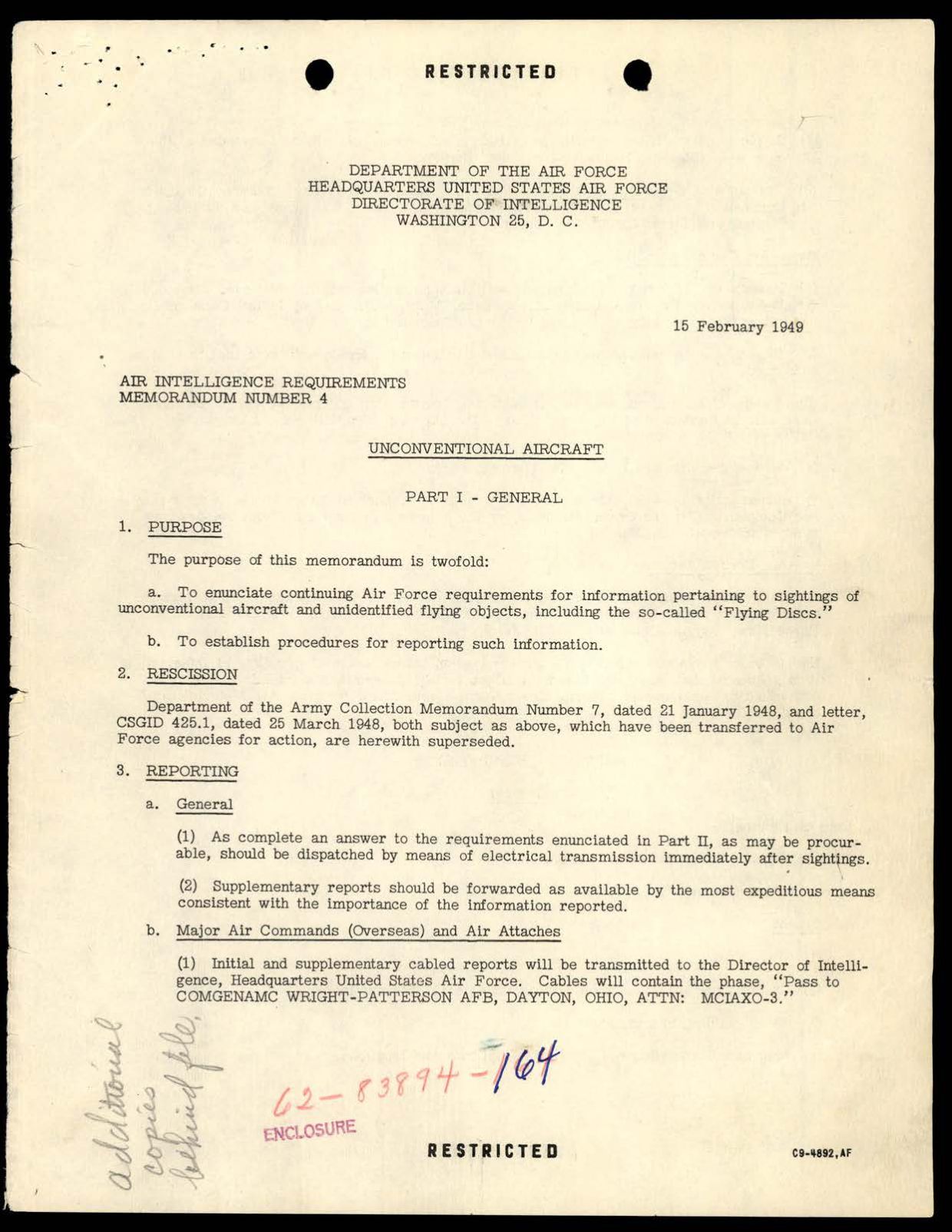
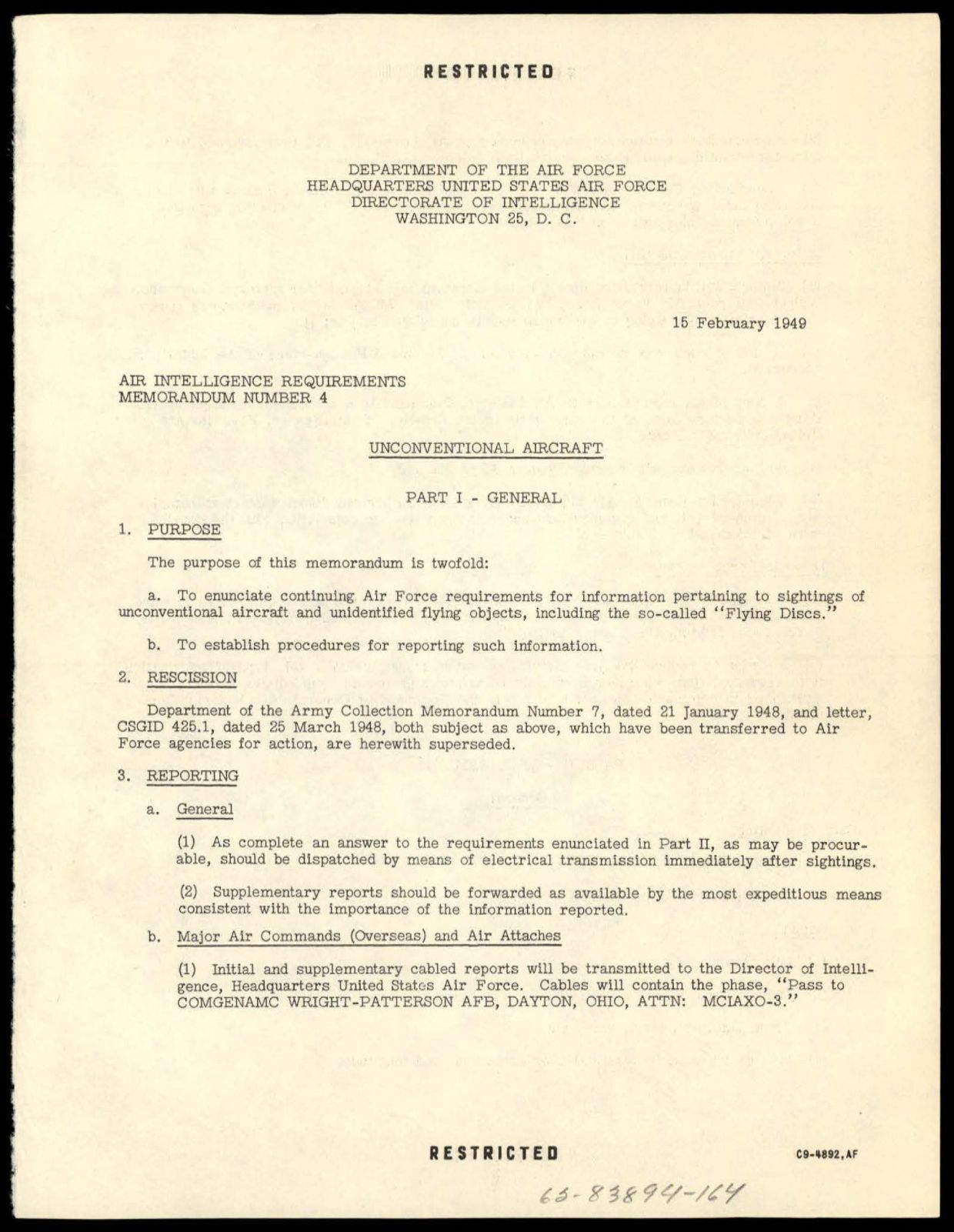
RESTRICTED r DEPARTMENT OF THE AIR FORCE HEADQUARTERS UN1TED STATES AIR FORCE DIRECTORATE OF INTELLIGENCE WASHINGTON 25, D. C. 15 February 1949 AIR INTELLIGENCE REQUIREMENTS MEMORANDUM NUMBER 4 UNCONVENTIONAL AIRCRAFT PART I - GENERAL 1. PURPOSE The purpose of this memorandum is twofold: a. To enunciate continuing Air Force requirements for information pertaining to sightings of unconventional aircraft and unidentified flying objects, including the so-called "Flying Discs." b. To establish procedures for reporting such information. 2. RESCISSION Department of the Army Collection Memorandum Number 7, dated 21 January 1948, and letter, CSGID 425.1, dated 25 March 1948, both subject as above, which have been transferred to Air Force agencies for action, are herewith superseded. 3. REPORTING a. General (1) As complete an answer to the requirements enunciated in Part II, as may be procur able, should be dispatched by means of electrical transmission immediately afte:' sighttngs. (2) Supplementary reports should be forwarded as availabl e by the most expeditious means consistent with the importance of the information reported. b. Major Air Commands (Overseas) and Air Attaches (1) Initial and supplementary cabled reports will be transmitted to the Dir ector of Intelli gence, Headquarters United States Air Force. Cables will contain the phase, " Pass to COMGENAMC WRIGHT-PATTERSON AFB, DAYTON, OHIO, ATTN: MCIAXO- 3." RESTRICTED C9-~892, AF
PAGE 3 / 137
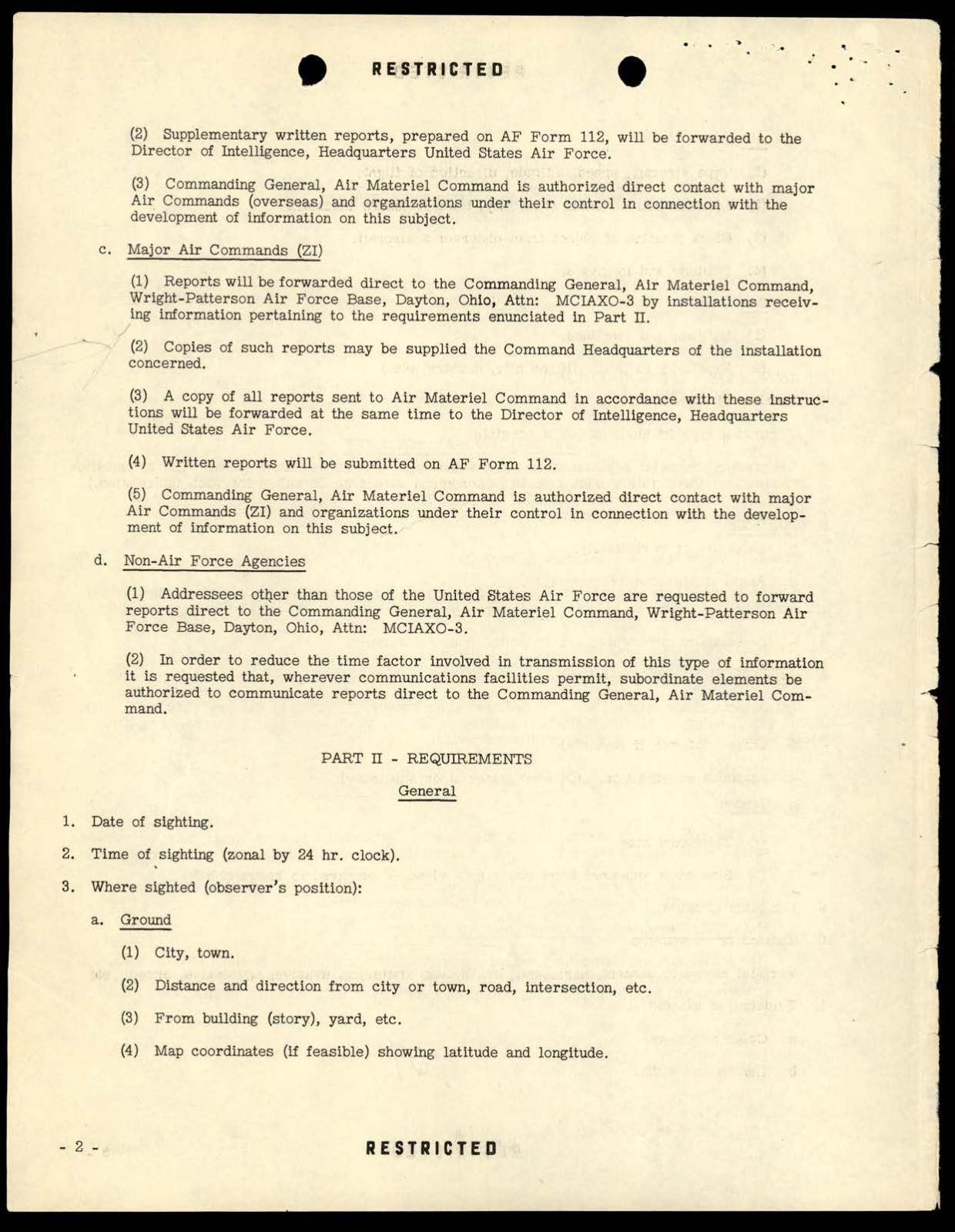
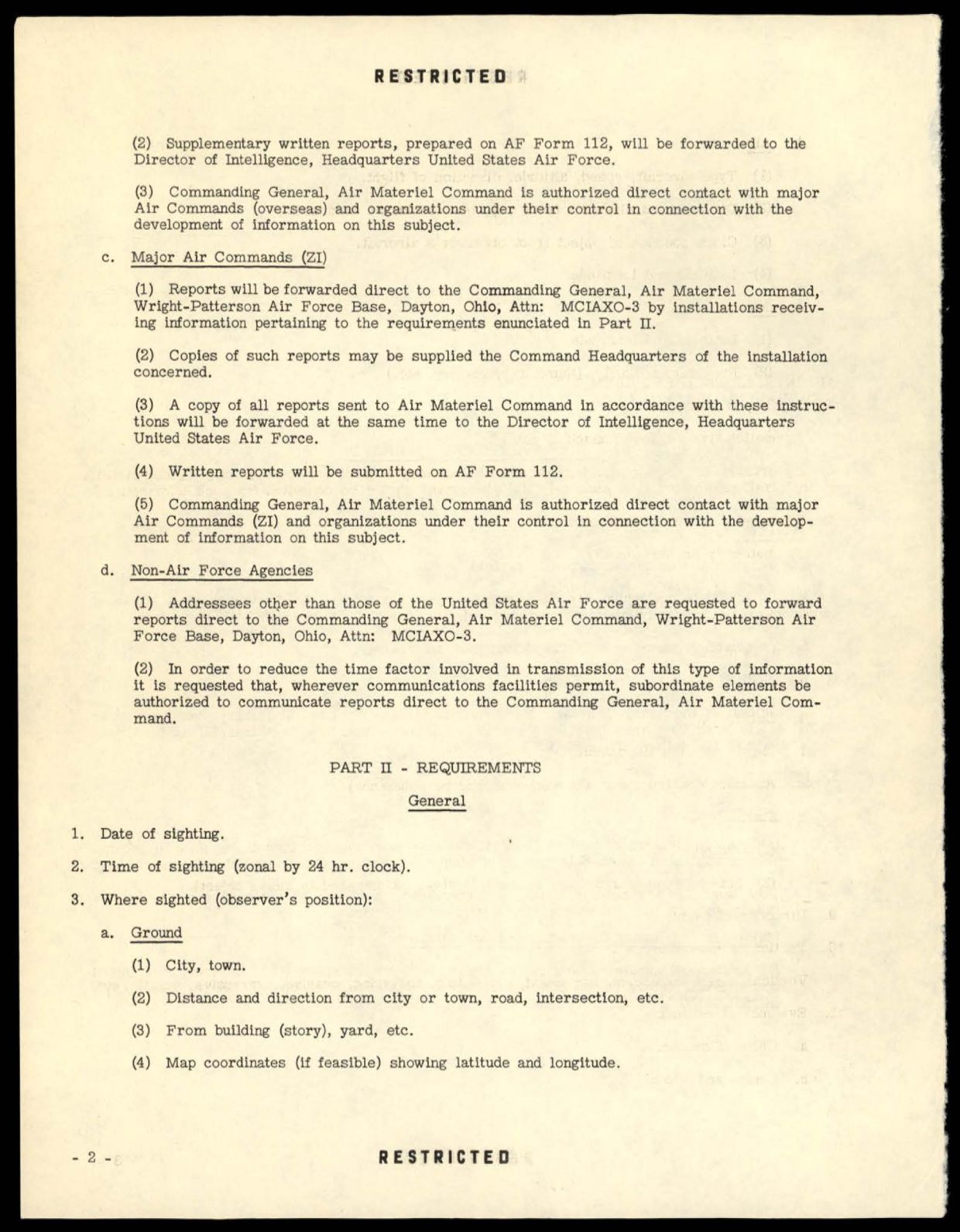
.. RESTRICTED (2) Supplementary written reports, prepared on AF Form 112, will be forwarded to the Director of Intelligence, Headquarters United States Air Force. (3) Commanding General, Air Materiel Command is authorized direct contact with major Air Commands (overseas) and organizations under their control in connection with the development of information on this subject. c. Major Air Commands (ZI) (1) Reports will be forwarded direct to the Commanding General, Air Materiel Command, Wright-Patterson Air Force Base, Dayton, Ohio, Attn: MCIAXO-3 by installations receiv ing information pertaining to the requirements enunciated in Part II. (2) Copies of such reports may be supplied the Command Headquarters of the installation concerned. (3) A copy of all reports sent to Air Materiel Command in accordance with these instruc tions will be forwarded at the same time to the Director of Intelligence, Headquarters United States Air Force. (4) Written reports will be submitted on AF Form 112. (5) Commanding General, Air Materiel Command is authorized direct contact with major Air Commands (ZI) and organizations under their control in connection with the d~velop ment of information on this subject. d. Non-Air Force Agencies (1) Addressees otqer than those of the United States Air Force are requested to forward reports direct to the Commanding General, Air Materiel Command, Wright-Patterson Air Force Base, Dayton, Ohio, Attn: MCIAXO-3. (2) In order to reduce the time factor involved in transmission of this type of information it is requested that, wherever communications facilities permit, subordinate elements be authorized to communicate reports direct to the Commanding General, Air Materiel Com mand. PART II - REQUIREMENTS General 1. Date of sighting. 2. Time of sighting (zonal by 24 hr. clock). 3. Where sighted (observer's position): a. Ground (1) City, town. (2) Distance and direction from city or town, road, intersection, etc. (3) From building (story), yard, etc. (4) Map coordinates (if feasible) showing latitude and longitude. - 2 - RESTRICTED
PAGE 4 / 137
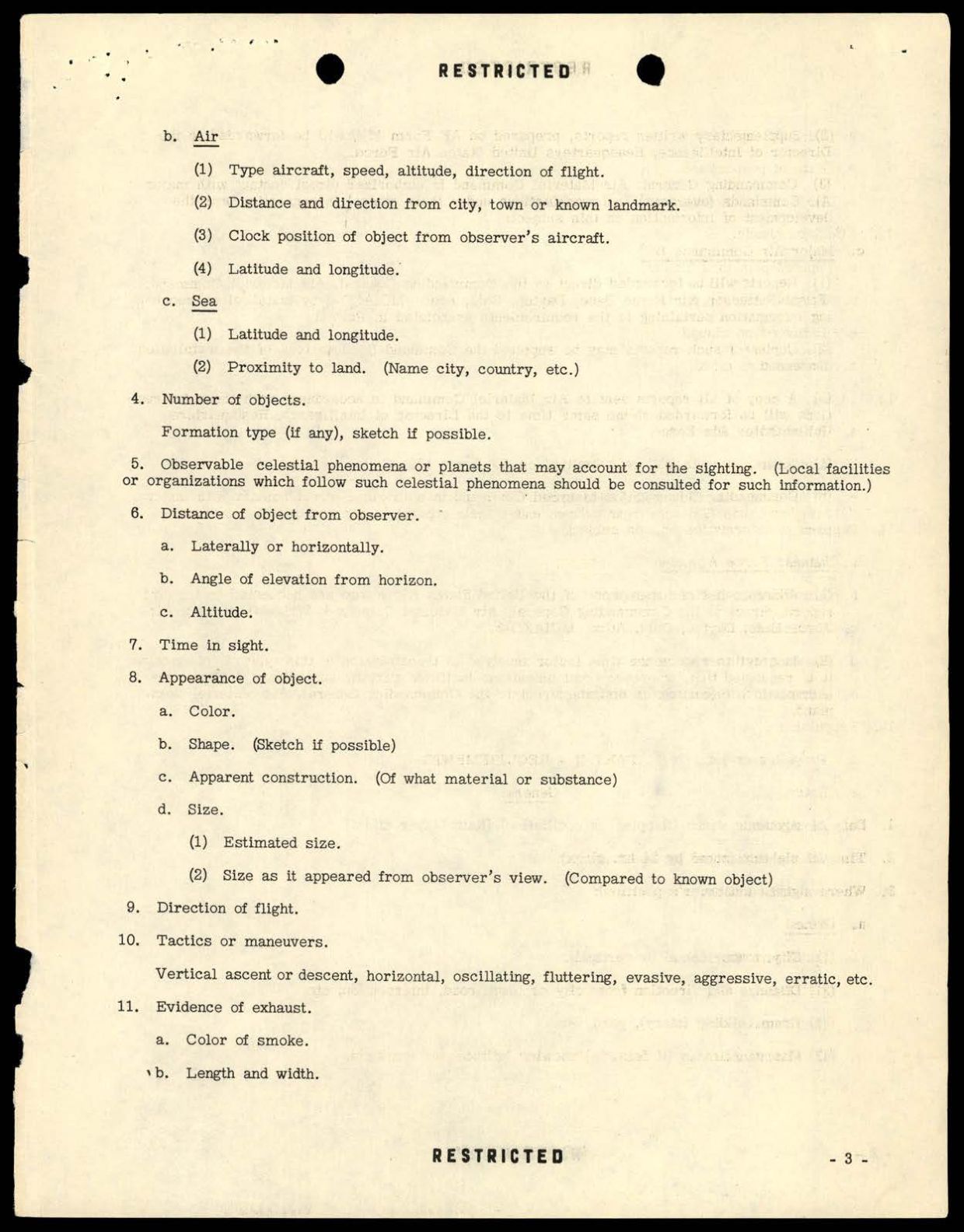
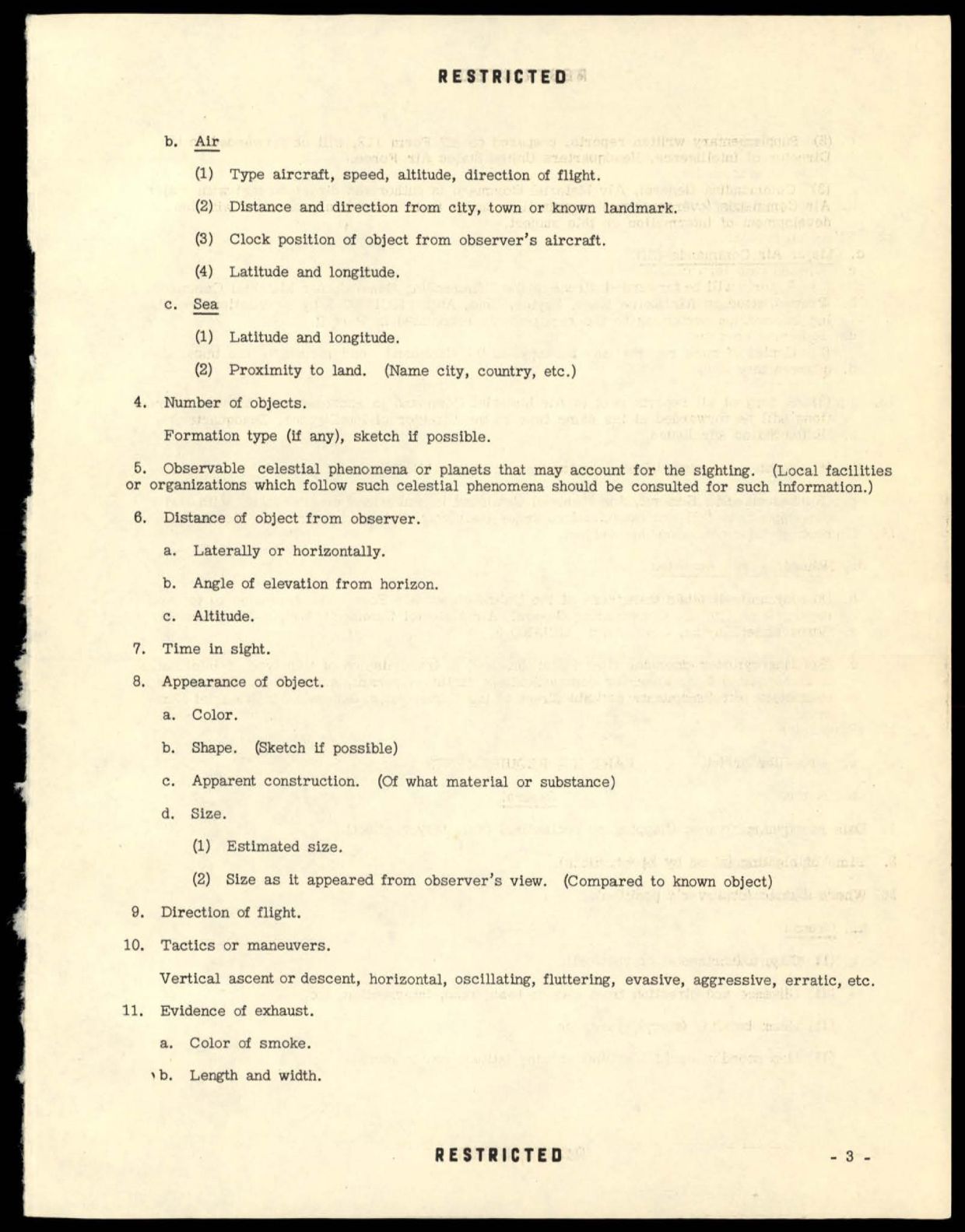
RESTRICTED b. Air (1) Type aircraft, speed, altitude, direction of flight. (2) Distance and direction from city, town or known landmark. (3) Clock position of object from observer's aircraft. (4) Latitude and longitude.' c. Sea (1) Latitude and longitude. (2) Proximity to land. (Name city, country, etc.) 4. Number of objects. Formation type (if any), sketch if possible. 5. Observable celestial phenomena or planets that may account for the sighting. (Local facilities or organizations which follow such celestial phenomena should be consulted for such information.) 6. Distance of object from observer. a. Laterally or horizontally. b. Angle of elevation from horizon. C. Altitude. 7. Time in sight. 8. Appearance of object. a. Color. b. Shape. (Sketch if possible) c. Apparent construction. (Of what material or substance) d. Size. (1) Estimated size. (2) Size as it appeared from observer's view. (Compared to known object) 9. Direction of flight. 10. Tactics or maneuvers. Vertical ascent or descent, horizontal, oscillating, fluttering, evasive, aggressive, erratic, etc. 11. Evidence of exhaust. a. Color of smoke. , b. Length and width. RESTRICTED - 3
PAGE 5 / 137
•
RESTRICTED
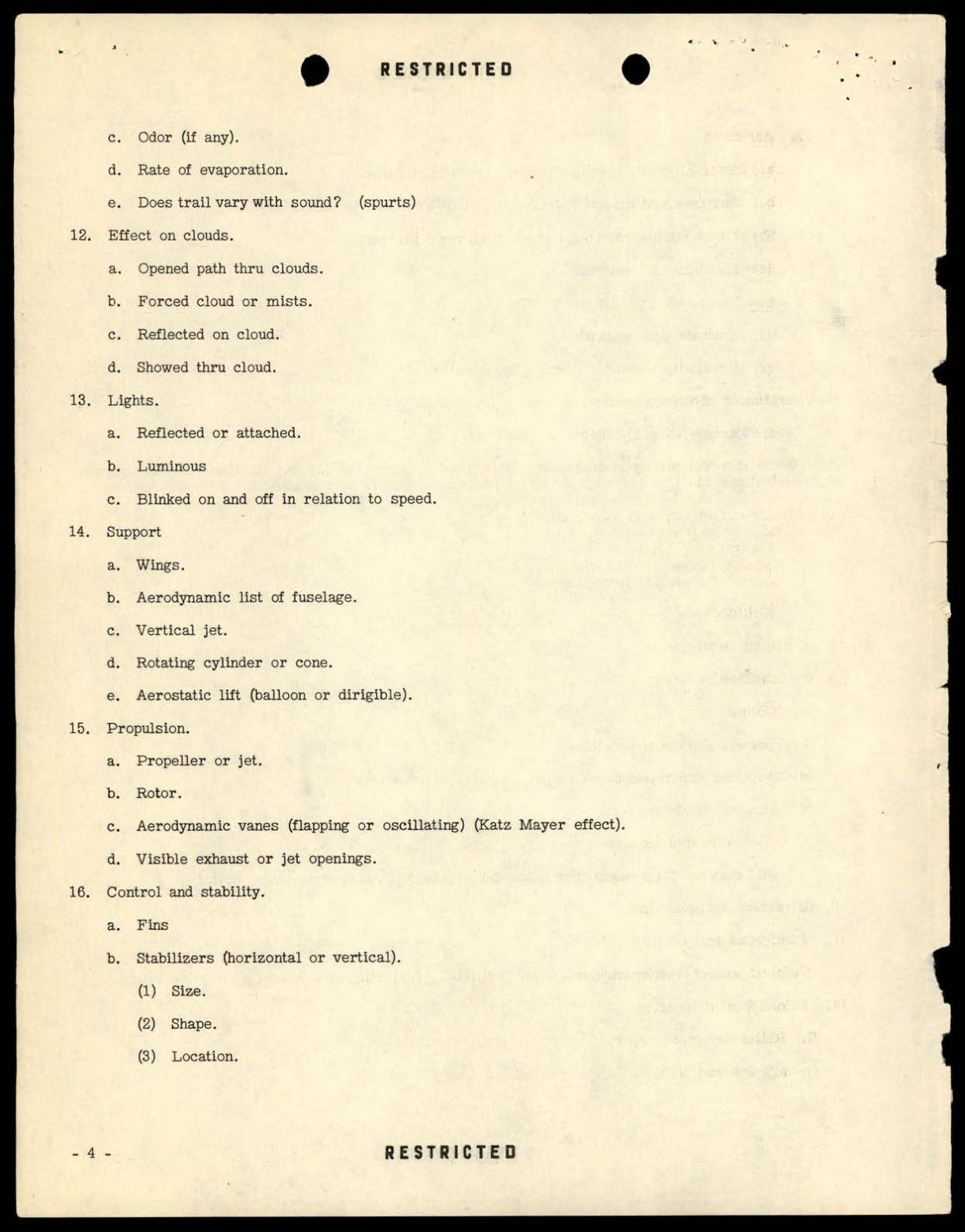
c. Odor (if any).
d. Rate of evaporation.
e. Does trail vary with sound? (spurts)
12. Effect on clouds.
a. Opened path thru clouds.
b. Forced cloud or mists.
c. Reflected on cloud.
d. Showed thru cloud.
13. Lights.
a. Reflected or attached.
b. Luminous
c . Blinked on and off in relation to speed.
14. Support
a. Wings.
b. Aerodynamic list of fuselage.
c. Vertical jet.
d. Rotating cylinder or cone.
e. Aerostatic lift (balloon or dirigible).
15. Propulsion.
a. Propeller or jet.
b. Rotor.
c. Aerodynamic vanes (flapping or oscillating) (Katz Mayer effect).
d. Visible exhaust or jet openings.
16. Control and stability.
a . Fins
b. Stabilizers (horizontal or vertical).
(1) Size.
(2) Shape.
(3) Location.
- 4 -
RESTRICTED
PAGE 6 / 137
, ..
,,. ...
..
RESTRICTED
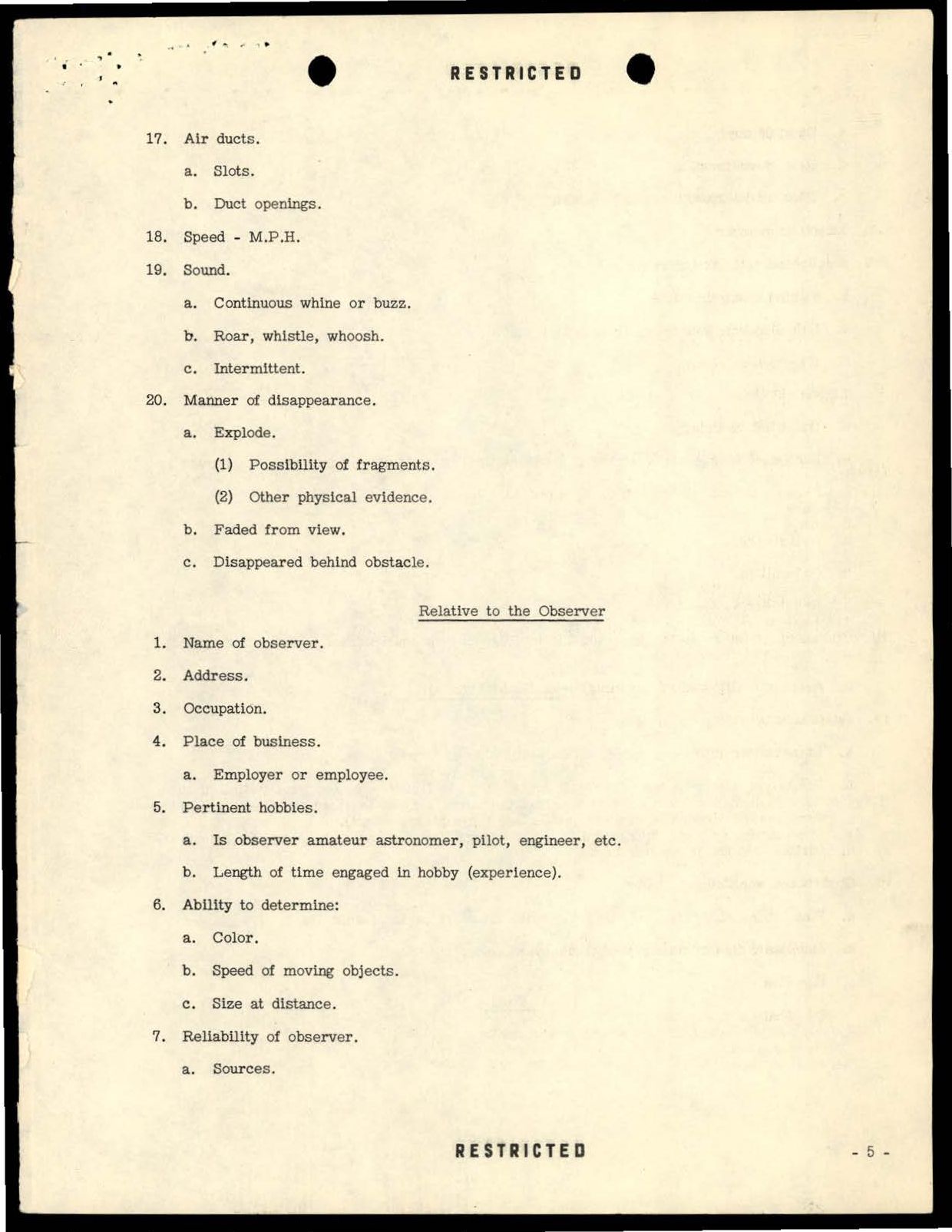
17. Air ducts.
a. Slots.
b. Duct openings.
18. Speed - M.P.H.
19. Sound.
a. Continuous whine or buzz.
b. Roar, whistle, whoosh.
c. Intermittent.
20. Manner of disappearance.
a.
Explode.
(1) Possibility of fragments.
(2) Other physical evidence.
b. Faded from view.
c. Disappeared behind obstacle.
Relative to the Observer
1. Name of observer.
2. Address.
3. Occupation.
4. Place of business.
a. Employer or employee.
5. Pertinent hobbies.
a. Is observer amateur astronomer, pilot, engineer, etc.
b. Length of time engaged in hobby (experience).
6. AbUity to determine:
a. Color.
b. Speed of moving objects.
c . Size at distance.
7. Reliability of observer.
a.
Sources.
RESTRICTED
- 5 -
PAGE 7 / 137
.• ''
RESTRICTED
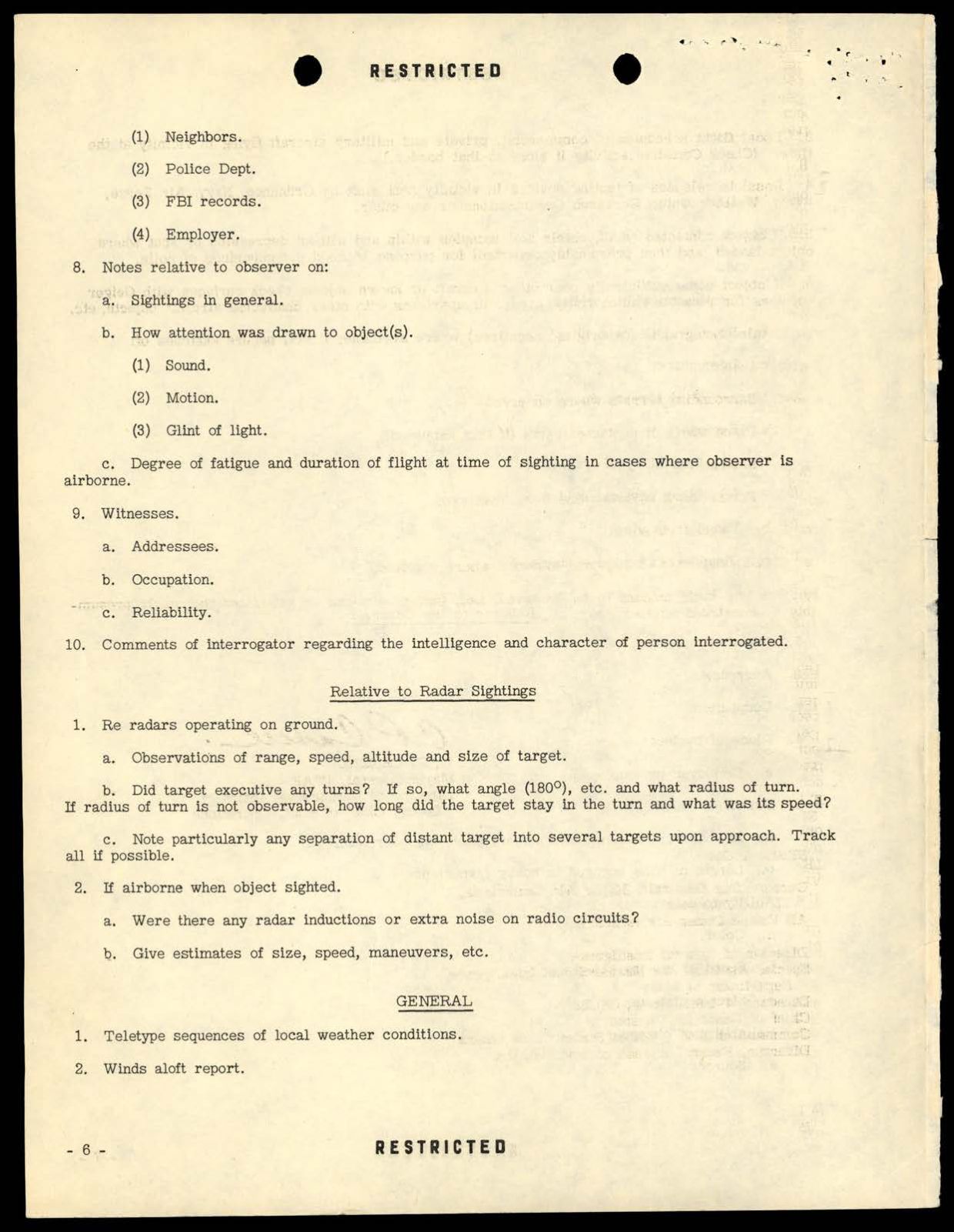
(1) Neighbors.
(2)
Police Dept.
(3)
FBI records.
(4)
Employer.
8. Notes relative to observer on:
a. Sightings in general.
b. How attention was drawn to object(s).
(1) Sound.
(2)
Motion.
(3) Glint of light.
c. Degree of fatigue and duration of flight at time of sighting in cases where observer is
airborne.
9. Witnesses.
a. Addressees.
b. Occupation.
C. Reliability.
10. Comments of interrogator regarding the intell1gence and character of person interrogated.
Relative to Radar Sightings
1. Re radars operating on ground.
a. Observations of range, speed, altitude and size of target.
b. Did target executive any turns?
If so, what angle (180°), etc. and what radius of turn.
If radius of turn is not observable, how long did the target stay in the turn and what was its speed?
c. Note particularly any separation of distant target into several targets upon approach. Track
all if possible.
2.
If airborne when object sighted.
a. Were there any radar inductions or extra noise on radio circuits?
b. Give estimates of size, speed, maneuvers, etc.
GENERAL
1. Teletype sequences of local weather conditions.
2. Winds aloft report.
- 6 -
RESTRICTED
PAGE 8 / 137
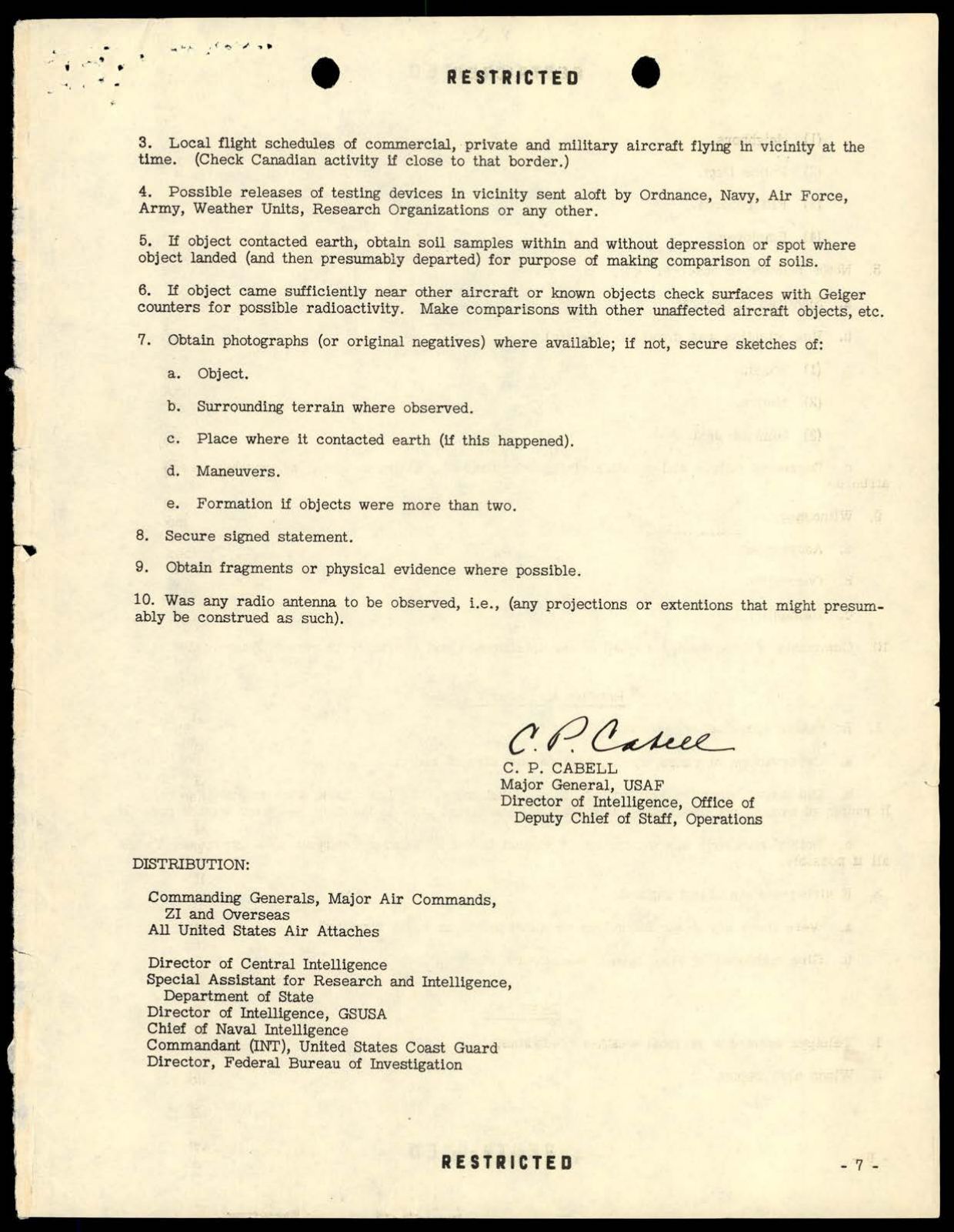
,. ' RESTRICTED • 3. Local flight schedules of commercial, private and military aircraft flying in vic!nity at the time. (Check Canadian activity if close to that border.) 4. Possible releases of testing devices in vicinity sent aloft by Ordnance, Navy, Air Force, Army, Weather Units, Research Organizations or any other. 5. Jf object contacted earth, obtain soil samples within and without depression or spot where object landed (and then presumably departed) for purpose of making comparison of soils. 6. Jf object came sufficiently near other aircraft or known objects check surfaces with Geiger counters for possible radioactivity. Make comparisons with other unaffected aircraft objects, etc. 7. Obtain photographs (or original negatives) where available; if not, secure sketches of: a. Object. b. Surrounding terrain where observed. c. Place where it contacted earth (ii this happened). d. Maneuvers. e. Formation ii objects were more than two. 8. Secure signed statement. 9. Obtain fragments or physical evidence where possible. 10. Was any radio antenna to be observed, i.e., (any projections or extentlons that might presum ably be construed as such). c>:1-?~ C. P . CABELL Major General, USAF Director of Intelligence, Office of Deputy Chief of Staff, Operations DISTRIBUTION: Commanding Generals, Major Air Commands, ZI and Overseas All United States Air Attaches Director of Central Intelligence Special Assistant for Research and Intelligence, Department of State Director of Intelligence, GSUSA Chief of Naval Intelligence Commandant (INT), United States Coast Guard Director, Federal Bureau of Investigation RESTRICTED - 7 -
PAGE 9 / 137
•
RESTRICTED
RESTRICTED
PAGE 10 / 137
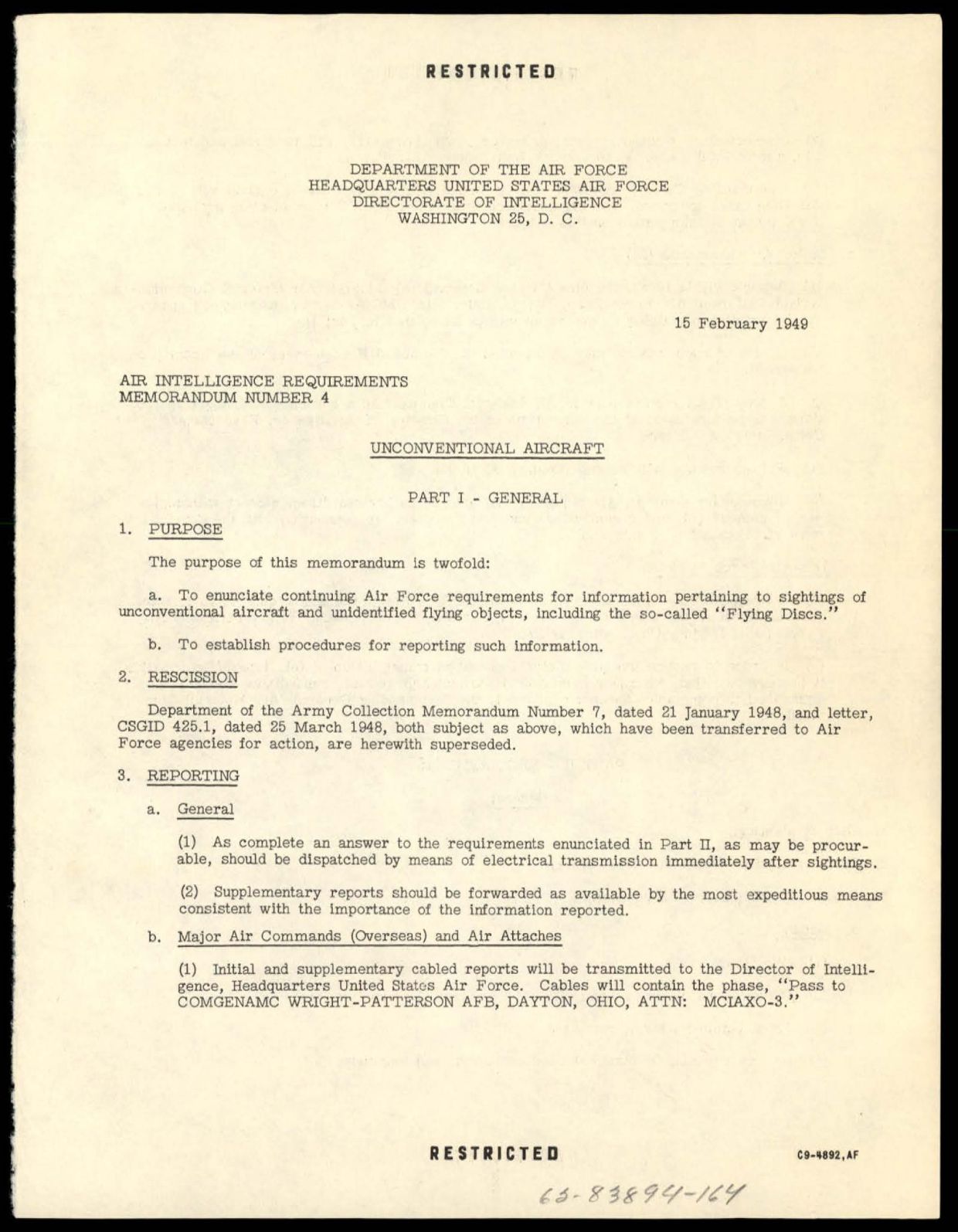
RESTRICTED DEPARTMENT OF THE AIR FORCE HEADQUARTERS UNITED STATES AIR FORCE DIRECTORATE OF INTELLIGENCE WASHINGTON 25, D. C. 15 February 1949 AIR INTELLIGENCE REQUIREMENTS MEMORANDUM NUMBER 4 UNCONVENTIONAL AIRCRAFT PART I - GENERAL 1. PURPOSE The purpose of this memorandum is twofold: a. To enunciate continuing Air Force requirements for information pertaining to sightings of unconventional aircraft and unidentified flying objects, including the so-called "Flying Discs." b. To establlsh procedures for reporting such information. 2. RESCISSION Department of the Army Collection Memorandum Number 7, dated 21 January 1948, and letter, CSGID 425.1, dated 25 March 1948, both subject as above, which have been transferred to Air Force agencies for action, ar e herewith superseded. 3. REPORTING a. General (1) As complete an answer to the requirements enunciated in Part II, as may be procur able, should be dispatched by means of electrical transmission immediately after sightings. (2) Supplementary reports should be forwarded as available by the most expeditious means consistent with the importance of the information reported. b. Major Air Commands (Overseas) and Air Attaches (1) Initial and supplementary cabled reports wlll be transmitted to the Director of Intelll gence, Headquarters United State:s Air Force. Cables will contain the phase, "Pass to COMGENAMC WRIGHT-PATTERSON AFB, DAYTON, OHIO, ATTN: MCIAX0-3." RESTRICTED ~a- 8 ~t-9~-/t'1/
PAGE 11 / 137
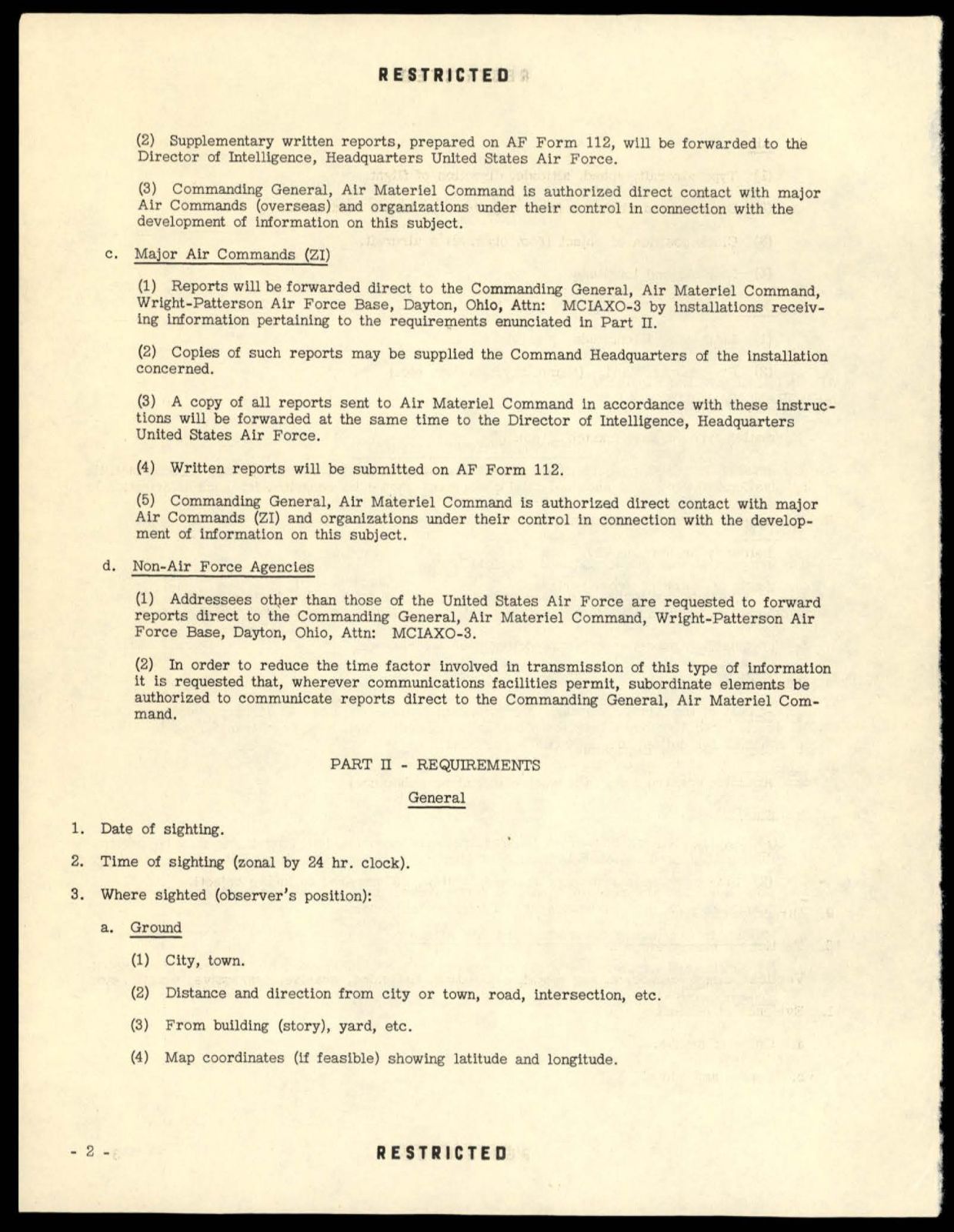
RESTRICTED (2) Supplementary written reports, prepared on AF Form 112, will be forwarded to the Director of Intelligence, Headquarters United States Air Force. (3) Commanding General, Air Materiel Command is authorized direct contact with major Air Commands (overseas) and organizations under their control in connection with the development of information on thl.s subject. c. Major Air Commands (ZI) (1) Reports wlll be forwarded direct to the Commanding General, Al.r Materiel Command, Wright-Patterson Al.r Force Base, Dayton, Ohio, Attn: MCIAXO-3 by installations receiv ing lnformation pertaining to the requirements enunciated in Part II. (2) Copies of such r eports may be supplied the Command Headquarters of the installation concerned. (3) A copy of all r eports sent to Air Materiel Command in accordance with these instruc tions wlll be forwarded at the same ti.me to the Director of Intelligence, Headquarters United States Air Force. (4) Written r eports will be submitted on AF Form 112. (5) Commanding General, Air Materiel Command is authorized direct contact with major Air Commands (ZI) and organizations under thel.r control in connection wl.th the develop ment of information on this subject. d. Non-Air Force Agencies (1) Addressees otQer than those of the United States Air Force are r equested to forward r eports direct to the Commanding General, Al.r Materiel Command, Wright-Patterson Air Force Base, Dayton, Ohio, Attn: MCIAXO-3. (2) In order to r educe the ti.me factor involved in transmission of this type of information it is r equested that, wher ever communications facilities permit, subordinate elements be authorized to communicate reports dir ect to the Commanding General, Air Materiel Com mand. PART Il - REQUIREMENTS General 1. Date of sighting. 2. Time of sighting (zonal by 24 hr. clock). 3. Where sighted (observer's position): a. Ground (1) City, town. (2) Distance and direction from city or town, road, intersection, etc. (3) Fr om building (story), yard, etc. (4) Map coordinates (lf feasible) showing latitude and longitude. - 2 - RESTRICTED
PAGE 12 / 137
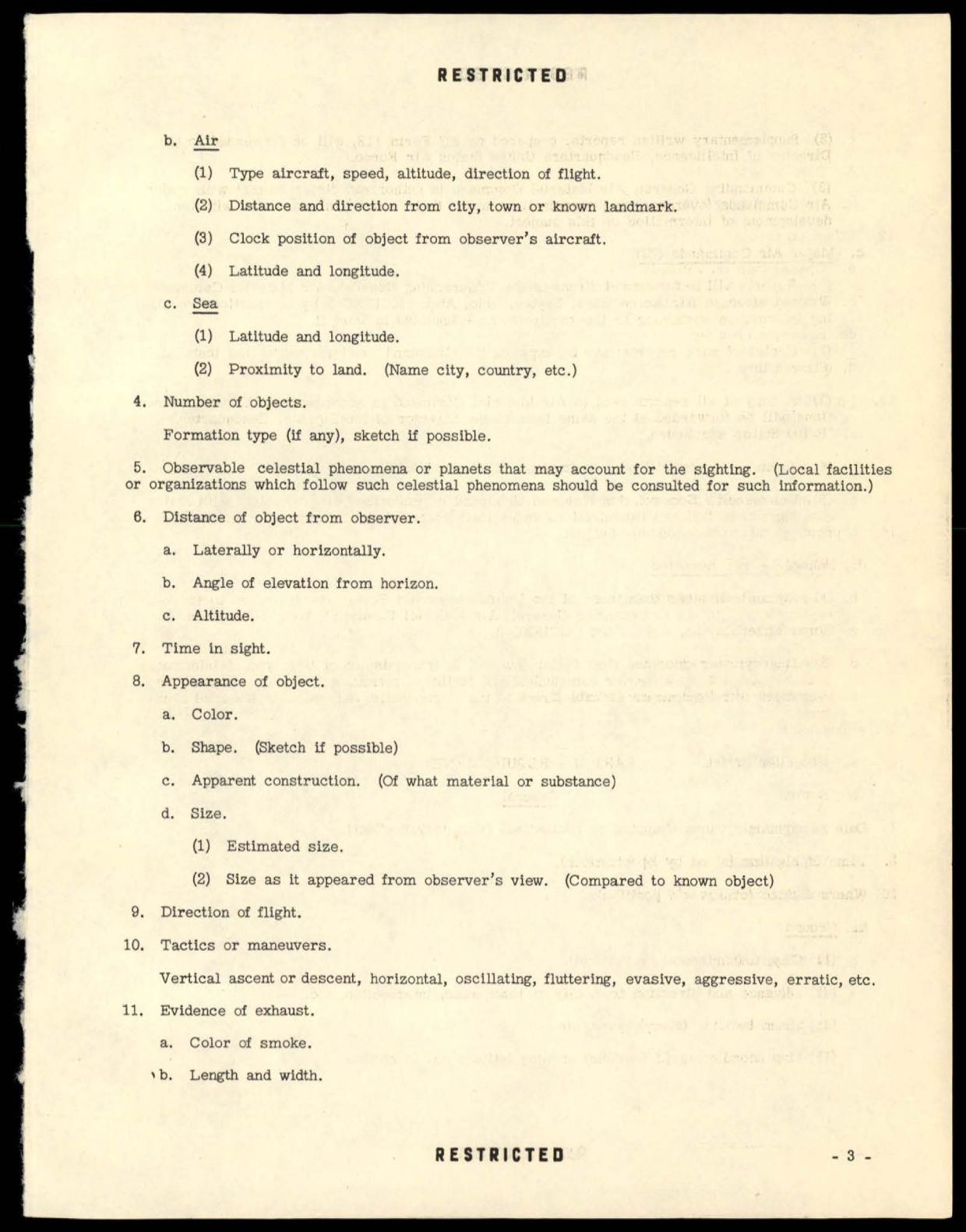
RESTRIC:t'ED b. Air (1) Type aircraft, speed, altltude, direction of flight. (2) Distance and direction from city, town or known landmark. (3) Clock position of object from observer's aircraft. (4) Latitude and longitude. c. Sea (1) Latitude and longitude. (2) Proximity to land. (Name city, country, etc.) 4. Number of objects. Formation type (l.f any), sketch l.f possible. 5. Observable celestial phenomena or planets that may account for the slghtlng. (Local fac111t!.es or organizations which follow such celestial phenomena should be consulted for such information.) 6. Distance of object from observer. a. Laterally or horizontally. b. Angle of elevation from horizon. c. Altitude. 7. Time in sight. 8. Appearance of object. a. Color. b. Shape. (Sketch ti possible) c. Apparent construction. (Of what material or substance) d. Size. (1) Estimated size. (2) Size as Lt appeared from observer's view. (Compared to known object) Q. Direction of flight. 10. Tactics or maneuvers. Vertical ascent or descent, horizontal, osctllatlng, fluttering, evasive, aggressive, erratic, etc. 11. Evidence of exhaust. a. Color of smoke. , b. Length and width. RESTRICTED - 3
PAGE 13 / 137
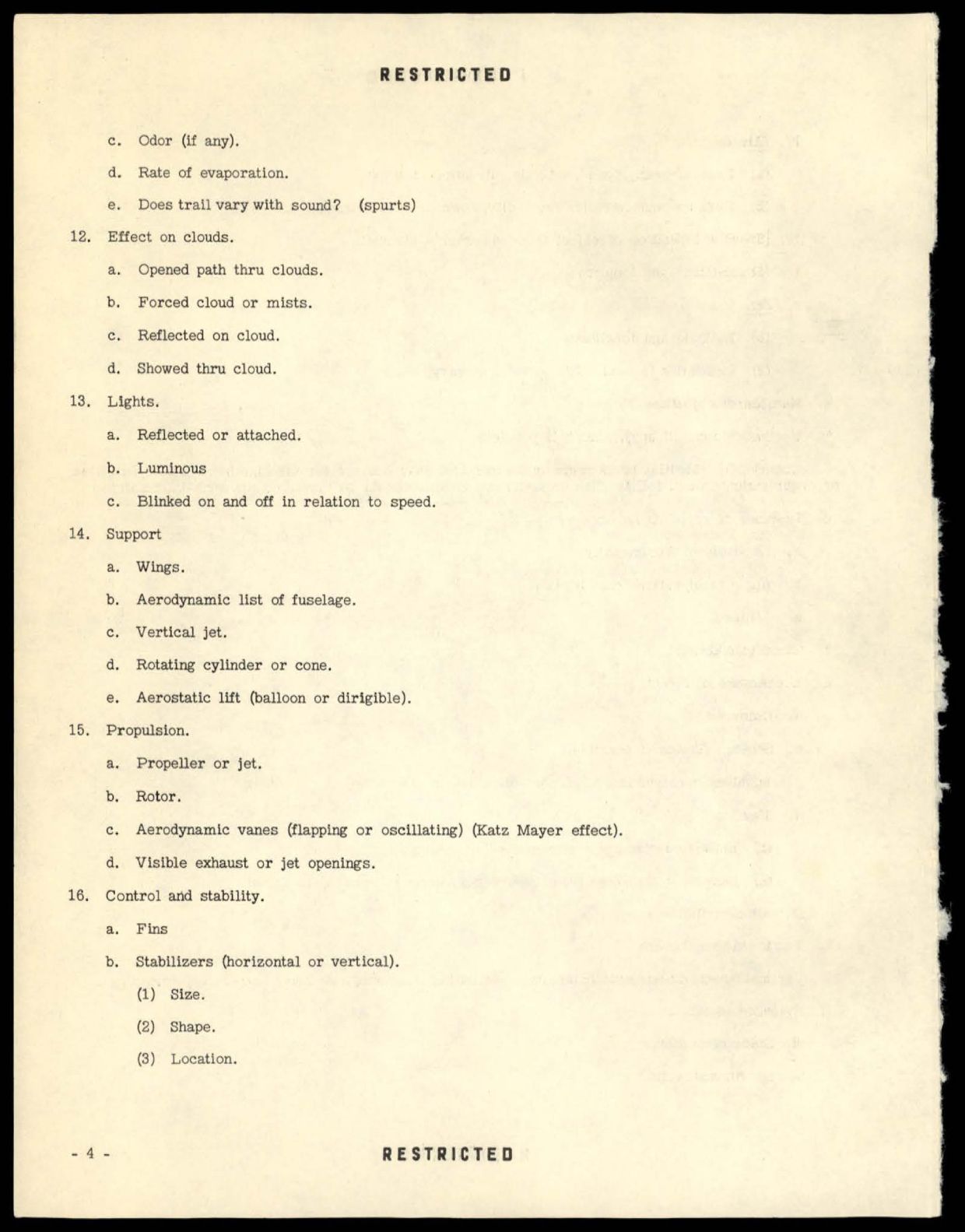
RESTRICTED
c. Odor (if any).
d. Rate of evaporatlon.
e. Does trail vary with sound?
(spurts)
12. Effect on clouds.
a.
Opened path thru clouds.
b.
Forced cloud or mists.
c. Reflected on cloud.
d. Showed thru cloud.
13. Lights.
a. Reflected or attached.
b.
Luminous
c. Blinked on and off in r elation to speed.
14. Support
a. Wings.
b. Aerodynamic list of fuselage.
c. Vertical jet.
d. Rotating cylinder or cone.
e. Aerostatic lift (balloon or dirigible).
15. Propulsion.
a. Propeller or jet .
b.
Rotor .
c. Aerodynamlc vanes (flapping or osclllating) (Katz Mayer effect).
d. Visible exhaust or jet openings.
16. Control artd stability.
a. Fins
b. Stablll.zers (hor izontal or vertical).
(1) Size.
(2) Shape.
(3) Location.
- 4 -
RESTRIC T ED
PAGE 14 / 137
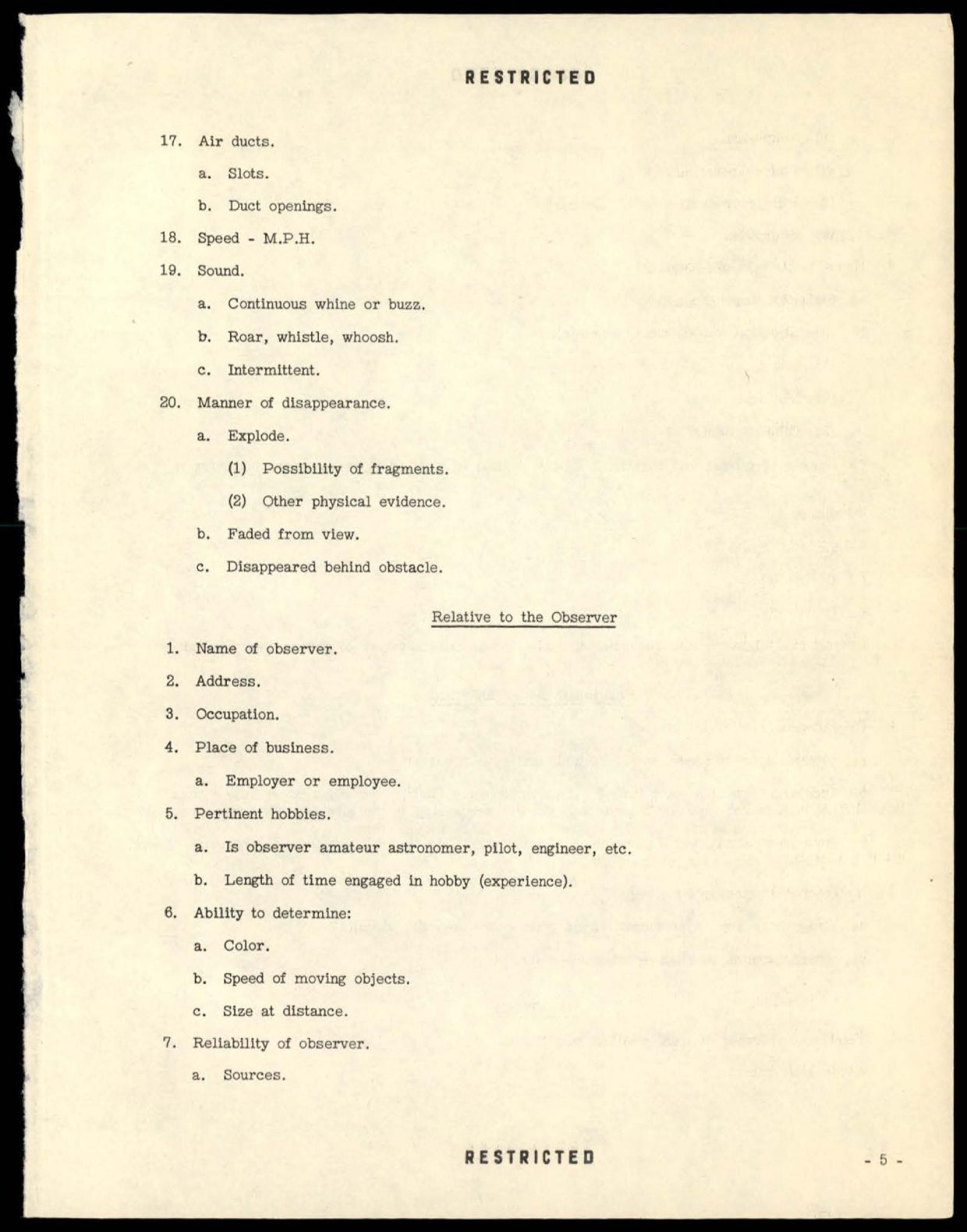
RESTRICTED 17. Al.r ducts. a. Slots. b. Duct openings. 18. Speed - M.P.H. 19. Sound. a. Continuous wblne or buzz. b. Roar, whistle, whoosh. c. Interml.ttent. 20. Manner of disappearance. a. Explode. (1) Possl.bill.ty of fragments. (2) Other physl.cal evldence. b. Faded from vlew. c. Disappeared behlnd obstacle. Relative to the Observer 1. Name of observer. 2. Address. 3. Occupation. 4. Place of business. a. Employer or employee. 5. Pertinent hobbles. a. Is observer amateur astronomer, pllot, engineer, etc. b. Length of time engaged in hobby (experience). 6. Abllity to determine: a. Color. b. Speed of movl.ng objects. c. Size at distance. ? . ReUabll1ty of observer. a. Sources. REST RICTED - 5
PAGE 15 / 137
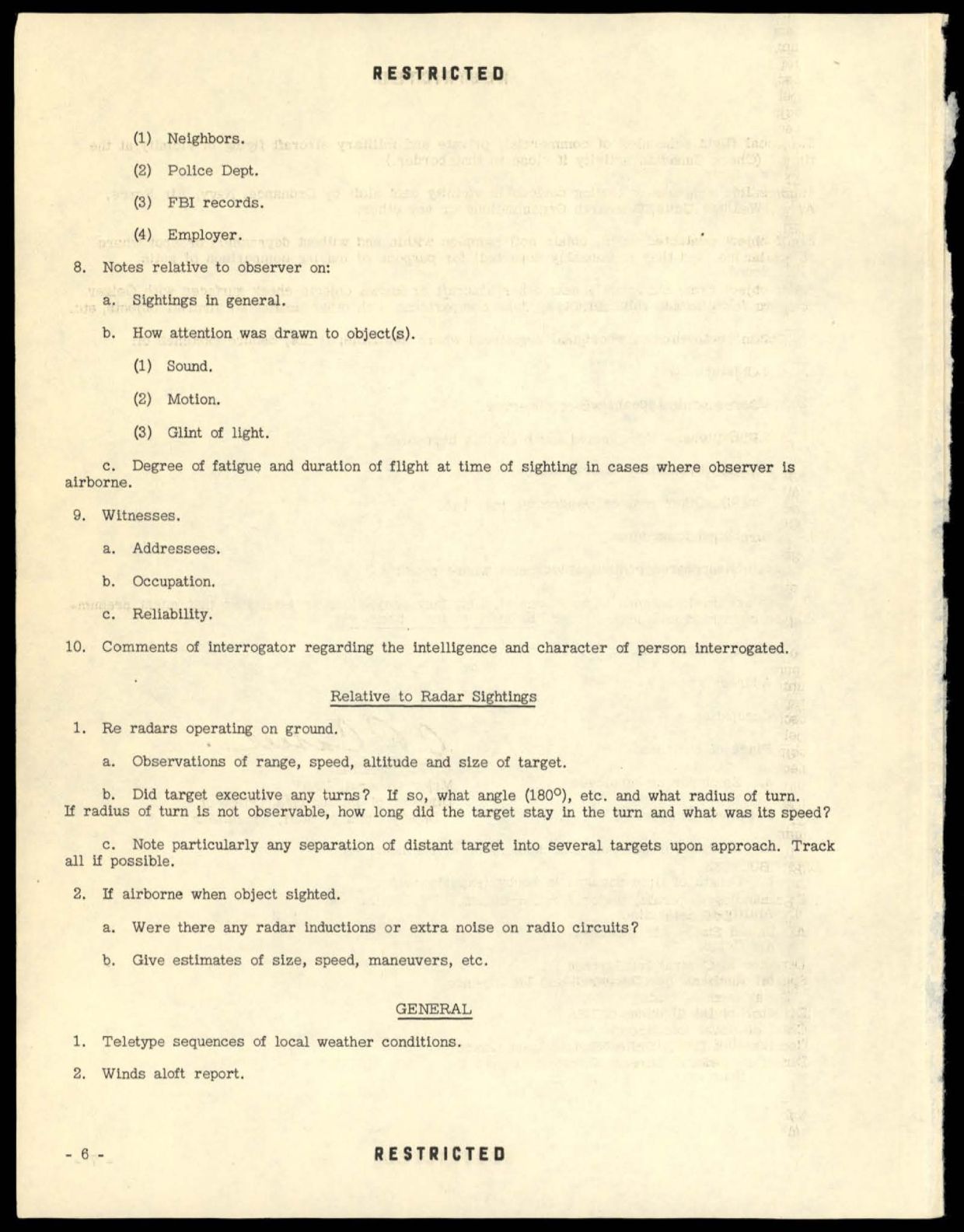
RESTRICTED
(1) Neighbors.
(2) Police Dept.
(3) FBI records .
(4)
Employer.
8. Notes relative to observer on:
a. Sightings in general.
b. How attention was drawn to object(s).
(1) Sound.
(2) Motion.
(3) Glint of llght.
c. Degree of fatigue and duratlon of flight at time of sighting in cases where observer ls
airborne.
9. Witnesses.
a. Addressees.
b.
Occupation.
c. Reliabllity.
10. Comments of interrogator regarding the intelligence and character of person interrogated.
Relative to Radar Sightings
1. Re radars operating on ground.
a. Observations of range, speed, altitude and size of target.
b.
Did target executive any turns? If so, what angle (180°), etc. and what radius of turn.
If radius of turn 1s not observable, how long did the target stay in the turn and what was its speed?
c. Note particularly any separation of distant target into several targets upon approach. Track
all if possible.
2. If airborne when object sighted.
a. Were there any radar inductions or extra noise on radio circuits?
b. Give estimates of size, speed, maneuvers, etc.
GENERAL
1. Teletype sequences of local weather condltl.ons.
2. Winds aloft report.
- 6 -
RESTRICTED
PAGE 16 / 137
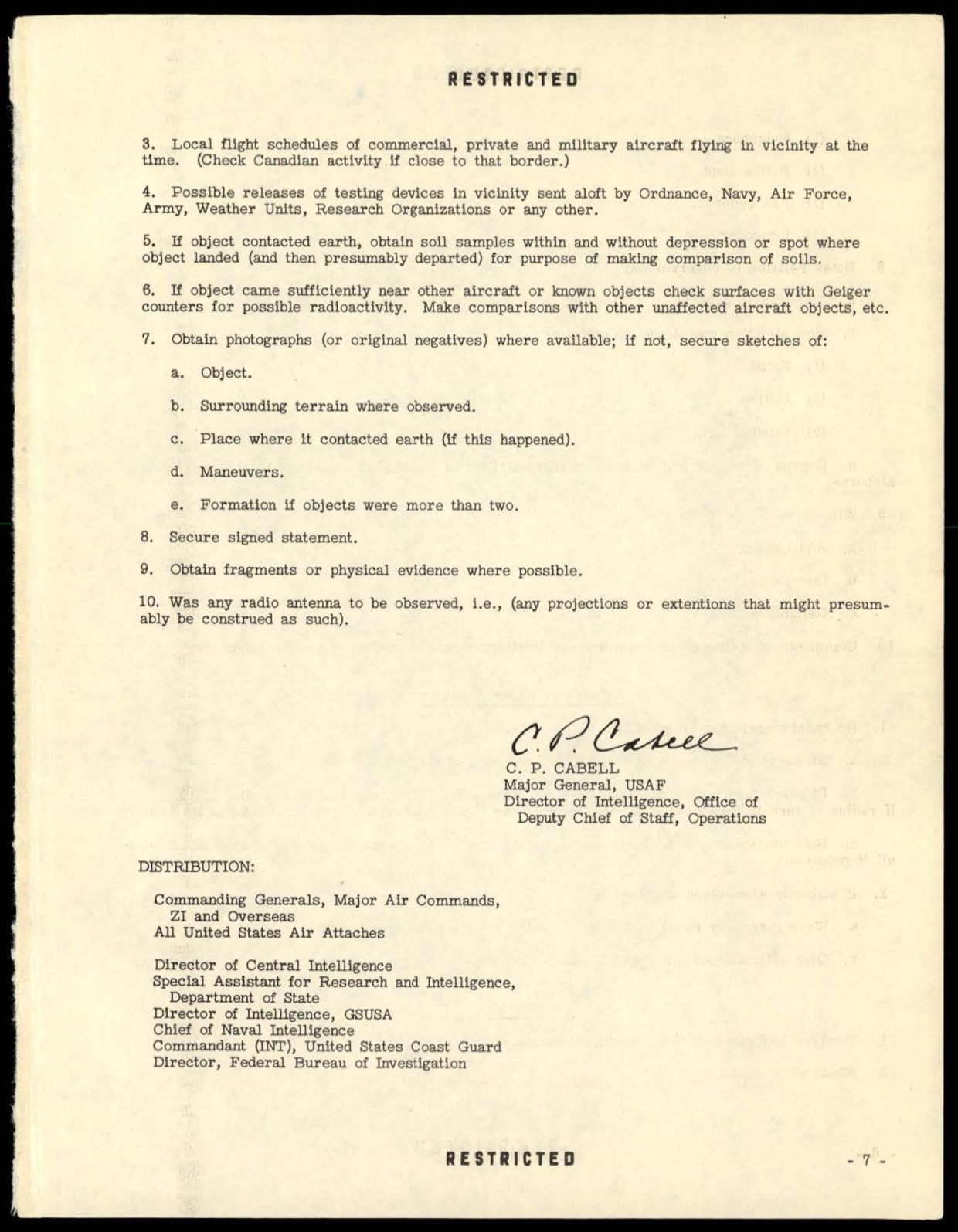
RESTRICTED 3. Local fUght schedules of commercial, private and m1litary aircraft flying in vicinity at the time. (Check Canadian activ1ty 1f close to that border.) 4. Possible releases of testing devices ln vicinity sent aloft by Ordnance, Navy, Air Force, Army, Weather Units, Research Organizations or any other. 6. If object contacted earth, obtain soil samples within and without depression or spot where object landed (and then presumably departed) for purpose of making comparison of sons. 6. If object came sufficiently near other aircraft or known objects check surfaces with Geiger counters for possible radioactivity. Make comparisons with other unaffected aircraft objects, etc. 7. Obtain photographs (or original negatives) where available; if not, secure sketches of: a. Object. b. Surrounding terrain where observed. c. Place where it contacted earth (if this happened). d. Maneuvers. e. Formation if objects were more than two. 8. Secure signed statement. 9. Obtain fragments or physical evidence where possible. 10. Was any radio antenna to be observed, 1.e., (any projections or extentions that might presum ably be construed as such). c>:t-!~ C. P. CABELL Major General, USAF Director of Intelligence, Offlce of Deputy Chtef of Staff, Operations DISTRlBUTION: Commanding Generals, Major Air Commands, ZI and Overseas All United States Air Attaches Director of Central Intelligence Special Assistant for Research and Intelllgence, Department of State Director of Intelligence, GSUSA Chief of Naval Intelligence Commandant (INT), United States Coast Guard DirectorI Federal Bur eau of Investigation RESTRICTED - 7 -
PAGE 17 / 137
RESTRICTED
RESTRICTED
PAGE 18 / 137
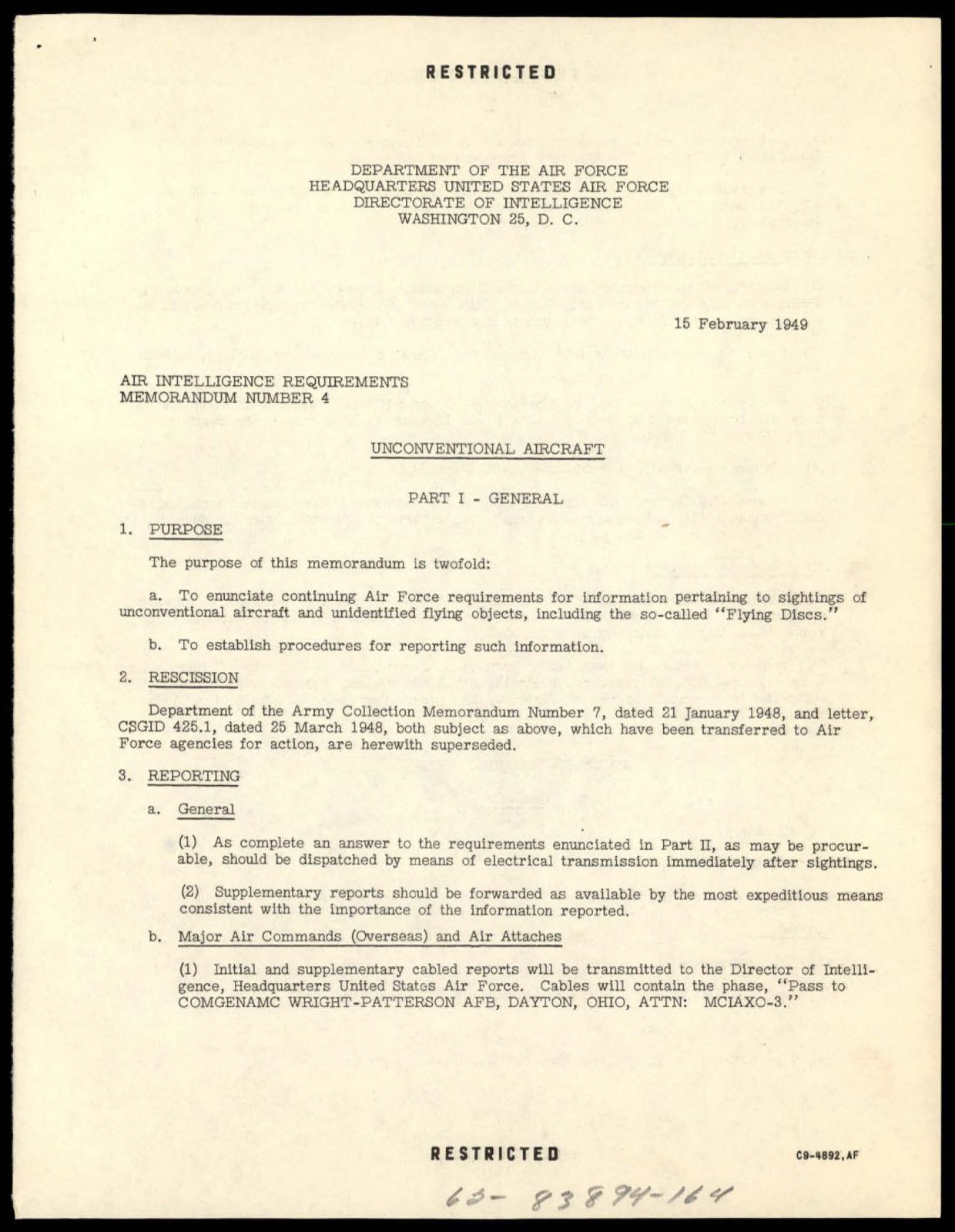
RESTRICTED DEPARTMENI' OF THE Affi. FORCE HEADQUARTERS UNITED STATES Am FORCE DmECTORATE OF INI'ELLIGENCE WASHINGTON 25, D. C. 15 February 1949 Am INTELLIGENCE REQUIBEMENI'S MEMORANDUM NUMBER 4 UNCONVENTIONAL Arn.CRAFT PART I - GENERAL 1. PURPOSE The purpose of this memorandum ls twofold; a. To enunciate continuing Air Force requirements for information pertaining to sightings of unconventional aircraft and un1dent1f1ed flying objects, including the so-called "Flying Discs. " b. To establish procedures for reporting such information. 2. RESCISSION Department of the Army Collection Memorandum Number 7, dated 21 January 1948, and letter, CSGID 425.1, dated 25 March 1948, both subject as above, which have been transferred to Air Force agencies for action, are herewith superseded. 3. REPORTING a. General (1) As complete an answer to the requirements enunciated in Part II, as may be procur able, should be dispatched by means of electrical transmission immediately after sightings. (2) Supplementary reports should be forwarded as available by the most expeditlous means consistent with the importance of the information reported. b. Major Air Commands (Overseas) and Air Attaches (1) Initial and supplementary cabled reports will be transmitted to the Director of Intem gence, Headquarters United State:s Air Force. Cables will contain the phase, "Pass to COMGENAMC WRIGHT-PATTERSON AFB, DAYTON, OHIO, ATTN: MCIAX0-3." RESTRICTED
PAGE 19 / 137
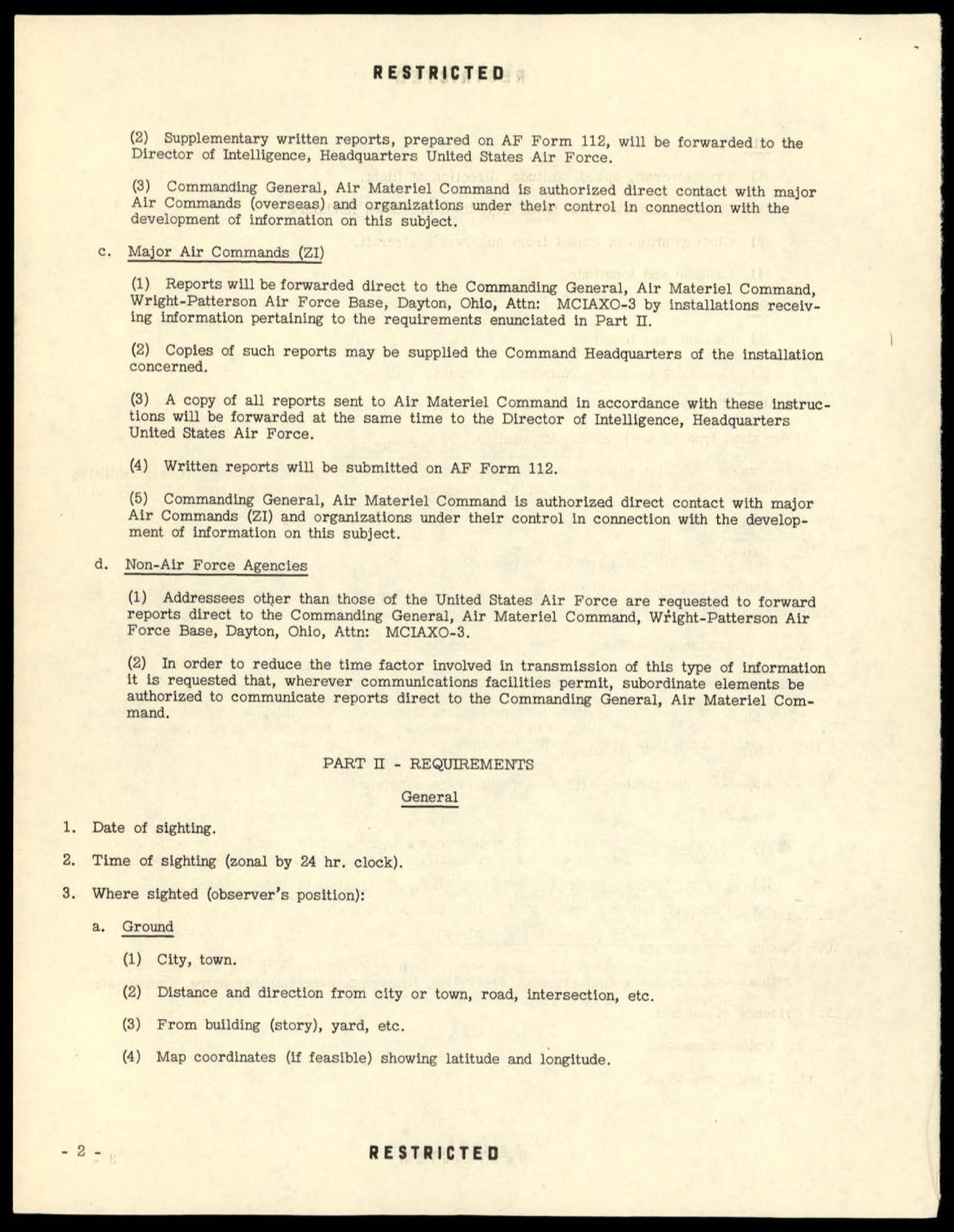
RESTRICTED (2) Supplementary written reports, prepared on AF Form 112, wlll be forwarded to the Director of Intelllgence, Headquarters United States Air Force. (3) Commanding General, Air Materiel Command is authorized direct contact with major Al.r Commands (overseas) and organizations under their control in connection with the development of information on this subject. c. Major Air Commands (Zl) (1) Reports will be forwarded direct to the Commanding General, Air Materiel Command, Wright-Patterson Air Force Base, Dayton, Ohio, Attn: MCIAXO-3 by l.nstallations receiv ing information pertaining to the requirements enunciated in Part TI. (2) Copies of such reports may be supplied the Command Headquarters of the installation concerned. (3) A copy of all reports sent to Air Materiel Command in accordance with these instruc tions will be forwarded at the same time to the Dlrector of Intelligence, Headquarters United States Air Force. (4) Written r eports wlll be submitted on AF Form 112. (5) Commanding General, Al.r Materiel Command is authorized direct contact with major Air Commands (ZI) and organizations under their control in connection with the develop ment of information on this subject. d. Non-Air Force Agencies (1) Addressees otQer than those of the United states Air Force are r equested to forward reports direct to the Commanding General, Air Materiel Command, Wright-Patter son Air Force Base, Dayton, Ohio, Attn: MCIAXO-3. (2) In order to reduce the time factor involved in transmission of this type of information it ts r equested that, wher ever communications facillties permit, subordinate elements be authorized to communicate r eports direct to the Commanding General, Air Materiel Com mand. PART II - REQUIREMENTS General 1. Date of sighting. 2. Time of sighting (zonal by 24 hr. clock). 3. Where sighted (observer's position): a. Ground (1) City, town. (2) Distance and direction from city or town, road, intersection, etc. (3) From building (story), yard, etc. (4) Map coordinates (if feasible) showing latitude and l~ngitude. - 2 - RESTRICTED
PAGE 20 / 137
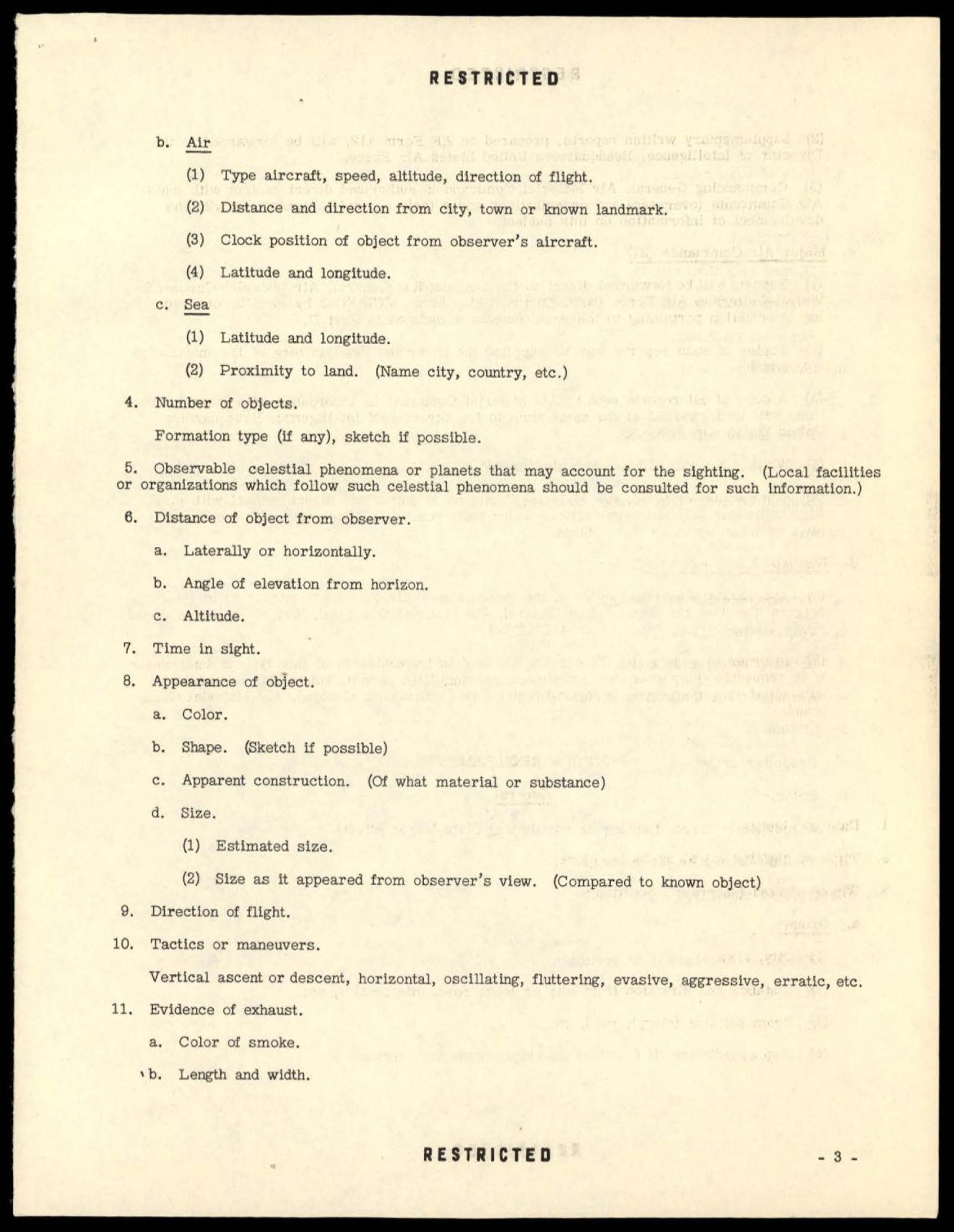
RESTRICTED b. Air (1) Type aircraft, speed, altitude, direction of flight. (2) Distance and direction from city, town or known landmark. (3) Clock position of object from observer's aircraft. (4) Latitude and longitude. c. Sea (1) Latitude and longitude. (2) Proximity to land. (Name city, country, etc.) 4. Number of objects. Formation type (if any), sketch if possible. 5. Observable celestial phenomena or planets that may account for the sighting. (Local facilities or organizations which follow such celestial phenomena should be consulted for such information.) 6. Distance of object from observer. a. Laterally or horizontally. b. Angle of elevation from horizon. c. Altitude. 7. Time in sight. 8. Appearance of object. a. Color. b. Shape. (Sketch if possible) c. Apparent construction. (Of what material or substance) d. Size. (1) Estimated size. (2) Size as it appeared from observer's view. (Compared to known object) 9. Direction of flight. 10. Tactics or maneuvers. Vertical ascent or descent, horizontal, osclllating, fluttering, evasive, aggressive, erratic, etc. 11. Evidence of exhaust. a. Color of smoke. , b. Length and width. RESTRICTED - 3 •
PAGE 21 / 137
RESTRICTED
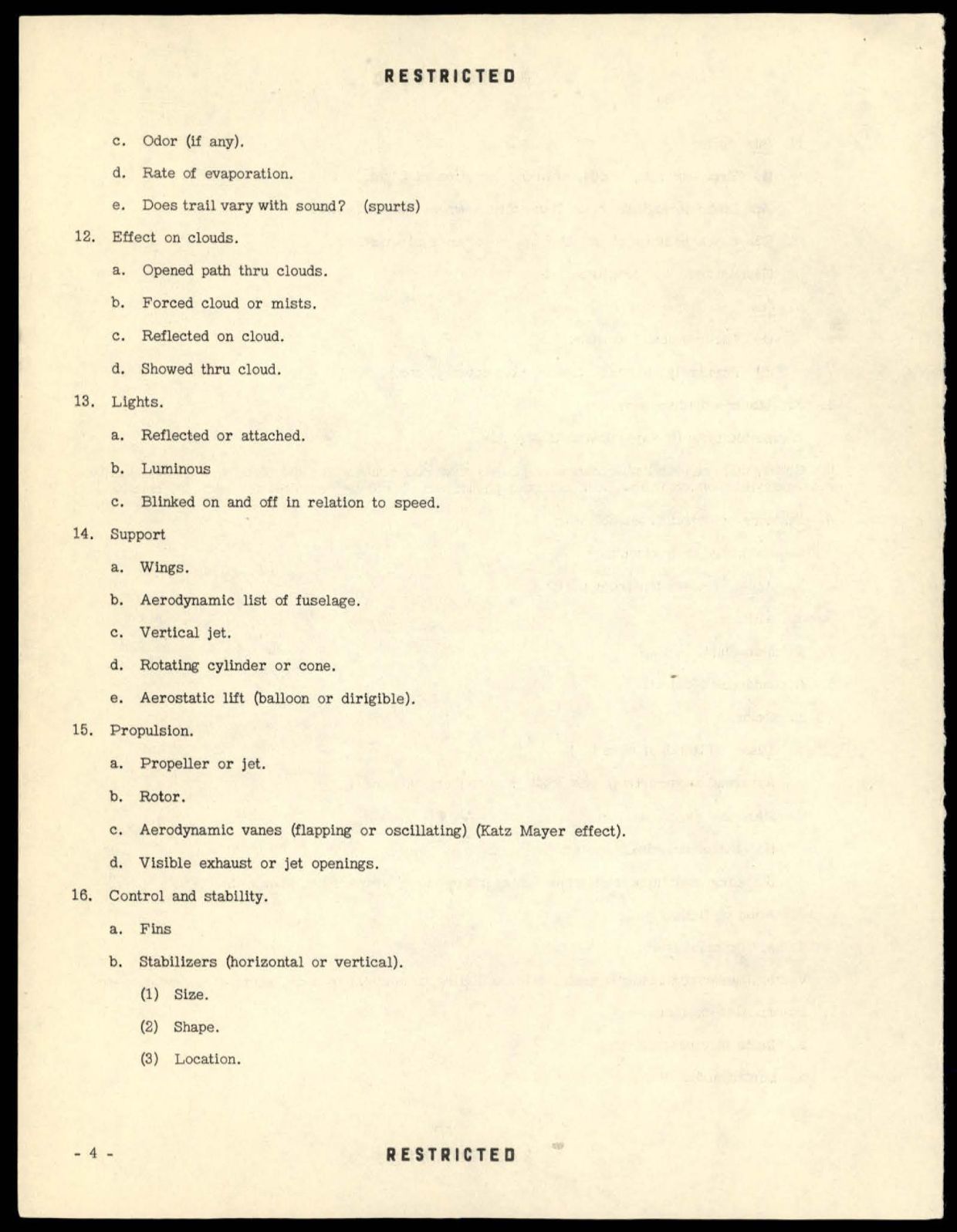
c. Odor (if any).
d. Rate of evaporation.
e. Does trail vary with sound?
(spurts)
12. Effect on clouds.
a. Opened path thru clouds.
b. Forced cloud or mists .
c. Reflected on cloud.
d. Showed thru cloud.
13, Lights.
a.
Reflected or attached.
b. Luminous
c. Blinked on and off Ln r elation to speed.
14. Support
a. Wings.
b. Aerodynamic list of fuselage.
c. Vertical jet.
d. Rotating cylinder or cone.
e. Aerostatic lift (balloon or dirigible).
15.
Propulsion.
a. Pr opeller or jet.
b. Rotor.
c. Aerodynamic vanes (flapping or oscillating) (Katz Mayer effect).
d. Visible exhaust or jet openings.
16. Control and stability.
a. Fins
b. StabiUzers (hor izontal or vertical).
(1) Size.
(2) Shape.
(3)
Location.
- 4 -
RESTRICTED
PAGE 22 / 137
RESTRICTED
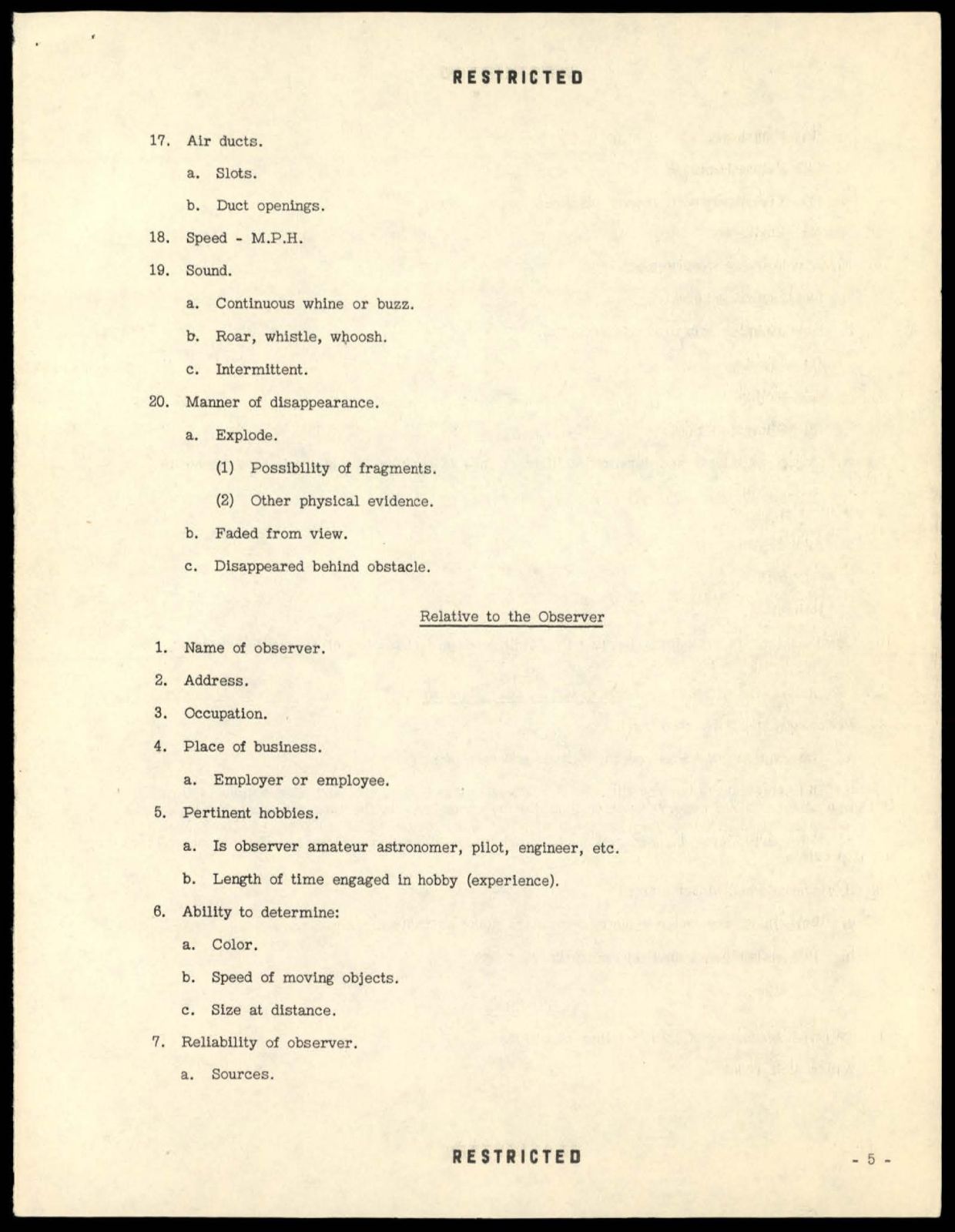
17. Alr ducts.
a. Slots.
b. Duct openlngs.
18. Speed - M.P.H.
19. Sound.
a. Continuous whlne or buzz.
b. Roar, whlstle, wl;loosh.
c. Intermittent.
20. Manner of disappearance.
a. Explode.
(1)
PosslbHlty of fragments.
(2)
Other physical evidence.
b. Faded from view.
c. Disappeared behind obstacle.
Relative to the Observer
1. Name of observer.
2. Address.
3. Occupation.
4. Place of business.
a. Employer or employee.
5. Pertinent hobbies.
a. Is observer amateur astronomer, pilot, engineer, etc.
b. Length of time engaged ln hobby (experience).
6. Ablllty to determine:
a . Color.
b. Speed of moving objects.
c. Size at distance.
7. Rell.abllity of observer.
a. Sources.
RESTRICTED
- 5 -
PAGE 23 / 137
RESTRICTED
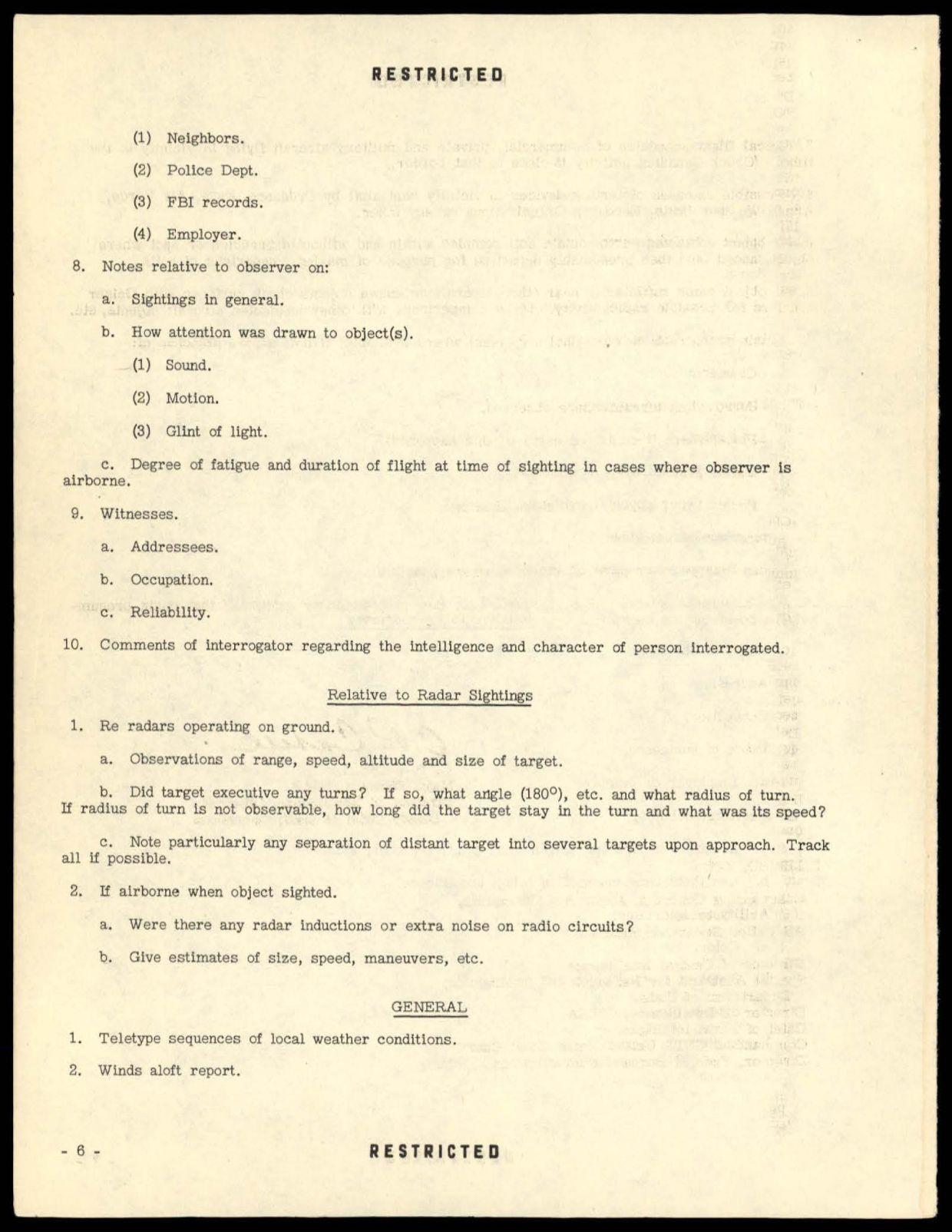
(1) Neighbors.
(2) Police Dept.
(3) FBI records.
(4) Employer.
8. Notes relative to observer on:
a. Sightings in general.
b. How attention was drawn to ob1ect(s).
(1) Sound.
(2) Motion.
(3) Glint of light,
c. Degree of fatigue and duration of :flight at time of sighting in cases where observer is
airborne.
9. Witnesses.
a. Addressees.
b. Occupation.
c. Reliability.
10. Comments of interrogator regarding the intelHgence and character of person interrogated.
Relative to Radar Sightings
1. Re radars operating on ground.
a. Observatlons of range, speed, altitude and size of target.
b. Did target executive any turns? If so, what arlgle (180°), etc. and what radius of turn.
If radius of turn is not observable, how long did the target stay 1n the turn and what was its speed?
c. Note particularly any separation of distant target into several targets upon approach. Track
all if possible.
2.
If airborne when object sighted.
a. Were there any radar inductions or extra noise on radio circuits?
b. Give estimates of size, speed, maneuvers, etc.
GENERAL
1. Teletype sequences of local weather conditions.
2.
Winds aloft report.
- 6 -
RESTRICTED
PAGE 24 / 137
..
RESTR I CTED
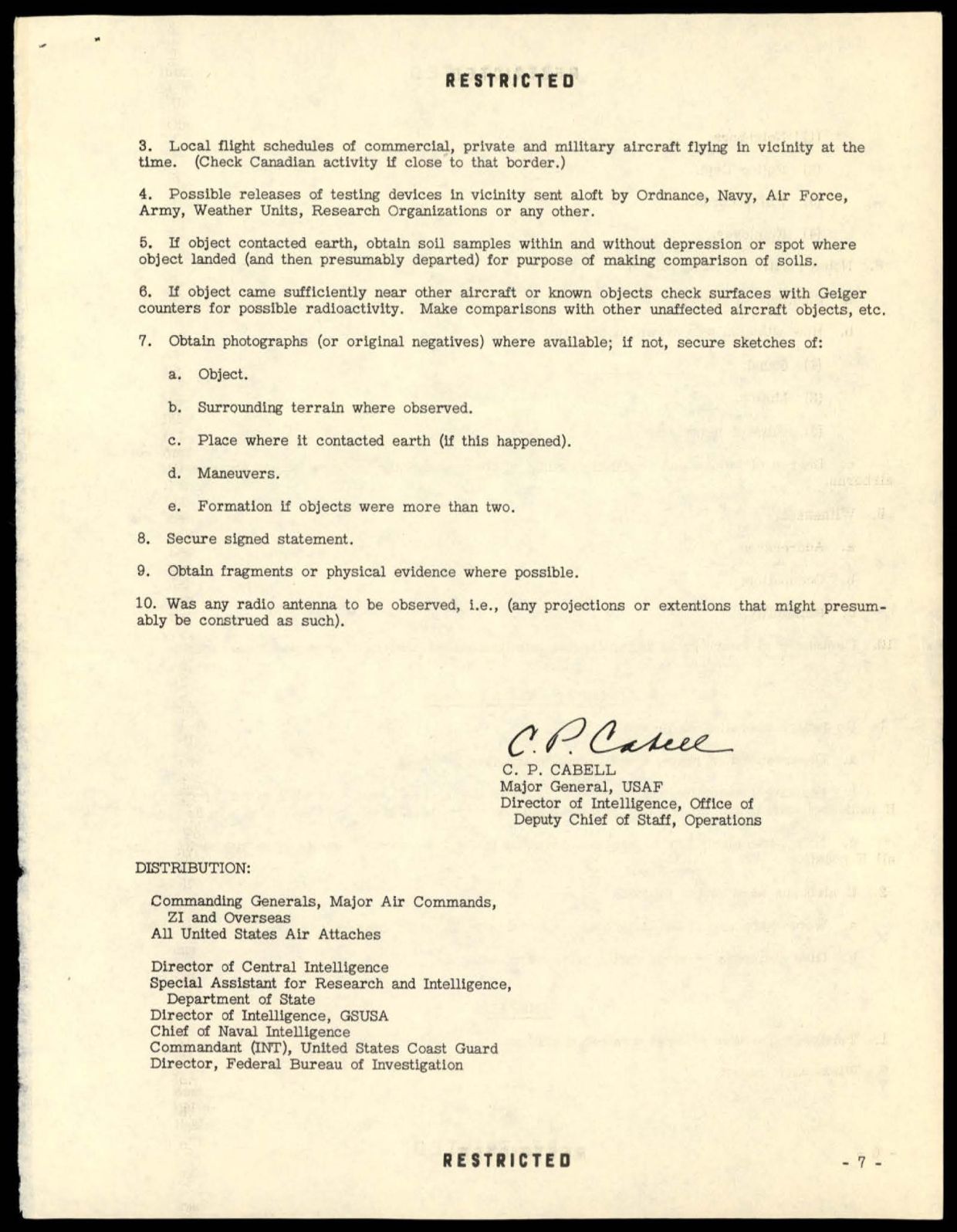
3, Local flight schedules of commercial, private and m111tary aircraft flying in vicinity at the
time. {Check Canadian activity if close to that border.)
4. Possible releases of testing devices in vicinity sent aloft by Ordnance, Navy, Alr Force,
Army, Weather Units, Research Organizations or any other.
6. If object contacted earth, obtain sou samples within and without depression or spot where
object landed {and then presumably departed) for purpose of making comparison of sol.ls.
6.
If object came sufficiently near other aircraft or known objects check surfaces with Geiger
counters for possible radioactivity. Make comparisons with other unaffected aircraft objects, etc.
7. Obtain photographs {or original negatives) where available; if not, secure sketches of:
a. Object.
b. Surrounding terrain where observed.
c. Place where it contacted earth (if this happened).
d. Maneuvers.
e. Formation if objects were more than two.
8. Secure signed statement.
9.
Obtain fragments or physical evidence where possible.
10. Was any radio antenna to be observed, l..e., {any projections or extentlons that mlght presum
ably be construed as such).
cl?~
C. P. CABELL
Major General, USAF
Director of Intelligence, Office of
Deputy Chief of Staff, Operations
DISTRIBUTION:
Commanding Generals, Major Air Commands,
ZI and Overseas
All United States Air Attaches
Director of Central Intelligence
Special Assistant for Research and IntelUgence,
Department of State
Director of Intelligence, GSUSA
Chief of Naval Intelligence
Commandant (INT), United States Coast Guard
Director, Federal Bureau of Investlgatlon
RESTRIC TED
- 7 -PAGE 25 / 137
RESTRICTED
RESTRICTED
PAGE 26 / 137
RESTRICTED DEPARTMENT OF THE Affi FORCE HEADQUARTERS UNITED STATES AIR FORCE DlRECTORATE OF INTELLIGENCE WASHINGTON 25, D. C. 16 February 1949 AIR INTELLIGENCE REQUIREMENTS MEMORANDUM NUMBER 4 UNCONVENTIONAL AJRCRAFT PART I - GENERAL 1. PURPOSE The purpose of this memorandum is twofold: a. To enunciate continuing Air Force requirements for information pertaining to sightings of unconventional aircraft and unidentified flying objects, including the so-called "Flying Discs." b. To establish procedures for reporting such information. 2. RESCISSION Department of the Army Collection Memorandum Number 7, dated 21 January 1948, and letter, CSGID 425.1, dated 25 March 1948, both subject as above, which have been transfer red to Air Force agencies for action, are herewith superseded. 3. REPORTING a. General (1) As complete an answer to the requirements enunciated in Part II, as may be procur able, should be dispatched by means of electrical transmission immediately after sightings. (2) Supplementary reports should be forwarded as available by the most expeditious means consistent with the importance of the information reported. b. Major Air Commands (Overseas) and Air Attaches (1) Initial and supplementary cabled reports wlll be transmitted to the Dir ector of Intelli gence, Headquarters United State:s Air Force. Cables will contain the phase, " Pass to COMGENAMC WRIGHT-PATTERSON AFB, DAYTON, OHIO, ATTN: MCIAX0-3." RESTRICTED C9-H92, AF
PAGE 27 / 137
RESTRICTED (2) Supplementary written reports, prepared on AF Form 112, will be forwarded to the Director of Intelll.gence, Headquarters Unlted States Alr Force. (3) Commandlng General, Air Materiel Command is authorized direct contact with major Alr Commands (overseas) and organizations under thelr control in connection with the development of information on this subject. c. Major Air Commands (ZI) (1) Reports will be forwarded dlrect to the Commanding General, Air Materiel Command, Wright-Patterson Air Force Base, Dayton, Ohio, Attn: MCIAXO-3 by installatlons r eceiv ing information pertaining to the requirements enunciated ln P art II. (2) Coples of such r eports may be supplied the Command Headquarters of the installation concerned. (3) A copy of all reports sent to Air Materiel Command in accordance with these instruc tions will be forwarded at the same time to the Director of Intelllgence, Headquarters United States Air Force. (4) Written r eports will be submitted on AF Form 112. (5) Commandlng General, Air Materiel Command is authorized direct contact with major Air Commands (ZI) and organizations under their control in connection with the develop ment of information on this subject. d. Non-Air Force Agencies (1) Addressees otQer than those of the United States Air Force are requested to forward r eports direct to the Commanding General, Air Materiel Command, Wright-Patterson Air Force Base, Dayton, Ohio, Attn: MCIAXO-3. (2) In order to reduce the time factor involved ln transmission of this type of information it is r equested that, wher ever communications facilltles permit, subordinate elements be authorized to communicate r eports direct to the Commanding General, Air Materiel Com mand. PART II - REQUIREMENTS General 1. Date of sighting. 2. Time of sighting (zonal by 24 hr. clock). 3. Where sighted (observer's posltion): a. Ground (1) City, town. (2) Distance and direction from city or town, road, lnter sect1on, etc. (3) From building (story), yard, etc. (4) Map coordinates (if feasible) showing latitude and longitude. - 2 - RESTRICTED
PAGE 28 / 137
RESTRICTED
b. Air
(1)
Type aircraft, speed, altitude, direction of flight.
(2)
Distance and direction from city, town or known landmark.
(3)
Clock position of object from observer's aircraft.
(4) Latitude and longitude.
c. Sea
(1) Latitude and longitude.
(2) Proxlmity to land.
(Name city, country, etc.)
4,
Number of objects.
Formation type (if any), sketch 1f possible.
6. Observable celestial phenomena or planets that may account for the slghtlng.
(Local facillties
or organizations which follow such celestial phenomena should be consulted for such information.)
6. Distance of object from observer.
a. Laterally or horizontally.
b. Angle of elevation from horizon.
c. Altitude.
7. Time in sight.
8.
Appearance of object.
a. Color.
b. Shape.
(Sketch if possible)
c. Apparent construction.
(Of what material or substance)
d. Size.
(l} Estimated size.
(2) Size as Lt appeared from observer's view. (Compared to known object)
9. Direction of flight,
10. Tactics or maneuvers.
Vertical ascent or descent, horizontal, osclllatlng, flutterlng, evasive, aggressive, erratic, etc.
11. Evidence of exhaust.
a. Color of smoke.
, b. Length and width.
RESTRICTED
- 3 -
PAGE 29 / 137
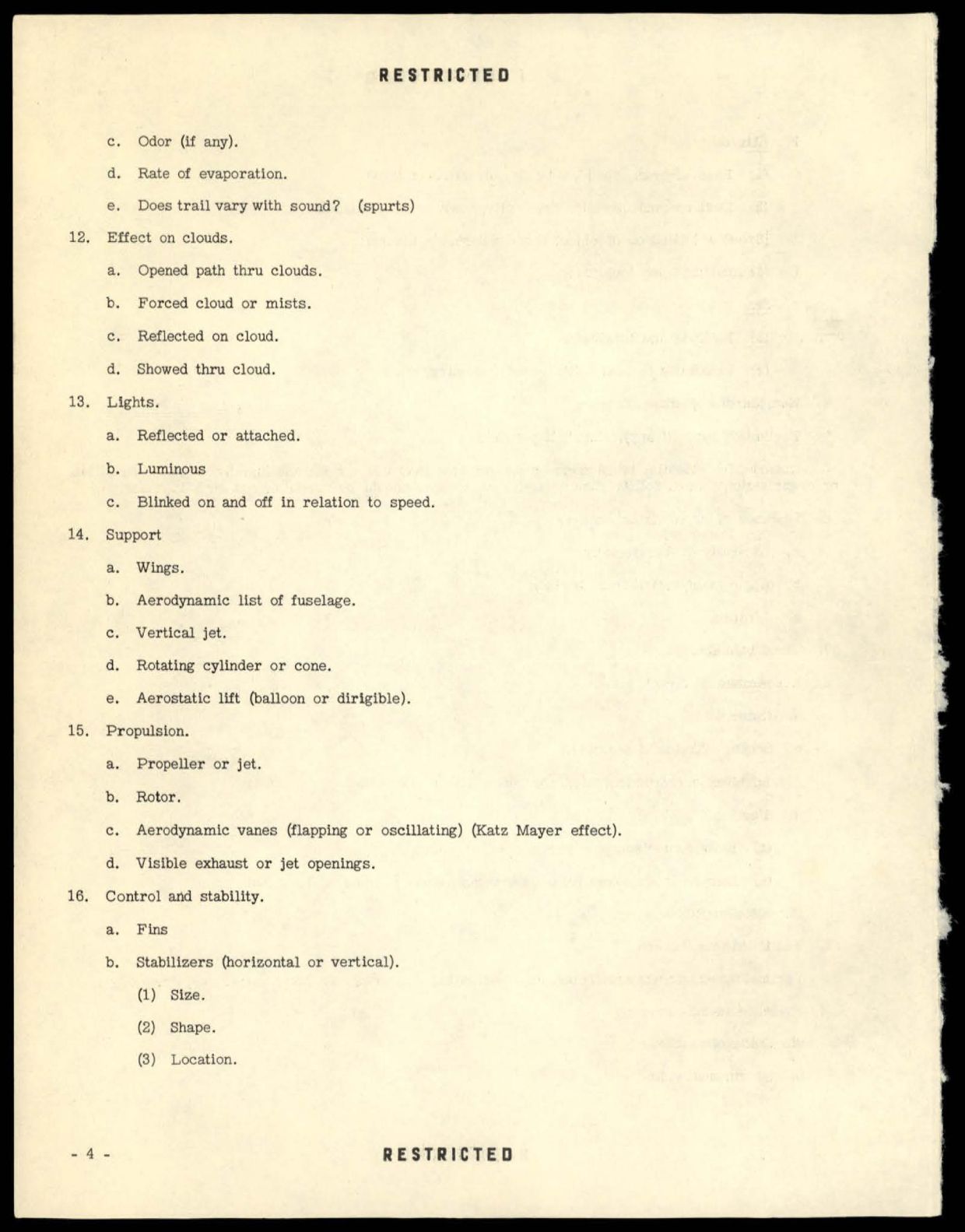
RESTRICTED
C.
Odor (if any).
d.
Rate of evaporation.
e.
Does trail vary wlth sound? (spurts)
12, Effect on clouds.
a.
Opened path thru clouds.
b.
Forced cloud or mists.
c.
Reflected on cloud.
d. Showed thru cloud.
13. Lights.
a. Reflected or attached.
b. Luminous
c.
Blinked on and off in relation to speed.
14. Support
a. Wings.
b.
Aerodynamic 11st of fuselage.
C .
Vertical jet.
d.
Rotating cylinder or cone.
e.
Aerostatic lift (balloon or dir igible).
15. Pr opulslon.
a.
Propeller or jet.
b.
Rotor.
c.
Aerodynamlc vanes (flapping or osclilating) (Katz Mayer effect).
d. Visible eXhaust or jet openings.
16. Control and stability.
a.
Fins
b. Stabilizers (horizontal or vertical).
(1) Size.
(2) Shape.
(3) Location.
- 4 -
RESTRICTED
PAGE 30 / 137
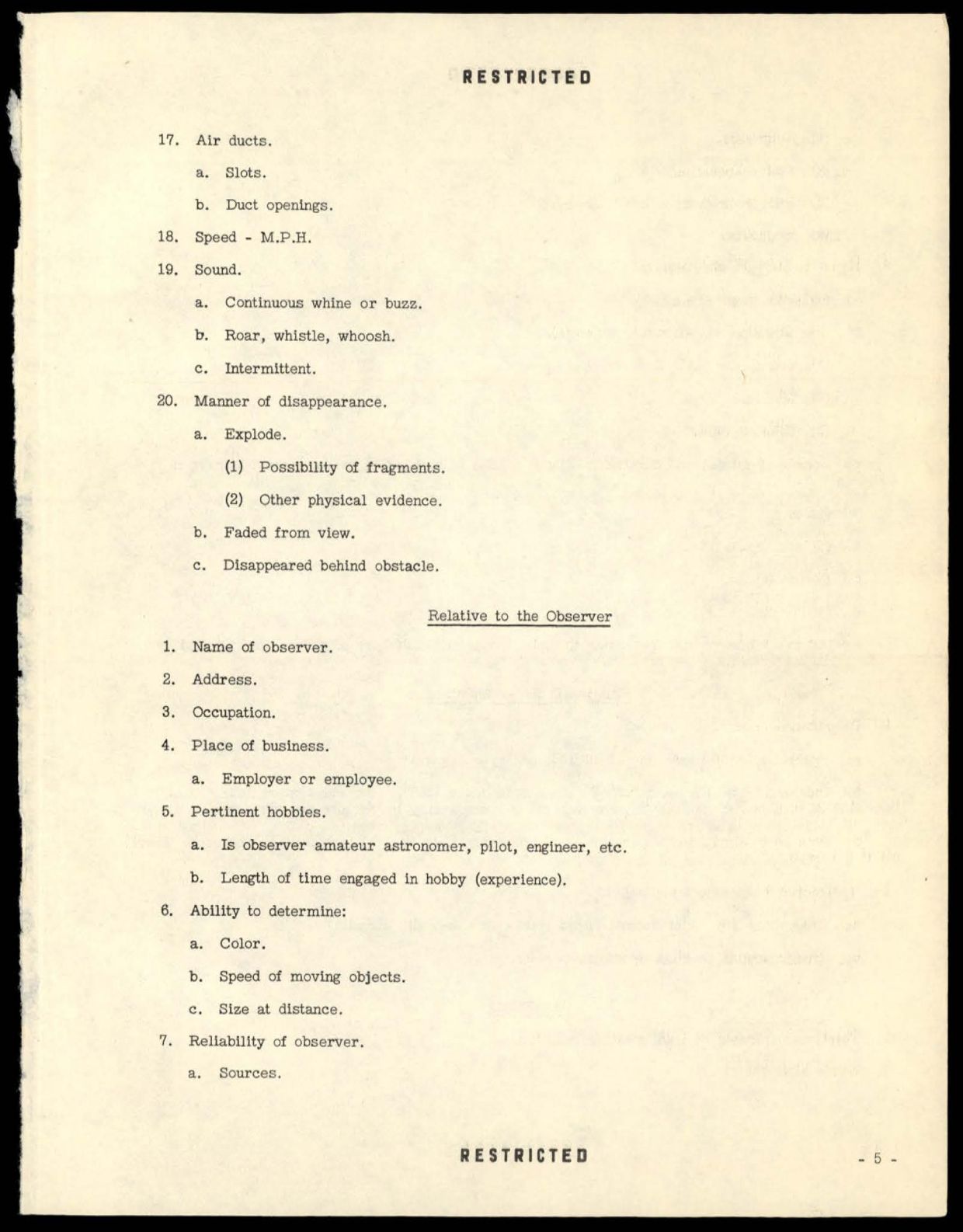
RESTRICTED 17. Air ducts. a. Slots. b. Duct openings. 18. Speed - M.P.H. 19. Sound. a. Continuous whine or buzz. b, Roar, whistle, whoosh. c. Intermittent. 20. Manner of disappearance. a. Explode. (1) Possibility of fragments. (2) Other physical evidence. b. Faded from view. c. Disappeared behind obstacle. Relative to the Observer 1. Name of observer. 2. Address. 3. Occupation. 4. Place of business. a. Employer or employee. 5. Pertinent hobbies. a. Is observer amateur astronomer, pilot, engineer, etc. b. Length of time engaged in hobby (experience). 6. Ability to determine: a. Color, b. Speed of moving objects. c . Size at distance. 7. Reliability of observer. a. Sources. RESTRICTED - 5
PAGE 31 / 137
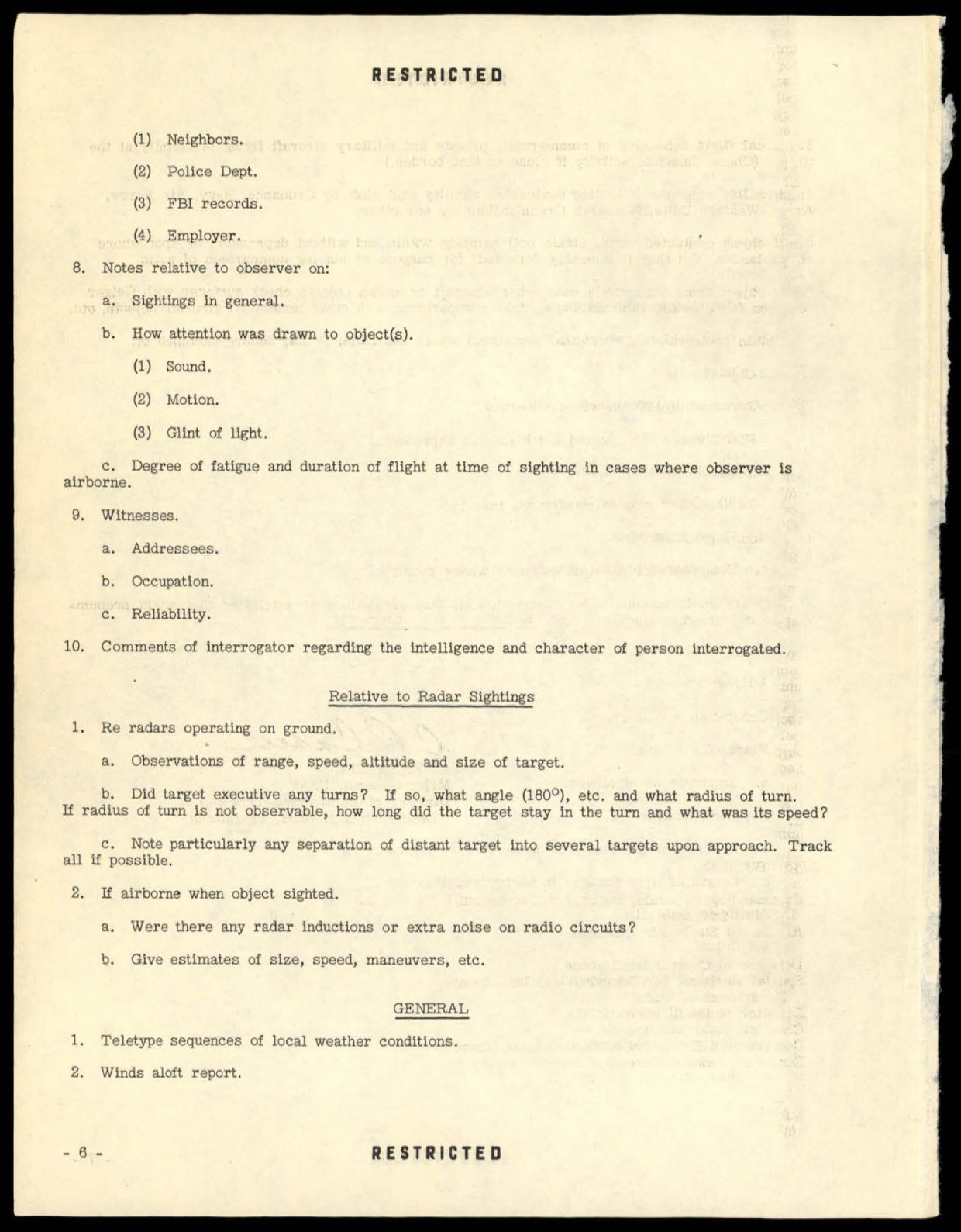
RESTRICTED
(1) Neighbors.
(2) Police Dept.
(3) FBI records.
(4) Employer.
8. Notes relative to observer on:
a. Sightings in general.
b. How attention was drawn to object{s).
(1) Sound.
(2) Motion.
(3) Glint of light.
c. Degree of fatigue and duration of flight at time of sighting ln cases where observer ls
airborne.
9. Witnesses.
a. Addressees.
b. Occupation.
c. Reliability.
10. Comments of interrogator regarding the intelligence and character of person interrogated.
Relative to Radar Sightings
1. Re radars operating on ground.
a. Observations of range, speed, altitude and size of target.
b.
Did target executive any turns? If so, what angle (180°), etc. and what radius of turn.
If radius of turn ls not observable, how long did the target stay in the turn and what was its speed?
c. Note particularly any separation of distant target into several targets upon approach. Track
all 1f possible.
2. If airborne when object sighted.
a. Were there any radar inductions or extra noise on radio circuits?
b. Give estimates of size, speed, maneuvers, etc.
GENERAL
1. Teletype sequences of local weather conditions.
2. Winds aloft r eport.
- 6 -
RESTRICTED
PAGE 32 / 137
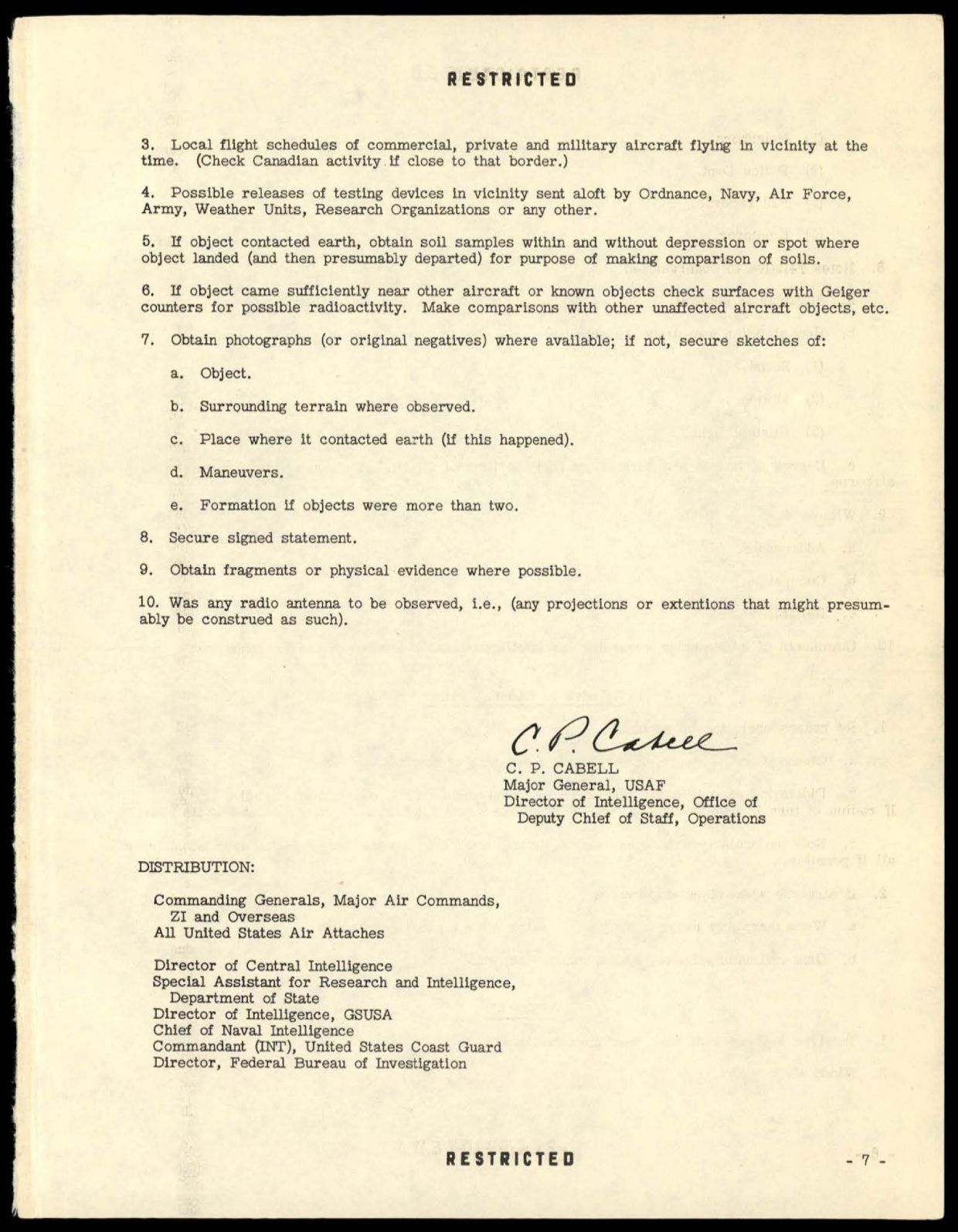
RESTRICTED 3. Local flight schedules of commerc1al, private and m1Utary aircraft flying ln viclnity at the time. (Check Canadian activity if close to that border.) 4. Possible releases of testlng devices in vicinity sent aloft by Ordnance, Navy, Air Force, Army, Weather Units, Research Organizations or any other. 5. If object contacted earth, obtain son samples within and without depression or spot where object landed (and then presumably departed) for purpose of making comparison of soils. 6. If object came sufficiently near other aircraft or known objects check surfaces with Geiger counters for possible radioactivity. Make comparisons with other unaffected aircraft objects, etc. 7. Obtain photographs (or original negatives) where available; if not, secure sketches of: a. Object. b. Surrounding terraln where observed. c. Place where 1t contacted earth (if this happened). d. Maneuvers. e. Formation if objects were more than two. 8. Secure signed statement. 9. Obtain fragments or physical evidence where possible. 10. Was any radio antenna to be observed, i.e., (any projections or extentlons that might presum ably be construed as such). cl-!~ C. P. CABELL Major General, USAF Director of Intelligence, Office of Deputy Chief of Staff, Operations DISTRJBUTION: Commanding Generals, Major Air Commands, ZI and Overseas All United States Air Attaches Director of Central Intelligence Special Assistant for Research and Intelllgence, Department of State Director of Intelllgence, GSUSA Chief of Naval Intelligence Commandant (INT), United States Coast Guard Director, Federal Bureau of Investigation RESTRICTED - 7 -
PAGE 33 / 137
RESTRICTED
RESTRICTED
PAGE 34 / 137
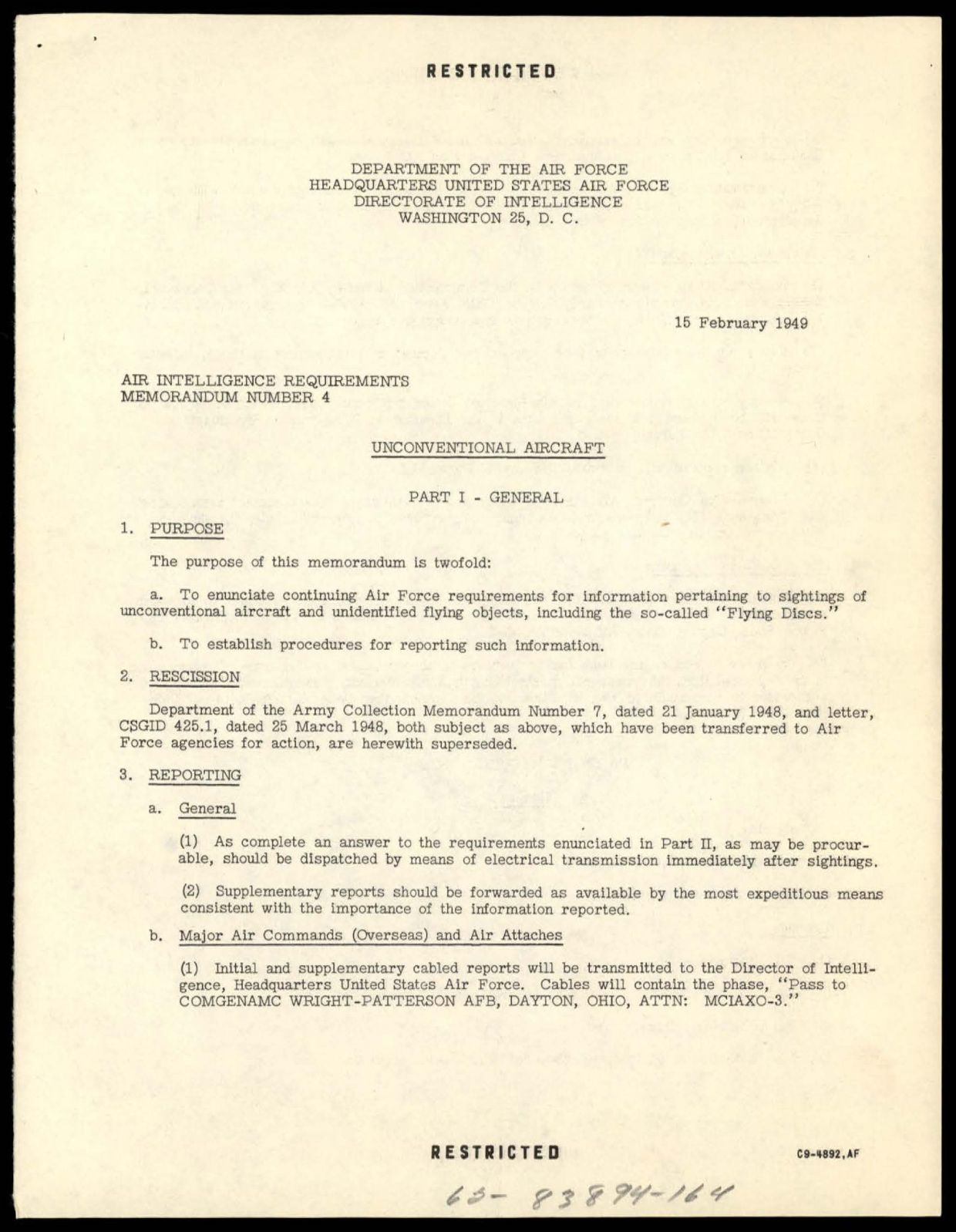
RESTRICTED DEPARTMENT OF THE AIR FORCE HEADQUARTERS UNITED STATES AIR FORCE DIRECTORATE OF INTELLIGENCE WASHINGTON 25, D. C. 15 February 1949 Am INTELLIGENCE REQUIB.EMENTS MEMORANDUM NUMBER 4 UNCONVENTIONAL AIRCRAFT PART I - GENERAL 1. PURPOSE The purpose of this memorandum is twofold: a. To enunciate continuing Air Force requirements for information pertaining to s ightings of unconventional aircraft and unidentified flying objects, including the so-called "Flying Discs." b. To establish procedures for reporting such information. 2. RESCISSION Department of the Army Collection Memorandum Number 7, dated 21 January 1948, and letter, CSGID 425.1, dated 25 March 1948, both subject as above, which have been transferred to Air Force agencies for action, are herewith superseded. 3. REPORTING a. General (1) As complete an answer to the requirements enWlCiated in Part II, as may be procur able, should be dispatched by means of electrical transmission immediately after sightings. (2) Supplementary reports should be forwarded as available by the most expeditious means consistent with the importance of the information reported. b. Major Air Commands (Overseas) and Air Attaches (1) Initial and supplementary cabled reports will be transmitted to the Director of IntelU gence, Headquarters United States Air Force. Cables wm contain the phase, "Pass to COMGENAMC WRIGHT-PATTERSON AFB, DAYTON, OHIO, ATTN: MCIAX0-3." RESTRICTED C9-'892,AF
PAGE 35 / 137
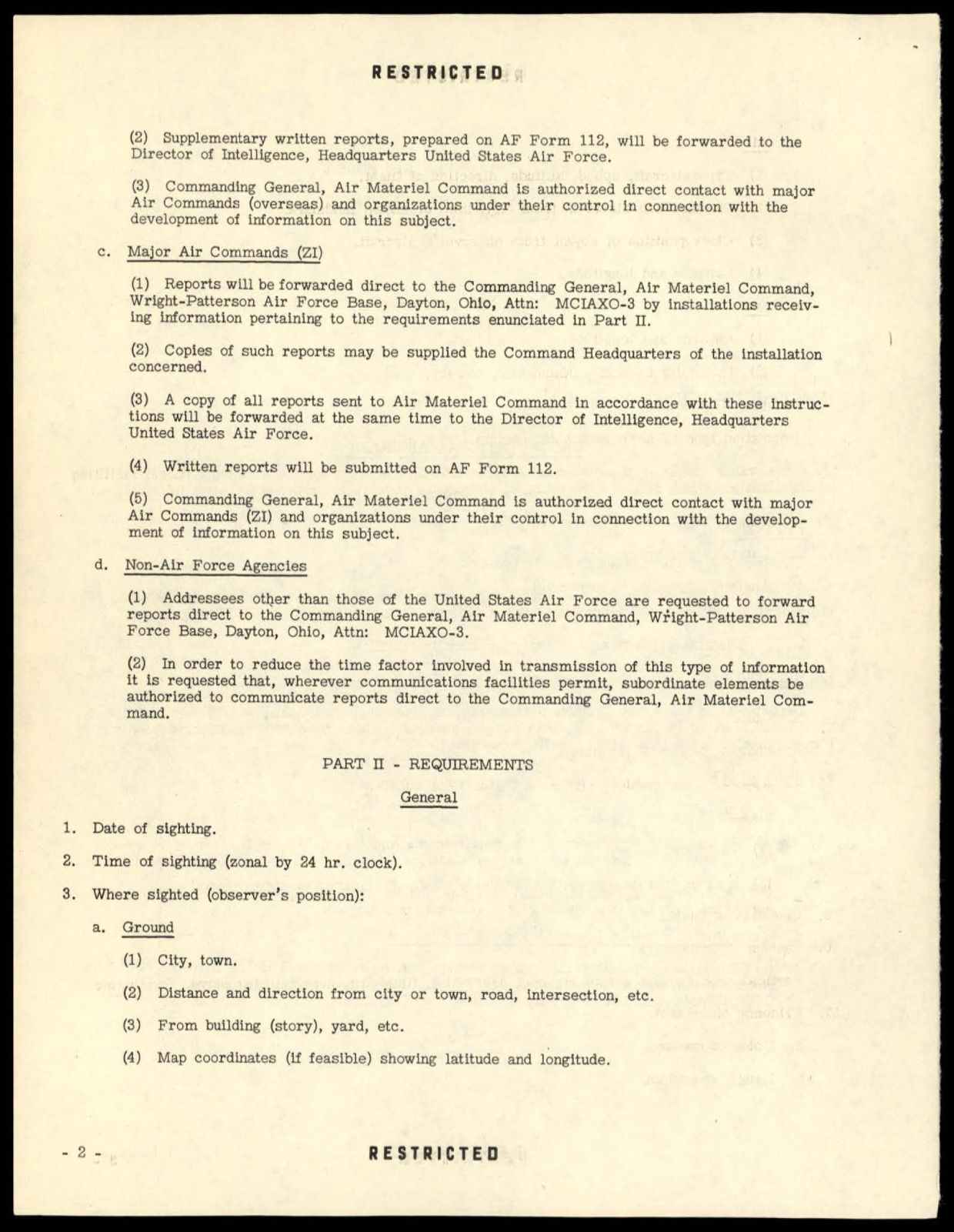
RESTRICTED (2) Supplementary written reports, prepared on AF Form 112, will be forwarded to the Director of Intelligence, Headquarters United States Alr Force. (3) Commandlng General, Alr Materiel Command ls authorized direct contact with major Air Commands (over seas) and organizations under their control in connection with the development of information on this subject. c. Major Air Commands (ZI) (1) Reports wlll be forwarded direct to the Commanding General, Air Materiel Command, Wright-Patterson Air Force Base, Dayton, Ohio, Attn: MCIAX0-3 by Installations r eceiv ing information pertaining to the requirements enunciated in Part II. (2) Copies of such r eports may be supplied the Command Headquarters of the installation concerned. (3) A copy of all reports sent to Air Materiel Command in accordance with these instruc tions wtll be forwarded at the same time to the Director of Intelligence, Headquarters United states Air Force. (4) Written r eports wm be submitted on AF Form 112. (5) Commanding General, Air Materiel Command ls authorized direct contact with major Air Commands (ZI) and or ganizations under their control in connection with the develop ment of information on this subject. d. Non-Air Force Agencies (1) Addr essees ot.cyer than those of the United states Air For ce are requested to forward reports direct to the Commanding General, Air Materiel Command, Wright-Patterson Air Force Base, Dayton, Ohio, Attn: MCIAX0-3. (2) In order to reduce the time factor involved in transmission of this type of information it is requested that, wher ever communications faciUties permit, subordinate elements be authorized to communicate r eports direct to the Commanding General, Air Materiel Com mand. PART IT - REQUIREMENTS General 1. Date of sighting. 2. Time of sighting (zonal by 24 hr. clock). 3. Where sighted (observer's position): a. Ground (1) City, town. (2) Distance and direction from city or town, r oad, inter section, etc. (3) From building (story), yard, etc. (4) Map coordinates (if feasible) showing latitude and longitude. - 2 - RESTRICTED
PAGE 36 / 137
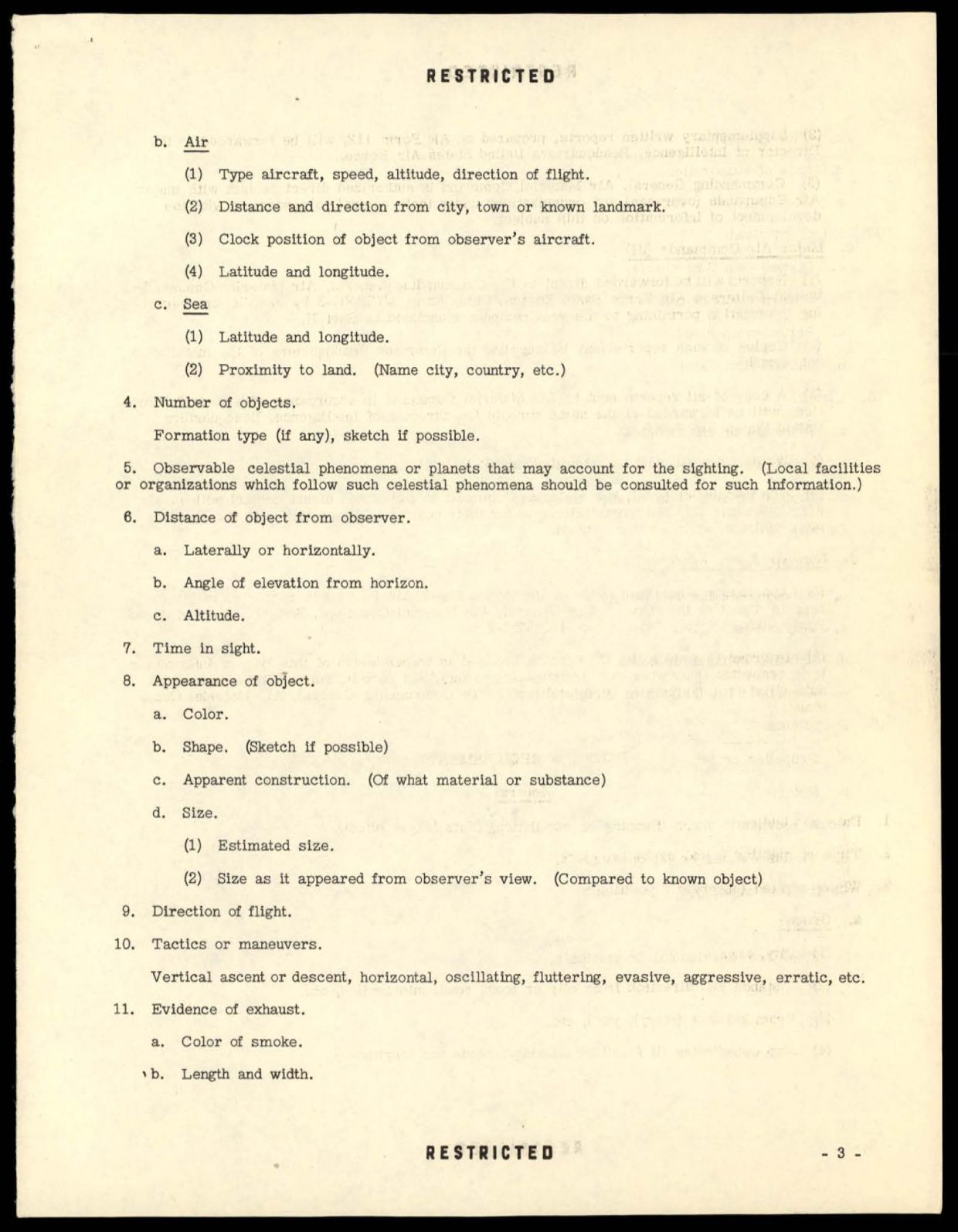
RESTRICTED
b. Air
(1) Type aircraft, speed, altitude, direction of flight.
(2) Distance and direction from city, town or known landmark.
(3) Clock position of object from observer's aircraft.
(4) Latitude and longitude.
c. Sea
(1) Latitude and longitude.
(2) Proxlmity to land. (Name city, country, etc.)
4.
Number of objects.
Formation type (If any), sketch if possible.
5. Observable celestial phenomena or planets that may account for the sighting.
(Local facilities
or organizations which follow such celestial phenomena should be consulted for such information.)
6.
Distance of object from observer.
a. Laterally or horizontally.
b. Angle of elevation from horizon.
c. Altitude.
7. Time in sight.
8. Appearance of object.
a. Color.
b. Shape.
(Sketch if possible)
c. Apparent construction.
(Of what material or substance)
d. Size.
(1)
Estimated size.
(2) Size as it appeared from observer's view. (Compared to known object)
9. Direction of fllght.
10. Tactics or maneuvers.
Vertical ascent or descent, horizontal, oscillating, fluttering, evasive, aggressive, erratic, etc.
11.
Evidence of exhaust.
a. Color of smoke.
, b. Length and width.
RESTRICTED
- 3 -
•
PAGE 37 / 137
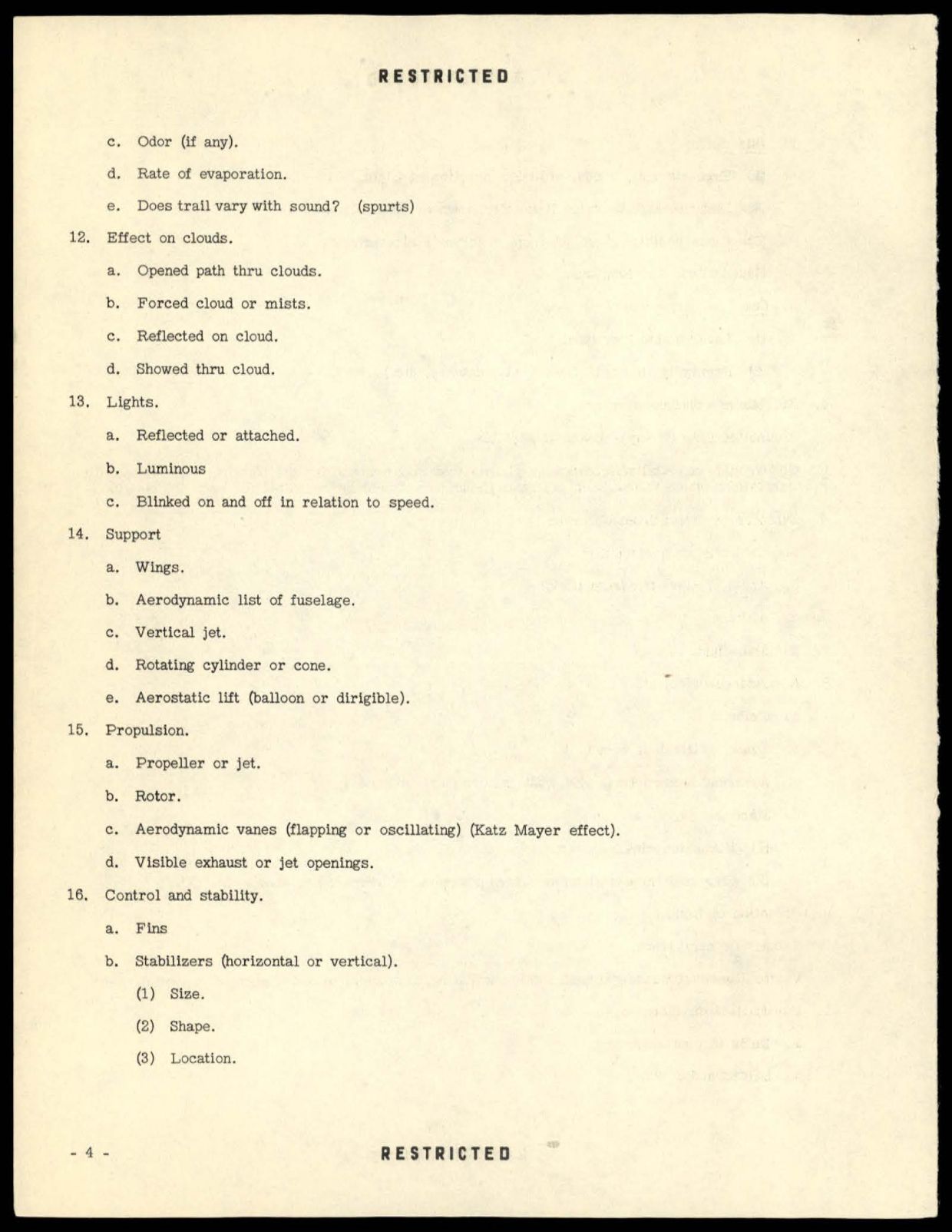
RESTRICTED
C.
Odor (if any).
d. Rate of evaporation.
e. Does trall vary with sound?
(spurts)
12. Effect on clouds.
a . Opened path thru clouds.
b. Forced cloud or mists.
c. Reflected on cloud.
d. Showed thru cloud.
13. Lights.
a. Reflected or attached.
b. Luminous
c. Blinked on and off ln relation to speed.
14. Support
a. Wings.
b. Aerodynamic Hst of fuselage.
c. Vertical jet.
d. Rotating cylinder or cone.
e. Aerostatic 11.ft (balloon or dirigible).
15. Propulsion.
a. Propeller or jet.
b. Rotor.
c. Aerodynamic vanes (flapping or osc1llat1ng) (Katz Mayer effect).
d. Visible exhaust or jet openings.
16. Control and stabHity.
a. Fins
b. Stabil!.zers (horizontal or vertical).
(1) Size.
(2) Shape.
(3) Location.
- 4 -
RESTRICTED
PAGE 38 / 137
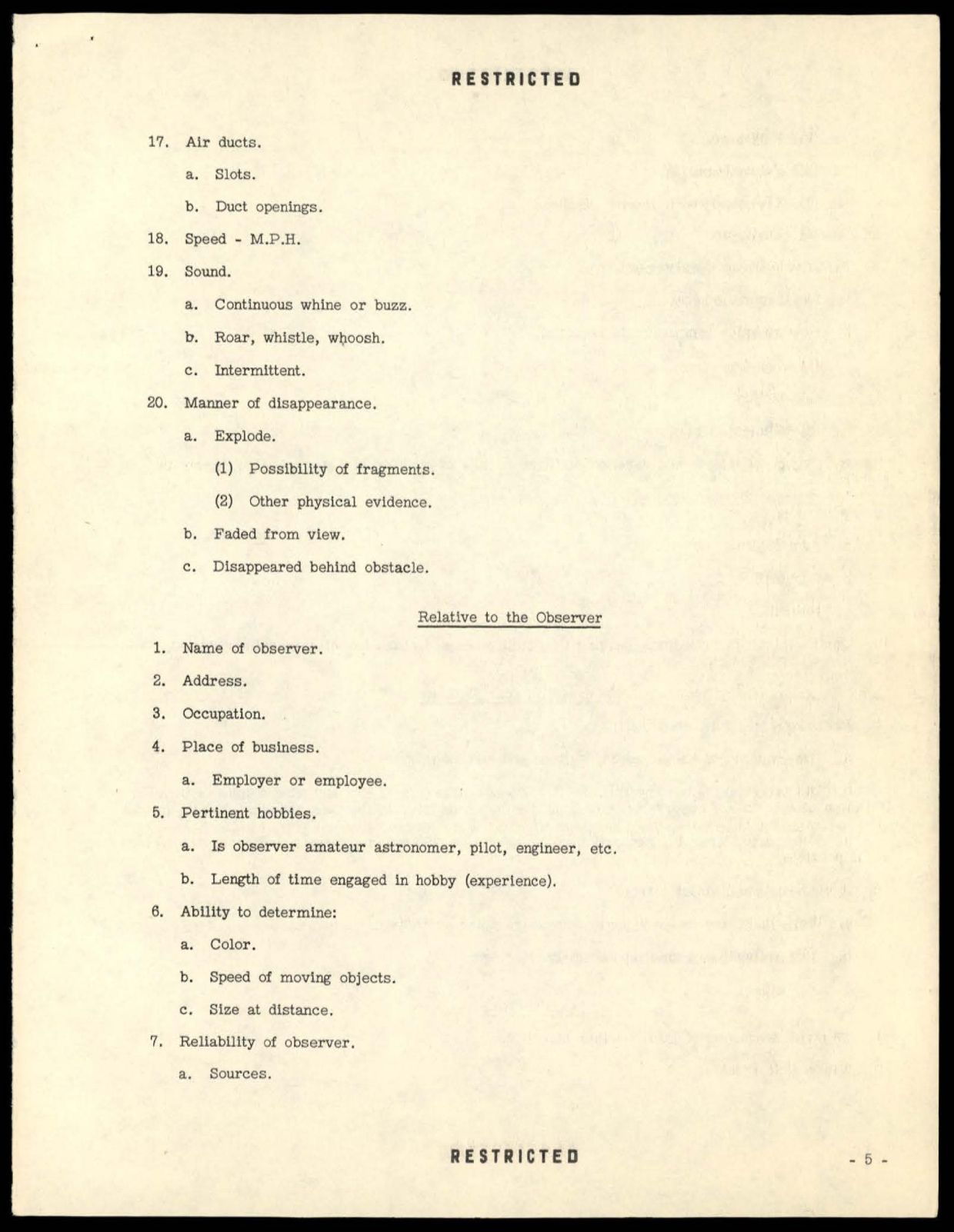
RESTR ICTED
17. Air ducts.
a. Slots.
b. Duct openings.
18. Speed - M.P.H.
19. Sound.
a. Continuous whine or buzz.
b. Roar, whistle, w};loosh.
c. Intermittent.
20. Manner of disappearance.
a.
Explode.
(1) Poss1b1Uty of fragments.
(2)
Other physical evidence.
b. Faded from view.
c. Disappeared behind obstacle.
Relattve to the Observer
1. Name of observer.
2. Address.
3. Occupation.
4.
Place of business.
a. Employer or employee.
6.
Pertinent hobbies.
a. Is observer amateur astronomer, pilot, engineer, etc.
b. Length of time engaged in hobby (experience).
6.
Ability to determine:
a. Color.
b. Speed of moving objects.
c. Size at distance.
7. Reliablllty of observer.
a. Sources.
RESTRICTED
PAGE 39 / 137
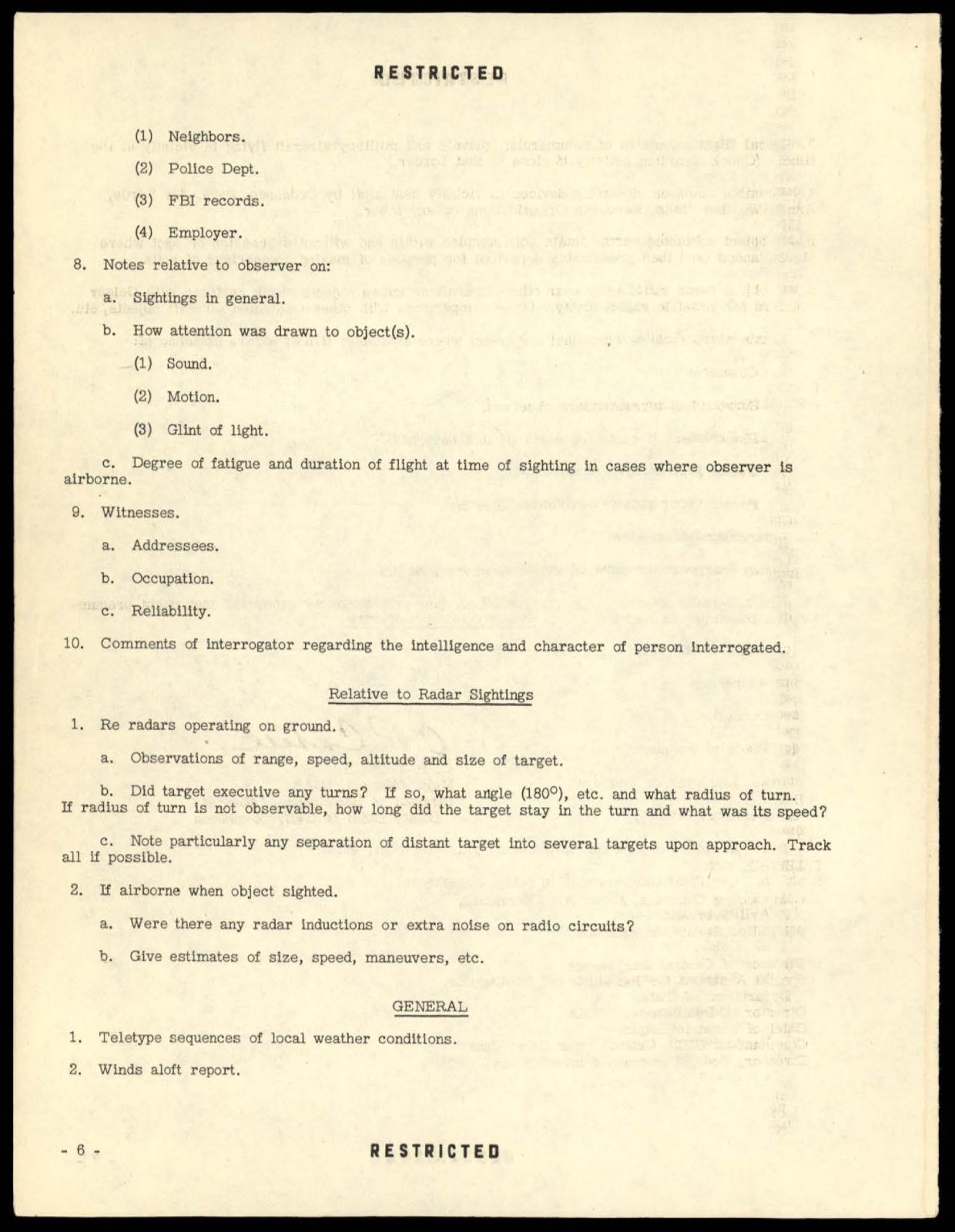
RESTRICTED
(1) Neighbors.
(2) Pollce Dept.
(3) FBI records.
(4) Employer.
8. Notes relative to observer on:
a. Sightings in gener al.
b. How attention was drawn to object(s).
(1) Sound.
(2) Motion.
(3) Glint of light.
c. Degree of fatigue and duration of flight at time of sighting in cases where observer is
airborne.
9. Witnesses.
a. Addressees.
b. Occupation.
c. Rellablllty.
10. Comments of interrogator regarding the lntelllgence and character of person interrogated.
Relative to Radar Sightings
1. Re radars operating on ground.
a. Observations of range, speed, altitude and size of target.
b. Did target executive any turns? If so, what angle (180°), etc. and what radius of turn.
If radius of turn is not observable, how long did the target stay ln the turn and what was its speed?
c. Note particularly any separation of distant target into several targets upon approach. Tr ack
all l.f possible.
2. If airborne when object sighted.
a. Were there any radar inductions or extra noise on radio circuits?
b. Give estimates of size, speed, maneuvers, etc.
GENERAL
1. Teletype sequences of local weather conditions.
2. Winds aloft report.
- 6 -
RESTRICTED
PAGE 40 / 137
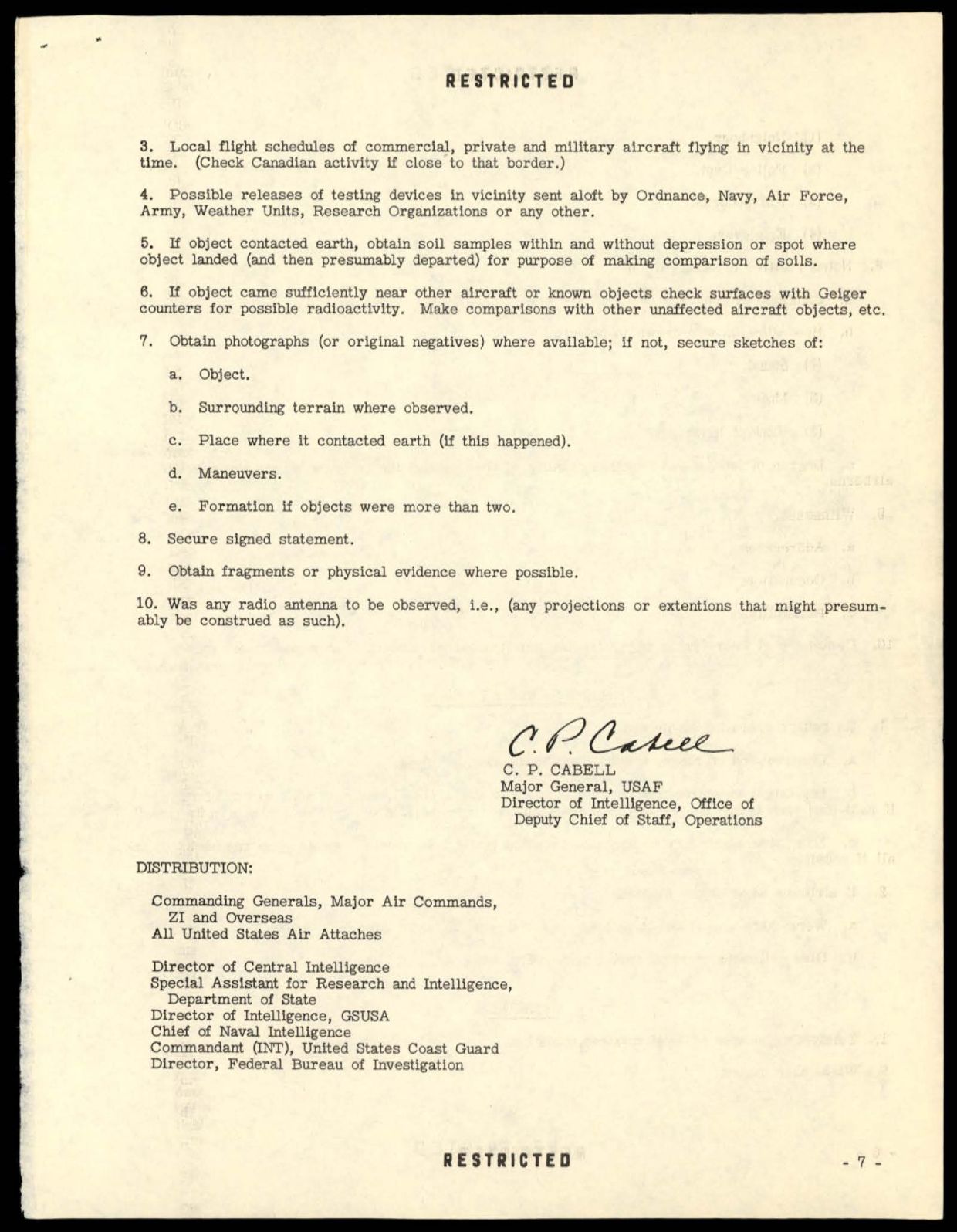
RESTRICTED 3. Local fllght schedules of commercial, private and mll1tary aircraft flying in vidnlty at the time. (Check Canadian activity l.f close to that border.) 4. Possible releases of testing devices in vlcinlty sent aloft by Ordnance, Navy, Air Force, Army, Weather Units, Research Organizations or any other. 5. If object contacted earth, obtain soil samples within and without depression or spot where object landed (and then presumably departed) for purpose of making comparison of soils. 6. If object came sufficiently near other aircraft or known objects check surfaces with Gelger counters for possible radioactivity. Make comparisons with other unaffected aircraft objects, etc. 7. Obtain photographs (or original negatives) where available; if not, secure sketches of: a. Object. b. Surrounding terrain where observed. c. Place where 1t contacted earth (if this happened). d. Maneuvers. e. Formation if objects were more than two. 8. Secure signed statement. 9. Obtain fragments or physical evidence where possible. 10. Was any radio antenna to be observed, Le., (any projections or extentlons that might presum ably be construed as such). e>:P~ C. P. CABELL Major General, USAF Dlrector of Intelligence, Office of Deputy Chief of Staff, Operations DISTRlBUTION: Commanding Generals, Major Air Commands, ZI and Overseas All United States Air Attaches Director of Central lntelllgence Special Assistant for Research and Intelligence, Department of State Director of Intelligence, GSUSA Chief of Naval Intelligence Commandant (INT), United States Coast Guard Director , Federal Bureau of Invest1gatlon RESTRICTED - 7 -
PAGE 41 / 137
RESTRICTED
RESTRICTED
PAGE 42 / 137
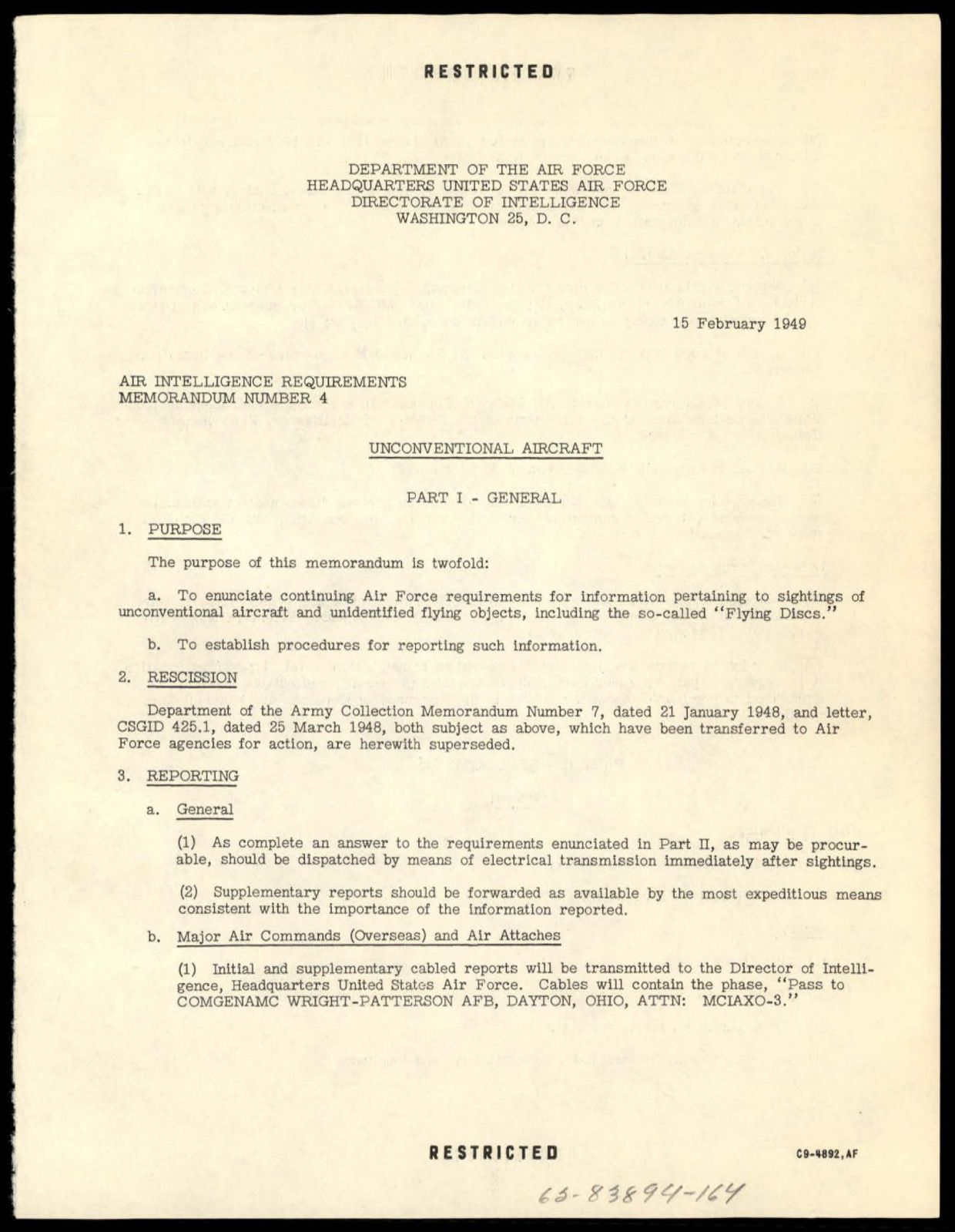
RESTRICTED DEPARTMENT OF THE AIR FORCE HEADQUARTERS UNITED STATES AIR FORCE DIRECTORATE OF INTELLIGENCE WASHINGTON 25, D. C. 15 February 1949 AIR INTELLIGENCE REQUIREMENTS MEMORANDUM NUMBER 4 UNCONVENTIONAL AIRCRAFT PART I - GENERAL 1. PURPOSE The purpose of this memorandum is twofold: a. To enunciate continuing Air Force requirements for information pertalning to sightings of unconventional aircraft and unidentified flying objects, including the so-called "Flying Discs." b. To establish procedures for reporting such information. 2. RESCISSION Department of the Army Collection Memorandum Number 7, dated 21 January 1948, and letter, CSGID 425.1, dated 25 March 1948, both subject as above, which have been transferred to Air Force agencies for action, are herewith superseded. 3. REPORTING a. General (1) As complete an answer to the requirements enunciated 1n Part II, as may be procur able, should be dispatched by means of electrical transmission immediately after sightings. (2) Supplementary reports should be forwarded as available by the most expeditious means consistent with the importance of the information reported. b. Major Air Commands (Overseas) and Air Attaches (1) Initial and supplementary cabled reports will be transmitted to the Director of Intelll gence, Headquarters United Stat(:s Air Force. Cables wl.11 contain the phase, "Pass to COMGENAMC WRIGHT-PATTERSON AFB, DAYTON, OHIO, ATTN: MCIAX0-3." RESTRICTED
PAGE 43 / 137
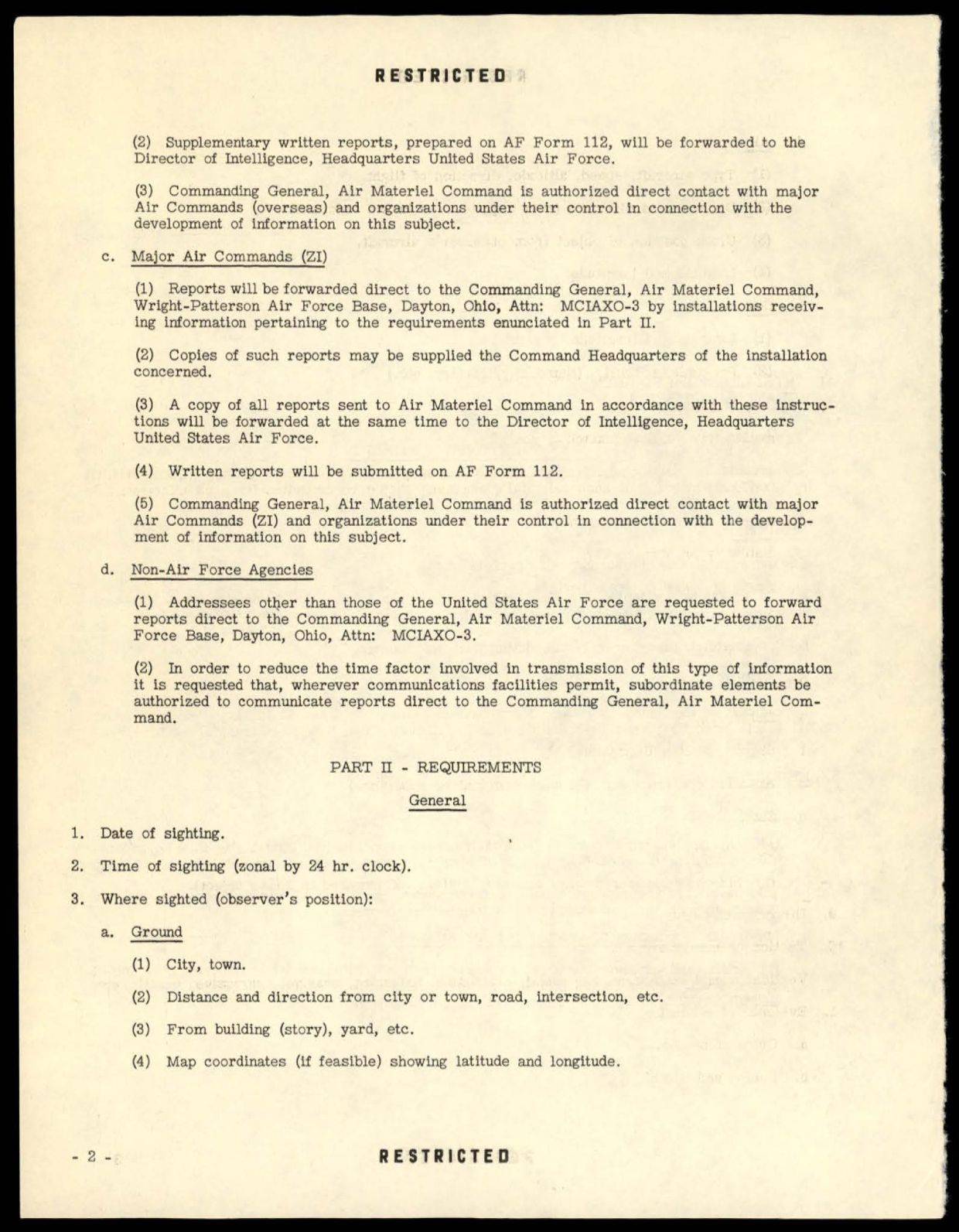
RESTRICTED (2) Supplementary wrltten reports, prepared on AF For m 112, will be forwarded to the Director of Intelligence, Headquarters United States Air Force. (3) Commanding General, Air Materiel Command ls authorized direct contact with major Air Commands (overseas) and organizations under their control in connection with the development of information on this subject, c. Major Air Commands (ZI) (1) Reports wm be forwarded direct to the Commanding General, Air Materiel Command, Wright-Patterson Air Force Base, Dayton, Ohio, Attn: MCIAXO-3 by installations receiv ing information pertaining to the requirements enunciated in Part II. (2) Copies of such reports may be supplied the Command Headquarters of the installation concerned. (3) A copy of all reports sent to Air Materiel Command in accordance with these instruc tions wm be forwarded at the same time to the Director of Intelligence, Headquarters United States Air Force. (4) Written reports will be submitted on AF Form 112. (6) Commanding General, Air Materiel Command is authorized direct contact with major Air Commands (ZI) and organizations under their control in connection with the develop ment of information on this subject. d. Non-Air Force Agencies (1) Addressees ot~er than those of the United States Air Force are requested to forward reports direct to the Commanding General, Air Materiel Command, Wright-Patterson Air Force Base, Dayton, Ohio, Attn: MCIAXO-3. (2) In order to reduce the time factor involved in transmission of this type of information it Ls requested that, wherever communications facilities permit, subordinate elements be authorized to communicate reports direct to the Commanding General, Air Materiel Com mand. PART II - REQUIB.EMENTS General 1. Date of sighting. 2. Time of sightl.ng (zonal by 24 hr. clock). 3, Where sighted (observer 's position): a. Ground (1) City, town. (2) Distance and direction from city or town, road, intersection, etc. (3) Fr om building (story), yard, etc. (4) Map coordinates (if feasible) showing latitude and longitude. - 2 - RESTRICTED
PAGE 44 / 137
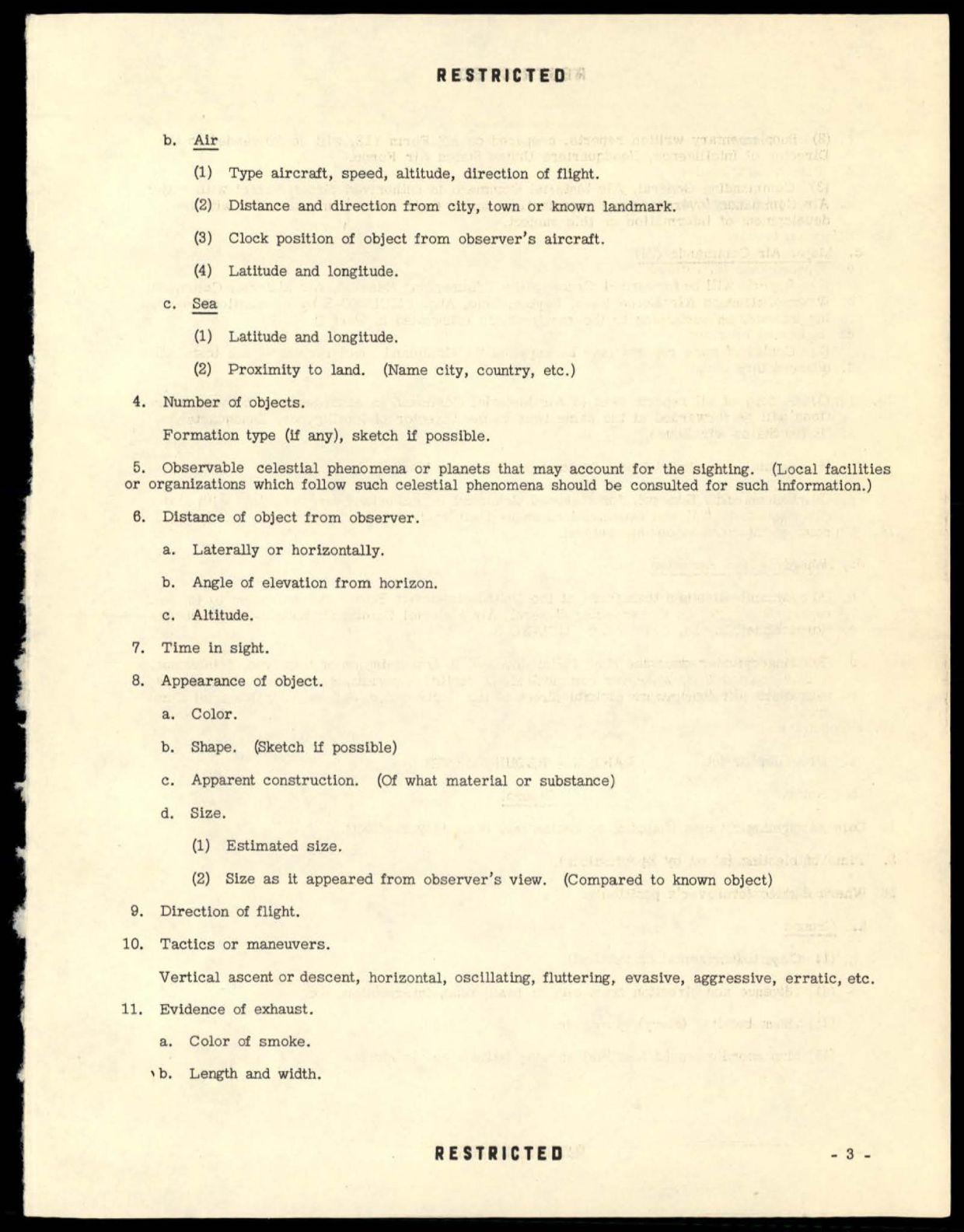
RESTRICTED b. Air (1) Type aircraft, speed, altitude, direction of fllght. (2) Distance and direction fr om city, town or known landmark. (3) Clock position of object from observer's aircraft. (4) Latitude and longitude. c. Sea (1) Latitude and longitude. (2) Proximity to land. (Name city, country, etc.) 4. Number of objects. Formation type (if any), sketch if possible. 6. Observable celestial phenomena or planets that may account for the slghtlng. (Local fac1lities or organizations which follow such celestial phenomena should be consulted for such information.) 6. Distance of object from observer. a. Laterally or horizontally. b. Angle of elevation from horizon. c. Altitude. 7. Time in sight. 8, Appearance of object. a. Color. b. Shape. (Sketch 1f possible) c. Apparent construction. (Of what material or substance) d. Size. (1) Estimated size. (2) Slze as it appeared from observer's vlew. (Compared to known object) 9. Direction of fUght. 10. Tactics or maneuvers. Vertical ascent or descent, horizontal, oscillatlng, fluttering,. evasive, aggressive, er ratic, etc. 11. Evidence of exhaust. a. Color of smoke. , b. Length and width. RESTRICTED - 3
PAGE 45 / 137
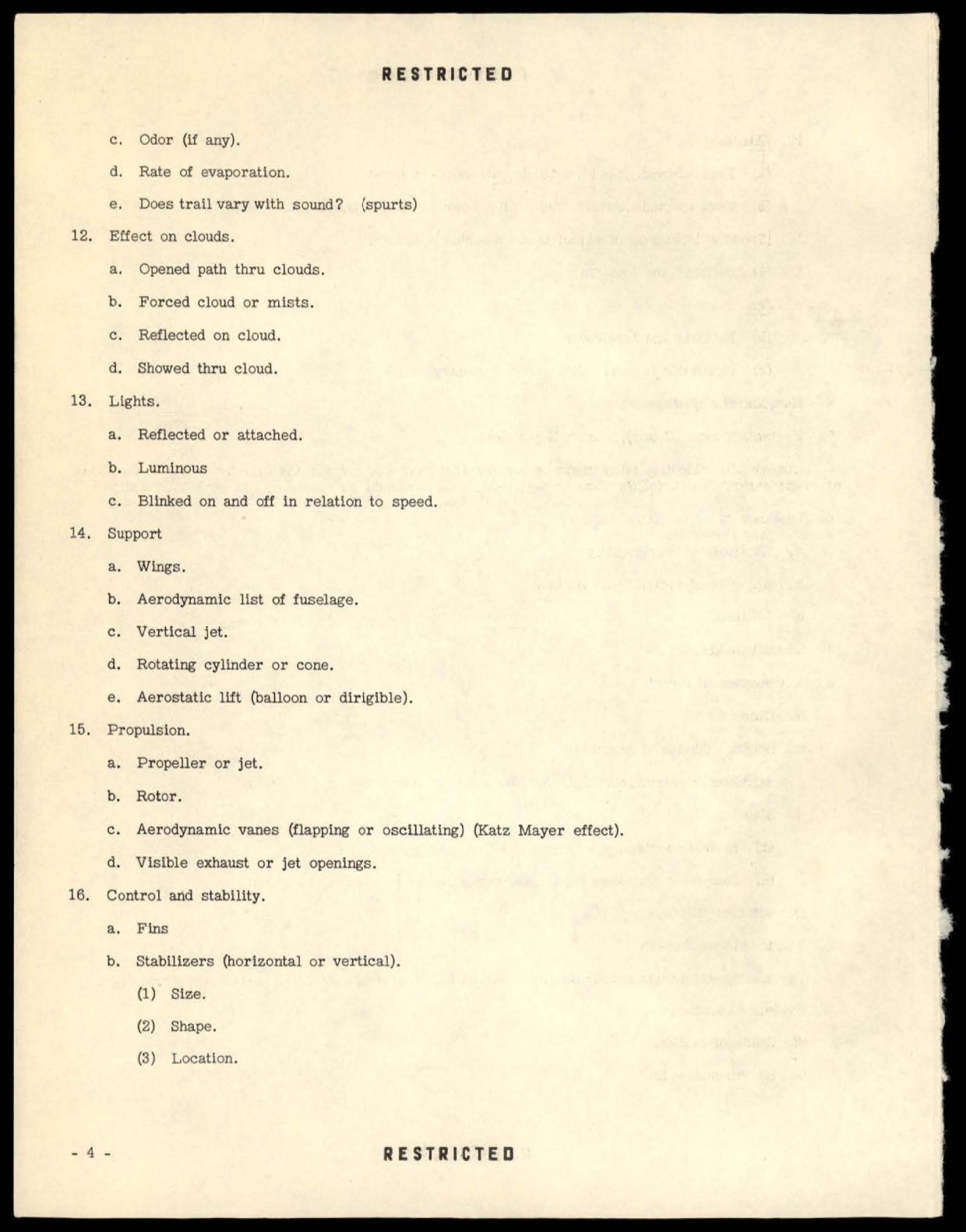
RESTRICTED
c. Odor (if any).
d. Rate of evaporation.
e. Does trail vary with som1d?
(spurts)
12. Effect on clouds.
a. Opened path thru clouds.
b . Forced cloud or mists.
c. Reflected on cloud.
d. Showed thru cloud.
13. Llghts.
a. Reflected or attached.
b. Luminous
c. Blinked on and off in relation to speed.
14. Support
a. Wlngs.
b. Aerodynamic Ust of fuselage.
c. Vertical Jet.
d. Rotating cyllnder or cone.
e. Aerostatic lift (balloon or dir igible).
15. Propulsion.
a. Propeller or jet.
b. Rotor.
c. Aerodynamic vanes (flapping or oscillating) (Katz Mayer effect).
d. Visible exhaust or jet openings.
18. Control and stability.
a. Flns
b. Stabilizers (horizontal or vertical).
(1) Size.
(2) Shape.
(3) Location.
- 4 -
RESTRICTED
PAGE 46 / 137
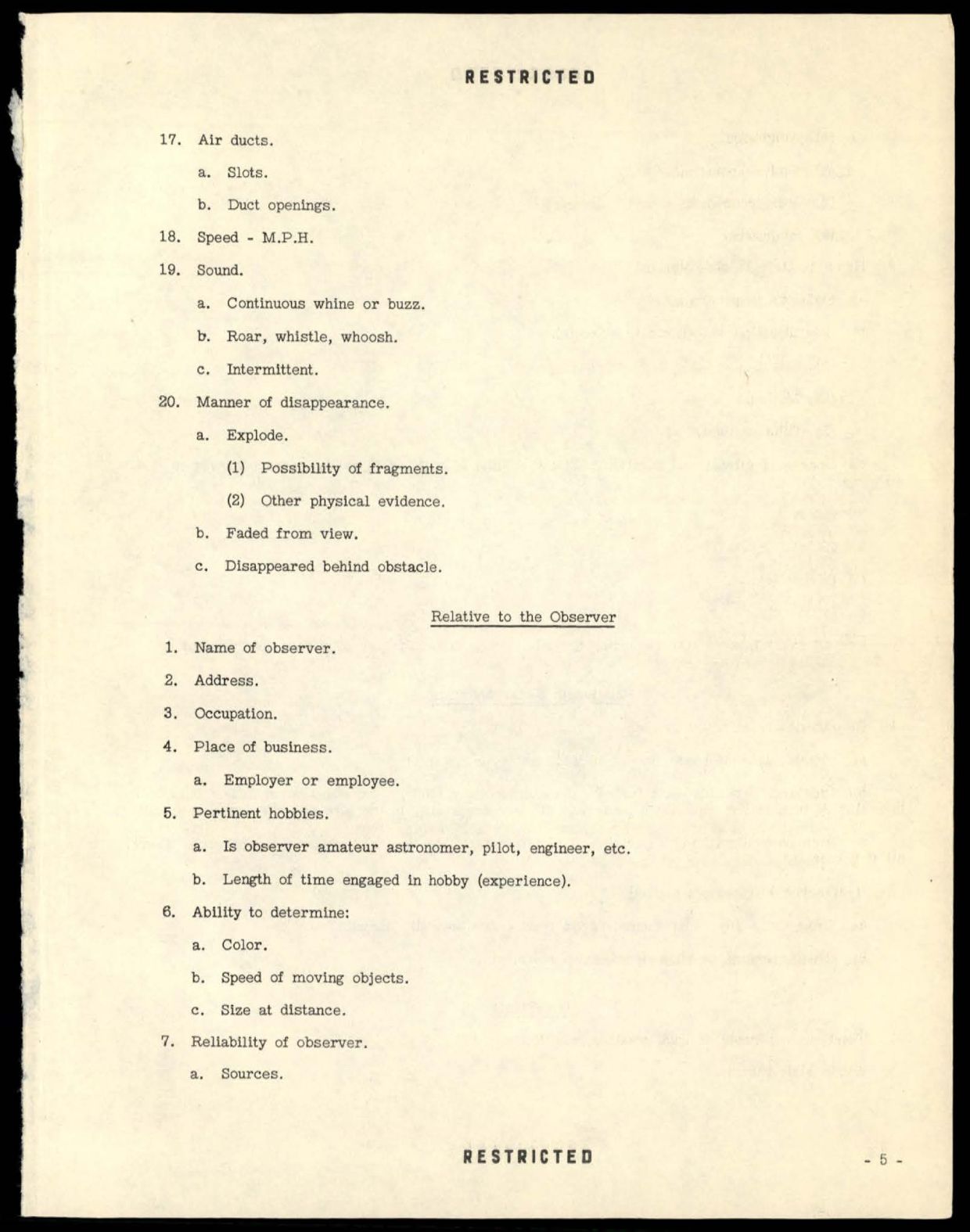
RESTRICTED
17. Air ducts.
a. Slots.
b. Duct openings.
18. Speed - M.P.H.
19. Sound.
a. Continuous whine or buzz.
b. Roar, whistle, whoosh.
c. Intermittent.
20. Manner of disappearance.
a. Explode.
(1) Possibility of fragments.
(2) Other physical evidence.
b.
Faded from view.
c. Disappeared behind obstacle.
Relative to the Observer
1. Name of observer.
2. Address.
3. Occupation.
4. Place of business.
a. Employer or employee.
5. Pertinent hobbies.
a. Is observer amateur astronomer, pl.lot, engineer, etc.
b. Length of time engaged in hobby (experience).
6. Abllity to determine:
a. Color.
b. Speed of moving objects.
c. Size at distance.
7. Reliability of observer.
a.
Sources.
RESTRICTE D
- 5 -
PAGE 47 / 137
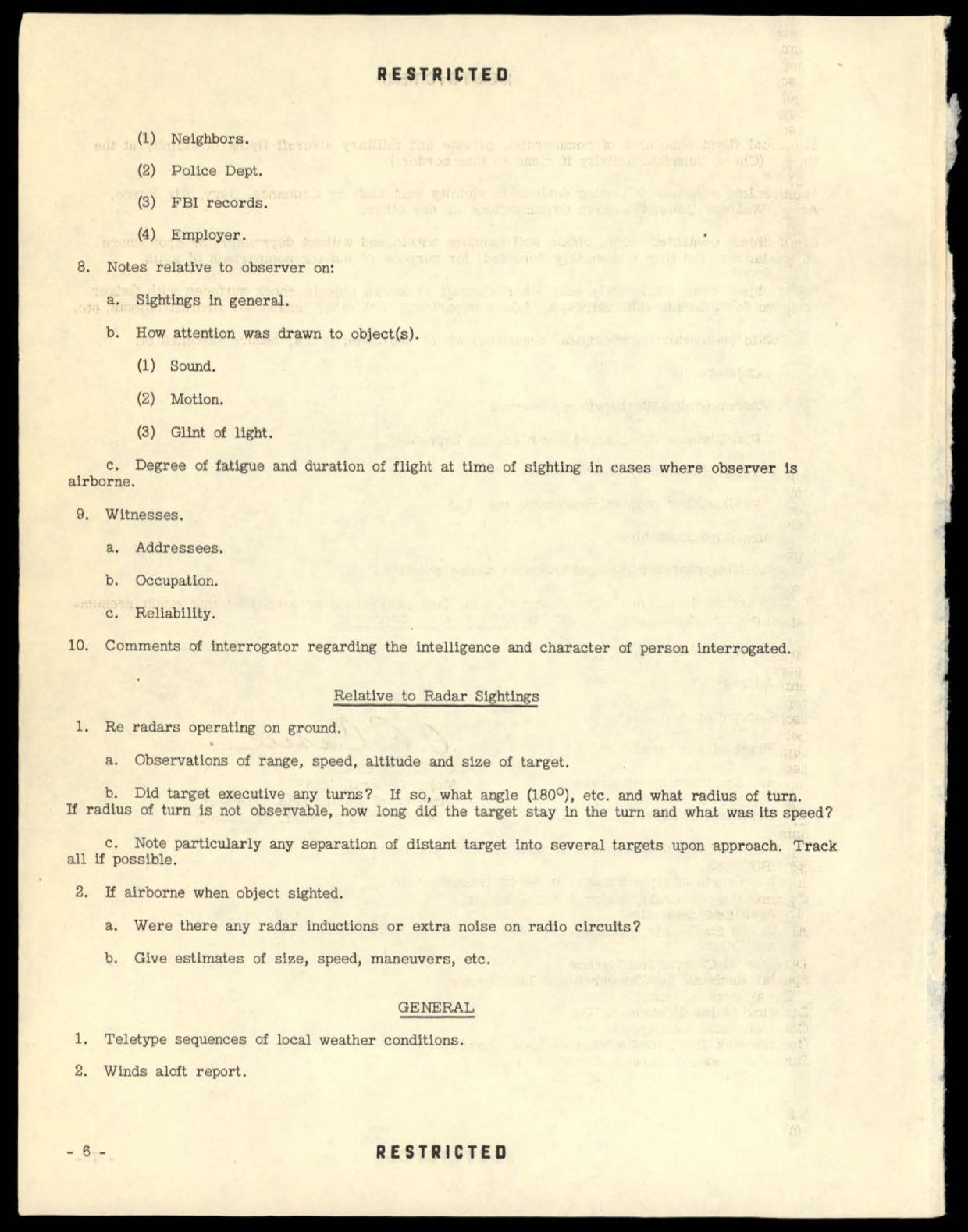
RESTRICTED
(1) Neighbors .
(2) Police Dept.
(3) FBI records.
(4) Employer.
8. Notes relative to observer on:
a. Sightings 1n general.
b. How attention was drawn to object(s).
(1) Sound.
(2) Motion.
(3) Glint of light.
c. Degree of fatigue and duration of flight at tlme of sightlng in cases where observer is
airborne.
9. Witnesses.
a. Addressees.
b. Occupation.
c. Reliability.
10. Comments of interrogator regarding the intelUgence and character of person interrogated.
Relative to Radar Sightings
1. Re radars operating on ground.
a. Observations of range, speed, altitude and size of target.
b. Did target executive any turns? If so, what angle (180°), etc. and what radius of turn.
If radius of turn is not observable, how long did the target stay in the turn and what was its speed?
c. Note particularly any separation of distant target into several targets upon appr oach, Track
all if possible.
2. If airborne when object sighted.
a. Were there any radar inductions or extra noise on radio circuits?
b, Give estimates of slze, speed, maneuvers, etc.
GENERAL
1. Teletype sequences of local weather conditions.
2. Winds aloft report.
- 6 -
RESTRICTED
PAGE 48 / 137
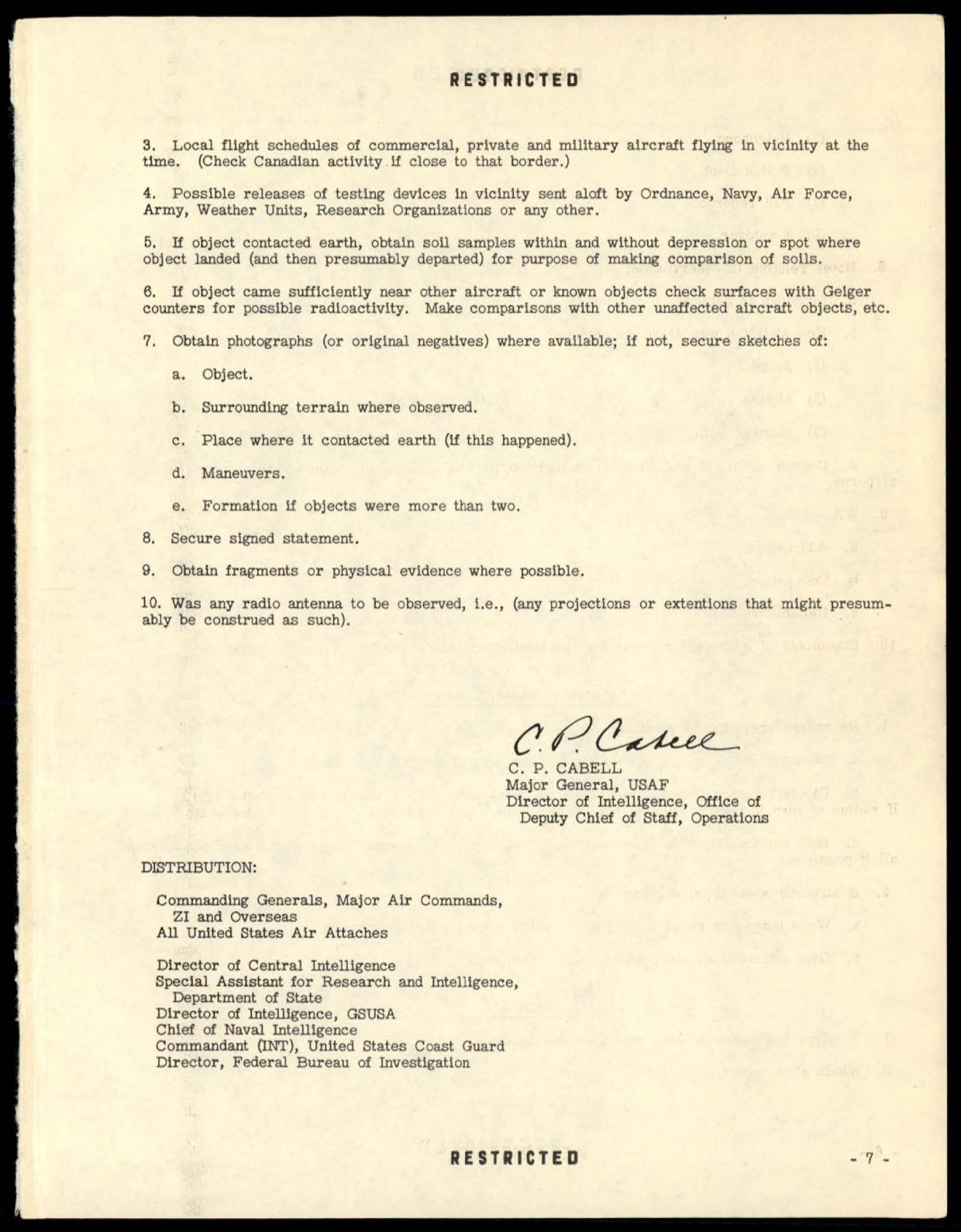
RESTRICTED 3. Local night schedules of commercial, private and m111tary aircraft flying 1n vicinity at the time. (Check Canadian activity 1f close to that border.) 4. Possible releases of testing devices 1n vicinity sent aloft by Ordnance, Navy, Alr Force, Army, Weather Units, Research Organizations or any other. 6. If object contacted earth, obtain soil samples within and without depression or spot where object landed (and then presumably departed) for purpose of making comparison of soils. 6. If object came sufficiently near other aircraft or known objects check surfaces with Geiger counters for possible radioactivity. Make comparisons with other unaffected aircraft objects, etc. 7. Obtain photographs (or original negatives) where available; if not, secure sketches of: a. Object. b. Surroundlng terrain where observed. c. Place where it contacted earth (if this happened). d. Maneuvers. e. FormaUon if objects were more than two. 8. Secure signed statement. 9. Obtain fragments or physical evidence where possible. 10. Was any radio antenna to be observed, i.e., (any pr ojections or extentions that might presum ably be construed as such). c:1-?~ C. P. CABELL Major General, USAF Director of lntell1gence, Office of Deputy Chief of Staff, Operations DISTRIBUTION: Commanding Generals, Major Air Commands, ZI and Overseas All United States Air Attaches Director of Central Intelligence Special Assistant for Research and Intelligence, Department of State Director of Intelligence, GSUSA Chief of Naval Intelligence Commandant (INT), United States Coast Guard Director, Federal Bureau of Investigation RESTRICTED - 7 -
PAGE 49 / 137
RESTRICTED
RESTRICTED
PAGE 50 / 137
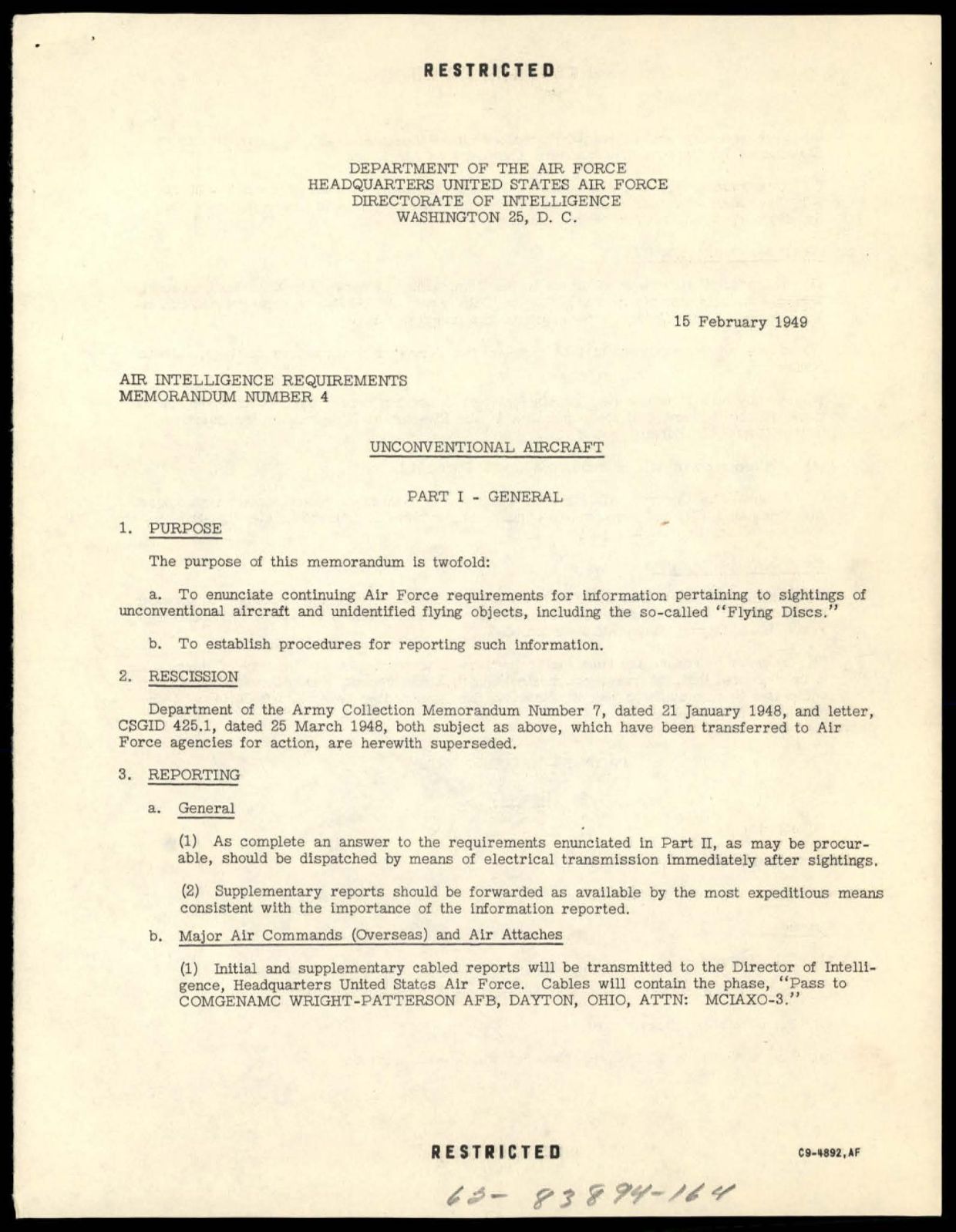
RESTRICTED DEPARTMENT OF THE AIR FORCE HEADQUARTERS UNITED STATES AIR FORCE DIRECTORATE OF INTELLIGENCE WASHINGTON 25, D. C. 15 February 1949 AIR INTELLIGENCE REQUIREMENTS MEMORANDUM NUMBER 4 UNCONVENTIONAL AIRCRAFT PART I - GENERAL 1. PURPOSE The purpose of thls memorandum Is twofold: a. To enunciate continuing Air Force requirements for information pertaining to sightings of unconventional aircraft and unidentified flying objects, lncludlng the so-called "Flying Discs. 11 b. To establish procedures for reporting such information. 2. RESCISSION Department of the Army Collection Memorandum Number 7, dated 21 January Hl48, and letter, CSGID 425.1, dated 25 March 1948, both subject as above, which have been transferred to Air Force agencies for action, are herewith superseded. 3. REPORTING a. General (1) As complete an answer to the requirements enunciated in Part II, as may be procur able, should be dispatched by means of electrical transmission immediately after sightings. (2) Supplementary r·eports should be forwarded as available by the most expeditious means consistent with the importance of the Information reported. b. Major Air Commands (Overseas) and Air Attaches (1) Initial and supplementary cabled reports will be transmitted to the Director of Intelll gence, Headquarters United Statc,s Air Force. Cables will contaln the phase, "Pass to COMGENAMC WRIGHT-PATTERSON AFB, DAYTON, OHIO, ATTN: MClAX0-3." RESTRICTED
PAGE 51 / 137
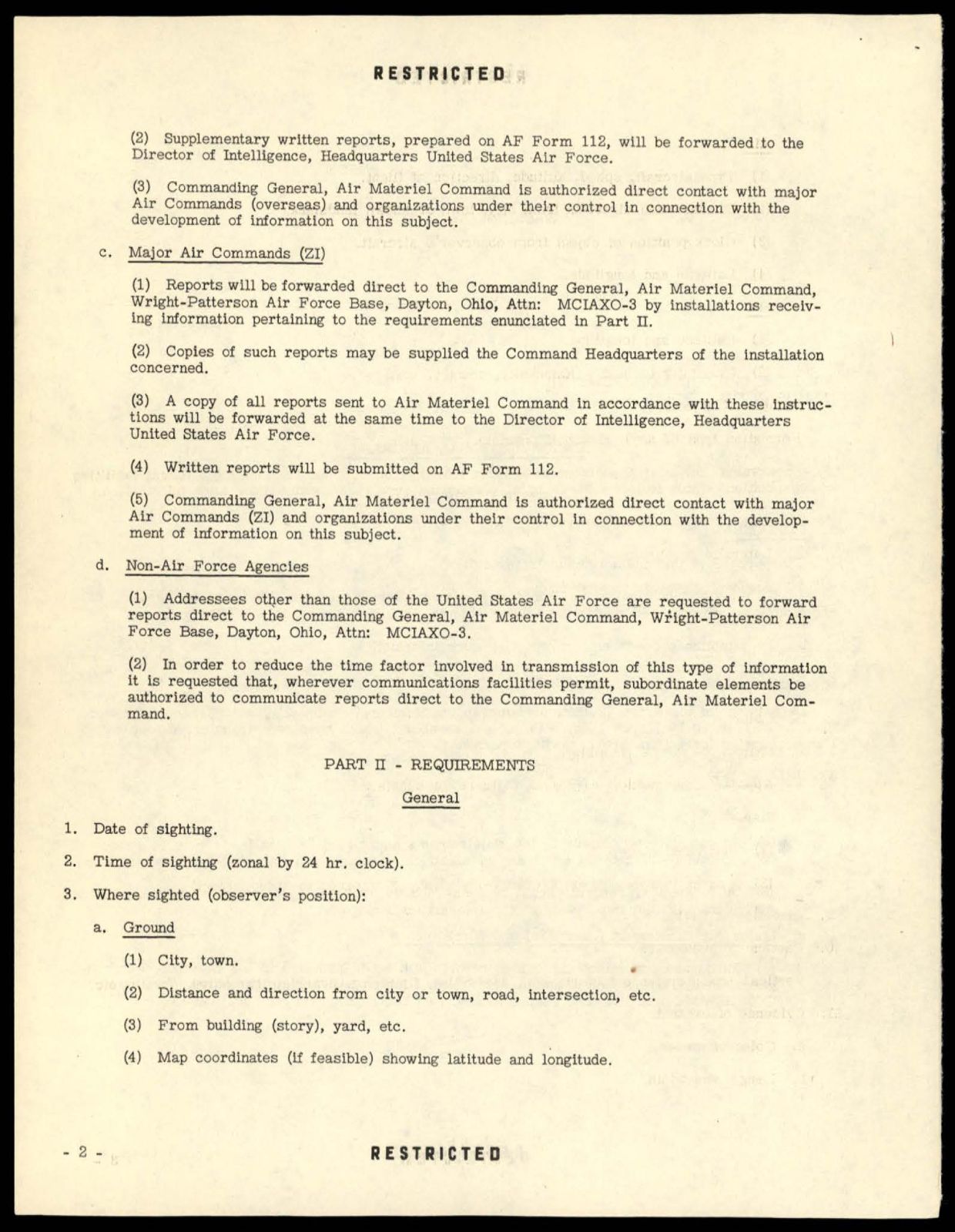
RESTRICTED (2) Supplementary written r eports, prepared on AF Form 112, will be forwarded to the Director of Intelligence, Headquarters United States Air Force. (3) Commanding General, Air Materiel Command is authorized direct contact wlth major Air Commands (overseas) and or ganizations under their contr ol in connection wlth the development of information on this subject. c. Major Air Commands (ZI) (1) Reports wm be forwarded direct to the Commanding General, Air Materiel Command, Wright-Patterson Air Force Base, Dayton, Ohio, Attn: MCIAXO-3 by installations receiv ing information pertaining to the requirements enunciated in Part Il. (2) Copies of such reports may be supplied the Command Headquarters of the installation concerned. (3) A copy of all reports sent to Air Materiel Command In accor dance with these instruc tions will be forwarded at the same time to the Director of Intelligence, Headquarters United States Air Force. (4) Written reports will be submitted on AF Form 112. (5) Commanding Gener al, Air Materiel Command is authorized direct contact with major Air Commands (ZI) and organizations under their control in connection with the develop ment of information on thls subject. d. Non-Air Force Agencies (1) Addressees ot~er than those of the United States Air Force are requested to forward r eports direct to the Commanding General, Air Materiel Command, Wright-Patterson Air Force Base, Dayton, Ohio, Attn: MCIAXO-3. (2) In order to reduce the time factor involved in transmission of this type of information it is requested that, wherever communications facUlties permit, subordinate elements be authorized to communicate reports direct to the Commanding General, Air Materiel Com mand. PART ll - REQUffiEMENTS General 1. Date of sighting. 2, Time of sighting (zonal by 24 hr. clock). 3. Where sighted (observer's position): a. Ground (1) City, town. (2) Distance and direction from city or town, road, intersection, etc. (3) From bullding (story), yard, etc. (4) Map coordinates (if feasible) showing latitude and longitude. - 2 - RESTRICTED
PAGE 52 / 137
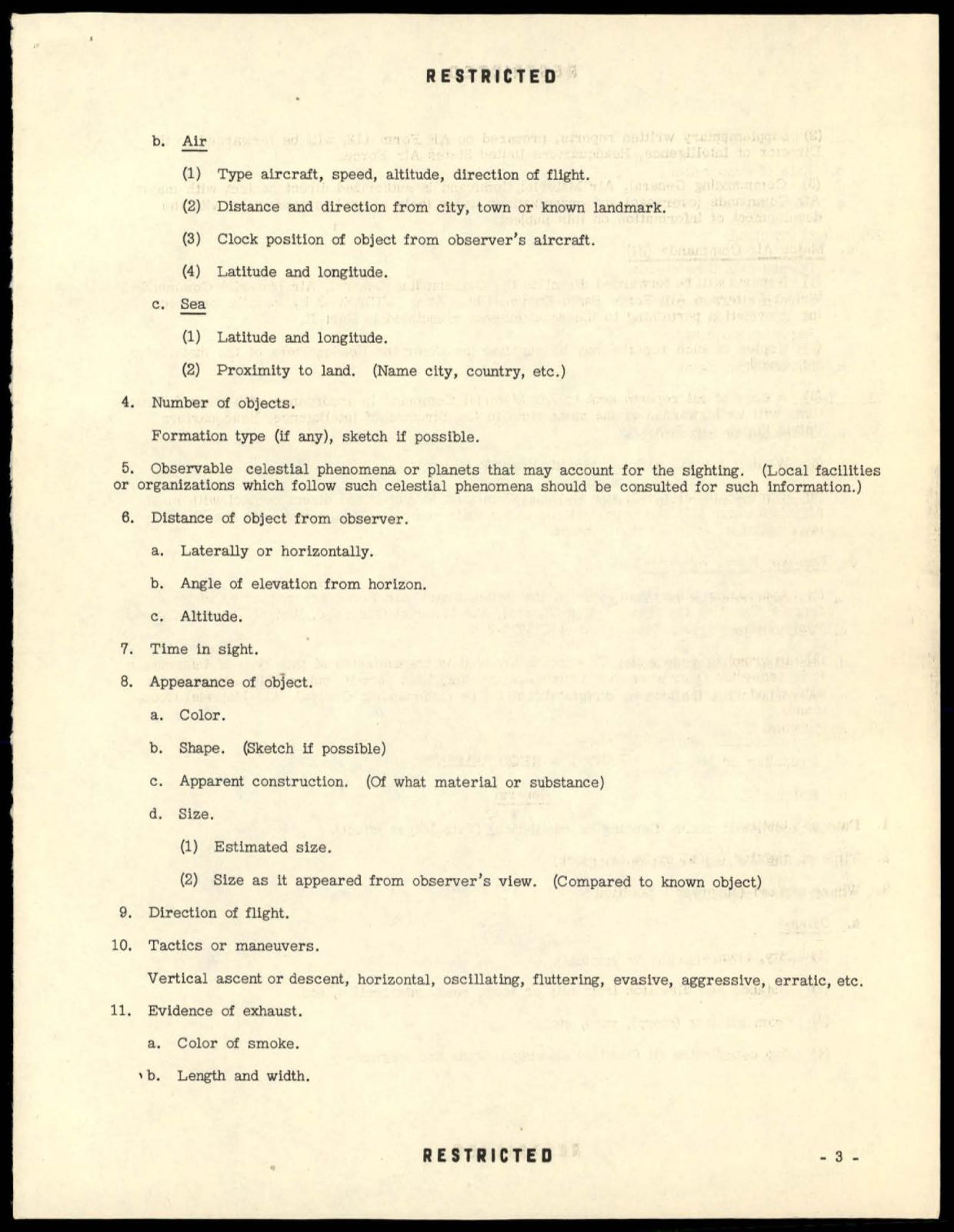
RESTRICTED b. Al.r (1) Type aircraft, speed, altitude, direction of flight. (2) Distance and direction from city, town or known landmark. (3) Clock position of object from observer's aircraft. (4) Latitude and longitude. c. Sea (1) Latitude and longitude. (2) Proximity to land. (Name clty, country, etc.) 4. Number of objects. Formation type (if any), sketch If possible. 5. Observable celestial phenomena or planets that may account for the sighting. (Local facilities or organizations which follow such celestial phenomena should be consulted for such information.) 6. Distance of object from observer. ' a. Laterally or horizontally. b. Angle of elevation from horizon. C. Altitude. 7. Time in sight. 8. Appearance of object. a. Color. b. Shape. (Sketch if possible) c . Apparent construction. (Of what material or substance) d. Size. (1) Estimated size. (2) Size as l.t appeared from observer's view. (Compared to known object) 9. Direction of flight. 10. Tactics or maneuvers. Vertical ascent or descent, horizontal, oscillating, fluttering, evasive, aggressive, erratic, etc. 11. Evidence of exhaust. a. Color of smoke. , b. Length and width. RESTRICTED - 3
PAGE 53 / 137
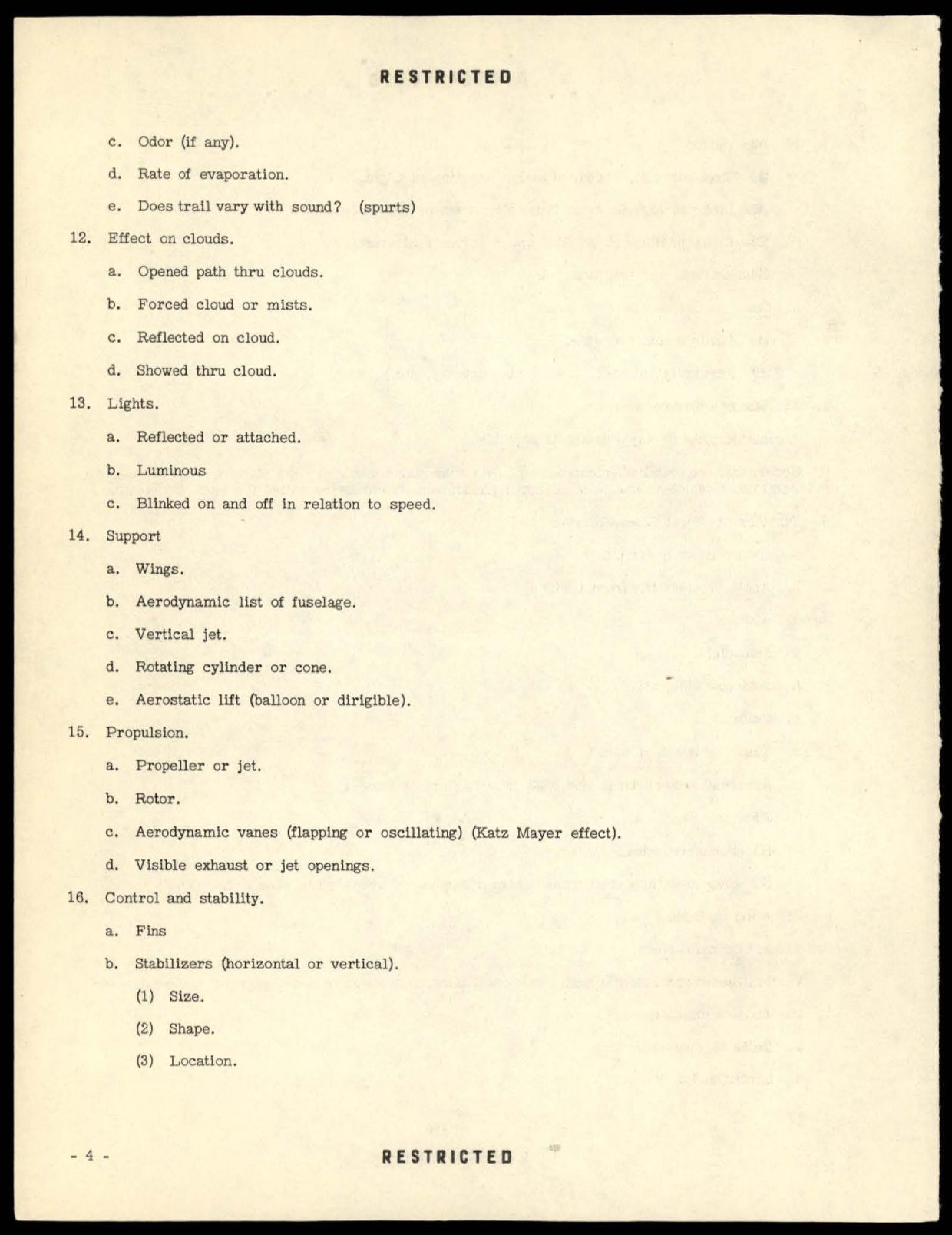
RESTRICTED
c. Odor (if any).
d. Rate of evaporation.
e. Does trail vary with sound?
(spurts)
12. Effect on clouds.
a. Opened path thru clouds.
b. Forced cloud or mists.
c. Reflected on cloud.
d. Showed thru cloud.
13. Lights.
a. Reflected or attached.
b. Luminous
c. Blinked on and off in r elation to speed.
14. Support
a. Wings .
b. Aerodynamic list of fuselage.
c. Vertical jet.
d. Rotating cylinder or cone.
e. Aerostatic 11ft (balloon or dirigible).
15. Propulsion.
a. Propeller or jet.
b. Rotor.
c. Aerodynamic vanes (flapping or oscillating) (Katz Mayer effect).
d. Visible exhaust or jet openings.
16. Control and stablll.ty.
a. Fins
b. Stabillzers (horizontal or vertical).
(1) Size.
(2) Shape.
(3) Locatlon.
- 4 -
RESTRICTED
PAGE 54 / 137
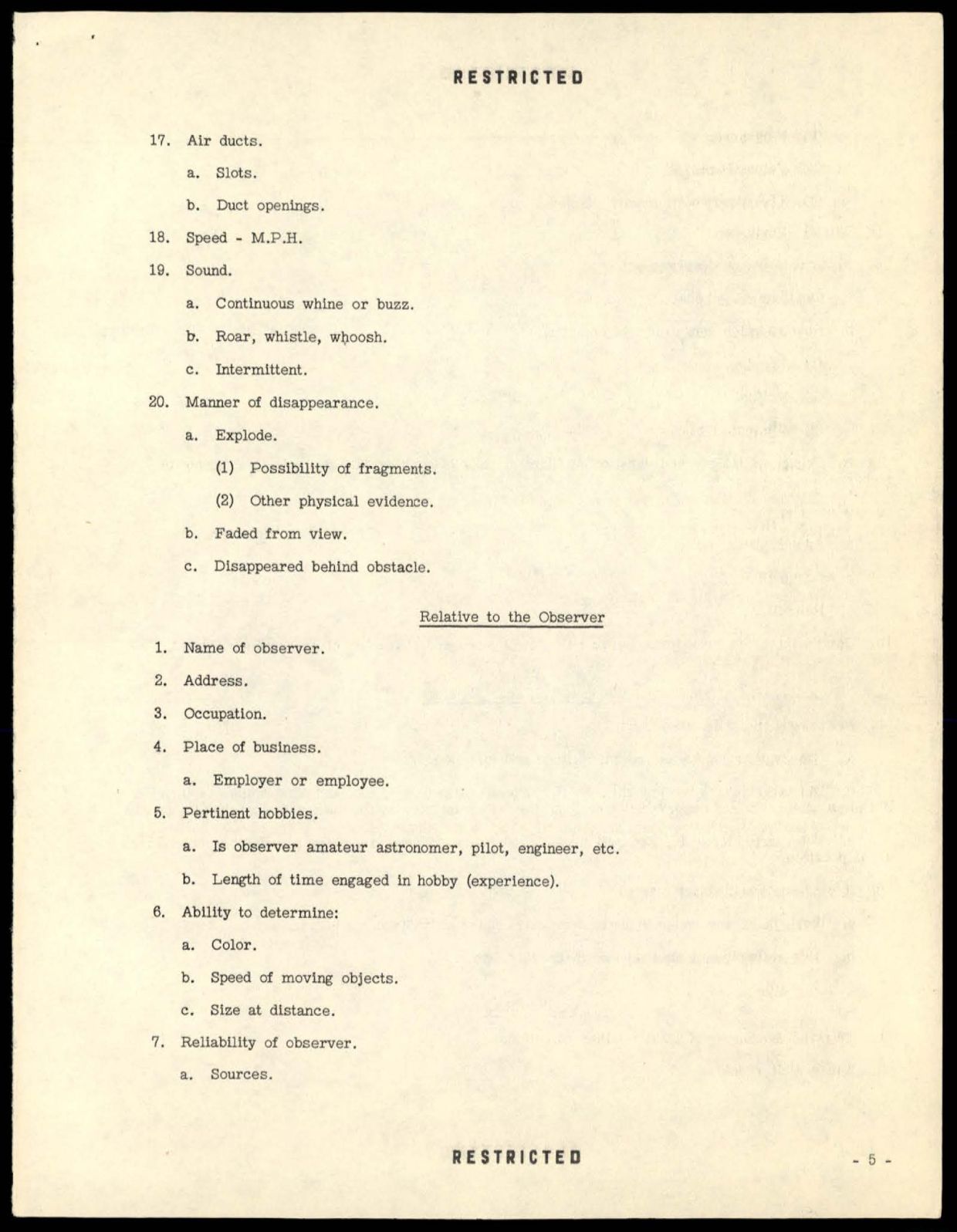
RESTRICTED
17. Air ducts.
a. Slots.
b. Duct openings.
18. Speed - M.P .H.
19. Sound.
a. Continuous whine or buzz.
b. Roar, whistle, w}:loosh.
C.
Intermittent.
20. Manner of disappearance.
a.
Explode.
(1) Possibility of fragments.
(2) Other physical evidence.
b. Faded from view.
C.
Disappeared behlnd obstacle.
Relative to the Observer
1.
Name of observer.
2. Address.
3. Occupation.
4. Place of business.
a. Employer or employee.
5. Pertinent hobbles.
a. Is observer amateur astronomer, pilot, engineer, etc.
b. Length of time engaged in bobby (experience).
6,
Ablllty to determine:
a. Color.
b. Speed of moving objects.
c. Size at distance.
7. Reliability of observer.
a. Sources.
RESTRICTED
- 5 -
PAGE 55 / 137
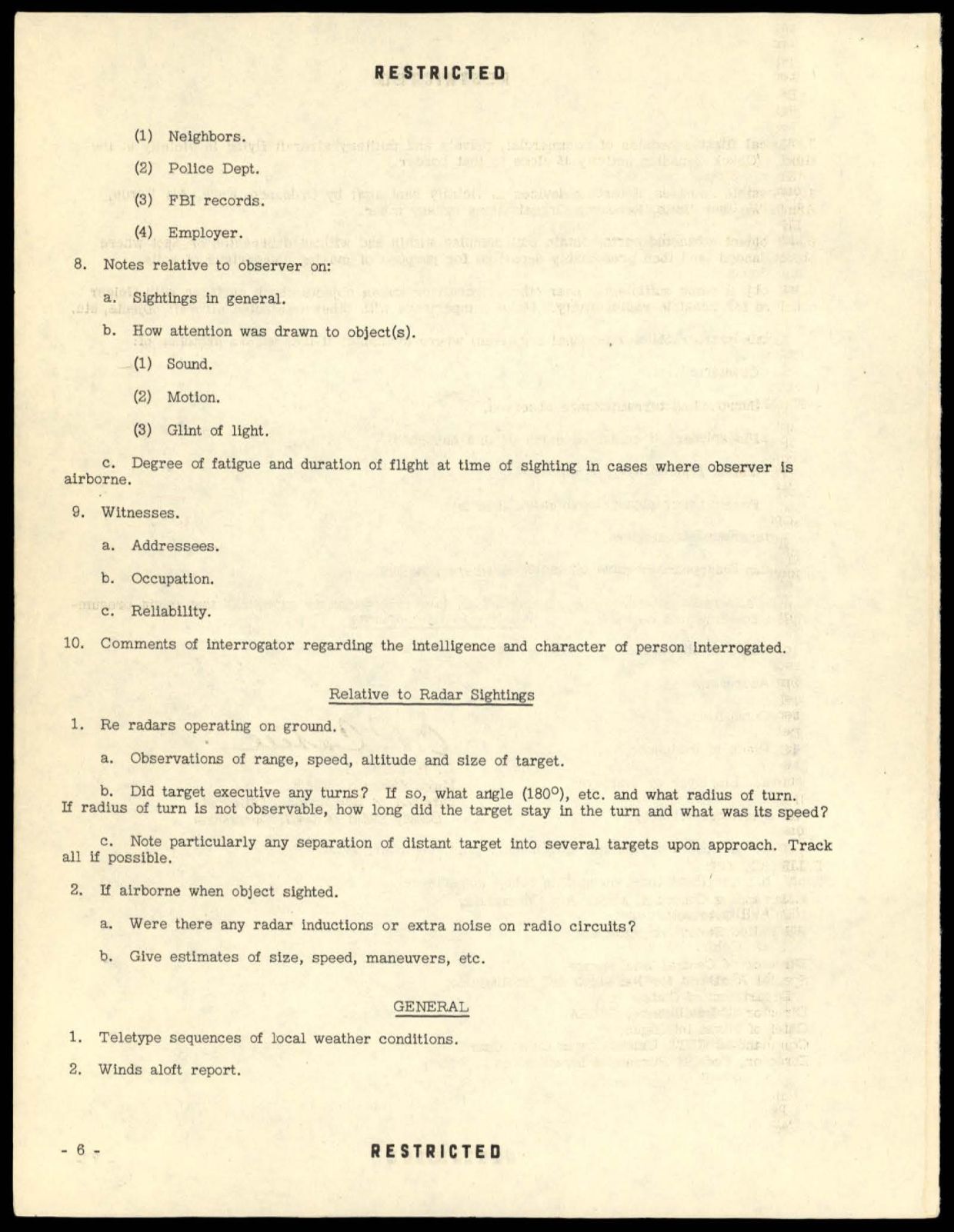
RESTRICTED
(1) Neighbors.
(2) Police Dept.
(3) FBI records.
(4) Employer.
8. Notes relative to observer on:
a, Sightings in general.
b. How attention was drawn to object(s).
(1) Sound.
(2) Motion.
(3) Glint of Ught.
c. Degree of fatigue and duration of flight at time of sighting in cases where observer is
airborne.
9. Witnesses.
a. Addressees.
b. Occupation.
C. ReliabiUty.
10. Comments of interrogator regarding the intelUgence and character of person interrogated.
Relative to Radar Sightings
1. Re radars operating on ground.
a. Observations of range, speed, altitude and size of target.
b. D1d target executive any turns? If so, what angle (180°), etc. and what radius of turn.
If radius of turn 1s not observable, how long did the target stay in the turn and what was its speed?
c. Note particularly any separation of distant target into several targets upon approach. Track
all if possible.
2.
I.f airborne when object sighted.
a. Were there any radar inductions or extra noise on radio circuits?
b. Give estimates of size, speed, maneuvers, etc.
GENERAL
1. Teletype sequences of local weather conditions.
2.
Winds aloft report.
- 6 -
RESTRICTED
PAGE 56 / 137
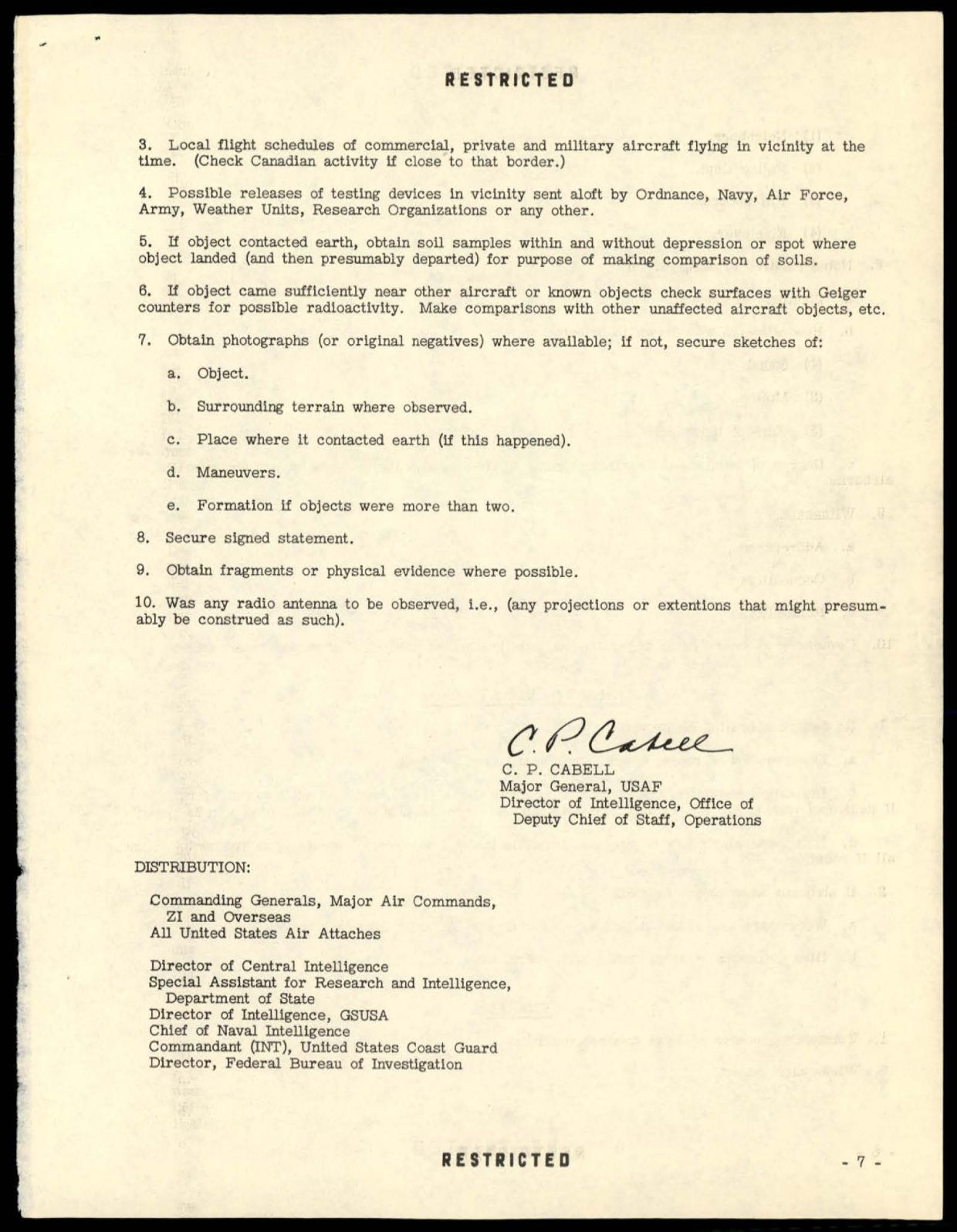
RESTRICTED 3. Local flight schedules of commercial, private and military aircraft flying 1n viclnlty at the time. (Check Canadian actlvlty 1f close to that border.) 4. Possible releases of testing devices in vicinlty sent aloft by Ordnance, Navy, Air Force, Army, Weather Units, Research Organizations or any other. 5. If object contacted earth, obtain soil samples within and without depression or spot where object landed (and then presumably departed) for purpose of making comparison of solls. 6. If object came sufflclently near other aircraft or known objects check surfaces with Gelger counters for possible radioactivity. Make comparisons wlth other unaffected aircraft objects, etc. 7. Obtain photographs (or original negatives) where available; Ii not, secure sketches of: a. Object. b. Surrounding terrain where observed. c. Place where it contacted earth (lf this happened). d. Maneuvers. e. Formation lf objects were more than two. 8. Secure signed statement. 9. Obtain fragments or physical evidence where possible. 10. Was any radio antenna to be observed, Le., (any projections or extentlons that might presum ably be construed as such). c>: P.~ C. P . CABELL Major General, USAF Director of Intelllgence, Office of Deputy Chief of Staff, Operations DISTRIBUTION: Commanding Generals, Major Air Commands, ZI and Overseas All United States Air Attaches Director of Central Intelligence Special Assistant for Research and Intelligence, Department of State Director of Intelligence, GSUSA Chief of Naval Intelligence Commandant (INT), United States Coast Guard Director, Federal Bureau of Investigation RESTRICTED - 7 -
PAGE 57 / 137
RESTRICTED
RESTRICTED
PAGE 58 / 137
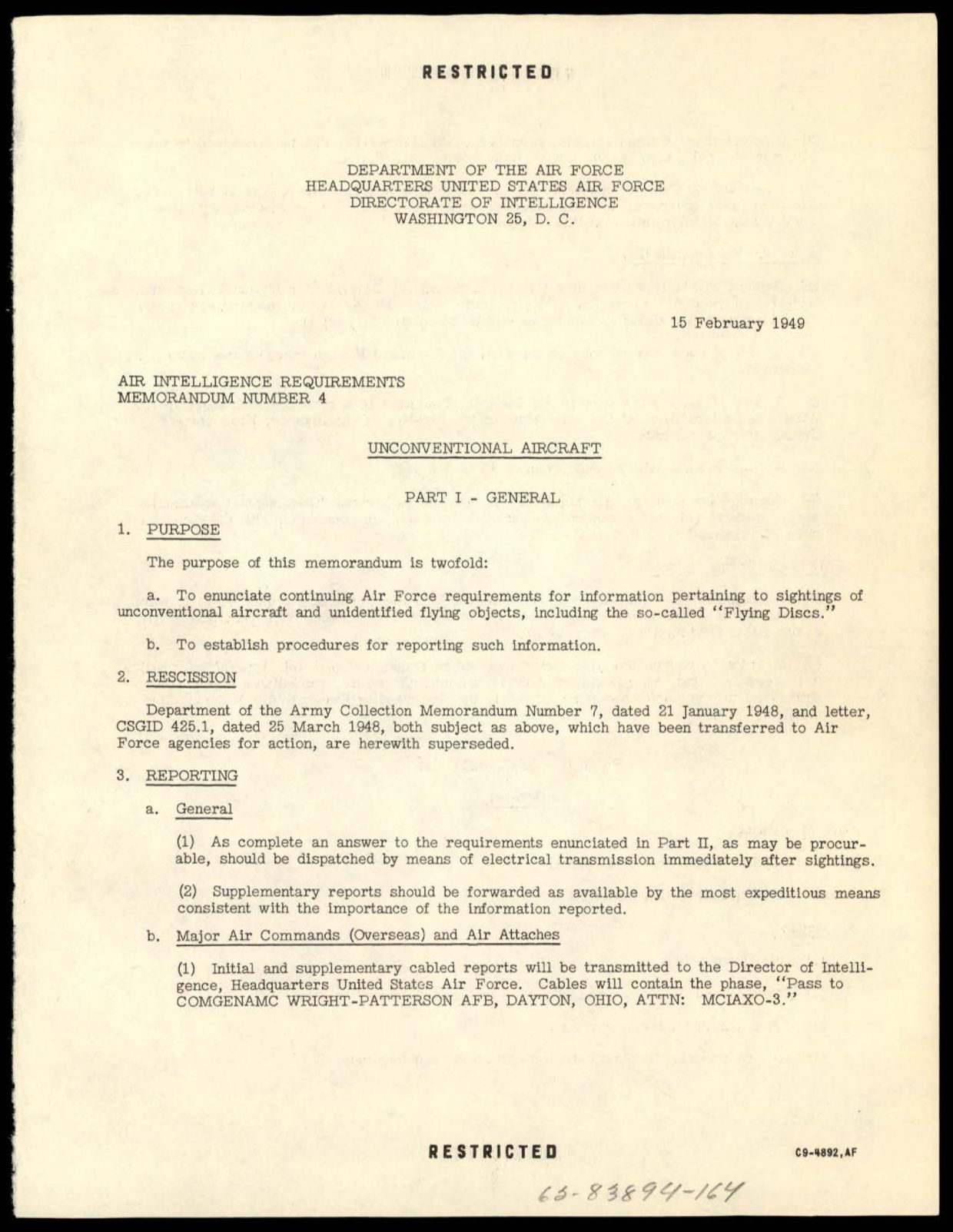
RESTRICTED DEPARTMENT OF THE Affi F ORCE HEADQUARTERS UNITED STATES AIR FORCE DffiECTORATE OF INTELLIGENCE WASHINGTON 25, D. C. 15 February 1949 Affi INTELLIGENCE REQUIB.EMENTS MEMORANDUM NUMBER 4 UNCONVENTIONAL AffiCRAFT PART I - GENERAL 1. PURPOSE The purpose of this memorandum is twofold: a. To enunciate contlnulng Air Force r equirements for information pertaining to sightings of unconventional aircraft and unidentified flying objects, including the so-called "Flying Dlscs." b. To establish procedures for reporting such information. 2. RESCISSION Department of the Army Collection Memorandum Number 7, dated 21 January 1948, and letter, CSGID 425.1, dated 25 March 1948, both subject as above, which have been transferred to Air Force agencies for action, ar e herewith super seded. 3. REPORTING a. General (1) As complete an answer to the requirements enunciated in Part II, as may be procur able, should be dispatched by means of electrical transmission immediately after sightings. (2) Supplementary reports should be forwarded as available by the consistent with the importance of the lnformation r eported. most expeditious means b. Major Air Commands (Over seas) and Air Attaches (1) Initial and supplementary cabled reports will be transmitted to the Director of Intem gence, Headquarters United Stat<::s Air Force. Cables will contain the phase, " Pass to COMGENAMC WRIGHT-PATTERSON AFB, DAYTON, OHIO, ATTN: MCIAXO-3." RESTRICTED C9-IIH2,AF
PAGE 59 / 137
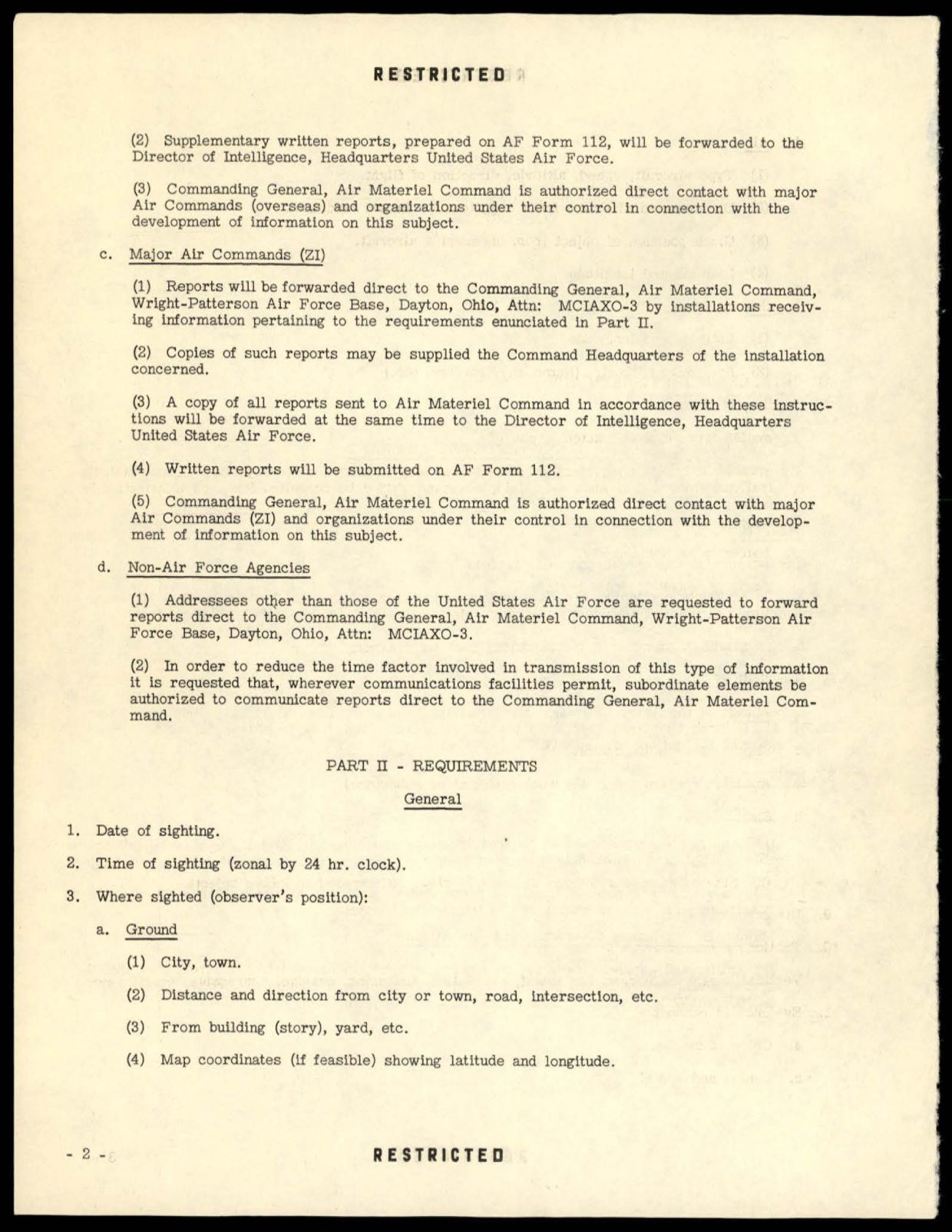
RESTRICTED (2) Supplementary written reports, prepared on AF Form 112, will be forwarded to the Director of Intelligence, Headquarters United States Air Force. (3) Commanding General, Air Materiel Command is authorized direct contact with major Air Commands (overseas) and organizations under their control in connection with the development of information on this subject. c. Major Air Commands (ZI) (1) Reports w111 be forwarded direct to the Commanding General, Air Materiel Command, Wright-Patterson Air Force Base, Dayton, Ohio, Attn: MCIAX0-3 by installations receiv ing Information pertaining to the requirements enunciated in Part II. (2) Coples of such reports may be supplled the Command Headquarters of the Installation concerned. (S) A copy of all reports sent to Air Materiel Command in accordance with these Instruc tions wlll be forwarded at the same time to the Director of Intelligence, Headquarters United States Air Force. (4) Written r eports will be submitted on AF Form 112. (5) Commanding General, Air Materiel Command ls authorized direct contact with major Air Commands (ZI) and or ganizations under their control in connection with the develop ment of information on this subject. d. Non-Air Force Agencies (1) Addressees o~er than those of the United States Air Force are requested to forward reports direct to the Commanding General, Air Materiel Command, Wright-Patterson Air Force Base, Dayton, Ohio, Attn: MCIAX0-3. (2) In order to reduce the time factor involved in transmission of this type of information 1t is requested that, wherever communications fac1litles permit, subordinate elements be authorized to communicate reports direct to the Commanding General, Air Materiel Com mand. PART Il - REQUIREMENTS General 1. Date of sighting. 2. Time of sighting (zonal by 24 hr. clock). 3. Where sighted (observer's position): a. Ground (1) City, town. (2) Distance and direction from city or town, road, intersection, etc. (3) From building (story), yard, etc. (4) Map coordinates (If feasible) showing latitude and longitude. - 2 - RESTRICTED
PAGE 60 / 137
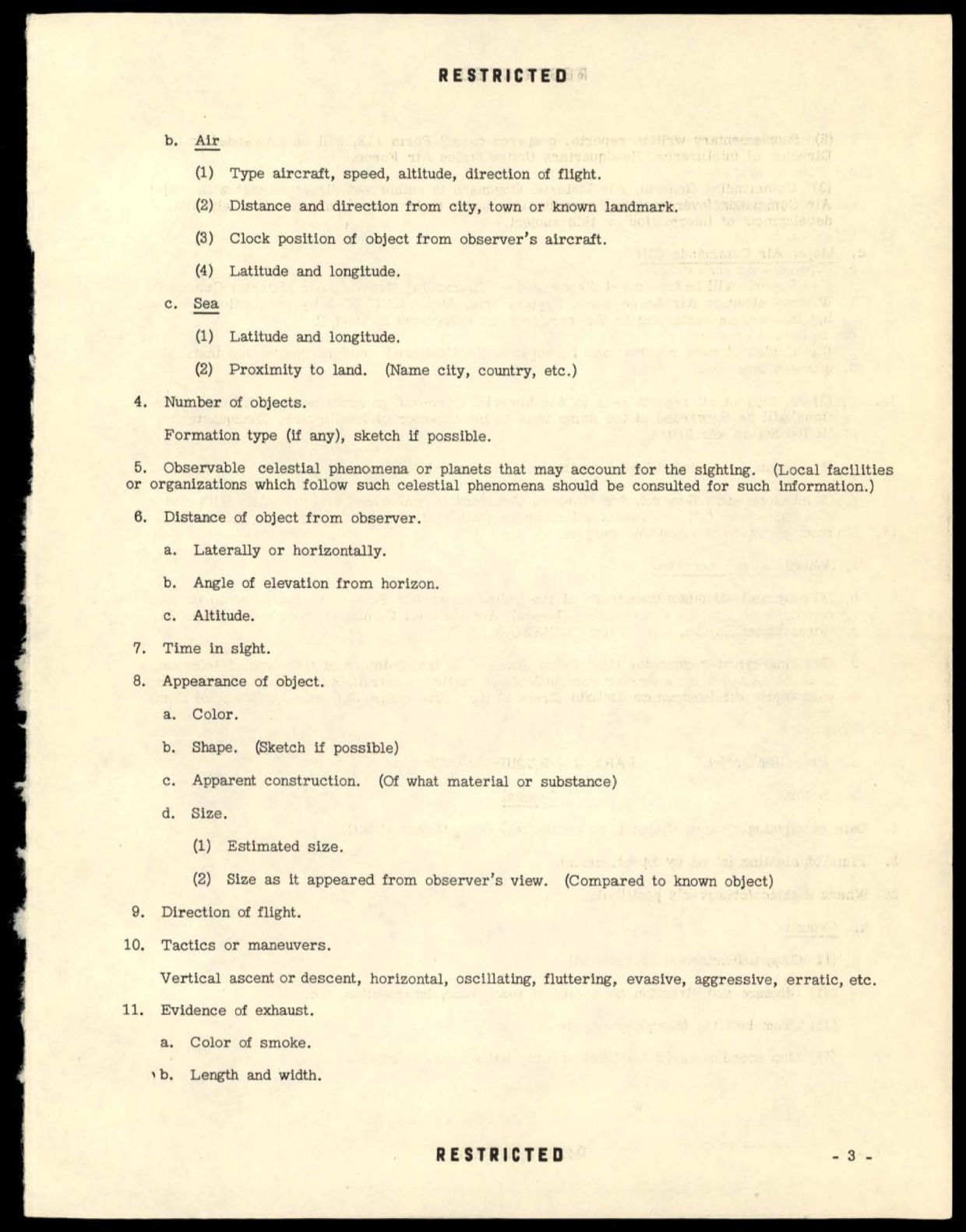
RESTRICfED b. Air (1) Type aircraft, speed, altitude, direction of flight. (2) Distance and direction from city, town or known landmark. (3) Clock position of object from observer's aircraft. (4) Latitude and longitude. c. Sea (1) Latitude and longitude. (2) Proxlml.ty to land. (Name city, country, etc.) 4. Number of objects. Formation type (!.f any), sketch l.f possible. 5. Observable celestial phenomena or planets that may account for the sighting. (Local fac111ties or organizations which follow such celestial phenomena should be consulted for such information.) 6. Distance of object from observer. a. Laterally or horizontally. b. Angle of elevation from horizon. c. Altitude. 7. Time 1n sight. 8. Appearance of object. a. Color. b. Shape. (Sketch l.f possible) c. Apparent construction. (Of what material or substance) d. Sii.e. (1) Estimated size. (2) Sl.ze as lt appeared from observer's view. (Compared to known object) 9. Direction of flight. 10. Tactics or maneuvers. Vertical ascent or descent, horizontal, oscillating, fluttering, evasive, aggressive, erratic, etc. 11. Evidence of exhaust. a. Color of smoke. 1 b. Length and width. RESTRICTED - 3
PAGE 61 / 137
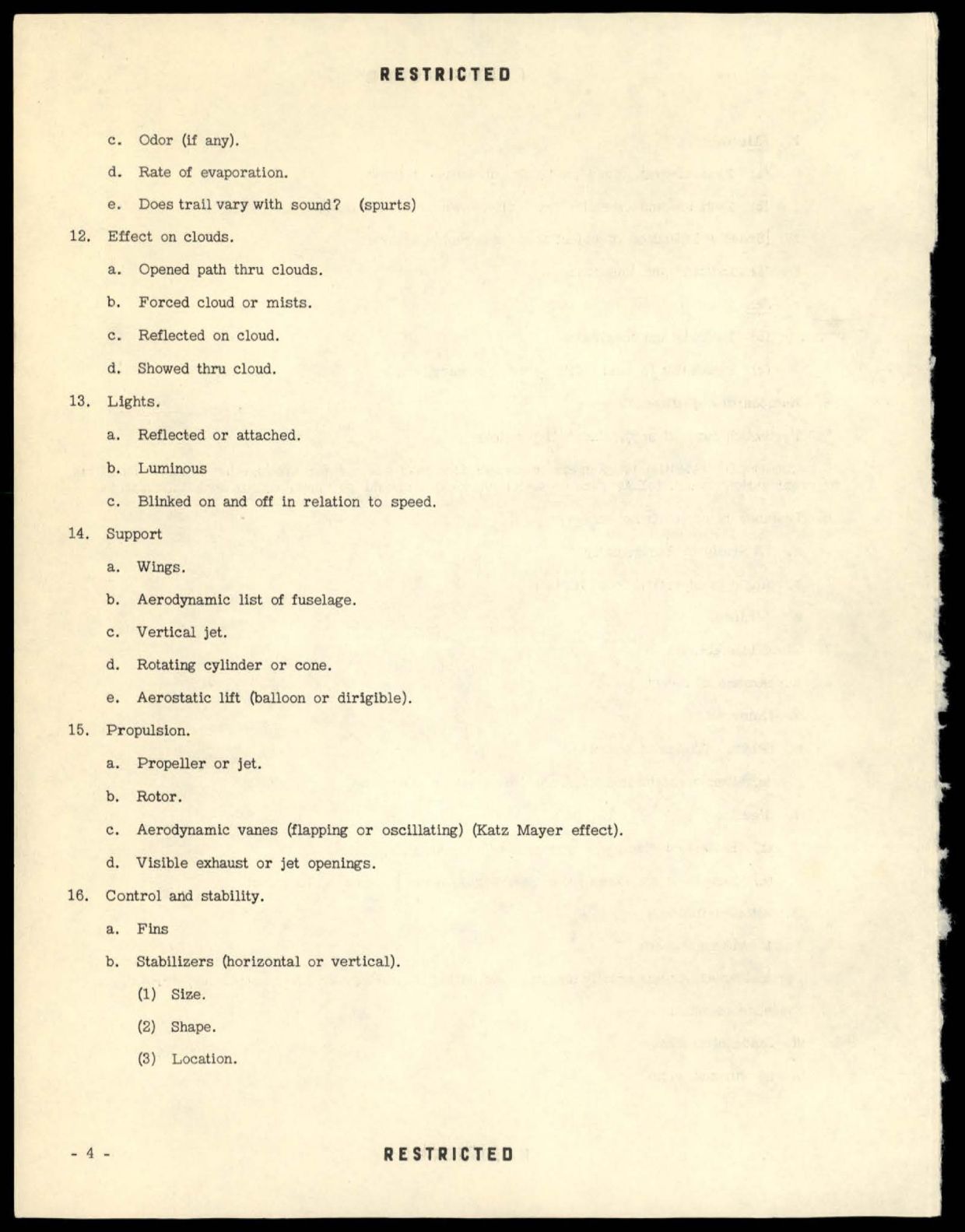
RESTRICTED
c. Odor (if any).
d. Rate of evaporation.
e.
Does trail vary with sound?
(spurts)
12.
Effect on clouds.
a. Opened path thru clouds.
b.
Forced cloud or mists.
c. Reflected on cloud.
d.
Showed thru cloud.
13. Lights.
a.
Reflected or attached.
b.
Luminous
c.
Blinked on and off in relation to speed.
14. Support
a. Wings.
b.
Aerodynamic 11st of fuselage.
c. Vertical jet.
d.
Rotating cylinder or cone.
e.
Aerostatic lift (balloon or dirigible).
15. Pr opulsion.
a.
P ropeller or jet.
b.
Rotor.
c.
Aerodynamic vanes (flapping or oscillating) (Katz Mayer effect).
d. Visible exhaust or jet openings.
16. Control artd stability.
a.
F!.ns
b.
Stabilizers (hor izontal or vertical).
(1) Size.
(2) Shape.
(3) Location.
- 4 -
RESTRICTED
PAGE 62 / 137
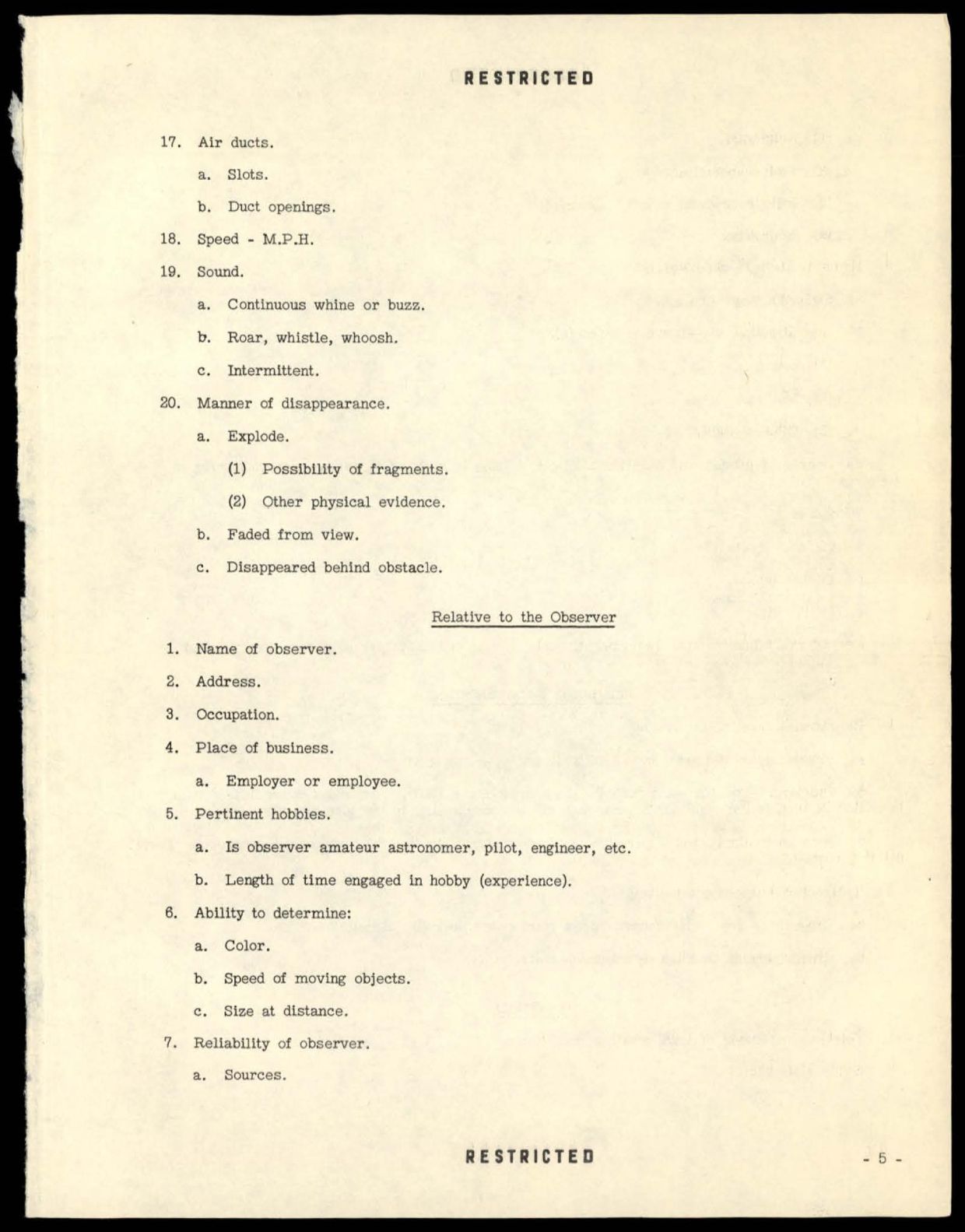
RESTRICTED
17. Air ducts.
a.
Slots.
b. Duct openings.
18. Speed - M.P.H.
19. Sound.
a. Continuous whine or buzz.
b. Roar, whistle, whoosh.
c. Intermittent.
20. Manner of disappearance.
a.
Explode.
(1) Possibility of fragments.
(2) Other physical evidence.
b. Faded from view.
c.
Disappeared behind obstacle.
Relative to the Observer
1. Name of observer.
2. Address.
3.
Occupation.
4. Place of business.
a.
Employer or employee.
5. Pertinent hobbies.
a. Is observer amateur astronomer, pilot, engineer, etc.
b. Length of time engaged in hobby (experience).
6. AbHity to determine:
a. Color.
b. Speed of moving objects.
c. Size at distance.
7. Reliab111ty of observer.
a.
Sources.
RESTRICTED
- 5 -
PAGE 63 / 137
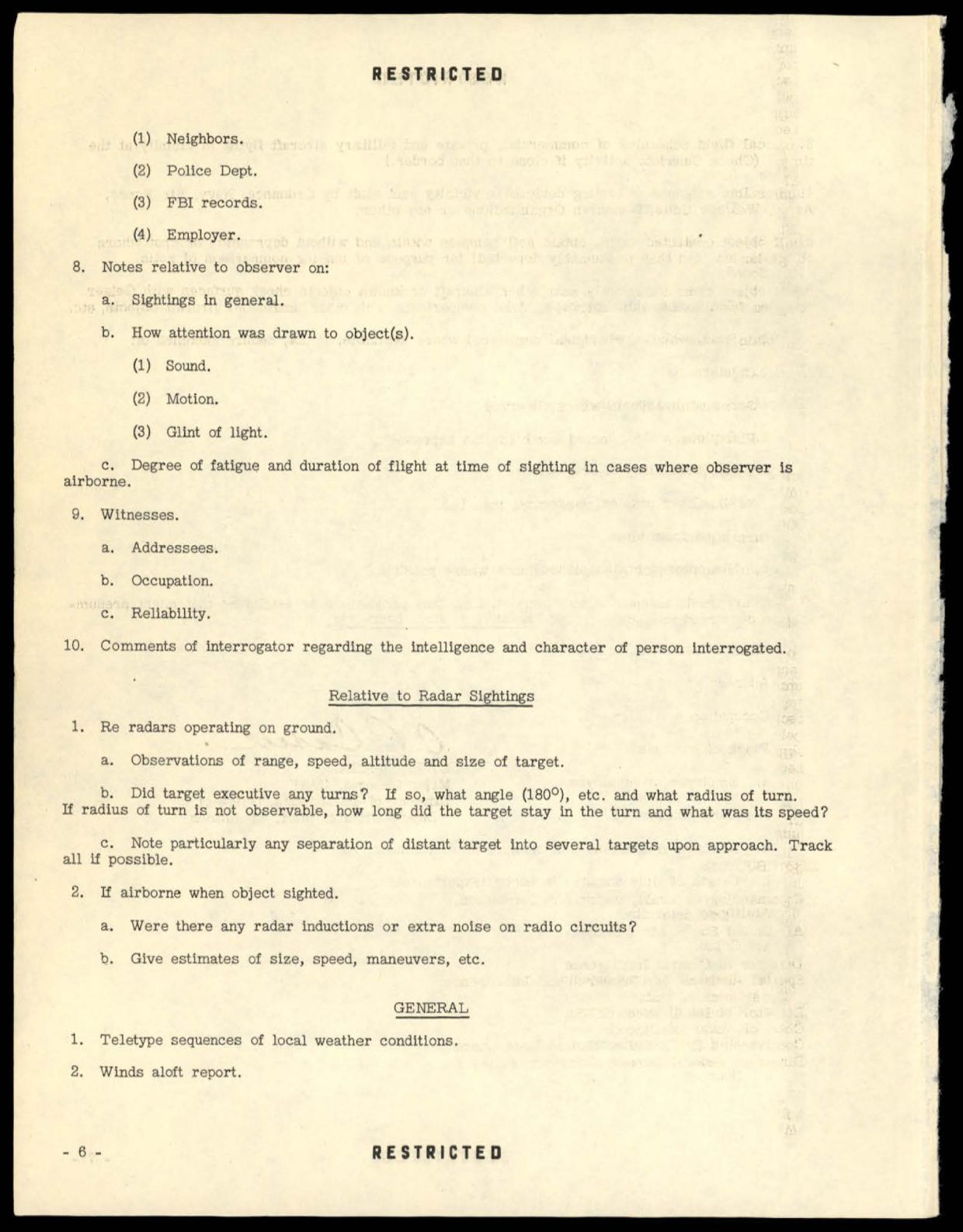
RESTRICTED
(1) Neighbors.
(2) Police Dept.
(3) FBI records.
(4) Employer.
8. Notes relative to observer on:
a . Sightings in general.
b.
How attention was drawn to object(s).
(1) Sound.
(2) Motion.
(3) Glint of light.
c. Degree of fatigue and duration of flight at time of slghtlng in cases where observer ls
airborne.
9. Witnesses.
a. Addressees.
b. Occupation.
c. Rellablllty.
10. Comments of interrogator regarding the intelllgence and character of person interrogated.
Relative to Radar Sightings
1. Re radars operating on ground.
a. Observations of range, speed, altitude and size of target.
b.
Did target executive any tw-ns? If so, what angle (180°), etc. and what radius of turn.
If radius of turn ls not observable, how long did the target stay in the turn and what was its speed?
c.
Note particularly any separation of distant target into several targets upon approach. Track
all if possible.
2. If airborne when object sighted.
a. Were there any radar inductions or extra noise on radio circuits?
b. Give estimates of size, speed, maneuvers, etc.
GENERAL
1. Teletype sequences of local weather conditions.
2. Winds aloft report.
- 6 -
RESTRICTED
PAGE 64 / 137
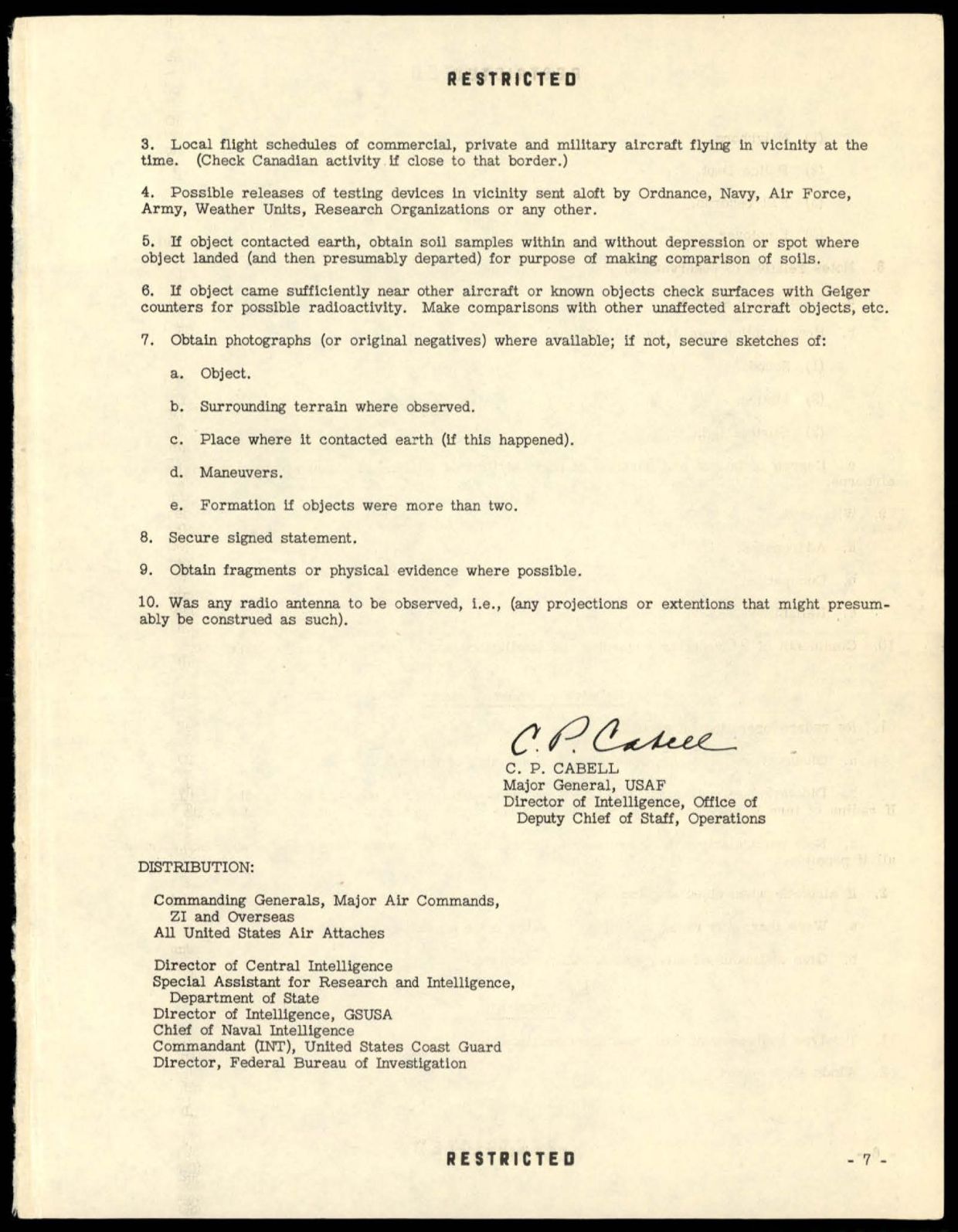
RESTRICTED 3. Local filght schedules of commercial, private and mmtary aircraft flylng In vicinity at the time. (Check Canadian activity If close to that border.) 4. Possible releases of testing devices In vicinity sent aloft by Ordnance, Navy, Air Force, Army, Weather Units, Research Organizations or any other. 5. If object contacted earth, obtain soil samples within and without depression or spot where object landed (and then presumably departed) for purpose of making comparison of soils. 6. 11 object ca.me sufficiently near other aircraft or known objects check surfaces with Gelger cowiters for possible radioactivity. Make comparisons with other unaffected aircraft objects, etc. 7. Obtain photographs (or original negatives) where available; 1f not, secure sketches of: a. Object. b. Surrounding terrain where observed. c. Place where lt contacted earth (lf this happened). d. Maneuvers. e. Formation Ii objects were more than two. 8. Secure signed statement. 9. Obtain fragments or physical evidence where possible . 10. Was any radio antenna to be observed, Le., (any projections or extentlons that might presum ably be construed as such). C. P. CABELL Major General, USAF Director of Intelllgence, Office of Deputy Chief of Staff, Operations DISTRIBUTION: Commanding Gener als, Major Air Commands, ZI and Overseas All United States Air Attaches Dir ector of Central Intelligence Special Assistant for Research and IntelUgence, Department of State Director of Intell1gence, GSUSA Chief of Naval Intelllgence Commandant (INT), United States Coast Guard DI.rector, Federal Bureau of Investigation RESTRIC TED - 7 -
PAGE 65 / 137
RESTRICTED
RESTRICTED
PAGE 66 / 137
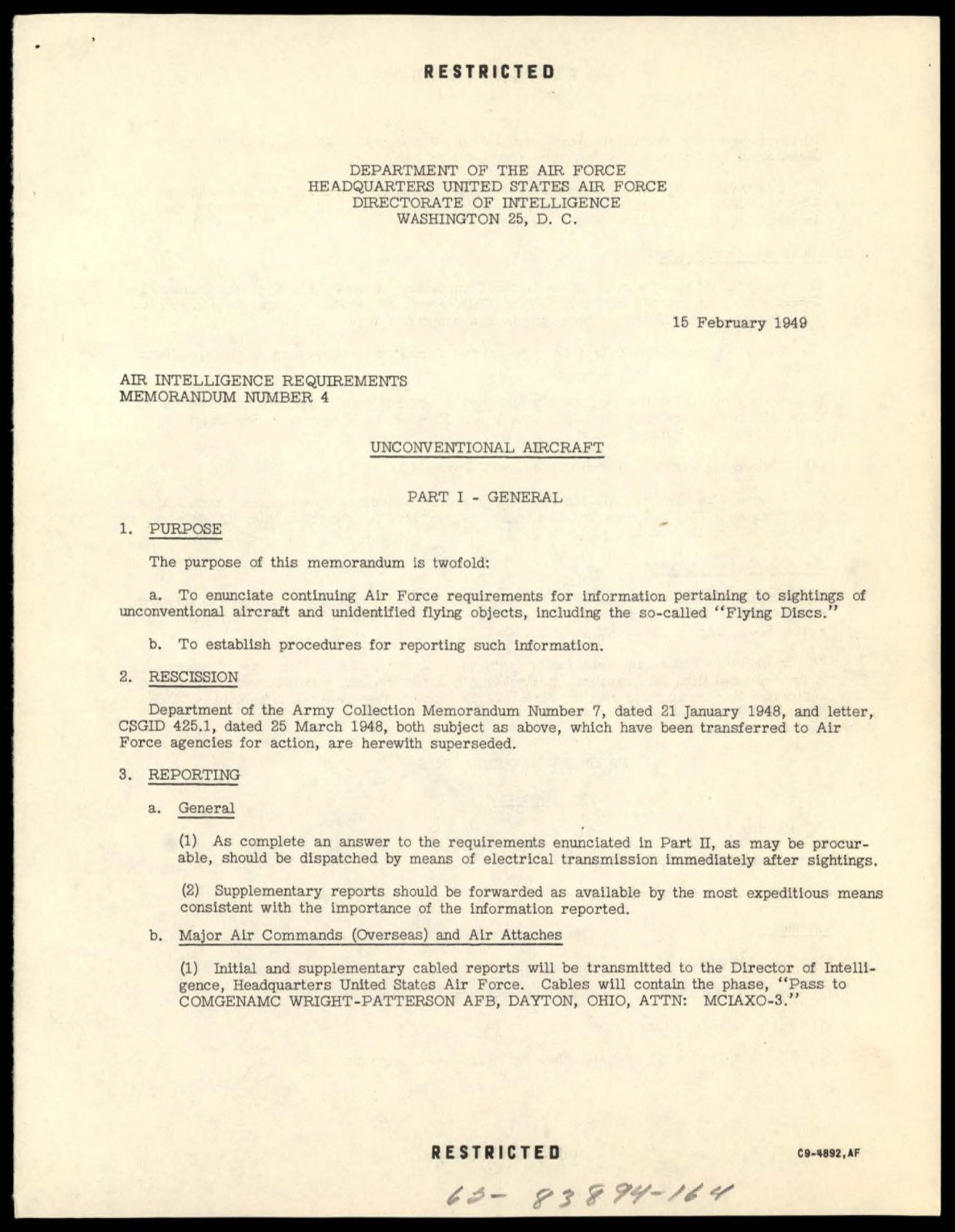
RESTRICTED DEPARTMENT OF THE AIR FORCE HEADQUARTERS UNITED STATES AIR FORCE DIRECTORATE OF INI'ELLIGENCE WASHINGTON 25, D. C. 15 February 1949 AIR INTELLIGENCE REQUIREMENTS MEMORANDUM NUMBER 4 UNCONVENTIONAL AIRCRAFT PART I - GENERAL 1. PURPOSE The purpose of this memorandum Is twofold: a. To enunciate continuing Air Force requirements for information pertaining to sightings of unconventional aircraft and unidentlfied flying objects, including the so-called "Flying Discs." b. To establish procedures for reporting such information. 2. RESCISSION Department of the Army Collection Memorandum Nwnber 7, dated 21 January 1948, and letter, CSGID 425.1, dated 25 March HM8, both subject as above, which have been transferred to Air Force agencies for action, are herewith superseded. 3. REPORTING a. General (1) As complete an answer to the requirements enunciated in Part II, as may be procur able, should be dispatched by means of electrical transmission immediately after sightings. (2) Supplementary reports should be forwarded as available by the most expeditious means consistent with the importance of the information reported. b. Major Air Commands (Overseas) and Air Attaches (1) Initial and supplementary cabled reports will be transmitted to the Director of Intelll gence, Headquarters United States Air Force. Cables wm contain the phase, " Pass to COMGENAMC WRIGHT-PATTERSON AFB, DAYTON, OHIO, ATTN: MCIAX0-3." RESTRICTED Cll-11892, AF
PAGE 67 / 137
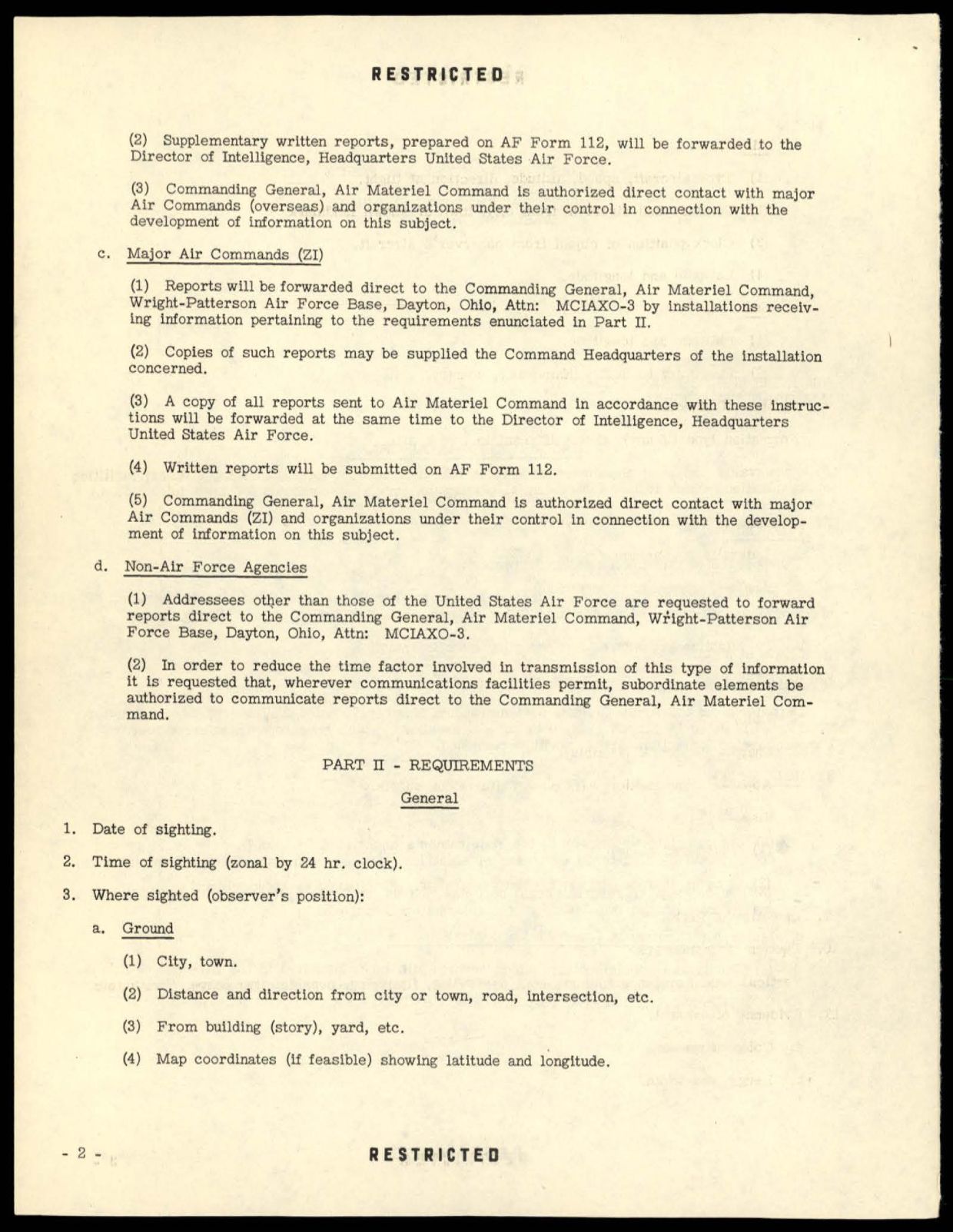
RESTRICTED (2) Supplementary wr1tten reports, prepared on AF Form 112, will be forwarded to the Director of Intelligence, Headquarters United States Air Force. (3) Commanding General, Air Materiel Command is authorized direct contact with major Air Commands (overseas) and organizations under their control in connection with the development of information on this s ubject. c. Major Air Commands (ZI) (1) Reports wlll be forwarded direct to the Commanding General, Air Materiel Command, Wright-Patterson Air Force Base, Dayton, Ohio, Attn: MCIAXO-3 by installations r eceiv ing information pertaining to the requirements enunciated in Part II. (2) Copies of such reports may be supplied the Command Headquarters of the installation concerned. (3) A copy of all reports sent to Air Materiel Command in accordance with these instruc tions wlll be forwarded at the same time to the Director of Intelligence, Headquarters United States Air Force. (4) Written reports will be submitted on AF Form 112. (5) Commanding General, Air Materiel Command 1s authorized direct contact with major Air Commands (ZI) and organizations under their control in connection with the develop ment of information on this subject. d. Non-Air Force Agencies (1) Addressees ot~er than those of the United States Air Force are r equested to forward reports direct to the Commanding General, Air Materiel Command, Wright-Patterson Air Force Base, Dayton, Ohio, Attn: MCIAXO-3. (2) In order to reduce the time factor involved in transmission of this type of information it is requested that, wher ever communications fac111ties permit, subordinate elements be authorized to communicate reports direct to the Commanding General, Air Materiel Com mand. PART II - REQUIREMENTS General 1. Date of sighting. 2. Time of sighting (zonal by 24 hr. clock). 3. Where sighted (observer's position): a. Ground (1) City, town. (2) Distance and direction from city or town, r oad, intersection, etc. (3) From building (story), yard, etc. (4) Map coordinates (if feasible) showing latitude and longitude. - 2 - RESTRICTED
PAGE 68 / 137
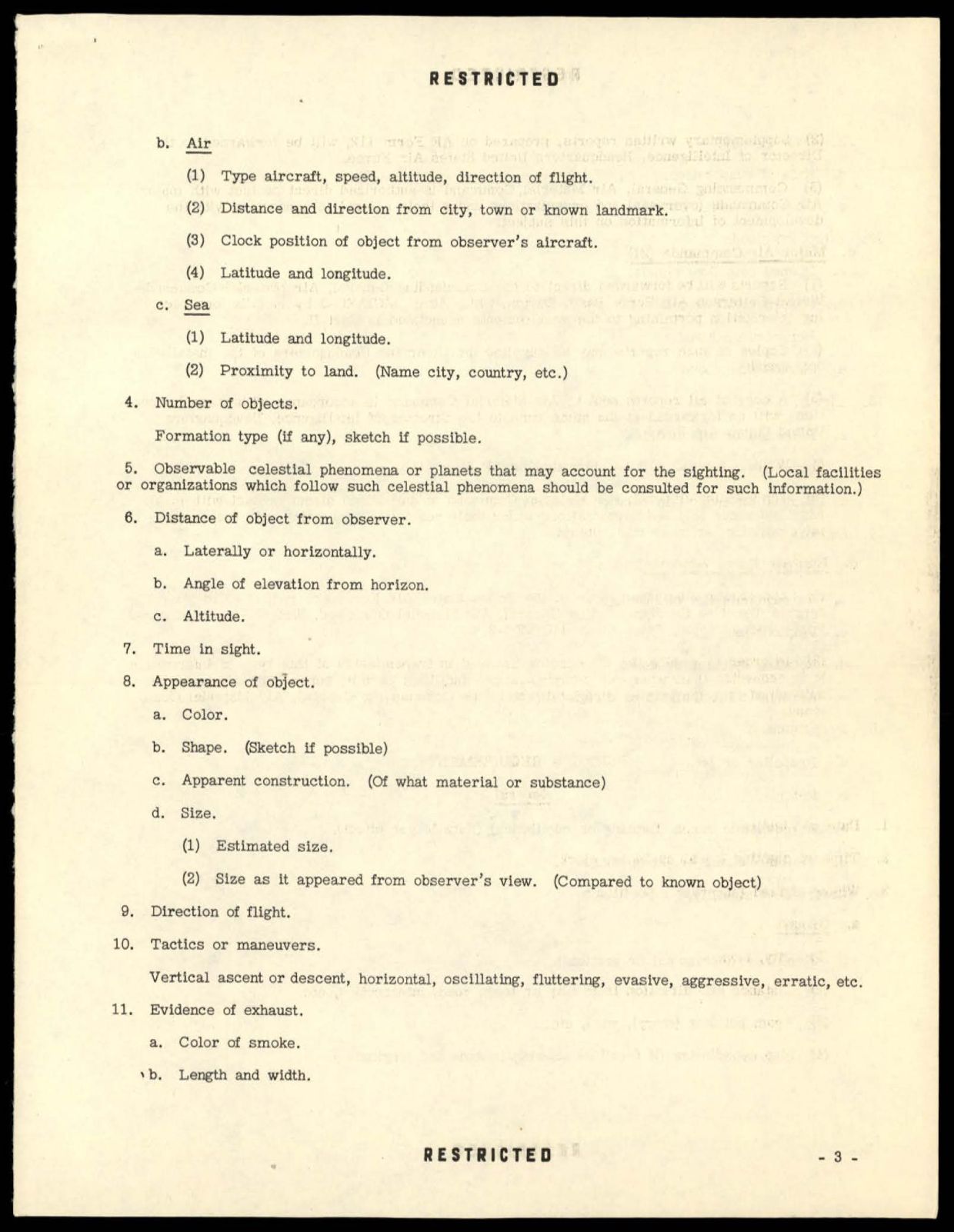
RESTRICTED b. Air (1) Type aircraft, speed, altltude, direction of flight. (2) Distance and direction from city, town or known landmark. (3) Clock position of object from observer's aircraft. (4) Latitude and longitude. c. Sea (1) Latitude and longitude. (2) Proximity to land. (Name city, country, etc.) 4. Number of objects. Formation type (if any), sketch if possible. 6. Observable celestial phenomena or planets that may account for the sighting. (Local facillties or organizations which follow such celestial phenomena should be consulted for such information.) 6. Distance of object from observer. a. Laterally or horizontally. b. Angle of elevation from horizon. C. Altitude. 7. Time in sight. 8. Appearance of object. a. Color. b. Shape. (Sketch if possible) c. Apparent construction. (Of what material or substance) d. Size. (1) Estimated size. (2) Size as it appeared from observer's view. (Compared to known object) 9. Direction of flight. 10. Tactics or maneuvers. Vertical ascent or descent, horizontal, oscillating, fluttering, evasive, aggressive, erratic, etc. 11. Evidence of exhaust. a. Color of smoke. , b. Length and width. RESTRICTED - 3 •
PAGE 69 / 137
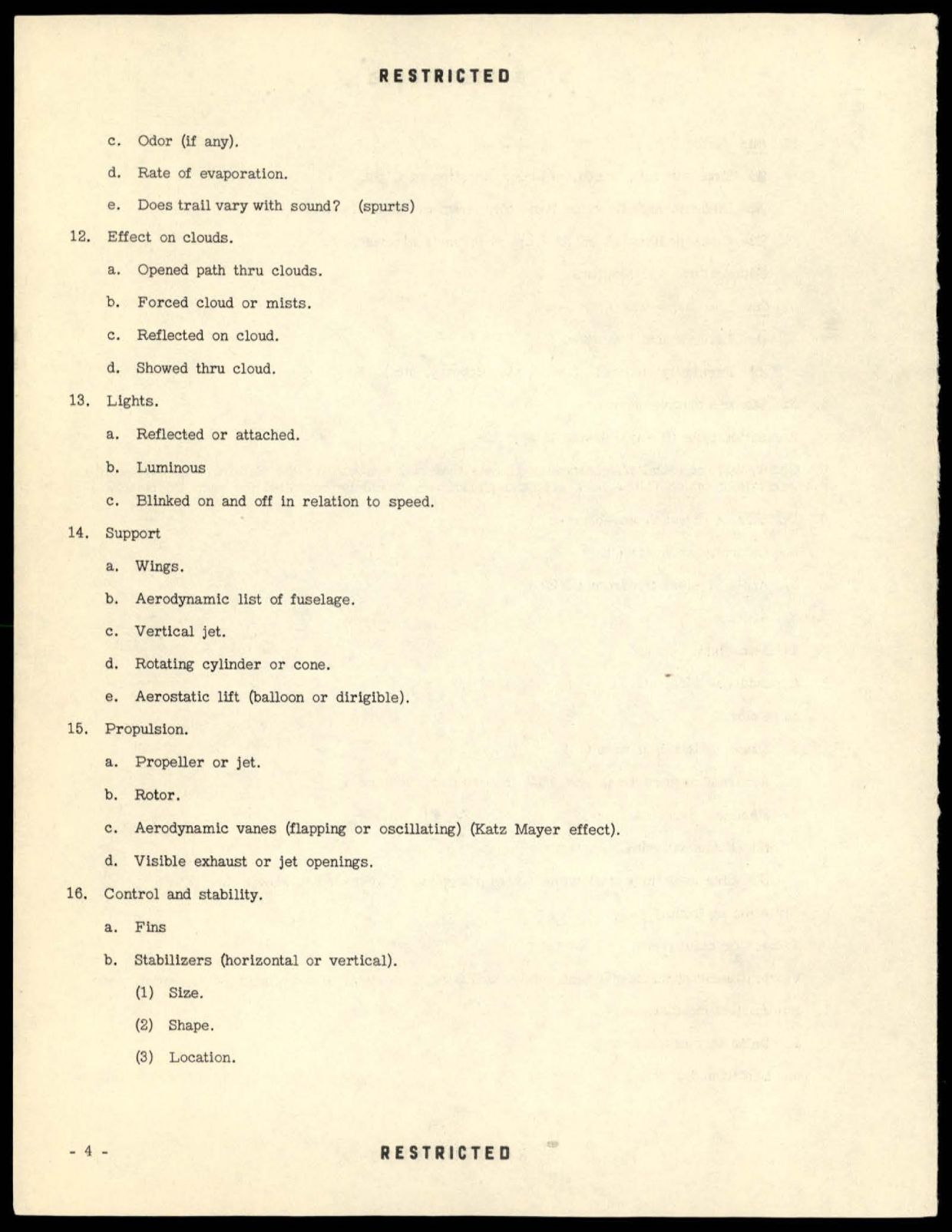
RESTRICTED
C. Odor (if any).
d. Rate of evaporation.
e. Does trail va:ry with sound?
(spurts)
12. Effect on clouds.
a. Opened path thru clouds.
b.
Forced cloud or mists.
c. Reflected on cloud.
d. Showed thru cloud.
13. Lights.
a.
Reflected or attached.
b. Luminous
c. Blinked on and off ln relation to speed.
14. Support
a. Wings.
b. Aerodynamic list of fuselage.
c. Vertical jet,
d. Rotating cylinder or cone.
e. Aerostatic lift (balloon or dirigible).
15. Propulsion.
a. Propeller or jet.
b. Rotor.
c. Aerodynamic vanes (flapping or oscillating) (Katz Mayer effect).
d. Visible exhaust or Jet openings.
16. Control and stability.
a . Fins
b. Stabillzers (horizontal or vertical).
(1) Size.
(2) Shape.
(3) Location.
- 4 -
RESTRICTED
PAGE 70 / 137
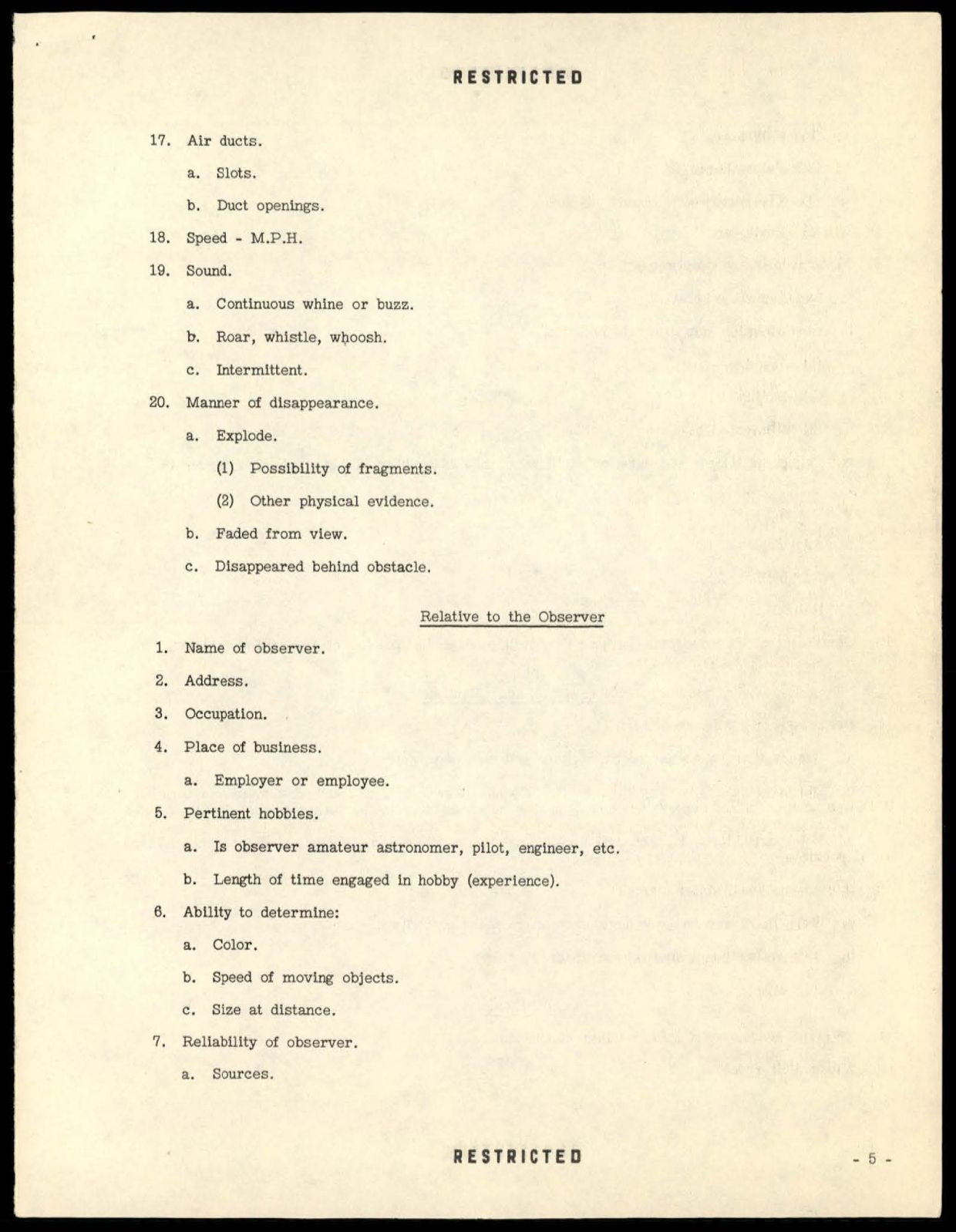
RESTRICTED
17. Air ducts.
a. Slots.
b. Duct openings.
18. Speed - M.P.H.
19. Sound.
a. Continuous whine or buzz.
b. Roar, whistle, wl;loosh.
c. Intermittent.
20. Manner of disappearance.
a. Explode.
(1)
Possibility of fragments.
(2)
Other physical evidence.
b. Faded from view.
c. Disappeared behind obstacle.
Relative to the Observer
1. Name of observer.
2. Address.
3, Occupatlon.
4. Place of business.
a. Employer or employee.
5. Pertinent hobbies.
a. Is observer amateur astronomer, pl.lot, engineer , etc.
b. Length of time engaged in hobby (experience).
6. Ability to determine:
a. Color.
b. Speed of moving objects.
c. Size at distance.
7. Reliabi11ty of observer.
a. Sources.
RESTRIC TED
- 5 -
PAGE 71 / 137
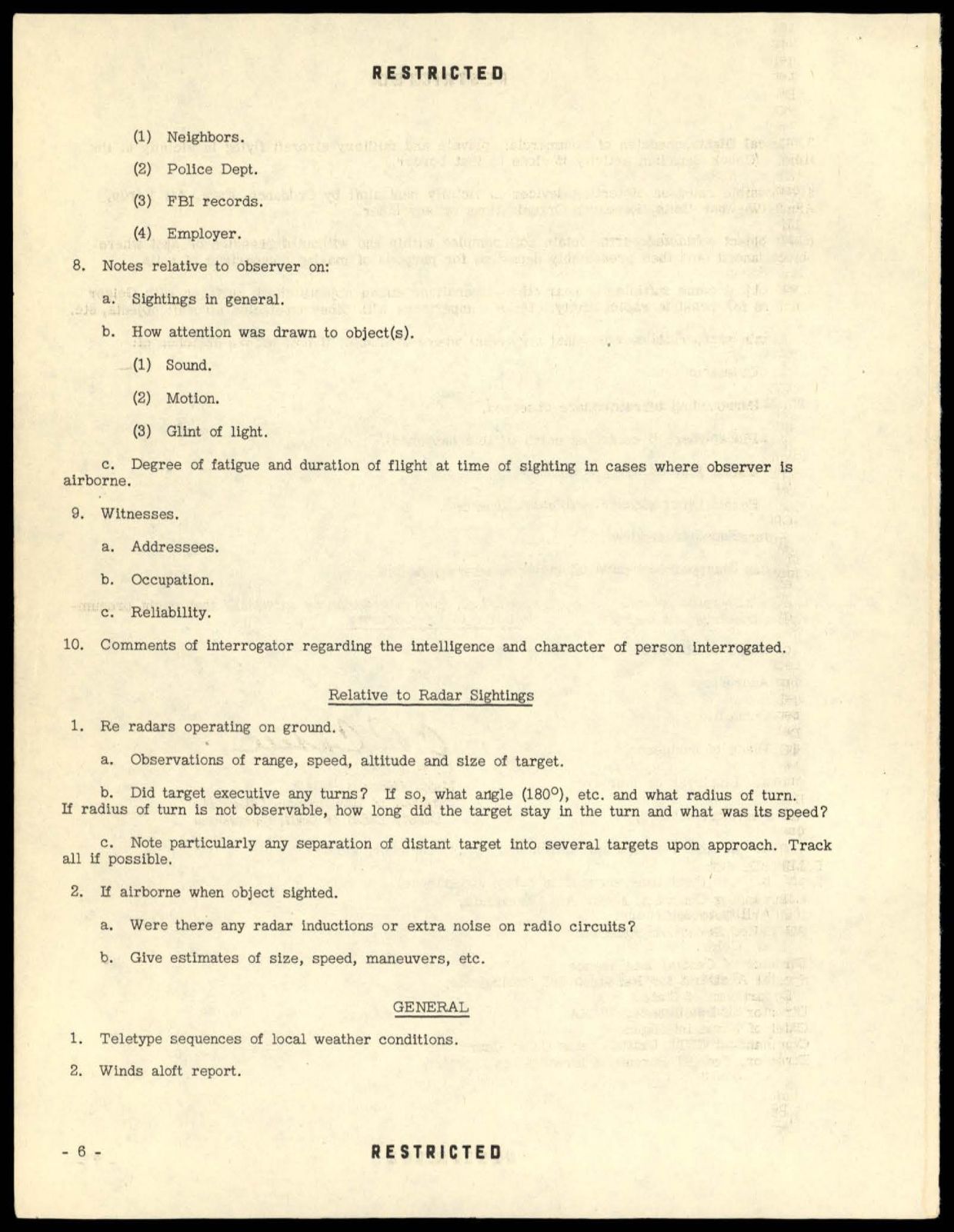
RESTRICTED
(1) Neighbors.
(2) Police Dept.
(3) FBI records.
(4) Employer.
8. Notes relative to observer on:
a. Sightings in general.
b. How attention was drawn to object(s).
(1) Sound.
(2) Motion.
(3) Glint of light.
c. Degree of fatigue and duration of flight at time of sighting in cases where observer ls
airborne.
9. Witnesses.
a. Addressees.
b. Occupation.
C.
Reliablllty.
10. Comments of interrogator regarding the lntelllgence and character of person interrogated.
Relative to Radar Sightings
1. Re radars operating on ground.
a. Observations of range, speed, altitude and size of target.
b. Did target executive any turns? If so, what angle (180°), etc. and what radius of turn.
If radius of turn is not observable, how long did the target stay in the turn and what was its speed?
c. Note particularly any separation of distant target into several targets upon approach. Tr ack
all if possible.
2. I! airborne when object sighted.
a. Were there any radar inductions or extra noise on radlo circuits?
b. Give estimates of size, speed, maneuvers, etc.
GENERAL
1. Teletype sequences of local weather conditions.
2. Winds aloft report.
- 6 -
RESTRICTED
PAGE 72 / 137
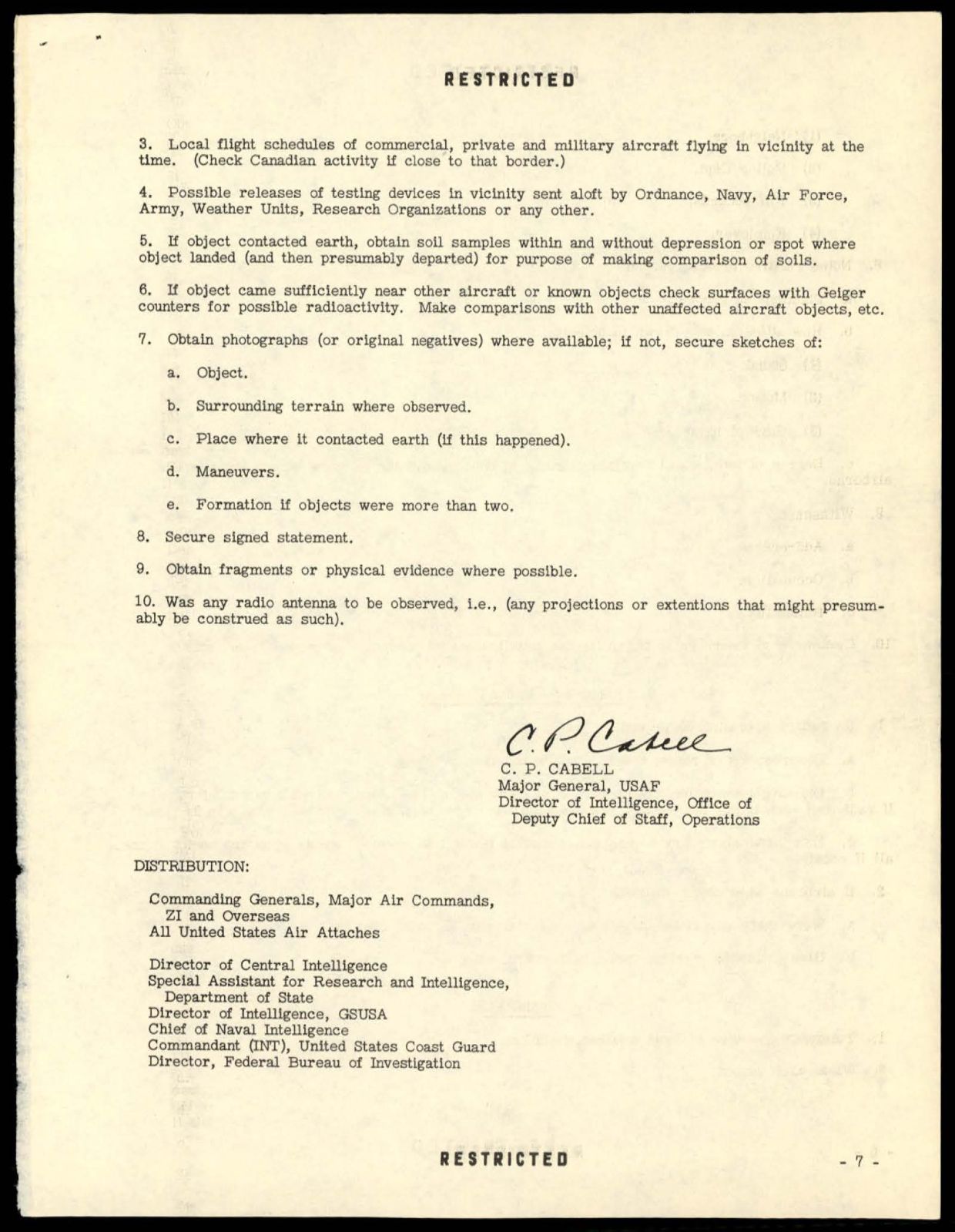
RESTRICTED 3. Local fl1ght schedules of commercial, private and military aircraft flying ln vicfnity at the time. (Check Canadian activity 1f close to that border.) 4. Possible releases of testing devices 1n vicinity sent aloft by Ordnance, Navy, Air Force, Army, Weather Units, Research Organizations or any other. 5. Ii object contacted earth, obtain soil samples within and without depr ession or spot where object landed (and then presumably departed) for purpose of making comparison of soils. 6. If object came sufficiently near other aircraft or known objects check surfaces with Geiger counters for possible radioactivity. Make comparisons with other unaffected aircraft objects, etc. ? . Obtain photographs (or original negatives) where available; 1f not, secure sketches of: a. Object. b. Surrounding terrain where observed. c. Place where it contacted earth (if this happened). d. Maneuvers. e. Formation 1f objects were more than two. 8. Secure signed statement. 9. Obtain fragments or physical evidence where possible. 10. Was any r adio antenna to be observed, i.e ., (any projections or extentions that might presum ably be construed as such). C. P . CABELL Major General, USAF Director of Intel11gence, Office of Deputy Chief of Staff, Operations DISTRlBUTION: Commanding Generals, Major Air Commands, ZI and Overseas All United States Air Attaches Director of Central Intelligence Special Assistant for Research and Intelllgence, Department of State Director of Intelligence, GSUSA Chief of Naval Intelligence Commandant (INT), United States Coast Guard Director, Federal Bureau of Investigation RESTRICTED - ? -
PAGE 73 / 137
RESTRICTED
RESTRICTED
PAGE 74 / 137
RESTRICTED DEPARTMENT OF THE AIR FORCE HEADQUARTERS UNITED STATES AIR FORCE DmECTORATE OF INTELLIGENCE WASHINGTON 25, D. C. 15 February 1949 AIR INTELLIGENCE REQUIREMENTS MEMORANDUM NUMBER 4 UNCONVENTIONAL AIRCRAFT PART I - GENERAL 1. PURPOSE The purpose of this memorandum is twofold: a. To enunciate continuing Air Force requirements for informatlon pertaining to sightings of unconventional aircraft and unldentifi.ed flying objects, including the so-called "Flying Discs.,, b. To establish procedures for reporting such information. 2. RESCISSION Department of the Army Collection Memorandum Number 7, dated 21 January 1948, and letter, CSGID 425.1, dated 25 March 1948, both subject as above, which have been transferred to Air Force agencies for action, are herewith super seded. 3. REPORTING a. General (1) As compl ete an answer to the requirements enunciated in Part Il, as may be procur able, should be dispatched by means of electrical transmission immediately after sightings, (2) Supplementary r eports should be forwarded as available by the most expeditlous means consistent with the importance of the information r eported. b. Major Air Commands (Over seas) and Air Attaches (1) Initial and supplementary cabled r eports will be transmitted to the Director of Intelli gence, Headquarters United States Air Force. Cables wlll contain the phase, " Pass to COMGENAMC WRIGHT-PATTERSON AFB, DAYTON, OHIO, ATTN: MCIAX0-3.'' RESTRICTED ce-,as2,AF ha ff 1K 9~-/t''/ r
PAGE 75 / 137
RESTRICTED (2) Supplementary written r eports, prepared on AF Form 112, wm be forwarded to the Director of IntelHgence, Headquarters United States Air Force. (3) Commanding General, Alr Materiel Command ls authorized direct contact with major Air Commands (overseas) and organizations under their control in connection with the development of information on this subject. c. Major Air Commands (ZI) (1) Reports will be forwarded direct to the Commanding General, Air Materiel Command, Wright-Patterson Alr Force Base, Dayton, Ohio, Attn: MCIAXO-3 by installations receiv ing information pertaining to the requirements enunciated in Part II. (2) Copies of such r eports may be supplied the Command Headquarters of the installation concerned. (3) A copy of all reports sent to Air Materiel Command in accordance with these instruc tions will be forwarded at the same time to the Director of Intelligence, Headquarters United States Air Force. (4) Written reports will be submitted on AF Form 112. (5) Commanding General, Air Materiel Command is authorized direct contact with major Air Commands (ZI) and organizations under their control in connection with the develop ment of information on this subject. d. Non-Air Force Agencies (1) Addressees otter than those of the United States Air Force are r equested to forward reports direct to the Commanding General, Air Materiel Command, Wright-Patterson Air Force Base, Dayton, Ohio, Attn: MCIAXO-3. (2) In order to reduce the time factor involved in transmission of this type of information it is requested that, wherever communications facilltles permit, subordinate elements be authorized to communicate reports direct to the Commanding General, Alr Materiel Com mand. PART II - REQUIREMENTS General 1. Date of sighting. 2. Time of slghtl.ng (zonal by 24 hr. clock). 3. Where sighted (observer's position): a. Ground (1) City, town. (2) Distance and direction from city or town, road, intersection, etc. (3) From building (story), yard, etc. (4) Map coordinates (if feasible) showing latitude and longitude. - 2 - RESTRICTE D
PAGE 76 / 137
RESTRICTED
b. Air
(1)
Type aircraft, speed, altitude, direction of fUght.
(2) Distance and direction from city, town or known landmark.
(3)
Clock position of object from observer's aircraft.
(4) Latitude and longitude.
c. Sea
(1) Latitude and longitude.
(2) Proximity to land.
(Name city, country, etc.)
4.
Number of objects.
Formation type (If any), sketch if possible.
5. Observable celestial phenomena or planets that may account for the sighting.
(Local facilltles
or organizations which follow such celestial phenomena should be consulted for such information.)
6. Distance of object from observer.
a. Laterally or horizontally.
b.
Angle of elevation from horizon.
c. Altitude.
7.
Time in sight.
8.
Appearance of object.
a. Color.
b. Shape.
(Sketch if possible)
c. Apparent constructlon.
(Of what material or substance)
d. Size.
(1)
Estimated size.
(2) Size as it appeared from observer's view.
(Compared to known object)
9. Direction of flight.
10. Tactics or maneuvers.
Vertical ascent or descent, horizontal, oscillating, fluttering, evasive, aggressive, erratlc, etc.
11. Evidence of exhaust.
a. Color of smoke.
, b.
Length and width.
RESTRICTED
- 3 -
PAGE 77 / 137
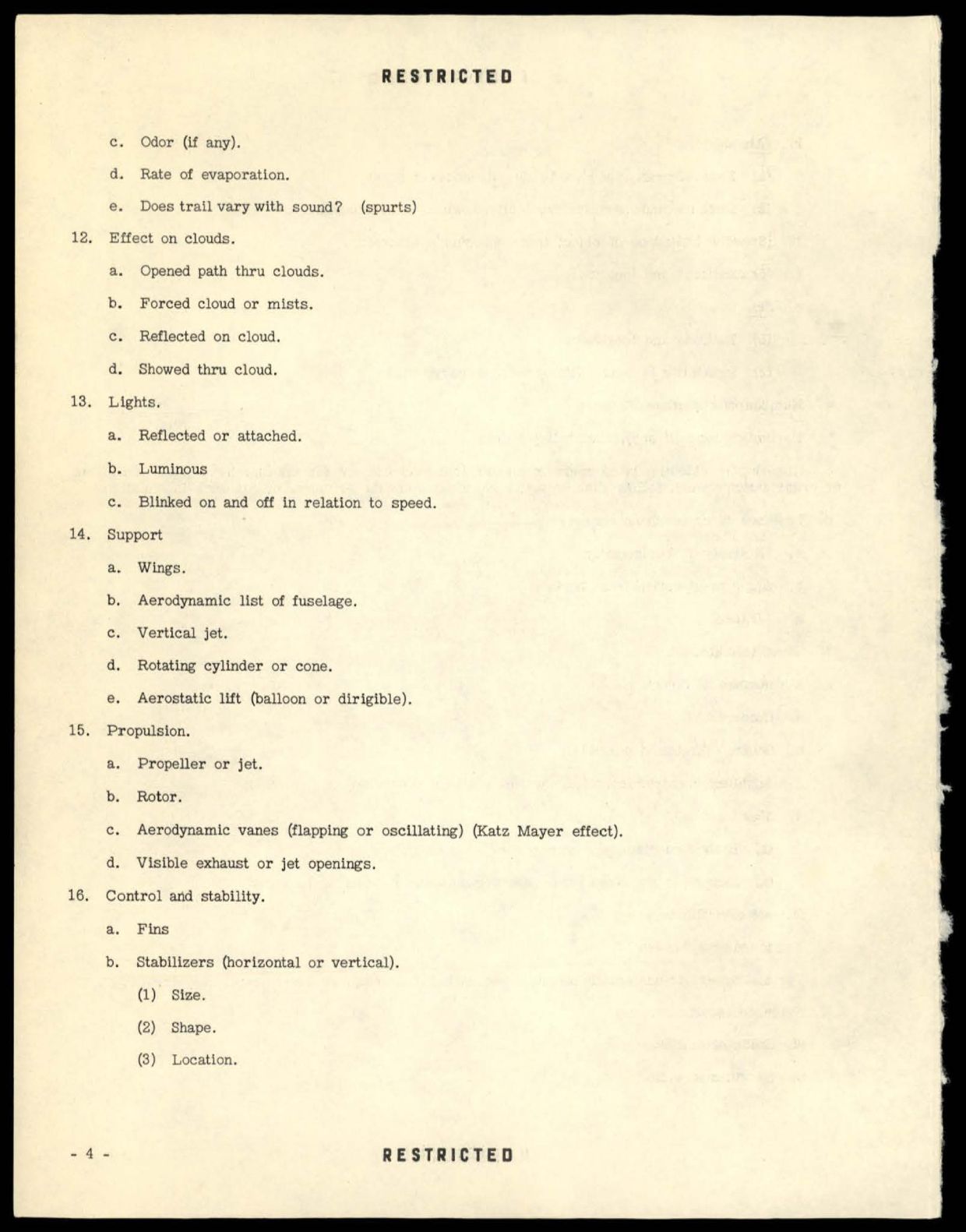
RESTRICTED
c. Odor (if any).
d. Rate of evaporatlon.
e.
Does trail vary with sound?
(spurts)
12. Effect on clouds.
a.
Opened path thru clouds.
b.
Forced cloud or mists.
c.
Reflected on cloud.
d. Showed thru cloud.
13. Lights.
a.
Reflected or attached.
b.
Luminous
c. Blinked on and off in relation to speed.
14. Support
a. Wings .
b.
Aerodynamic list of fuselage.
c. Vertical jet.
d.
Rotating cylinder or cone.
e.
Aerostatic lift (balloon or dirigible).
15. Propulsion.
a.
Propeller or jet .
b. Rotor .
c. Aerodynamic vanes (-flapping or oscl.llating} (Katz Mayer effect).
d. Visible exhaust or jet openings.
16. Control and stability.
a. Fins
b. Stabilizers (hor izontal or vertical).
(1) Size.
(2) Shape.
(3)
Location.
- 4 -
RESTRICTED
PAGE 78 / 137
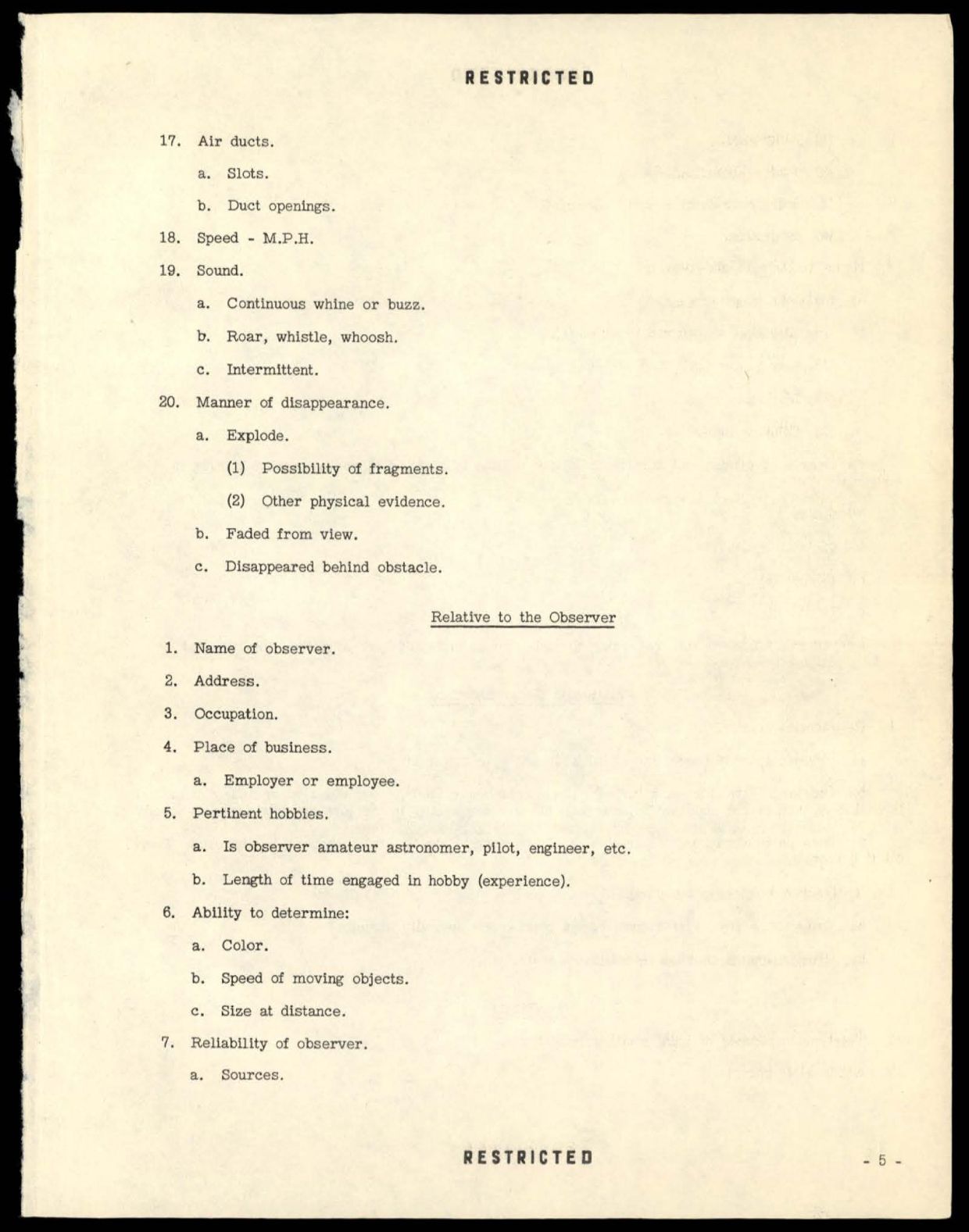
RESTRICTED
17. Air ducts.
a. Slots.
b. Duct openings.
18. Speed - M.P .H.
19. Sound.
a. Continuous whine or buzz.
b. Roar, whistle, whoosh.
C.
Intermittent.
20. Manner of disappearance.
a.
Explode.
(1)
Possibility of fragments.
(2)
Other physical evidence.
b. Faded from view.
c. Disappeared behind obstacle.
Relative to the Observer
1. Name of observer.
2. Address.
3, Occupation.
4. Place of business.
a. Employer or employee.
5.
Pertinent hobbies.
a. Is observer amateur astronomer, pilot, engineer, etc.
b. Length of time engaged in hobby (experience).
6. Ab111ty to determine:
a. Color.
b. Speed of moving objects.
c. Size at distance.
7. Reliabillty of observer.
a. Sources.
RESTRICTED
- 5 -
PAGE 79 / 137
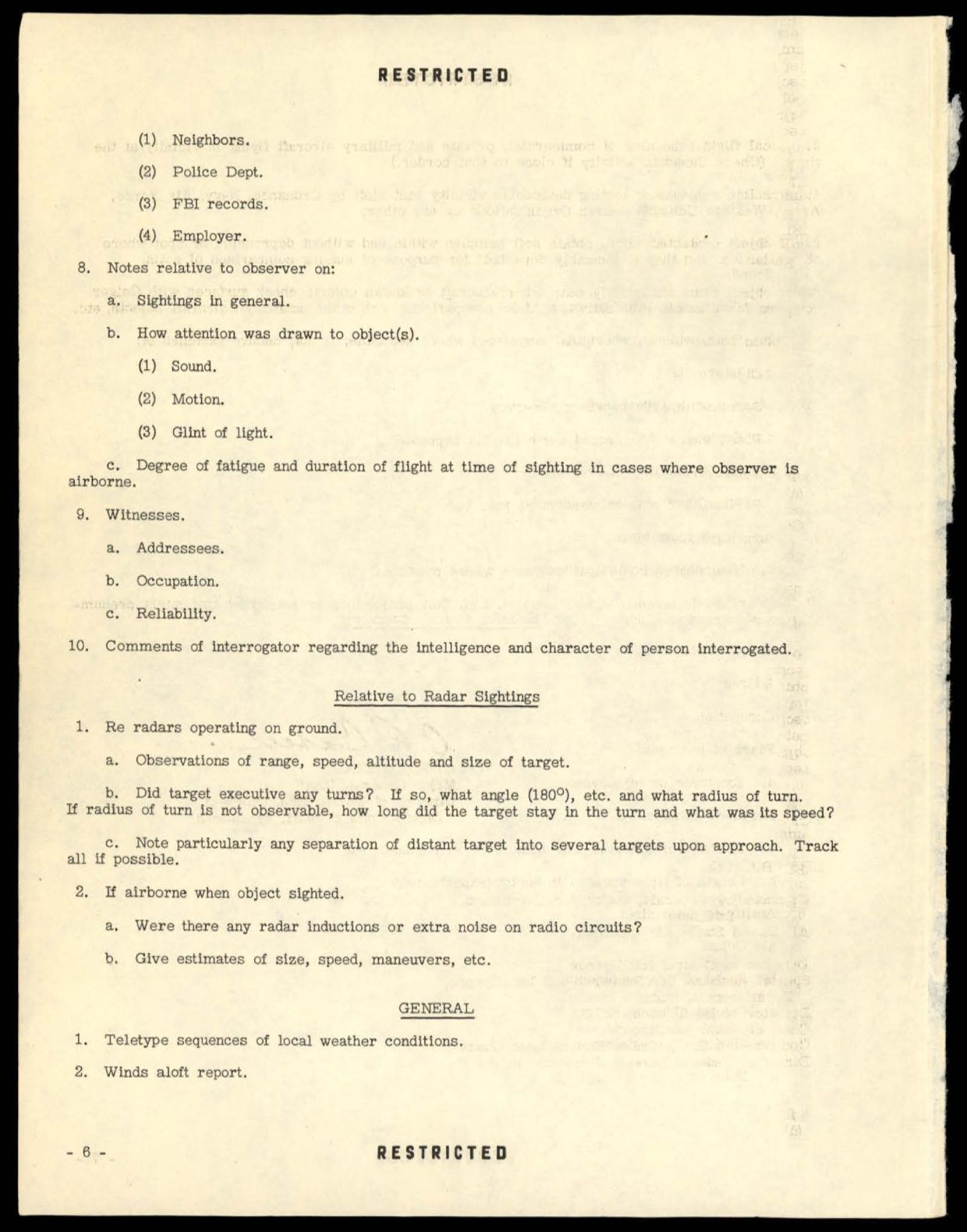
RESTRICTED
(1)
Neighbors.
(2)
Pollce Dept.
(3) FBI records.
(4) Employer.
8. Notes relative to observer on;
a. Sightings In general.
b. How attention was drawn to object(s).
(1) Sound,
(2) Motion.
(3) Glint of Ught.
c. Degree of fatigue and duration of flight at time of sighting in cases where observer ls
airborne.
9. Witnesses.
a. Addressees.
b.
Occupation.
c. Reliablllty.
10. Comments of Interrogator regarding the l.ntell1gence and character of person Interrogated.
Relative to Radar Sightings
1. Re radars operating on ground.
a. Observations of range, speed, altitude and size of target.
b.
Did target executive any turns? If so, what angle (180°), etc. and what radius of turn.
If radius of turn is not observable, how long did the target stay in the turn and what was I.ts speed?
c, Note particularly any separation of distant target into several targets upon approach. Tr ack
all l.f possible.
2.
If airborne when object sighted.
a. Were there any radar inductions or extra noise on radio circuits?
b. Give estimates of slze, speed, maneuvers, etc.
GENERAL
1. Teletype sequences of local weather condtuons.
2. Winds aloft report.
- 6 -
RESTRICTED
PAGE 80 / 137
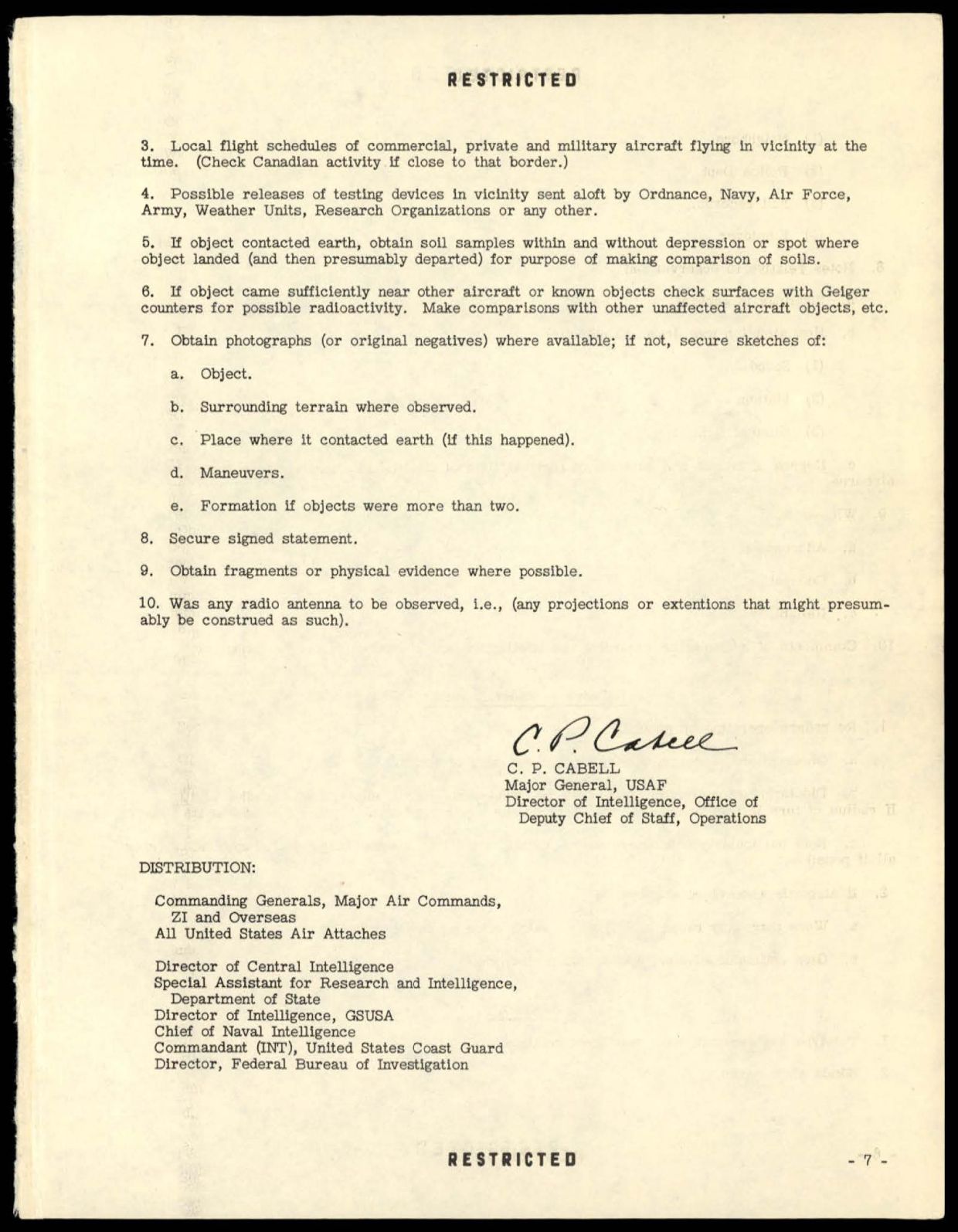
RESTRICTED
3. Local flight schedules of commercial, private and military aircra!t flying 1n vicinity at the
time.
(Check Canadian activity 1f close to that border.)
4. Possible releases of testing devices 1n vicinity sent aloft by Ordnance, Navy, Air Force,
Army, Weather Units, Research Organizations or any other.
5. If object contacted earth, obtain soil samples within and without depression or spot where
object landed (and then presumably departed) for purpose of making comparison of soils.
6.
11 object came sufficiently near other alrcra!t or known objects check surfaces with Geiger
counters for possible radioactivity. Make comparisons with other unaffected a1rcra!t objects, etc.
7. Obtain photographs (or original negatives) where available; if not, secure sketches of:
a. Object.
b. Surrounding terrain where observed.
c. Place where it contacted earth (If this happened).
d. Maneuvers.
e. Formation 1f objects were more than two.
8. Secure signed statement.
9. Obtain fragments or physical evidence wher e possible.
10. Was any radio antenna to be observed, Le., (any projections or extentl.ons that might presum
ably be construed as such).
C. P. CABELL
Major General, USAF
Director of Intelligence, Office of
Deputy Chief of Sta!f, Operations
DISTRIBUTION:
Commanding Generals, Major Air Commands,
ZI and Overseas
All United States Air Attaches
Director of Central Intelligence
Special Assistant for Research and Intelligence,
Department of State
Director of Intelllgence, GSUSA
Chief of Naval Intelligence
Commandant {INT), United States Coast Guard
Director, Federal Bureau of Investigation
RESTRICTED
- 7 -PAGE 81 / 137
RESTRICTED
RESTRICTED
PAGE 82 / 137
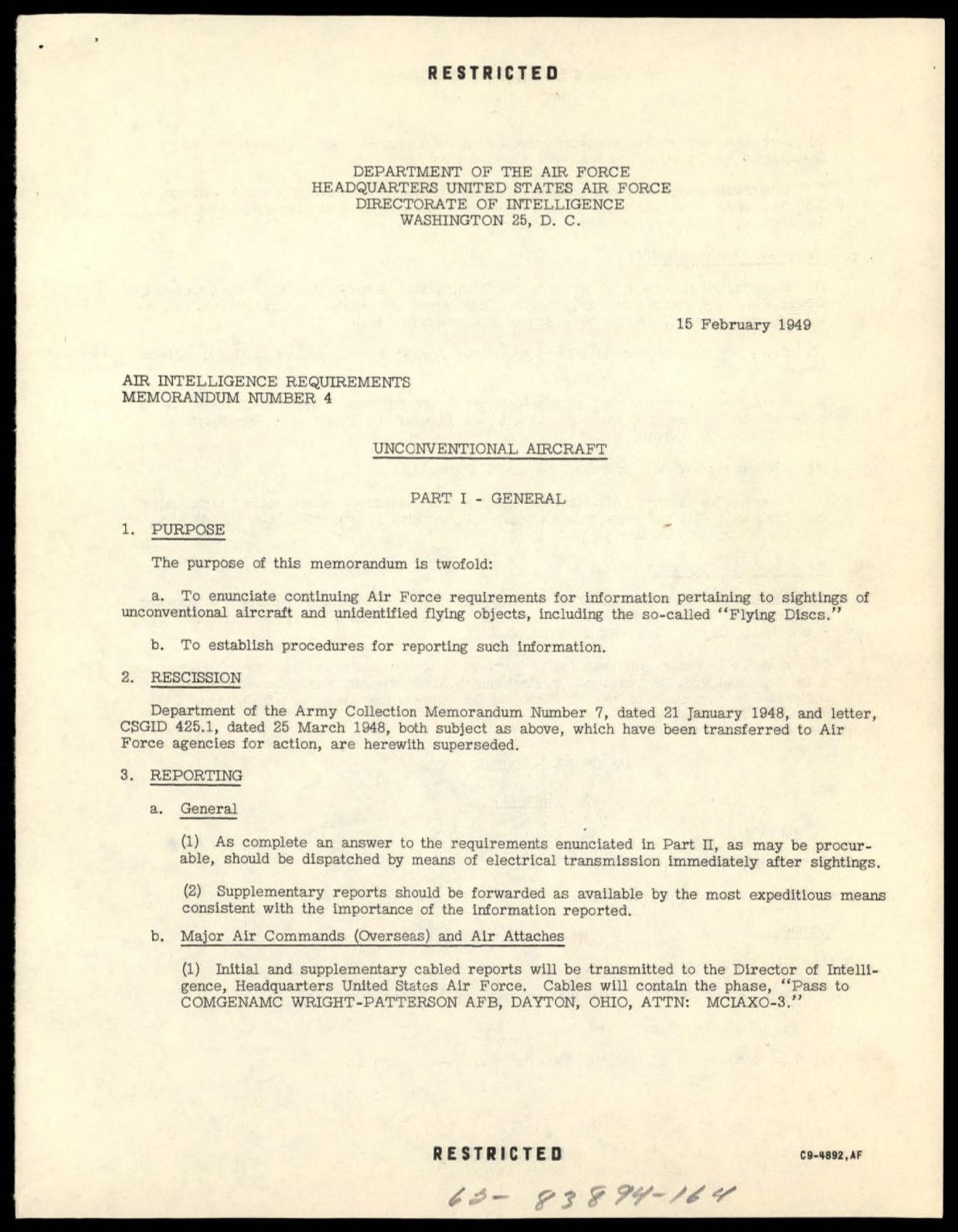
RESTRICTED DEPARTMENT OF THE AIR FORCE HEADQUARTERS UNITED STATES AIR FORCE DIRECTORATE OF INTELLIGENCE WASHINGTON 25, D. C. 15 February 1949 AIR INTELLIGENCE REQUIREMENTS MEMORANDUM NUMBER 4 UNCONVENTIONAL AIRCRAFT PART I - GENERAL 1. PURPOSE The purpose of this memorandum is twofold: a. To enunciate continuing Air Force requirements for information pertaining to sightings of unconventional aircraft and unidentified flying objects, including the so-called "Flying Discs.'' b. To establish procedures for reporting such information. 2. RESCISSION Department of the Army Collection Memorandum Number 7, dated 21 January 1948, and letter, CSGID 425.1, dated 25 March 1948, both subject as above, which have been transferred to Air Force agencles for action, are herewith superseded. 3. REPORTING a. General (1) As complete an answer to the requirements enunciated in Part n, as may be procur able, should be dispatched by means of electrical transmission immediately after sightings. (2) Supplementary reports should be for warded as available by the most expeditious means consistent with the importance of the information reported. b. Major Air Commands (overseas) and Air Attaches (1) Initial and supplementary cabled reports wm be transmitted to the Director of IntelU gence, Headquarter s United State:s Air Force. Cables wlll contain the phase, "Pass to COMGENAMC WRIGHT-PATTERSON AFB, DAYTON, OHIO, ATTN: MCIAX0-3." RESTRICTED ce- 11892, AF
PAGE 83 / 137
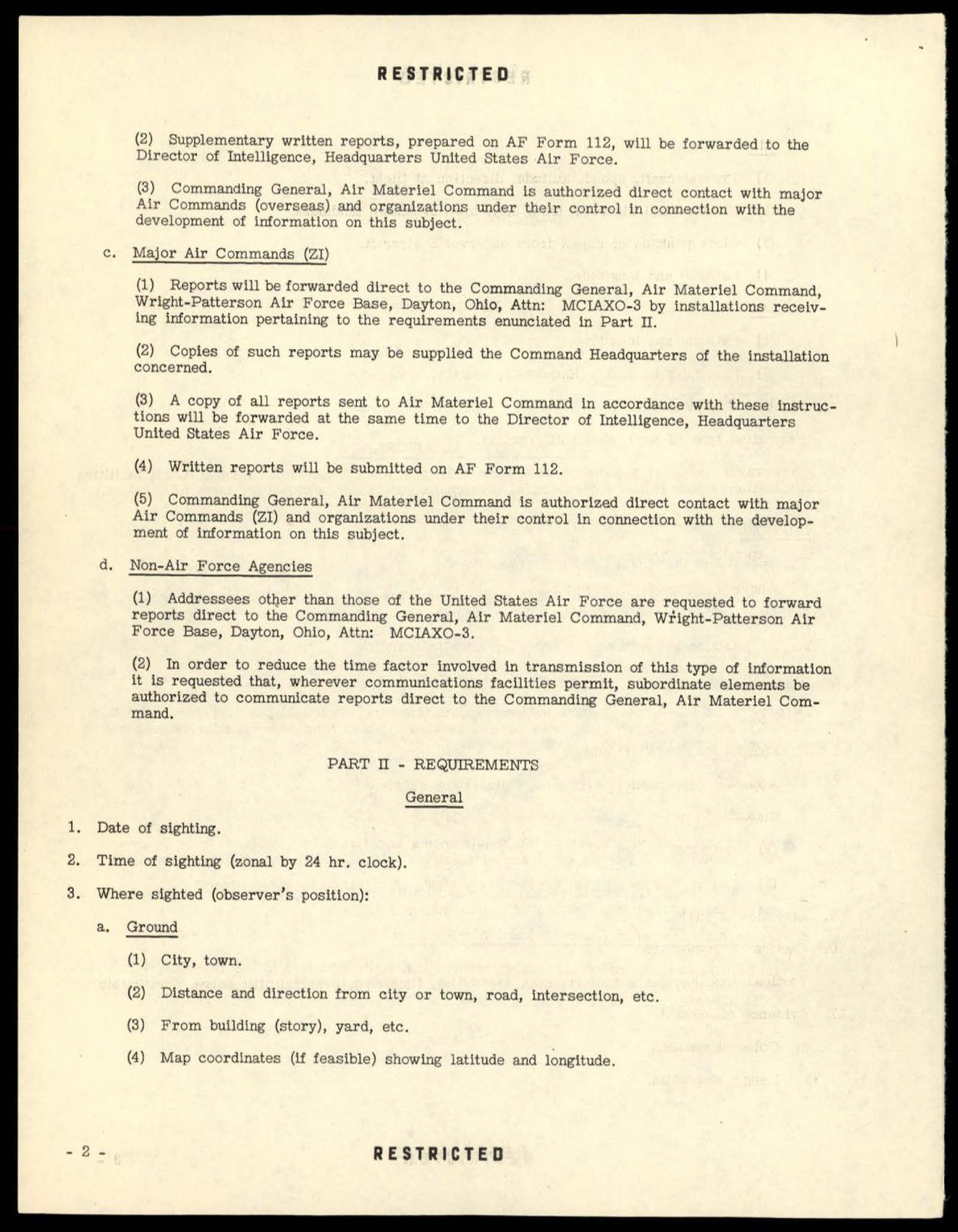
RES TRICTED (2) Supplementary written reports, prepared on AF Form 112, will be forwarded to the Director of Intelllgence, Headquarters United States Air Force. (3) Commanding General, Air Materiel Command ls authorized direct contact with major Air Commands (overseas) and organizations Wlder their control in connection with the development of information on this subject. c. Major Air Commands (ZI) (1) Reports will be forwarded direct to the Commanding General, Air Materiel Command, Wright-Patterson Air Force Base, Dayton, Ohio, Attn: MCIAX0-3 by installations r eceiv ing information pertaining to the requirements enW1ciated in Part II. (2) Copies of such reports may be supplled the Command Headquarters of the installation concerned. (3) A copy of all reports sent to Air Materiel Command in accordance with these instruc tions wlll be forwarded at the same time to the Director of Intelligence, Headquarters United States Air Force. (4) Written reports will be submitted on AF Form 112. (5) Commanding General, Air Materiel Command ls authorized direct contact with major Air Commands (ZI) and organizations W1der their control in connection with the develop ment of information on this subject. d. Non-Air Force Agencies (1) Addressees o~er than those of the United States Air Force are r equested to forward reports direct to the Commanding General, Air Materiel Command, Wright-Patterson Air Force Base, Dayton, Ohio, Attn: MCIAX0-3. (2) In order to reduce the time factor lnvolved ln transmission of this type of lnformatlon it ls r equested that, wherever communications faciUtles permit, subordinate elements be authorized to communicate reports direct to the Commanding General, Air Materiel Com mand. PART II - REQUffiEMENTS General 1. Date of sighting. 2. Time of sighting (zonal by 24 hr. clock). 3. Wher e sighted (observer 's position): a. Ground (1) City, town. (2) Distance and direction from city or town, road, intersection, etc. (3) Fr om building (story), yard, etc. (4) Map coordinates (I! feasible) showing latitude and longitude. - 2 - RESTRICTED
PAGE 84 / 137
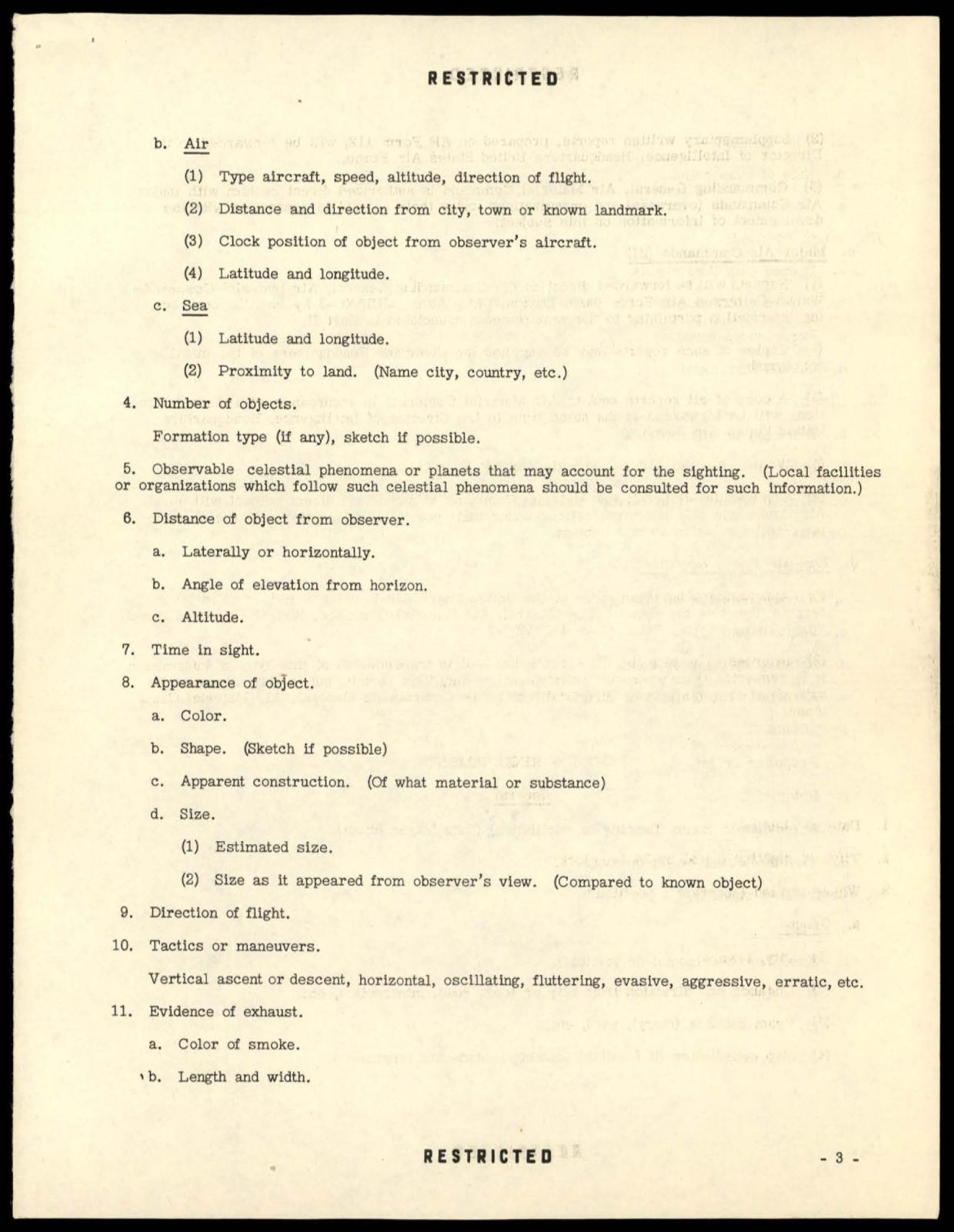
RESTRICTED
b. Air
(1) Type aircraft, speed, altitude, direction of flight.
(2) Distance and direction from city, town or known landmark.
(3)
Clock position of object from observer 's aircraft.
(4) Latitude and longitude.
c. Sea
(1) Latitude and longitude.
(2)
Proximity to land.
(Name city, country, etc.)
4.
Number of objects.
Formation type (if any), sketch if possible.
5. Observable celestial phenomena or planets that may account for the sighting.
(Local facl.llties
or organizations which follow such celestial phenomena should be consulted for such information.)
6. Distance of object from observer.
a. Laterally or horizontally.
b. Angle of elevation from horizon.
c. Altitude.
7. Time in sight.
8. Appearance of object.
a. Color.
b. Shape.
(Sketch if possible)
c. Apparent construction.
(Of what material or substance)
d. Size.
(1) Estimated size.
(2) Size as it appeared from observer's view. (Compared to known object)
9. Direction of flight.
10. Tactics or maneuvers.
Vertical ascent or descent, horizontal, osclllatl.ng, fluttering, evasive, aggressive, erratic, etc.
11. Evidence of exhaust.
a. Color of smoke.
•b. Length and width.
RESTRICTED
- 3 -
•
PAGE 85 / 137
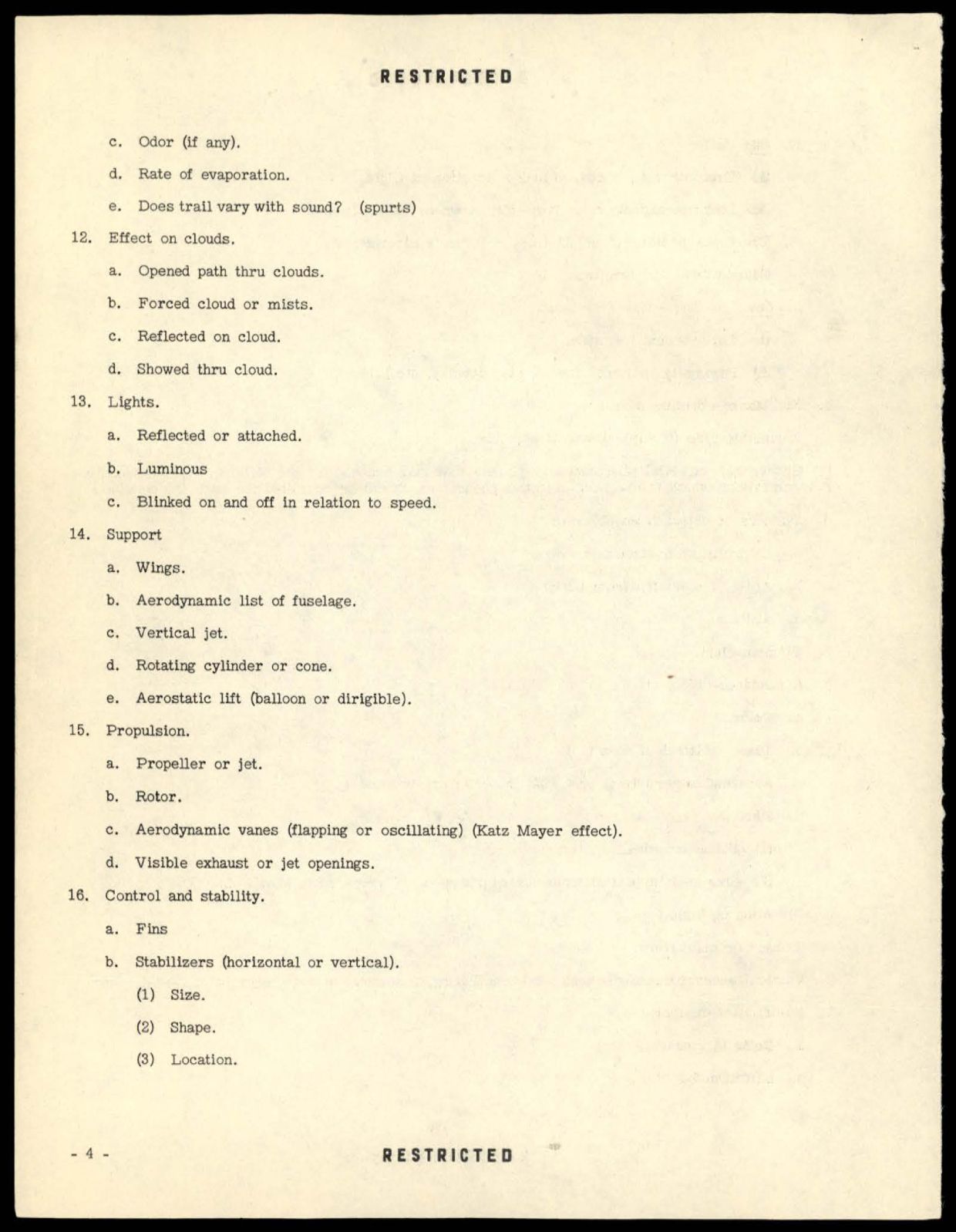
RESTRICTED
c. Odor (if any).
d. Rate of evaporation.
e. Does trail va:ry with sound? (spurts)
12.
Effect on clouds.
a.
Opened path thru clouds.
b. Forced cloud or mists .
c. Reflected on cloud.
d. Showed thru cloud.
13. Llghts.
a. Reflected or attached.
b. Luminous
i
c. Blinked on and off in relation to speed.
14, Support
a. Wings.
b. Aerodynamic 11st of fuselage.
c. Vertical jet.
d. Rotating cylinder or cone.
e. Aerostatic lift (balloon or dirigible).
15. Propulsion.
a.
Pr opeller or jet.
b.
Rotor.
c. Aerodynamic vanes (flapping or osclllating) (Katz Mayer effect).
d.
Visible exhaust or jet openings.
16. Control and stability.
a. Fins
b. StabiUzer s (horizontal or vertical).
(1) Size.
(2) Shape.
(3) Location.
- 4 -
RESTRICTED
PAGE 86 / 137
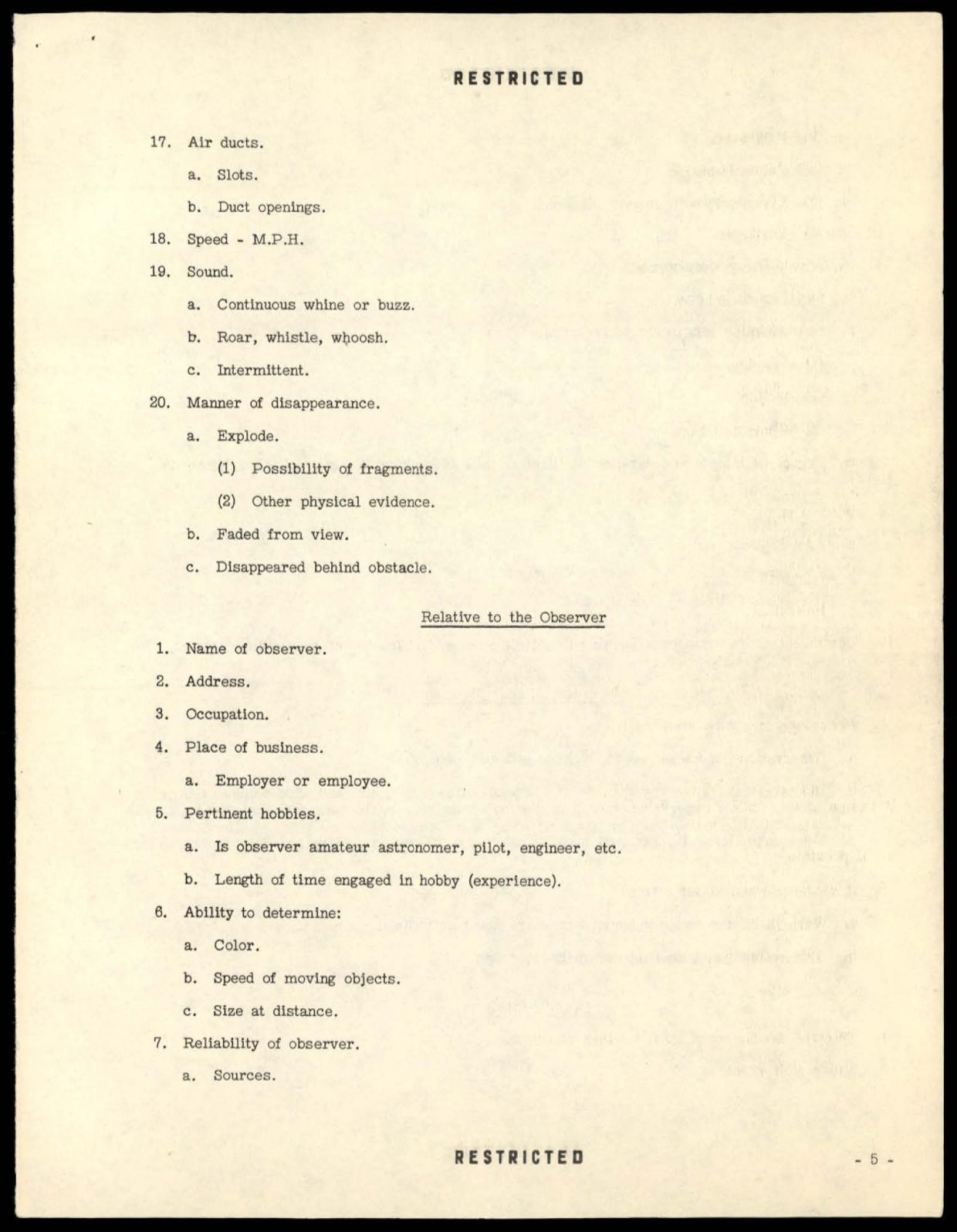
RESTRICTED
17. Air ducts.
a. Slots.
b.
Duct openings.
18. Speed - M.P.H.
HJ.
Sound.
a, Continuous whine or buzz.
b. Roar, whistle, wt)oosh.
c.
Intermittent.
20. Manner of disappearance.
a.
Explode.
(1) PossibHity of fragments.
(2) Other physical evidence.
b, Faded from view.
c. Disappeared behind obstacle.
Relative to the Observer
1. Name of observer.
2. Address.
3. Occupation.
4. Place of business.
a. Employer or employee.
5. Pertinent hobbies.
a. Is observer amateur astronomer, pilot, engineer, etc.
b. Length of time engaged in hobby (experience).
6.
Ab111ty to determine:
a. Color.
b. Speed of moving objects.
c. Size at distance.
7. Reliablll.ty of observer.
a. Sources.
RESTRICTED
- 5 -
PAGE 87 / 137
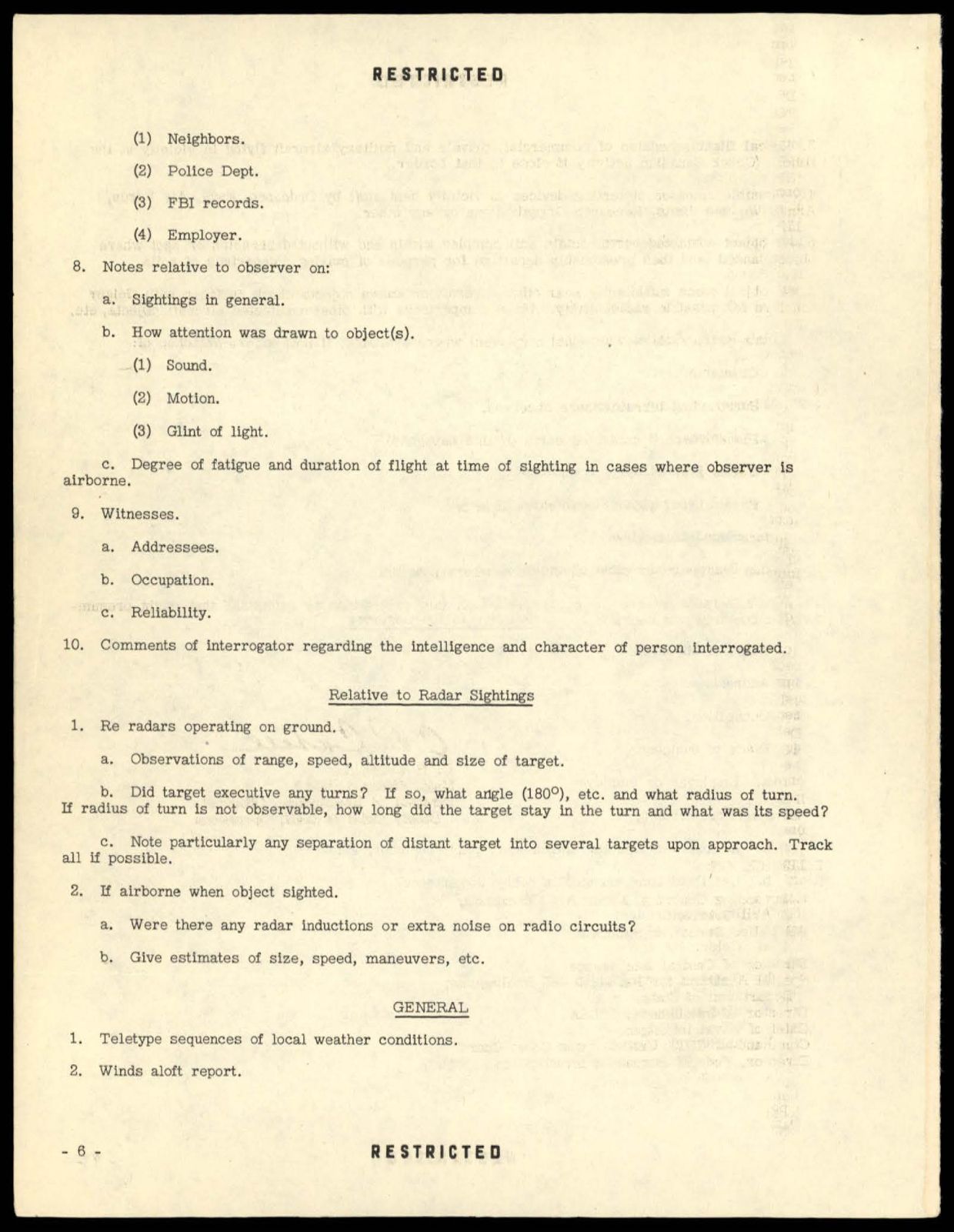
RESTRICTED
(1) Neighbors.
(2) PoUce Dept.
(3) FBI records.
(4) Employer.
8. Notes relative to observer on:
a.
Sightings 1n general.
b. How attention was drawn to object(s).
(1) Sound.
(2) Motion.
(3) Glint of light.
c. Degree of fatigue and duration of flight at time of sighting In cases where observer ls
airborne.
9. Witnesses.
a. Addressees.
b.
occupation.
c . Reliab111ty.
10. Comments of interrogator regarding the 1nte1Ugence and character of person interrogated.
Relative to Radar Sightings
1. Re radars operating on ground.
a. Observations of range, speed, altitude and size of target.
b.
Did target executive any turns? If so, what angle (180°), etc. and what radius of turn.
If radius of turn ls not observable, how long did the target stay 1n the turn and what was Its speed?
c. Note particularly any separation of distant target Into several targets upon approach. Track
all Ii possible.
2. If airborne when object sighted.
a. Were there any radar inductions or extra noise on radio circuits?
b. Give estimates of size, speed, maneuvers, etc.
GENERAL
1. Teletype sequences of local weather conditions.
2. Winds aloft report.
- 6 -
RESTRICTED
PAGE 88 / 137
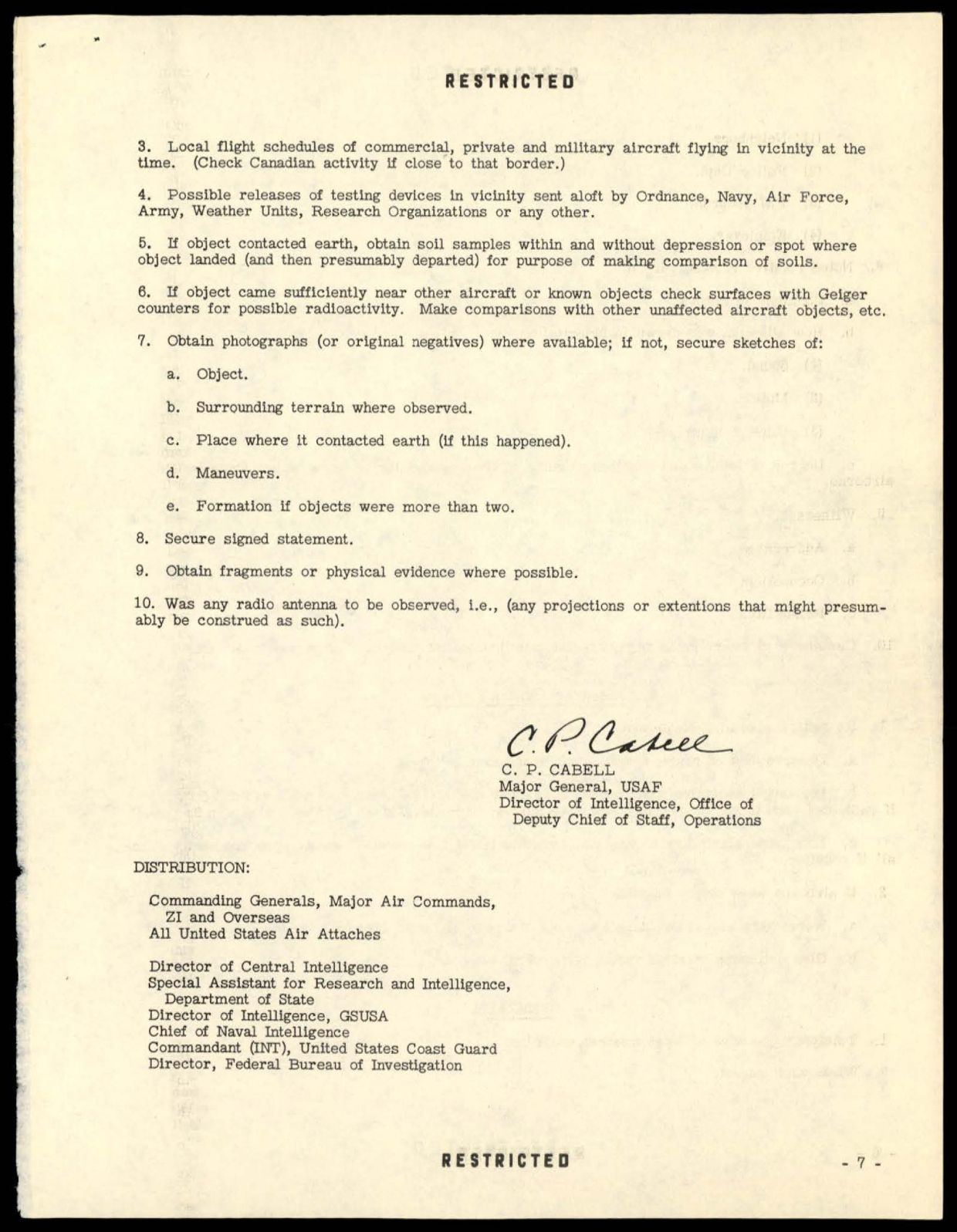
RESTRICTED S. Local flight schedules of commercial, private and military aircraft :flying in vic!nlty at the time. (Check Canadian activity 1f close to that border.) 4. Possible releases of testing devlces in vicinity sent aloft by Ordnance, Navy, Air Force, Ar my, Weather Units, Research Organlzatlons or any other. 5. If object contacted earth, obtain soll samples within and without depression or spot where object landed (and then presumably departed) for purpose of making comparison of soils. 6. If object came sufficiently near other aircraft or lmown objects check surfaces with Gelger counters for possible rad1oact1v1ty. Make comparisons with other unaffected aircraft objects, etc. 7. Obtain photographs (or original negatives) where available; if not, secure sketches of: a. Object. b. Surrounding terrain where observed. c. Place where it contacted earth (lf this happened). d. Maneuvers. e. Formation lf objects were more than two. 8. Secure signed statement. 9. Obtain fragments or physical evidence where possible. 10. Was any radio antenna to be observed, Le., (any projections or extentlons that might presum ably be construed as such). c:P.~ C. P. CABELL Major General, USAF Director of Intelllgence, Office of Deputy Chief of Staff, Operations DISTRIBUTION: Commanding Generals, Major Alr Commands, ZI and Overseas All United States Alr Attaches Director of Central Intelligence Special Assistant for Resear ch and Intelligence, Department of State Director of Intelligence, GSUSA Chief of Naval Intelllgence Commandant (I.NT), United States Coast Guard Director , Federal Bureau of Investigation RESTRICTED - 7 -
PAGE 89 / 137
RESTRICTED
RESTRICTED
PAGE 90 / 137
RESTRICTED DEPARTMENT OF THE AIR FORCE HEADQUARTERS UNITED STATES AIR FORCE DIRECTORATE OF INTELLIGENCE WASHINGTON 25, D. C. 15 February 1949 AIR INTELLIGENCE REQUIREMENTS MEMORANDUM NUMBER 4 UNCONVENTIONAL AIRCRAFT PART I - GENERAL 1. PURPOSE The purpose of this memorandum ls twofold: a. To enunciate continuing Air Force requirements for information pertaining to sightings of unconventional aircraft and unldentlfled flying objects, including the so-called "Flying Discs." b. To establish procedures for reporting such information. 2. RESCISSION Department of the Army Collection Memorandum Number 7, dated 21 January 1948, and letter, CSGID 425.1, dated 25 March 1948, both subject as above, which have been transferred to Air Force agencies for action, are herewith superseded. 3. REPORTING a. General (1) As complete an answer to the requirements enunciated in Part II, as may be procur able, should be dispatched by means of electrical transmission immediately after sightings, (2) Supplementary reports should be forwarded as ava1lable by the most expeditious means consistent with the importance of the information reported. b, Major Air Commands (Overseas) and Air Attaches (1) Initial and supplementary cabled reports wlll be transmitted to the Director of Intem gence, Headquarters United States Al.r Force. Cables wl.11 contain the phase, " Pass to COMGENAMC WRIGHT-PATTERSON AFB, DAYTON, OHIO, ATTN: MCIAXO-3." RESTRICTED ta- 8~k94'-/~1/
PAGE 91 / 137
RESTRICTED (2) Supplementary written reports, prepared on AF Form 112, wlll be forwarded to the Director of Intelligence, Headquarters United States Alr Force. (3) Commanding General, Air Materiel Command ls authorized direct contact with major Alr Commands (overseas) and organizations under their control in connection with the development of information on this subject. c. Major Air Commands (ZI) (1) Reports wm be forwarded direct to the Commanding General, Air Materiel Command, Wright-Patterson Air Force Base, Dayton, Ohio, Attn: MClAX0-3 by installations receiv ing information pertaining to the requirements enunciated in Part Il. (2) Coples of such r eports may be supplied the Command Headquarters of the Installation concerned. (3) A copy of all reports sent to Air Materiel Command In accordance with these instr uc tions will be forwarded at the same time to the Director of Intelllgence, Headquarters United States Air Force. (4) Written reports will be submitted on AF Form 112. (5) Commanding General, Air Materiel Command Ls authorized direct contact with major Air Commands (ZI) and organizations under their control In connection with the develop ment of information on this subject. d. Non-Air Force Agencies (1) Addressees ot~er than those of the United States Air Force are requested to forward reports direct to the Commanding General, Air Materiel Command, Wright-Patterson Air Force Base, Dayton, Ohio, Attn: MCIAX0-3. (2) In order to reduce the time factor involved in transmission of this type of information Lt ls requested that, wherever communications facilities permit, subordinate elements be authorized to communicate reports direct to the Commanding General, Air Materiel Com mand. PART II - REQUIREMENTS General 1. Date of sighting. 2. Time of sighting (zonal by 24 hr. clock). 3. Where sighted (observer's position): a. Ground (1) City, town. (2) Distance and direction from city or town, r oad, intersection, etc. (3) From building (story), yard, etc. (4) Map coordinates (11 feasible) showing latitude and longitude. - 2 - RESTRICTED
PAGE 92 / 137
RESTRICTED b, Air (1) Type a1rcraft, speed, alutude, d1rection of fUght. (2) Distance and d1rection from city, town or known landmark. (3) Clock posltlon of object from observer's aircraft. (4) Latitude and longitude. c. Sea (1) Latitude and longitude. (2) Pr oximity to land. (Name city, country, etc.) 4. Number of objects. Formation type (lf any), sketch 1f possible. 5. Observable celestlal phenomena or planets that may account for the sight1ng. (Local £ac1Uties or organizations which follow such celestial phenomena should be consulted for such Lnformatlon.) 6. Distance of object from observer. a. Laterally or hor1zontally. b. Angle of elevation from horizon. c. Altitude. 7. Time in sight. 8. Appearance of object. a. Color. b. Shape. (Sketch if possible) c. Apparent construction. (Of what material or substance) d, Size, (1) Estimated size. (2) Size as it appeared from observer's view. (Compared to known object) 9. Direction of flight. 10. Tactics or maneuvers. Vertical ascent or descent, horizontal, osclllatlng, fluttering, evasive, aggressive, erratic, etc. 11. Evidence of exhaust. a. Color of smoke. , b. Length and width. RESTRICTED - 3
PAGE 93 / 137
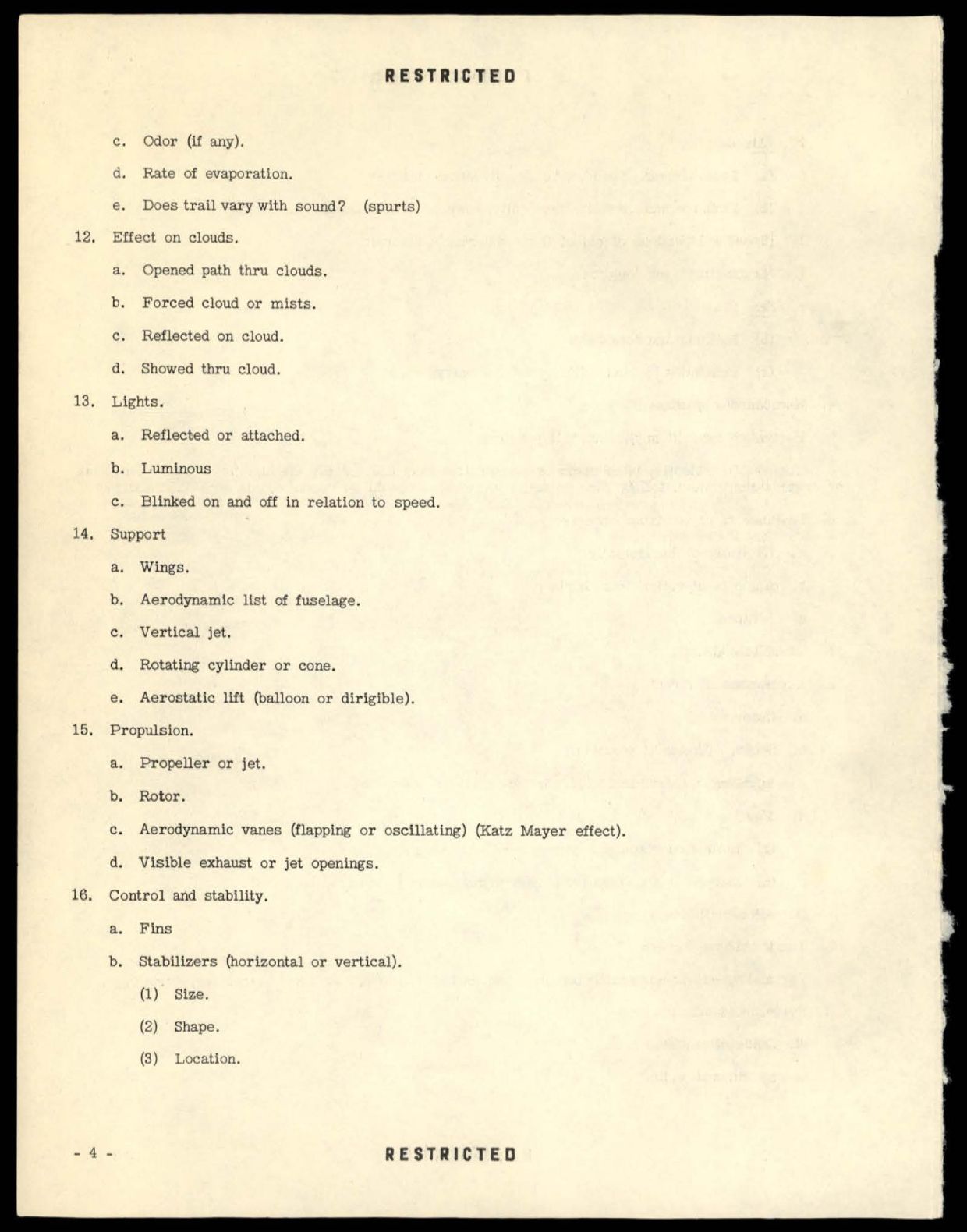
RESTRICTED
c. Odor (if any).
d. Rate of evaporation.
e. Does trail vary wl.th sound? (spurts)
12. Effect on clouds.
a. Opened path thru clouds.
b. Forced cloud or ml.sts.
c. Re.fleeted on cloud.
d. Showed thru cloud.
13. Llghts.
a. Reflected or attached.
b. Luminous
c. Blinked on and off in relation to speed.
14, Support
a. Wings.
b. Aerodynamic list of fuselage.
c. Vertical jet.
d. Rotating cylinder or cone.
e. Aerostatl.c lift (balloon or dirigible).
15. Propulsion.
a. Propeller or jet.
b. Rotor.
c. Aerodynamic vanes (flapping or oscillatlng) (Katz Mayer effect).
d. Visible exhaust or jet openings.
16. Control and stabllity.
a. Fins
b. Stabilizers (horizontal or vertical).
(1) Sl.ze.
(2) Shape.
(3)
Location.
- 4 -
RESTRICTED
PAGE 94 / 137
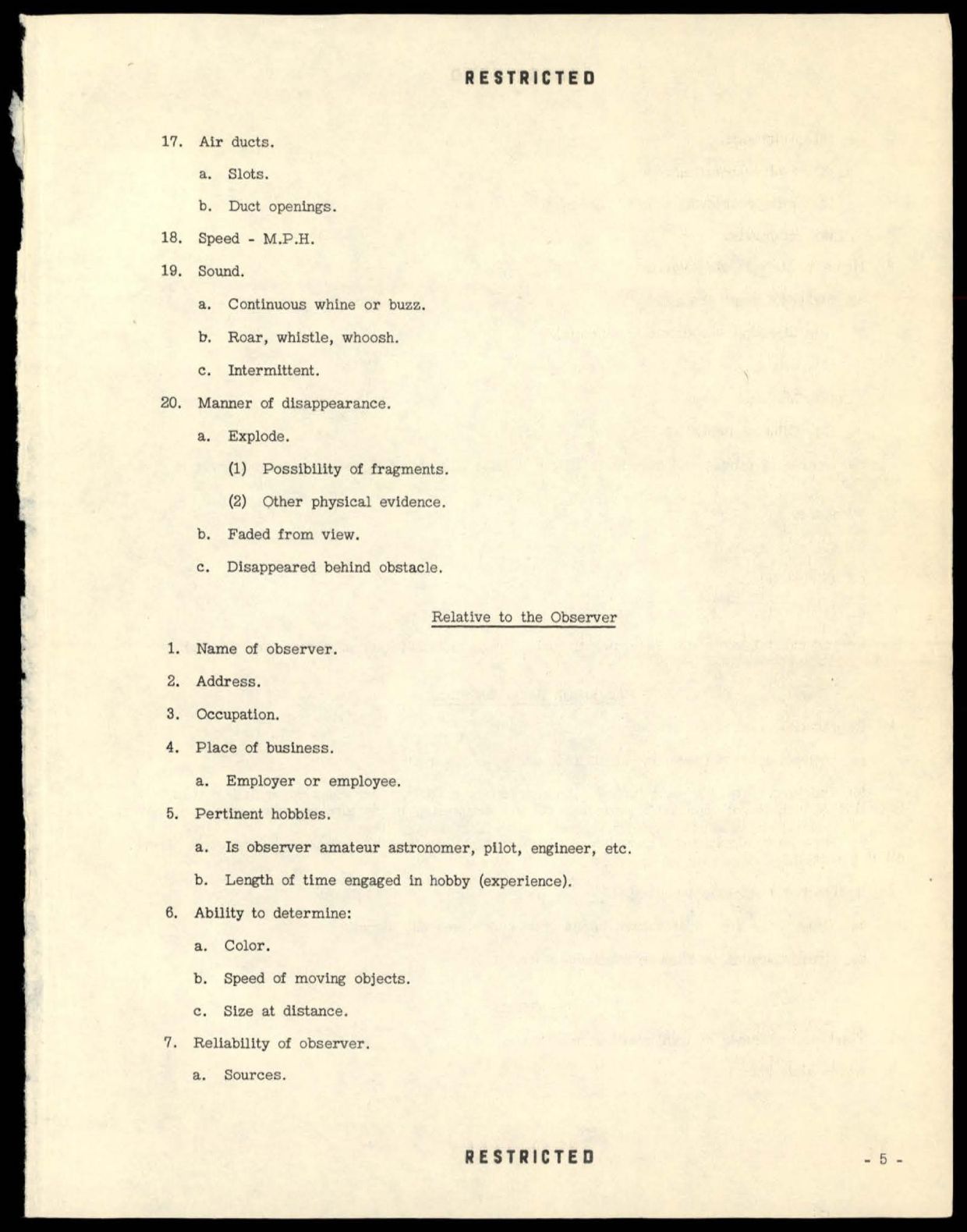
RESTRICTED
17. Air ducts.
a. Slots.
b. Duct openings.
18. Speed - M.P .H.
19. Sound.
a. Continuous whine or buzz.
b. Roar, whistle, whoosh.
c. Intermittent.
20. Manner of disappearance.
a.
Explode.
(1) Possibil!.ty of fragments.
(2) Other physical evidence.
b. Faded from view.
c. Disappeared behind obstacle.
Relat!.ve to the Observer
1. Name of observer.
2. Address.
3. Occupation.
4. Place of business.
a. Employer or employee.
5. Pertinent hobbies.
a. Is observer amateur astronomer, pilot, engineer, etc.
b. Length of time engaged in hobby (experience).
6. Ability to deter mine:
a. Color.
b. Speed of moving objects.
c. Size at distance.
7. Rellabillty of observer.
a.
Sources.
RESTRICTED
- 5 -
PAGE 95 / 137
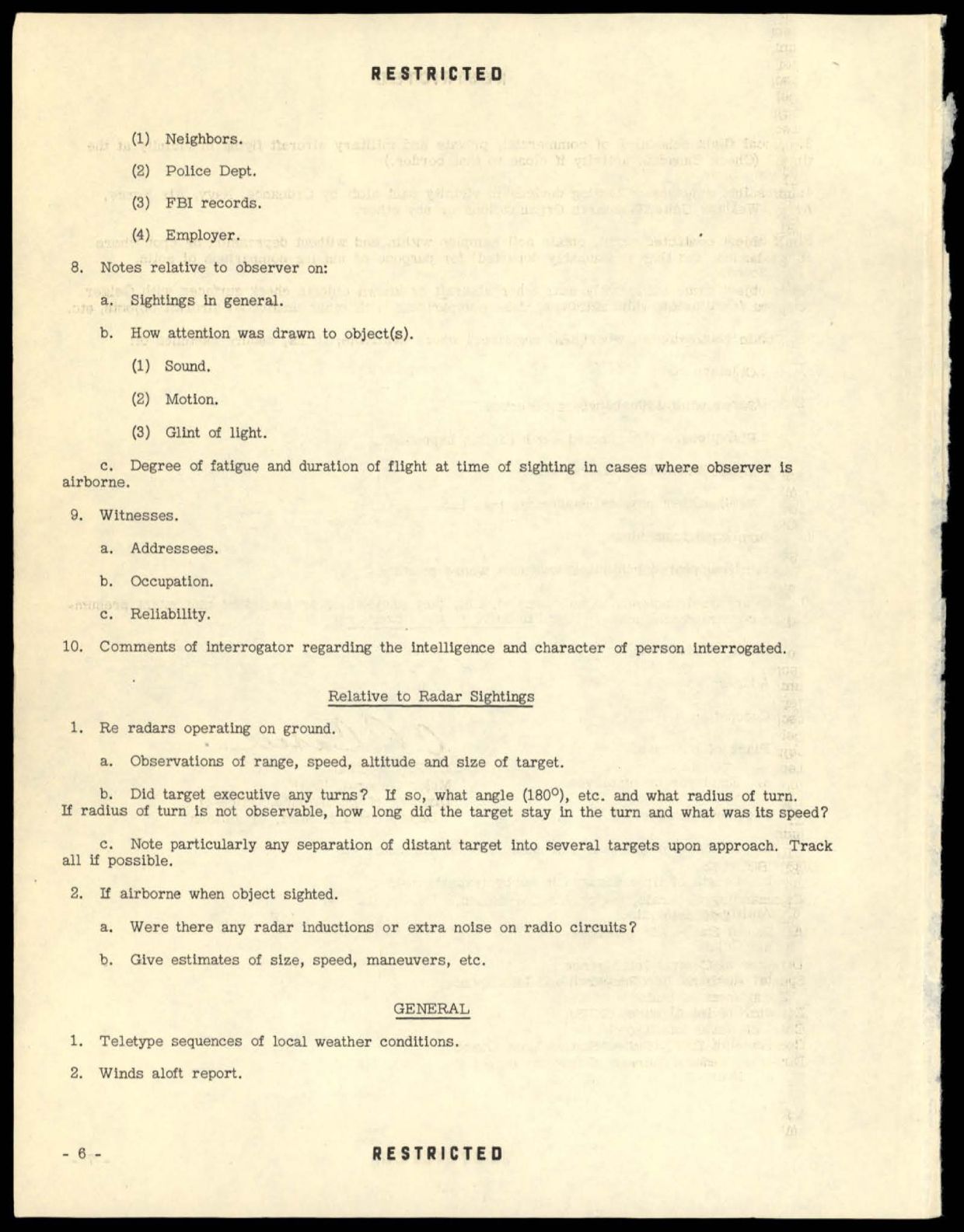
RESTRICTED
(1)
Neighbors.
(2) Police Dept.
(3) FBI records.
(4) Employer.
8. Notes relative to observer on:
a. Sightings in general.
b. How attention was drawn to object(s).
(1) Sound.
(2) Motion.
(3) Glint of light.
c. Degree of fatigue and duration of flight at time of slghtlng in cases where observer is
airborne.
9. Witnesses.
a. Addressees.
b. Occupation.
C.
ReUabiUty.
10. Comments of interrogator regarding the intelUgence and character of person inter rogated.
Relative to Radar Sightings
1. Re radars operating on ground.
a. Observations of range, speed, altitude and size of target.
b. Did target executive any turns? If so, what angle (180°), etc. and what radius of turn.
If radius of turn ls not observable, how long did the target stay in the turn and what was its speed?
c. Note particularly any separation of distant target Into several targets upon approach. Track
all if possible.
2. If airborne when object sighted.
a. Were there any radar inductions or extra noise on radio circuits?
b. Give estimates of size, speed, maneuvers, etc.
GENERAL
1. Teletype sequences of local weather condlt1ons.
2. Winds aloft report.
- 6 -
RES TRICTED
PAGE 96 / 137
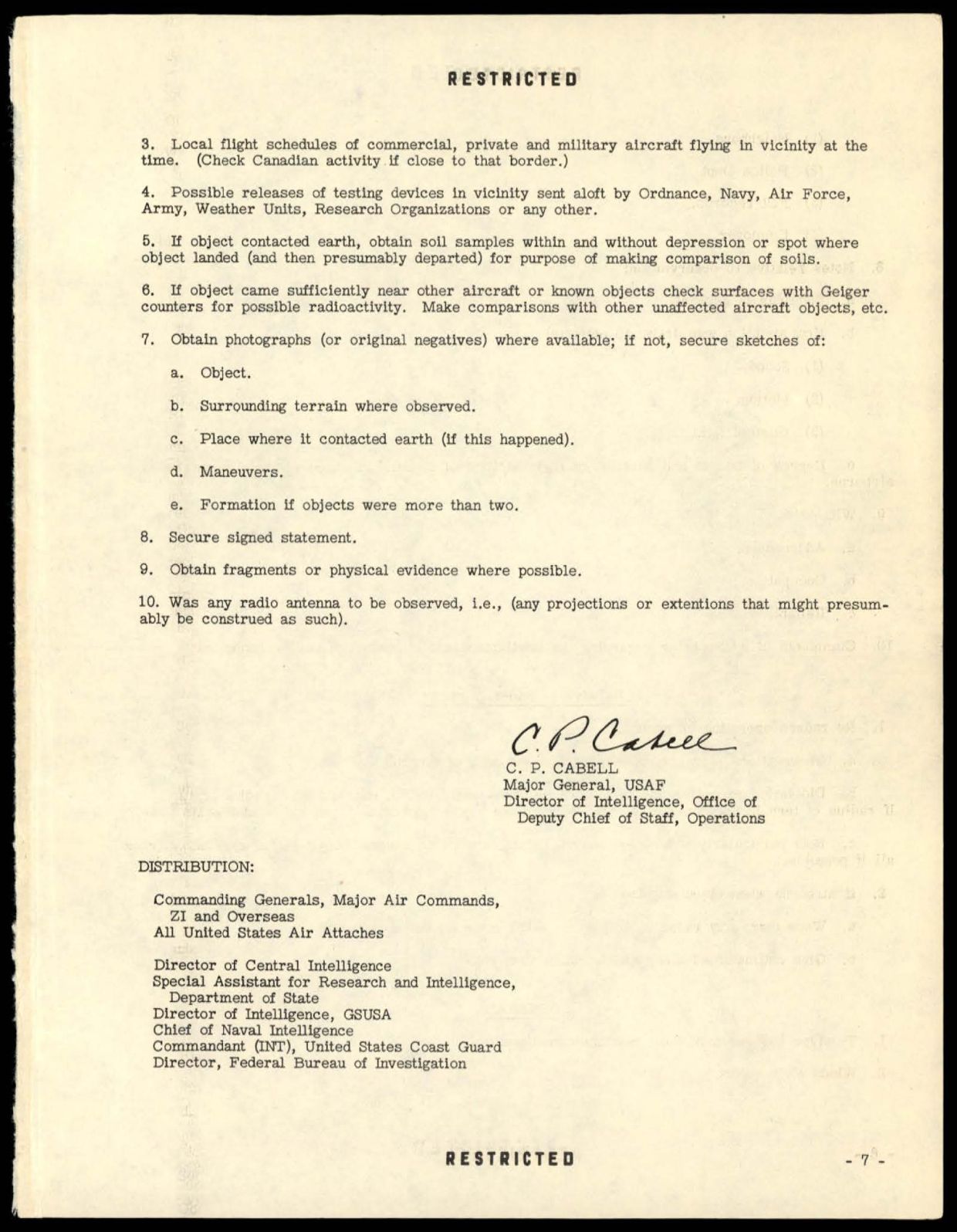
RESTRICTED S. Local flight schedules of commercial, private and military aircraft flying In vicinity at the time. (Check Canadian activity if close to that border.) 4. Possible releases of testing devices in vicinity sent aloft by Ordnance, Navy, Air Force, Army, Weather Units, Research Organizations or any other. 6. If object contacted earth, obtain soil samples within and without depression or spot where object landed (and then presumably departed) for purpose of making comparison of soils. 6. If object came sufficiently near other aircraft or known objects check surfaces with Geiger counters for possible radioactivity. Make comparisons with other unaffected aircrait objects, etc. 7. Obtain photographs (or original negatives) where available; if not, secure sketches of: a. Object. b. Surrounding terrain where observed. c. Place where it contacted earth (if this happened). d. Maneuvers. e. Formation 1f objects were more than two. 8. Secure signed statement. 9. Obtain fragments or physical evidence where possible. 10. Was any radio antenna to be observed, i.e., (any projections or extentlons that might presum ably be construed as such). cf-?~ C. P. CABELL Major General, USAF Director of Intelllgence, Office of Deputy Chief of Staff, Operations DISTRIBUTION: Commanding Generals, Major Air Commands, ZI and overseas All United States Air Attaches Director of Central IntelUgence Special Assistant for Research and Intelligence, Department of State Director o:f Intelllgence, GSUSA Chief of Naval Intelligence Commandant (!NT), United States Coast Guard Director, Federal Bureau of Investigation RESTRICTED - 7 -
PAGE 97 / 137
RESTRICTED
RESTRICTED
I
I
PAGE 98 / 137
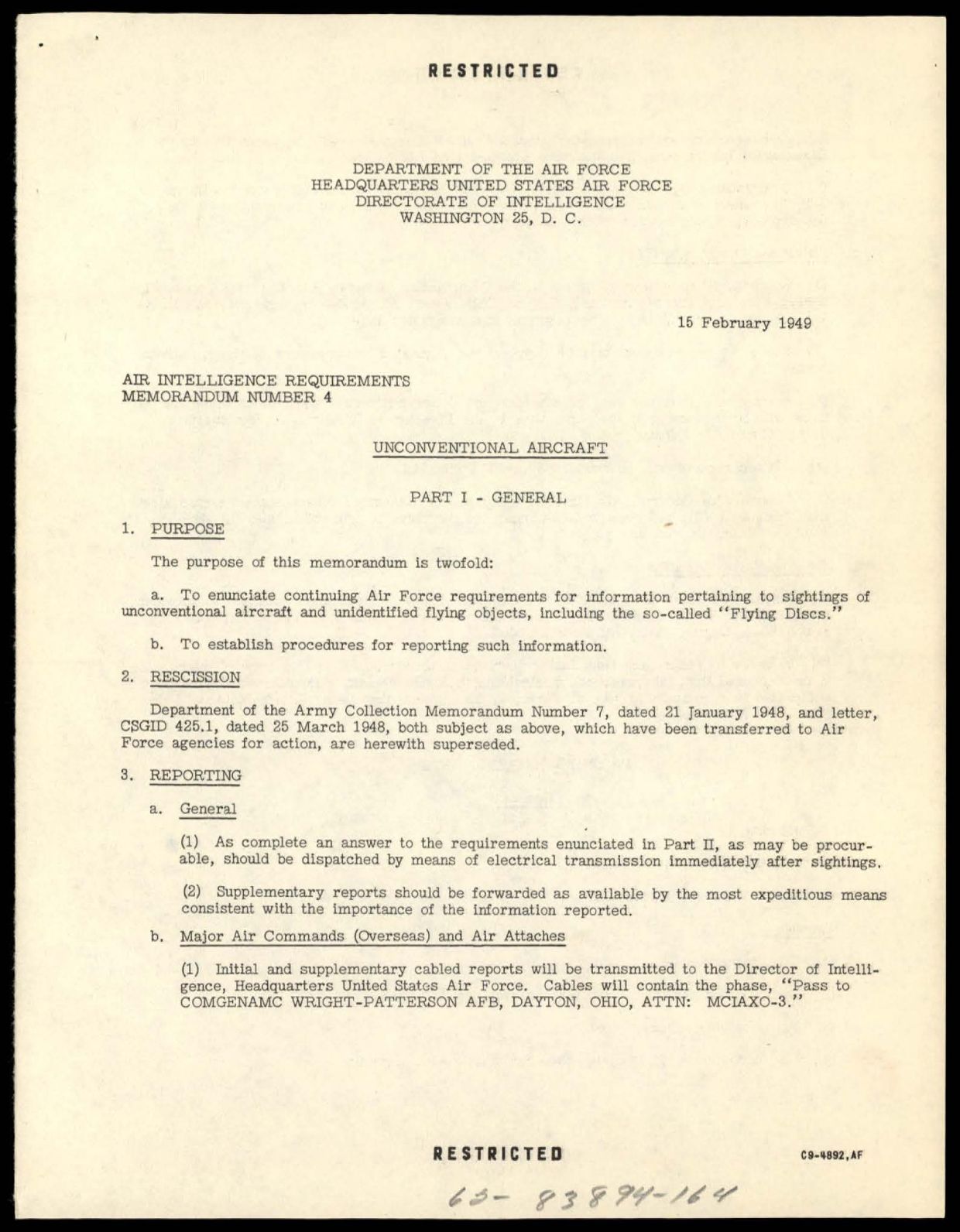
RESTRICTED DEPARTMENT OF THE AIR FORCE HEADQUARTERS UNITED STATES AIR FORCE DIRECTORATE OF INTELLIGENCE WASHINGTON 25, D. C. 16 February 1949 AIR INTELLIGENCE REQUIREMENTS MEMORANDUM NUMBER 4 UNCONVENTIONAL AIRCRAFT PART I - GENERAL 1. PURPOSE The purpose of this memorandum is twofold: a. To enunciate continuing Air Force requirements for information pertaining to sightings of unconventional aircraft and unidentified flying objects , including the so-called "Flying Discs." b. To establish procedures for reporting such information. 2. RESCISSION Department of the Army CollecUon Memorandum Number 7, dated 21 January 1948, and letter, CSGID 425.1, dated 25 March 1948, both subject as above, which have been transferred to Air Force agencies for action, are herewith superseded. 3. REPORTING a. General (1) As complete an answer to the requirements enunciated in Part II, as may be procur able, should be dispatched by means of electrical transmission immediately after sightings. (2) Supplementary reports should be forwarded as available by the most expeditious means consistent with the importance of the information reported. b. Major Air Commands (Overseas) and Air Attaches (1) Initial and supplementary cabled reports will be transmitted to the Director of Intelli gence, Headquarters United States Air Force. Cables wm contain the phase, " Pass to COMGENAMC WRIGHT-PATTERSON AFB, DAYTON, OHIO, ATTN: MCIAXO-3.'' RESTRICTED C9•11892,.4F
PAGE 99 / 137
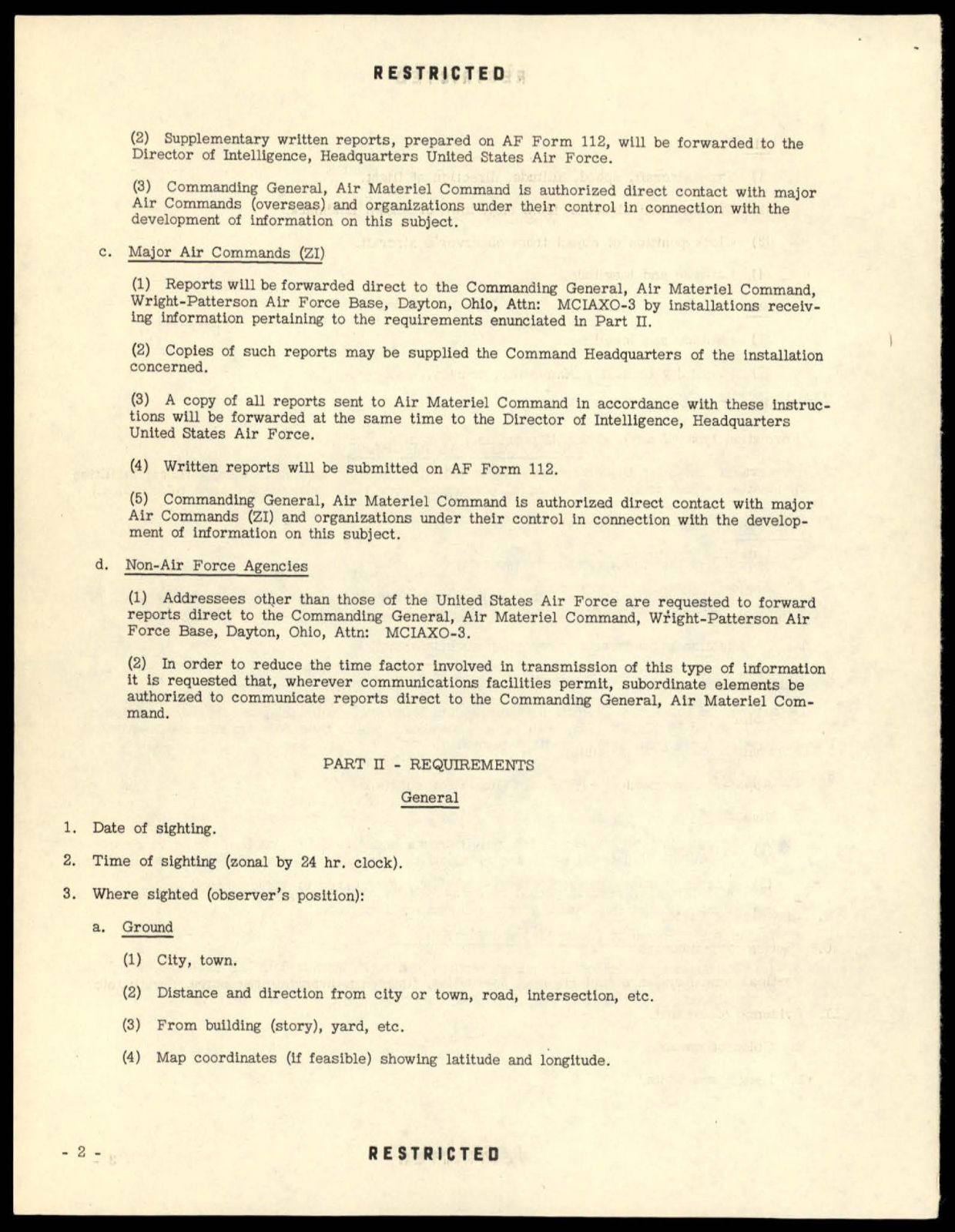
RES TRIC T ED
(2) Supplementary written reports, prepared on AF Form 112, will be forwarded to the
Director of Intelligence, Headquarters United States Air Force.
(3) Commanding General, Air Materiel Command is authorized direct contact wlth major
Air Commands (overseas) and organizations under their control in connection with the
development of information on this subject.
c. Major Air Commands (ZI)
(1) Reports wlll be forwarded direct to the Commanding General, Air Materiel Command,
Wright-Patterson Air Force Base, Dayton, Ohio, Attn: MCIAX0-3 by installations receiv
ing information pertaining to the requirements enunciated in Part II.
(2) Copies of such r eports may be supplied the Command Headquarters of the installation
concerned.
(3) A copy of all reports sent to Air Materiel Command in accordance with these instruc
tions will be forwarded at the same time to the Director of Intelligence, Headquarters
United States Air Force.
(4) Written r eports will be submitted on AF Form 112.
(5) Commanding General, Air Materiel Command ls authorized direct contact with major
Air Commands (ZI) and organizations under their contr ol in connection wlth the develop
ment of information on this subject.
d. Non-Air Force Agencies
(1) Addressees ot~er than those of the United States Air Force are requested to forward
r eports direct to the Commanding General, Alr Materiel Command, Wright-Patterson Air
Force Base, Dayton, Ohio, Attn:
MCIAX0-3.
(2) In order to reduce the time factor involved in transmission of this type of information
it is requested that, wherever communications facilities permit, subordinate elements be
authorized to communicate reports direct to the Commanding General, Alr Materiel Com
mand.
PART II - REQUIREMENTS
General
1. Date of sighting.
2. Time of sighting (zonal by 24 hr. clock).
3. Wher e sighted {observer's position):
a. Ground
(1) City, town.
(2) Distance and direction from city or town, road, intersection, etc.
(3)
From building (story), yard, etc.
(4) Map coordinates (if feasible) showing latitude and longitude.
- 2 -
RESTRICT EDPAGE 100 / 137
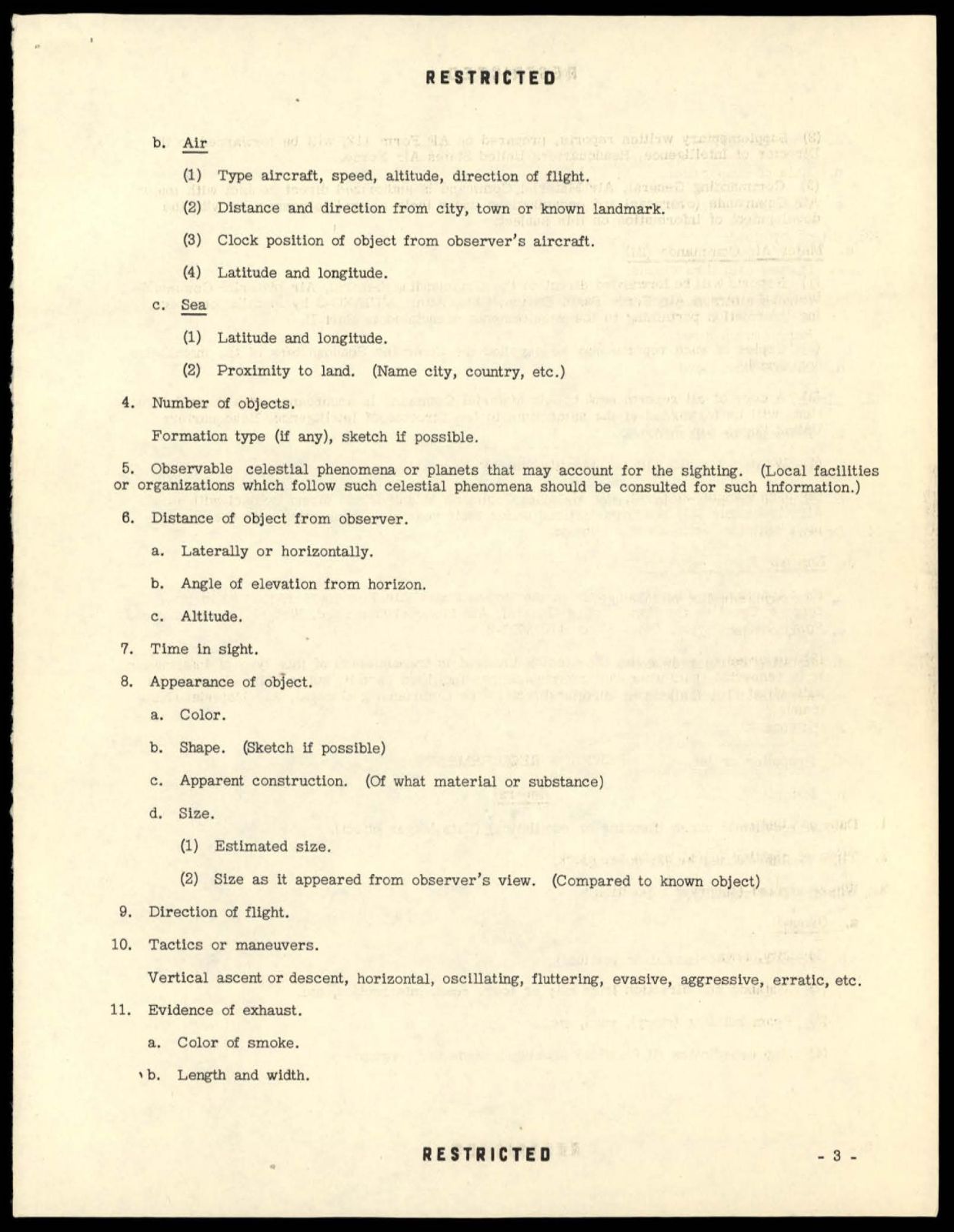
RESTRICTED b. Air (1) Type aircraft, speed, altitude, direction of flight. (2) Distance and direction from city, town or known landmark. (3) Clock position of object from observer's aircraft. (4) Latitude and longitude. c. Sea (1) Latitude and longitude. (2) Pr oximity to land. (Name city, country, etc.) 4. Number of objects. Formation type (If any), sketch if possible. 5. Observable celestial phenomena or planets that may account for the sighting. (Local faciUtles or organizations which follow such celestial phenomena should be consulted for such information.) 6. Distance of object from observer. a. Laterally or horizontally. b. Angle of elevation from horizon. c. Altitude. 7. Time in sight. 8. Appearance of object. a. Color. b. Shape. (Sketch If possible) c. Apparent construction. (Of what material or substance) d. Size. (1) Estimated size. (2) Size as lt appeared from observer's view. (Compared to known object) 9. Dir ection of flight. 10. Tactics or maneuvers. Vertical ascent or descent, horizontal, oscillating, fluttering, evasive, aggressive, erratic, etc. 11. Evidence of exhaust. a. Color of smoke. , b. Length and width. RESTRICTED - 3
PAGE 101 / 137
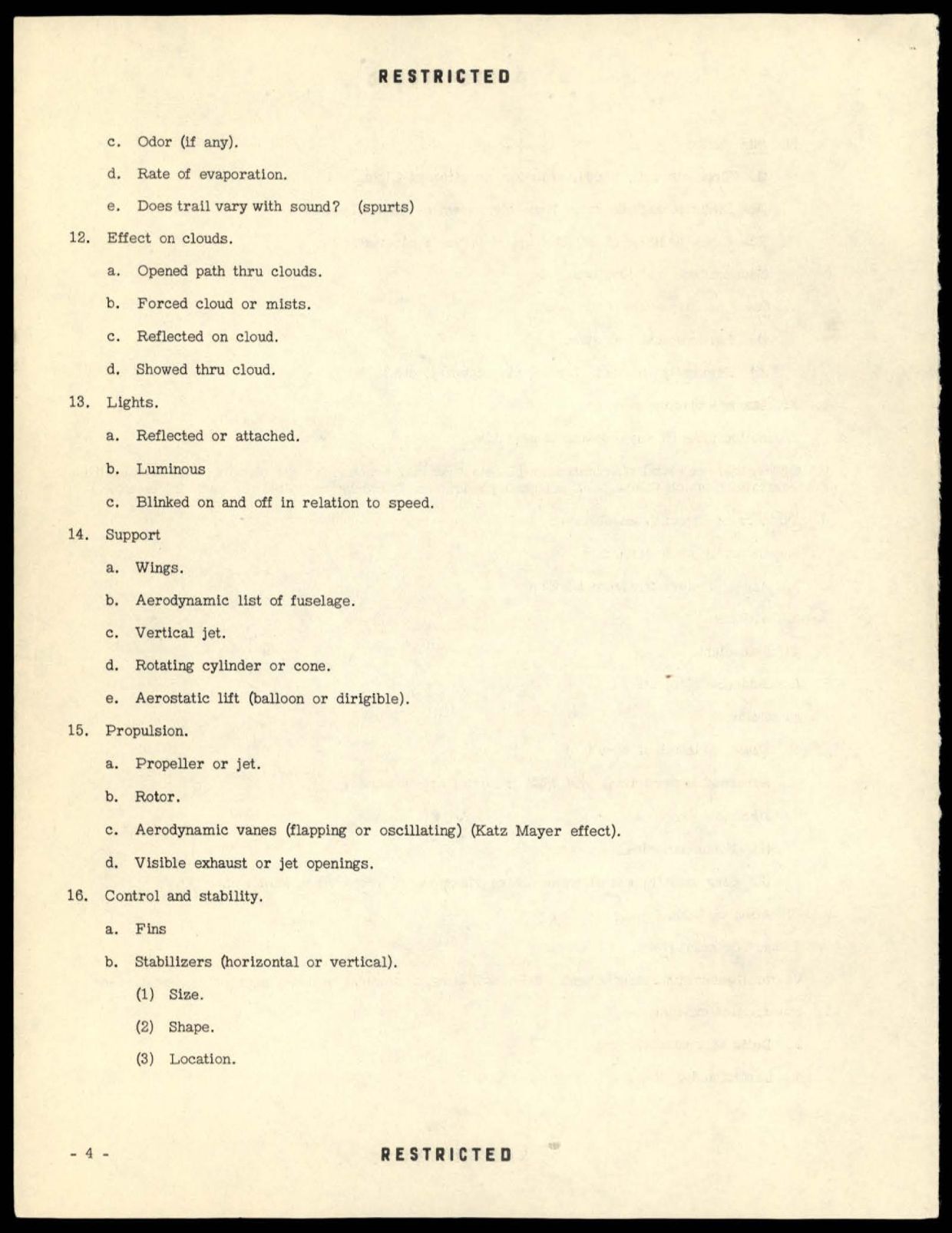
RESTRICTED
c. Odor (!.f any).
d. Rate of evaporation.
e. Does trail va:ry with sound?
(spurts)
12. Effect on clouds.
a. Opened path thru clouds.
b. Forced cloud or mists.
c. Reflected on cloud.
d. Showed thru cloud.
13. Lights.
a. Reflected or attached.
b. Luminous
c. Blmked on and off in relation to speed.
14. Support
a. Wings.
b. Aerodynamic 11st of fuselage.
c . Vertical jet.
d. Rotating cylinder or cone.
e. Aerostatic liit (balloon or dirigible).
15. Propulsion.
a. Propeller or jet.
b. Rotor.
c. Aerodynamic vanes (flapping or osclllating) (Katz Mayer effect).
d. Visible exhaust or jet openings.
16. Control and stability.
a. Fins
b. Stabilizers (horizontal or vertical).
(1) Size.
(2) Shape.
(3) Location.
- 4 -
RESTRICTED
PAGE 102 / 137
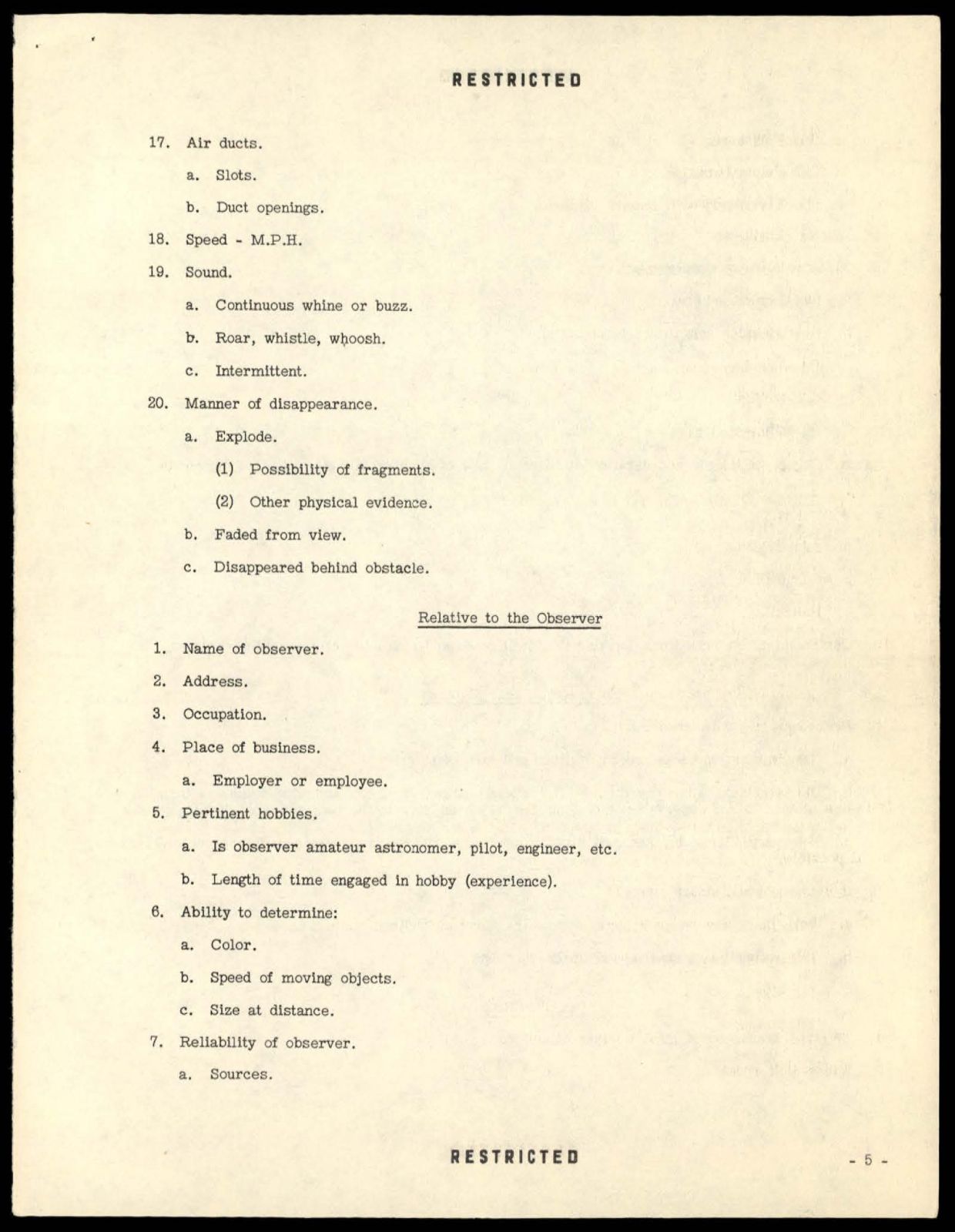
RESTRICTED
17. Air ducts .
a. Slots.
b.
Duct openings.
18. Speed - M.P .H.
19. Sound.
a. Continuous whine or buzz.
b. Roar, whistle, w};l.oosh.
c.
Intermittent.
20.
Manner of disappearance.
a.
Explode.
(1) PosslblUty of fragments.
(2) Other physical evidence.
b. Faded from view.
c. Disappeared behind obstacle.
Relative to the Observer
1. Name of observer .
2. Address.
3. Occupation.
4.
Place of business.
a. Employer or employee.
5. Pertinent hobbles.
a. Is observer amateur astronomer, pilot, engineer, etc.
b. Length of time engaged l.n hobby (experience).
6. Ablllty to determine:
a. Color .
b. Speed of moving objects.
c. Size at distance.
7. Reliability of observer.
a.
Sources.
RESTRICTED
- 5 -
PAGE 103 / 137
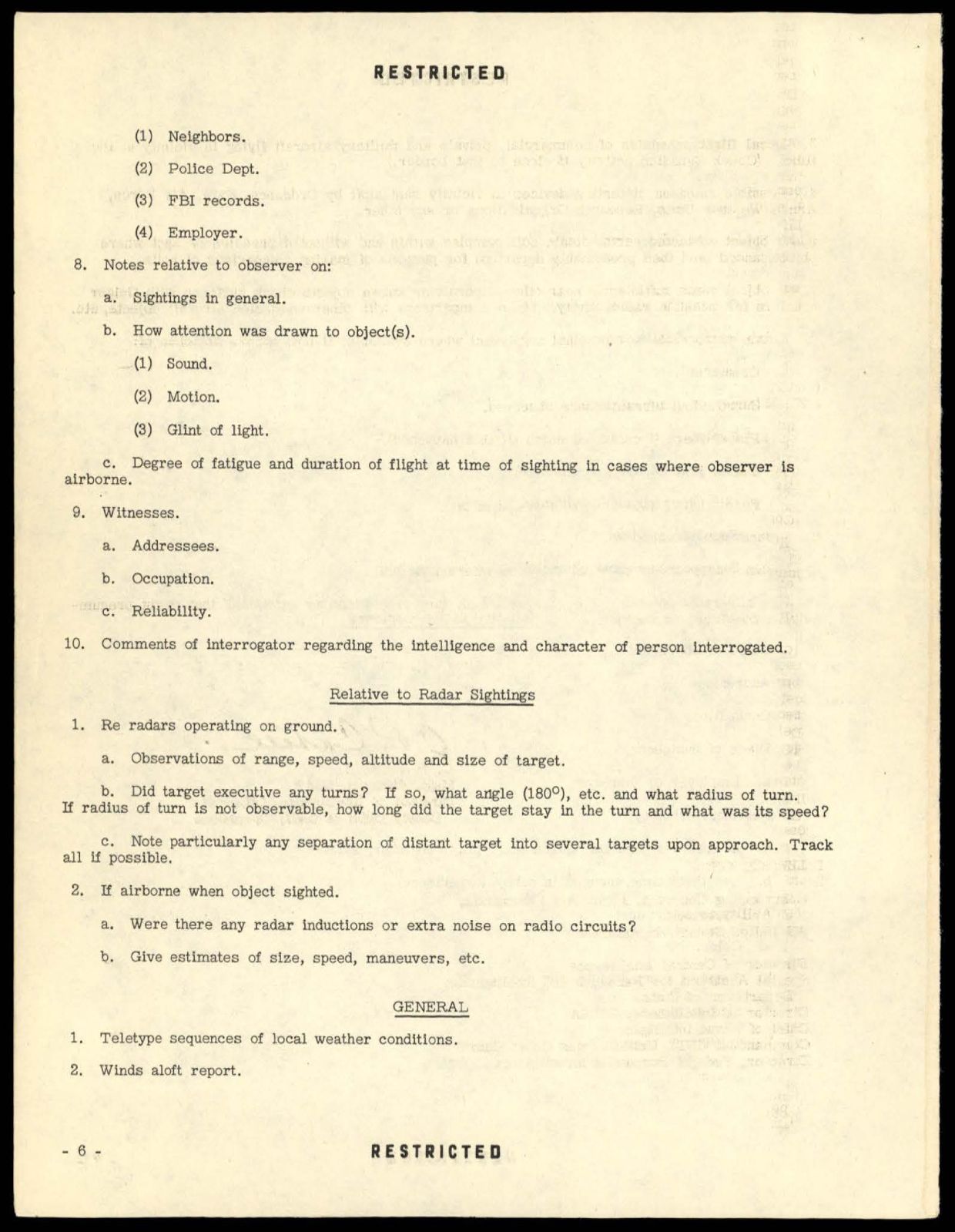
RESTRICTED
(1) Neighbors.
(2) Police Dept.
(3) FBI records,
(4) Employer.
8. Notes relative to observer on:
a. Sightings in general.
b. How attention was drawn to object(s}.
(1) Sound.
(2) Motion.
(3) Glint of light.
c . Degree of fatigue and duration of flight at time of sighting in cases where observer is
airborne.
9. Witnesses.
a. Addressees.
b. Occupation.
c. Rellab1Uty.
10. Comments of interrogator regarding the intelllgence and character of person interrogated.
Relative to Radar Sightings
1. Re radars operating on ground.
a. Observations of range, speed, altitude and size of target.
b. Did target executive any turns? If so, what angle (180°), etc. and what radius of turn.
If radius of turn is not observable, how long did the target stay in the turn and what was its speed?
c. Note particularly any separation of distant target into several targets upon appr oach. Track
all Ii possible.
2. If airborne when object sighted.
a. Were there any radar inductions or extra noise on radio circuits?
b. Give estimates of size, speed, maneuvers, etc.
GENERAL
1. Teletype sequences of local weather conditions.
2. Winds aloft report.
- 6 -
RESTRICTED
PAGE 104 / 137
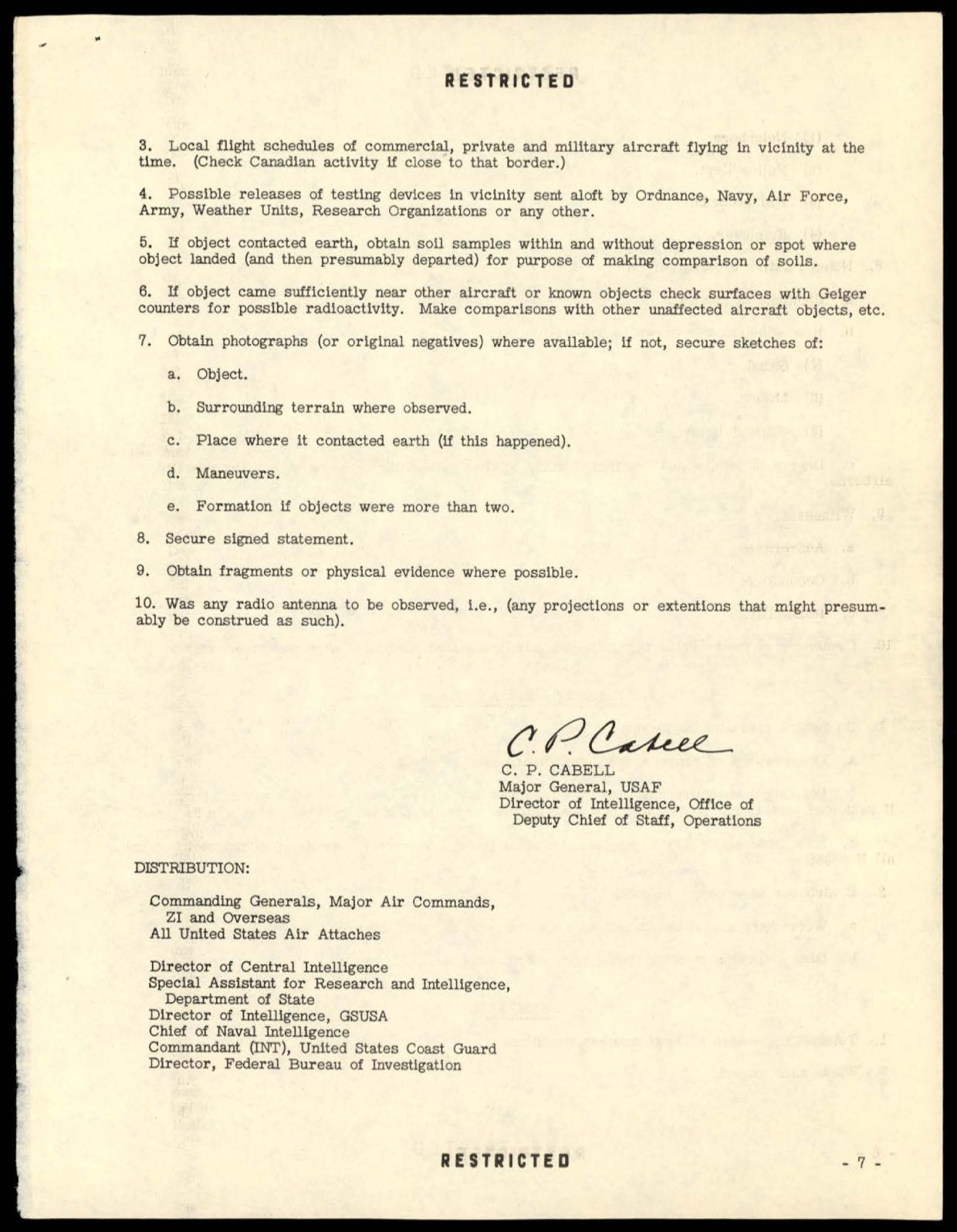
RESTRICTED 3. Local flight schedules of commercial, private and military aircraft flying 1n vicinity at the time. (Check Canadian activity If close to that border.) 4. Possible releases of testing devices in vicinity sent aloft by Ordnance, Navy, Air For ce, Army, Weather Units, Research Organizations or any other. 6. If object contacted earth, obtain sol.l samples within and without depr ession or spot where object landed (and then presumably departed) for purpose of making comparison of soils. 6. If object came sufficiently near other aircraft or known objects check surfaces with Gelger counters for possible radioactivity. Make comparisons with other unaffected aircraft objects, etc. 7. Obtain photographs (or original negatives) where available; 1f not, secure sketches of: a. Object. b. Surrounding terrain where observed. c. Place where it contacted earth (lf this happened). d. Maneuvers. e. Formation if objects were more than two. 8. Secure signed statement. 9. Obtain fragments or physical evidence where possible. 10. Was any radio antenna to be observed, i.e., (any projections or extentions that might presum ably be construed as such). C. P . CABELL Major General, USAF Director of Intelllgence, Office of Deputy Chief of Sta.ff, Operations DISTRIBUTION: Commanding Generals, Major Air Commands, ZI and Overseas All United States Air Attaches Director of Central Intelllgence Special Assistant for Research and Intelligence, Department of State Director of Intelligence, GSUSA Chief of Naval Intelllgence Commandant (INT), United States Coast Guard Director, Federal Bureau of Investlgatlon RESTRICTED - 7
PAGE 105 / 137
RESTRICTED
RESTRICTED
PAGE 106 / 137
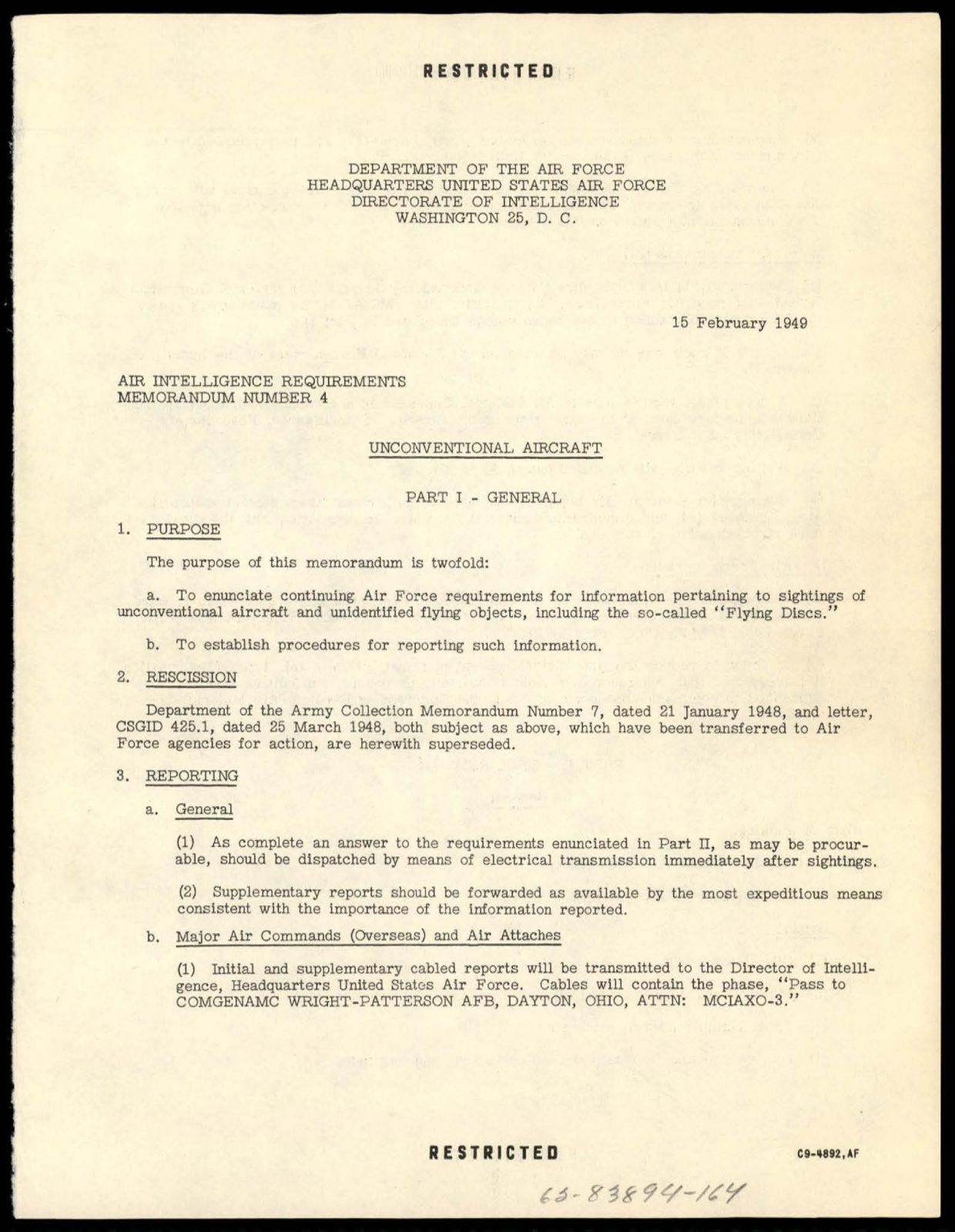
RESTRICTED DEPARTMENT OF THE AIR FORCE HEADQUARTERS UNITED STATES AIR FORCE DIRECTORATE OF INTELLIGENCE WASHINGTON 25, D. C. 15 February 1949 AIR INTELLIGENCE REQUIREMENTS MEMORANDUM NUMBER 4 UNCONVENTIONAL AIRCRAFT PART I - GENERAL 1. PURPOSE The purpose of this memorandum ls twofold: a. To enunciate continuing Air Force requirements for information pertaining to sightings of unconventional aircraft and unidentified flying objects, including the so~called "Flying Discs." b. To establish procedures for reporting such information. 2. RESCISSION Department of the Army Collectlon Memorandum Number 7, dated 21 January 1948, and letter, CSGID 425.1, dated 25 March 1948, both subject as above, which have been transferred to Air Force agencies for actlon, are herewith superseded. 3. REPORTING a. General (1) As complete an answer to the requirements enunciated in Part II, as may be procur able, should be dispatched by means of electrical transmission immediately after sightings. (2) Supplementary reports should be forwarded as available by the most expeditious means consistent with the importance of the information reported. b. Major Air Commands (Overseas) and Air Attaches (1) Initial and supplementary cabled reports will be transmitted to the Director of Intelll gence, Headquarters United State:s Air Force. Cables will contain the phase, " Pass to COMGENAMC WRIGHT-PATTERSON AFB, DAYTON, OHIO, ATTN: MCIAXO-3." RESTRICTED
PAGE 107 / 137
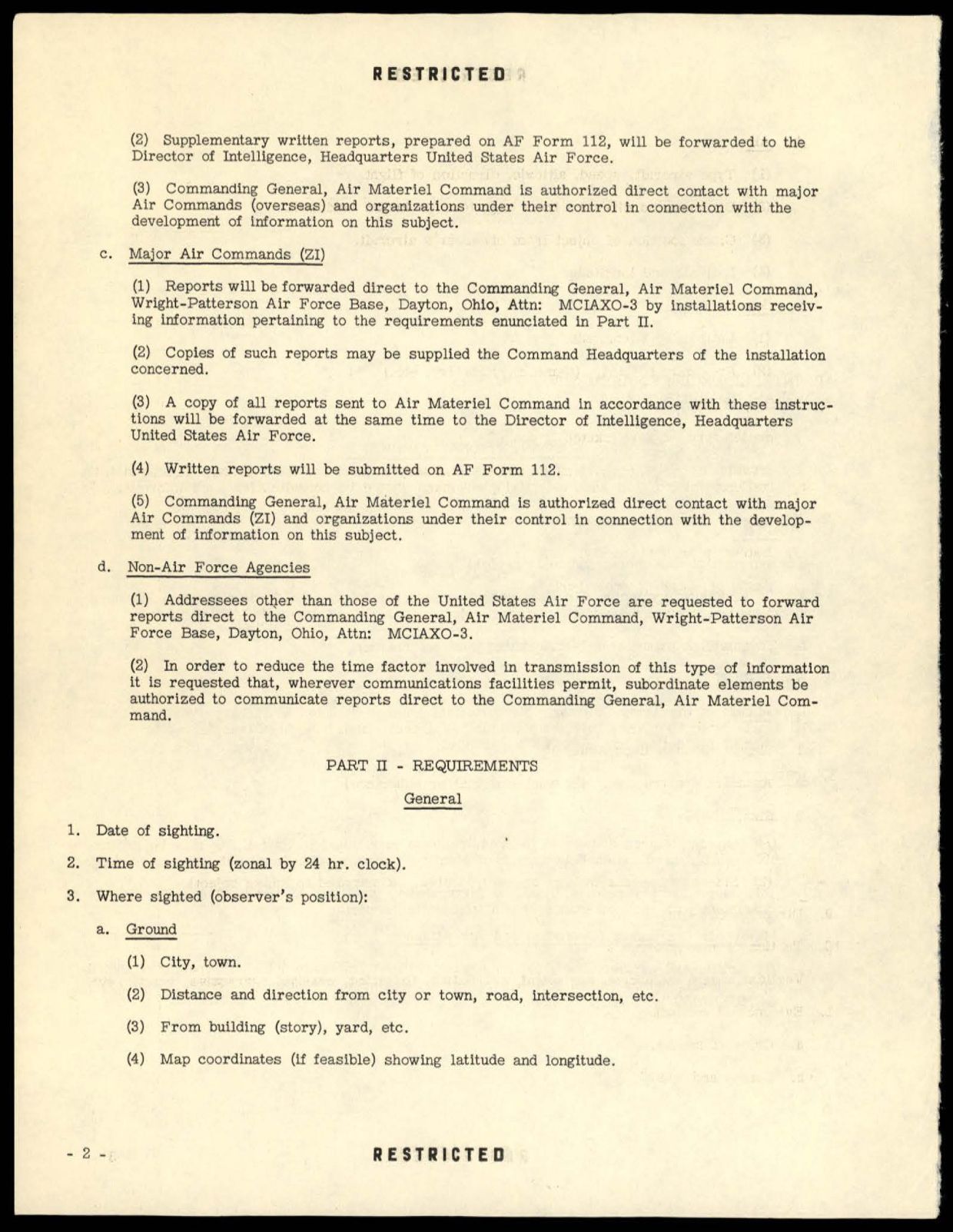
RESTRICTED (2) Supplementary written reports, prepared on AF Form 112, will be forwarded to the Director of Intelligence, Headquarter s United States Air Force. (3) Commanding General, Air Materiel Command is authorized direct contact with major Air Commands (overseas) and organizations under their control in connection with the development of information on this subject. c. Major Alr Commands (ZI) (1) Reports will be forwarded direct to the Commanding General, Air Materiel Command, Wright-Patterson Air Force Base, Dayton, Ohio, Attn: MCIAX0-3 by Installations receiv ing information pertaining to the requirements enunciated in Part II. (2) Coples of such r eports may be supplied the Command Headquarters of the installation concerned. (3) A copy of all reports sent to Air Materiel Command in accordance with these instruc tions will be forwarded at the same time to the Director of Intelllgence, Headquarters United States Air Force. (4) Written reports will be submitted on AF Form 112. (5) Commanding General, Air Materiel Command ls authorized direct contact with major Air Commands (ZI) and organizations under their control in connection with the develop ment of information on this subject . d. Non-Air Force Agencies (1) Addressees otqer than those of the United States Air Force are requested to forward reports direct to the Commanding General, Air Materiel Command, Wright-Patterson Air Force Base, Dayton, Ohio, Attn: MCIAX0-3. (2) In order to reduce the tlme factor involved 1n transmission of this type of information it ls requested that, wherever communications facilities permit, subordinate elements be authorized to communicate reports direct to the Commanding General, Air Materiel Com mand. PART Il - REQUIREMENTS General 1. Date of sighting. 2. Time of sighting (zonal by 24 hr. clock). 3. Wher e sighted (observer's position): a. Ground (1) City, town. (2) Distance and direction from city or town, road, Intersection, etc. (3) From building (story), yard, etc . (4) Map coordinates (if feasible) showing latitude and longitude. - 2 - RESTRICTED
PAGE 108 / 137
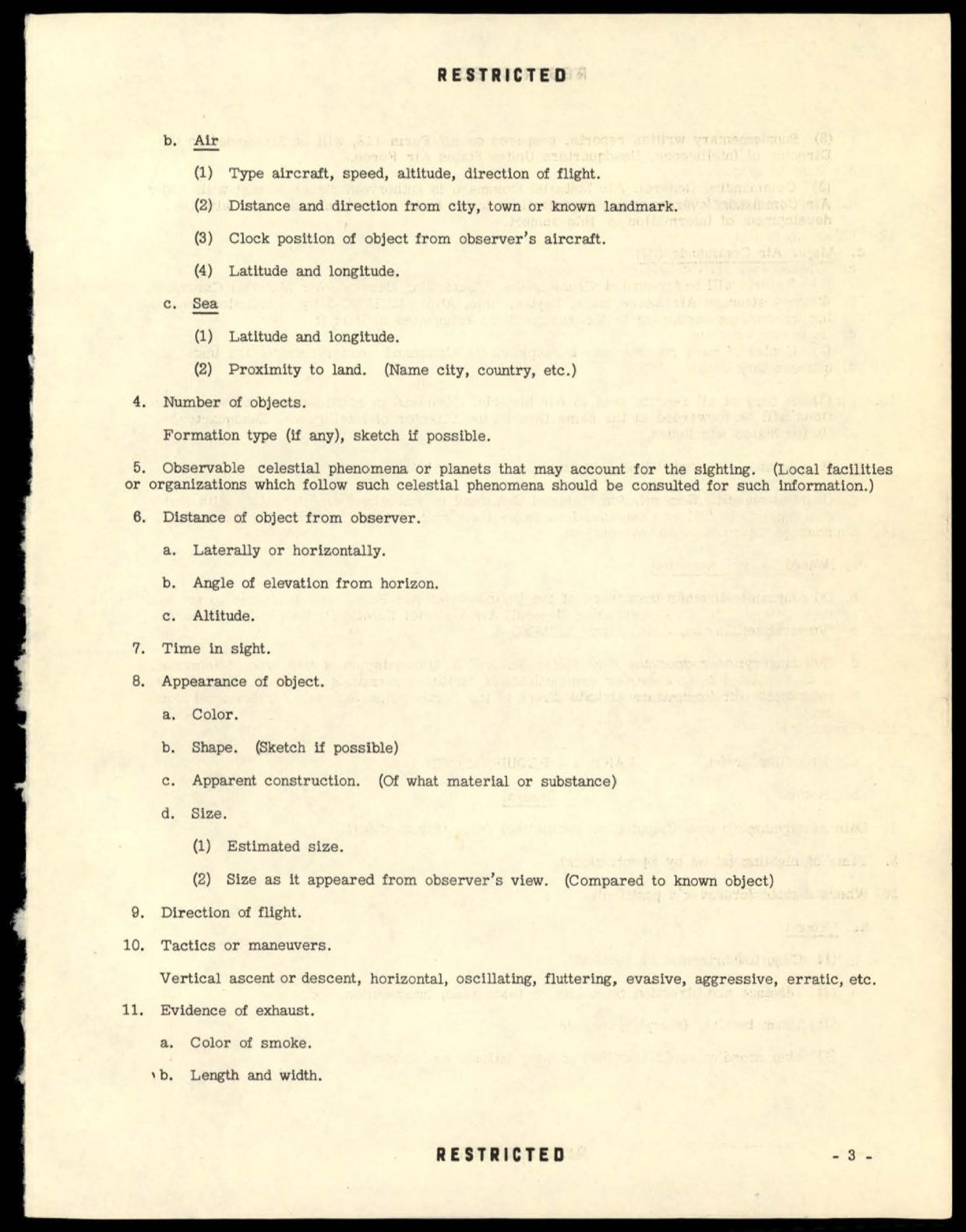
RESTRICTED b, Air (1) Type aircraft, speed, altitude, direction of flight. (2) Distance and direction fr om city, town or known landmark. (3) Clock position of object from observer's aircraft. (4) Latltude and longitude. c. Sea (1) Latitude and longitude. (2) Proximity to land. (Name city, country, etc.) 4. Number of objects. Formation type (!f any), sketch if possible. 5. Observable celestial phenomena or planets that may account for the sighting. (Local facllitles or organizations which follow such celestial phenomena should be consulted for such information.) 6. Distance of object from observer. a. Laterally or horizontally. b. Angle of elevation from horizon. c. Altitude. 7. Tl.me 1n sight. 8. Appearance of object. a. Color. b. Shape. (Sketch if possible) c. Apparent construction. (Of what material or substance) d. size. (1) Estimated size. (2) Size as it appeared from observer's view. (Compared to known object) 9. Dir ection of flight. 10. Tactics or maneuvers. Vertical ascent or descent, horizontal, osclllating, fluttering, evasive, aggressive, er ratic, etc. 11. Evidence of exhaust. a. Color of smoke. , b. Length and width. RESTRICTED - 3
PAGE 109 / 137
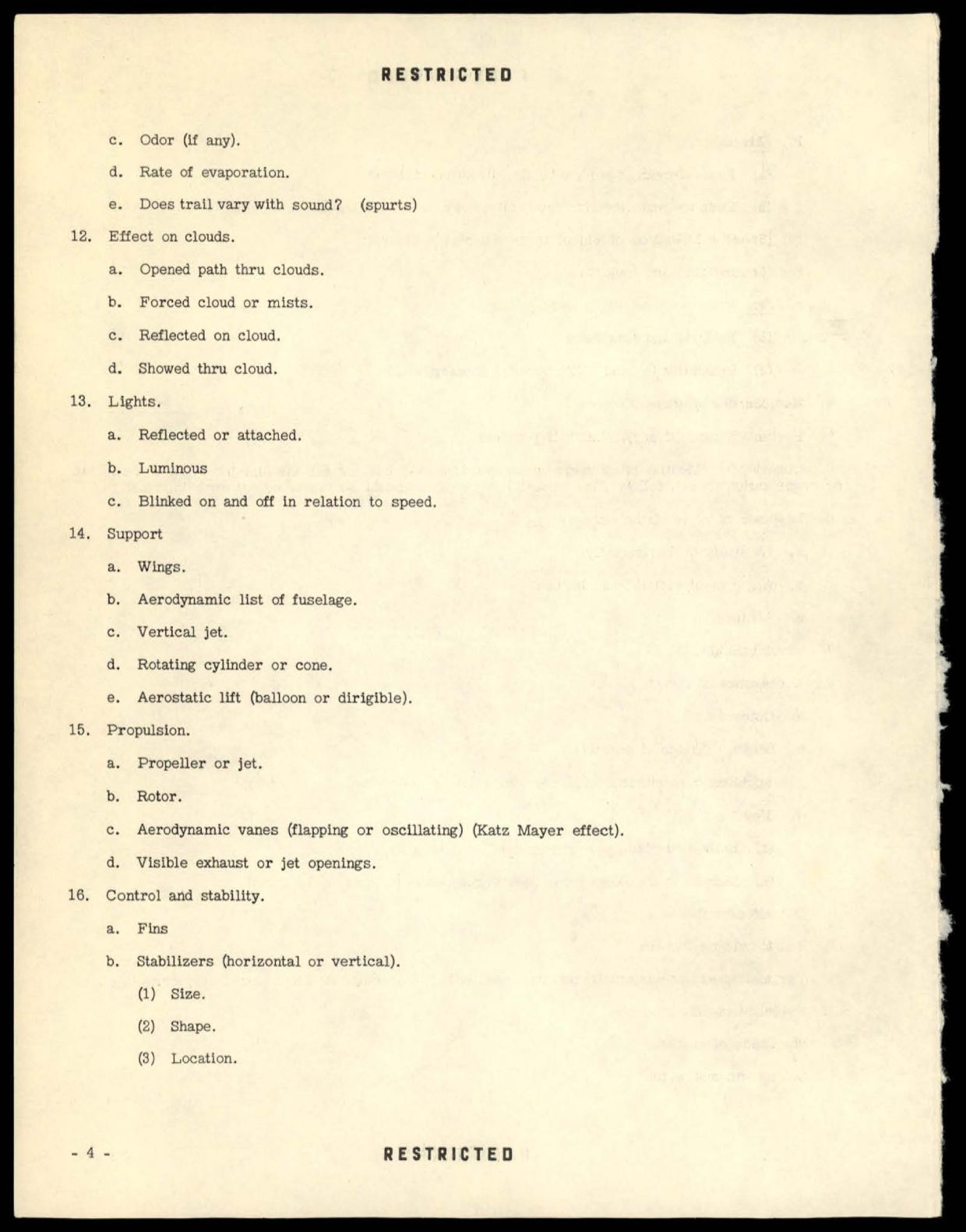
RESTRICTED
c.
Odor (if any).
d. Rate of evaporation.
e. Does trall vary with sound?
(spurts)
12. Effect on clouds.
a.
Opened path thru clouds.
b.
Forced cloud or mists.
c. Reflected on cloud.
d. Showed thru cloud.
13. Lights.
a. Reflected or attached.
b.
Luminous
c. Bllnked on and off l.n relation to speed.
14. Support
a. Wings.
b.
Aerodynamic list of fusel~e.
c. Vertical jet.
d.
Rotating cylinder or cone.
e. Aerostatic lift (balloon or dirigible).
15. Propulsion.
a.
Propeller or jet.
b.
Rotor.
c. Aerodynamlc vanes (flapping or oscUlating) (Katz Mayer effect).
d. Visible exhaust or jet openings.
16. Control and stability.
a. Fins
b.
StabiHzers (horizontal or vertical).
(1) Size.
(2) Shape.
(3) Location.
- 4 -
RESTRICTED
PAGE 110 / 137
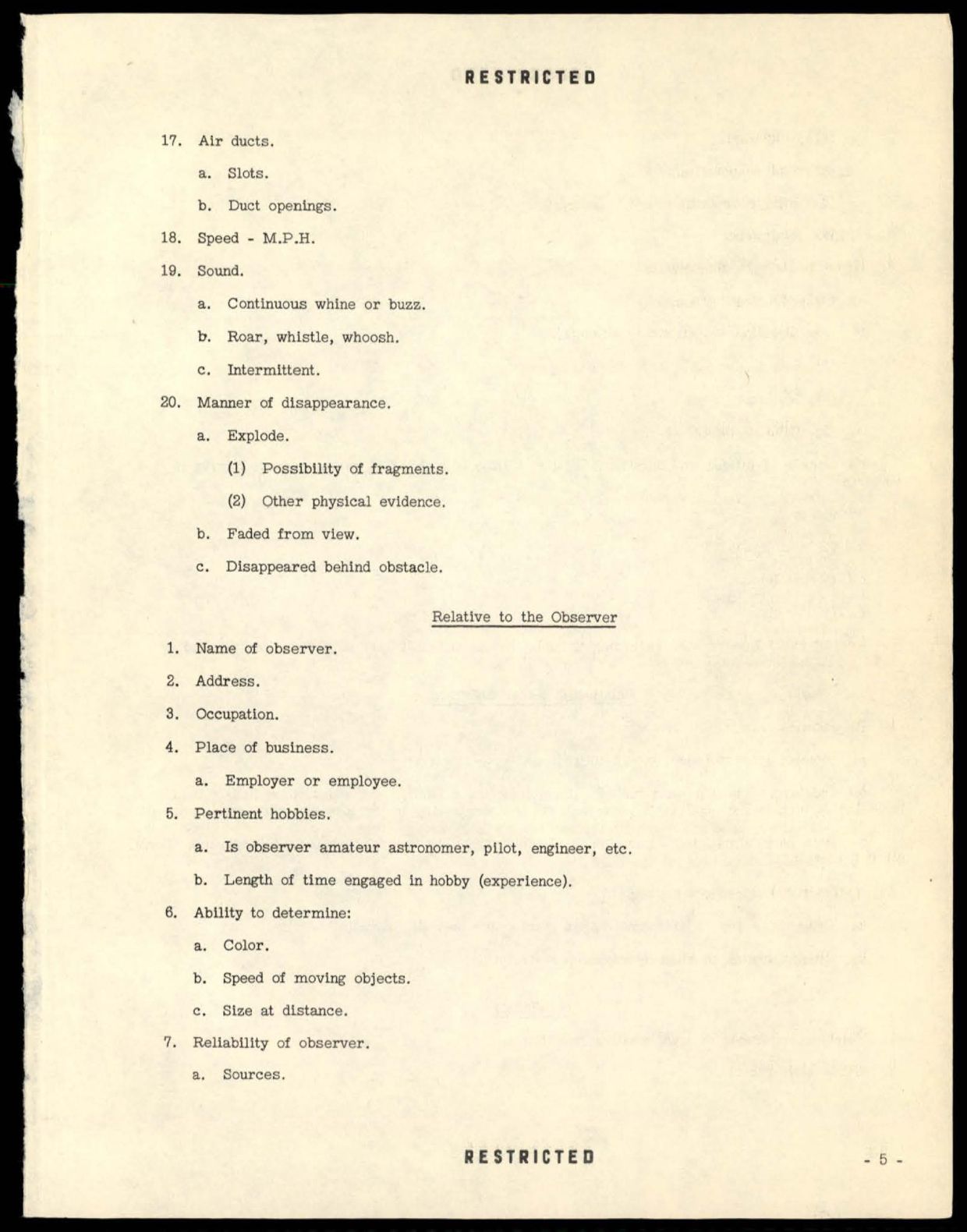
RESTRIC TED
17. Air ducts.
a. Slots.
b. Duct openlngs.
18. Speed - M.P.H.
19. Sound.
a. Contlnuous whine or buzz.
b. Roar, whistle, whoosh.
c. Intermittent.
20. Manner of disappearance.
a. Explode.
(1) Possibility of fragments.
(2)
Other physical evidence.
b.
Faded from view,
c.
Disappeared behind obstacle.
Relative to the Observer
1.
Name of observer.
2. Address.
3. Occupation.
4. Place of business.
a.
Employer or employee.
5.
Pertinent hobbies.
a. Is observer amateur astronomer, pilot, engineer, etc.
b. Length of time engaged in hobby (experience).
6. Ability to determine:
a.
Color.
b. Speed of moving objects.
c. Size at distance.
7.
Re11ab111ty of observer.
a.
Sources.
REST RICTED
- 5 -
PAGE 111 / 137
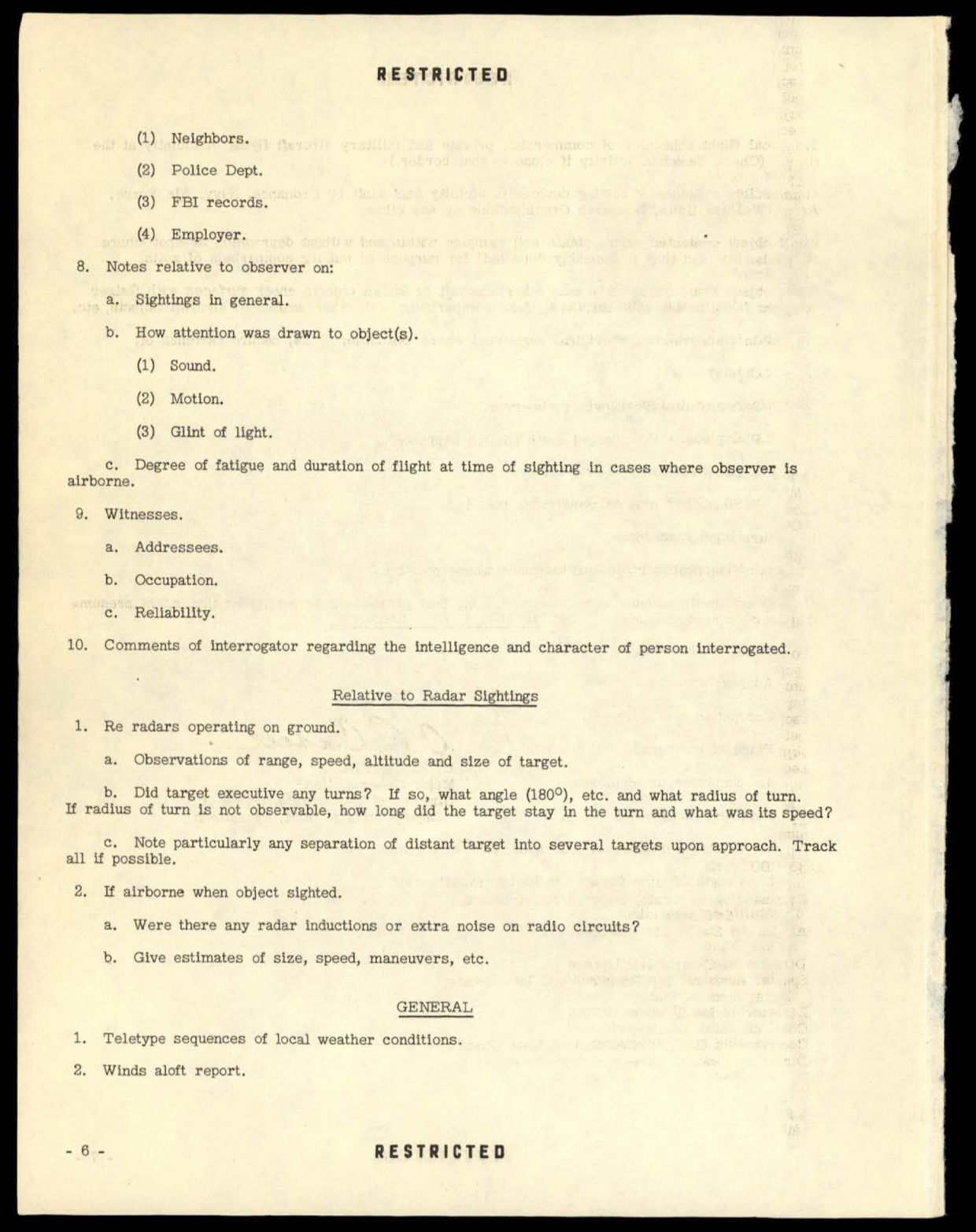
RESTRICTED
(1) Neighbors.
(2) Police Dept.
(3)
FBI records.
(4) Employer.
8.
Notes relative to observer on:
a. Sightings in general.
b. How attention was drawn to oblect(s).
(1) Sound.
(2) Motion.
(3) Glint of light.
c. Degree of fatigue and duration of flight at time of sighting ln cases where observer is
airborne.
9. Witnesses.
a. Addressees.
b.
Occupation.
c. Rell.ability.
10. Comments of interrogator regarding the lntelHgence and character of person interrogated.
Relative to Radar Sightings
1. Re radars operating on ground.
a. Observations of range, speed, altitude and size of target.
b. Did target executive any turns? If so, what angle (180°), etc. and what radius of turn.
If radius of turn ls not observable, how long did the target stay in the turn and what was I.ts speed?
c. Note particularly any separation of distant target into several targets upon approach. Track
all 1f possible.
2. If airborne when object sighted.
a. Were there any radar inductions or extra noise on radio circuits?
b. Give estimates of size, speed, maneuvers, etc.
GENERAL
1. Teletype sequences of local weather conditions.
2. Winds aloft report.
- 6 -
RESTRICTED
PAGE 112 / 137
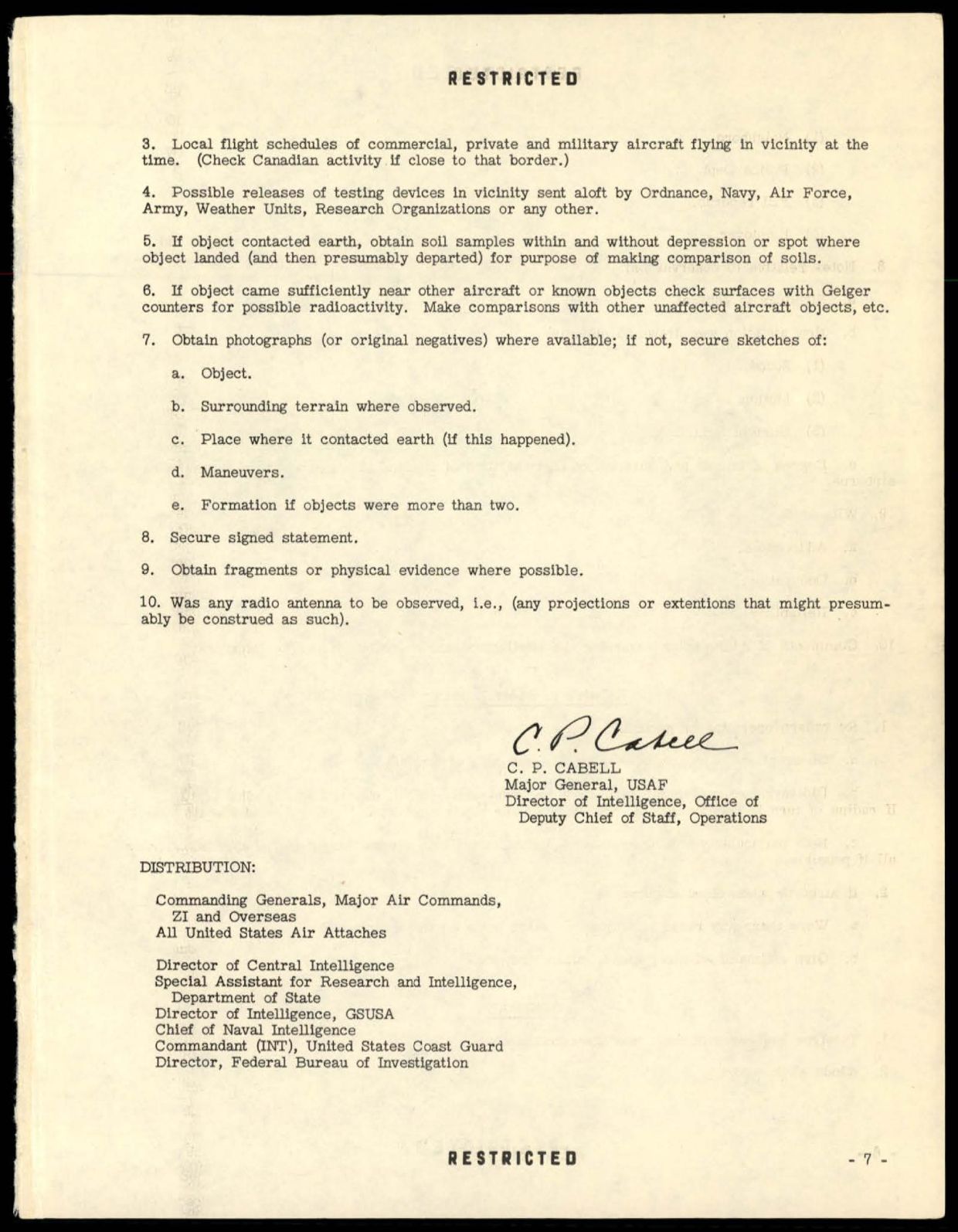
RESTRICTED 3. Local flight schedules of commercial, private and m111tary aircraft flylng ln vicinlty at the tlme. (Check Canadian activity 1f close to that border.) 4. Possible releases of testing devices 1n vicinity sent aloft by Ordnance, Navy, Air Force, Army, Weather Units, Research Organizations or any other. 5. If object contacted earth, obtain soil samples within and without depression or spot where object landed (and then presumably departed) for purpose of making comparison of sons. 6. If object came sufficiently near other aircraft or known objects check surfaces with Gelger counters for possible radioactivity. Make comparisons with other unaffected aircraft objects, etc. 7. Obtain photographs (or original negatives) where available; if not, secure sketches of: a . Object. b. Surrounding terrain where observed. c. Place where it contacted earth (if this happened). d. Maneuvers. e. Formation 1f objects were more than two. 8. Secure signed statement, 9. Obtain fragments or physical evidence where possible. 10. Was any radlo antenna to be observed, Le., (any projections or extentions that might presum ably be construed as such). c.P~ C. P. CABELL Major General, USAF Director of IntelUgence, Office of Deputy Chief of Staff, Operations DISTRIBUTION: Commanding Generals, Major Air Commands, ZI and Overseas All United States Air Attaches Director of Central Intelligence Special Assistant for Research and Intelligence, Department of State Director of Intelligence, GSUSA Chief of Naval Intelligence Commandant (INT), United States Coast Guard Director, Federal Bureau of Investigation AESTRICTED - 7 -
PAGE 113 / 137
RESTRICTED
RESTRICTED
PAGE 114 / 137
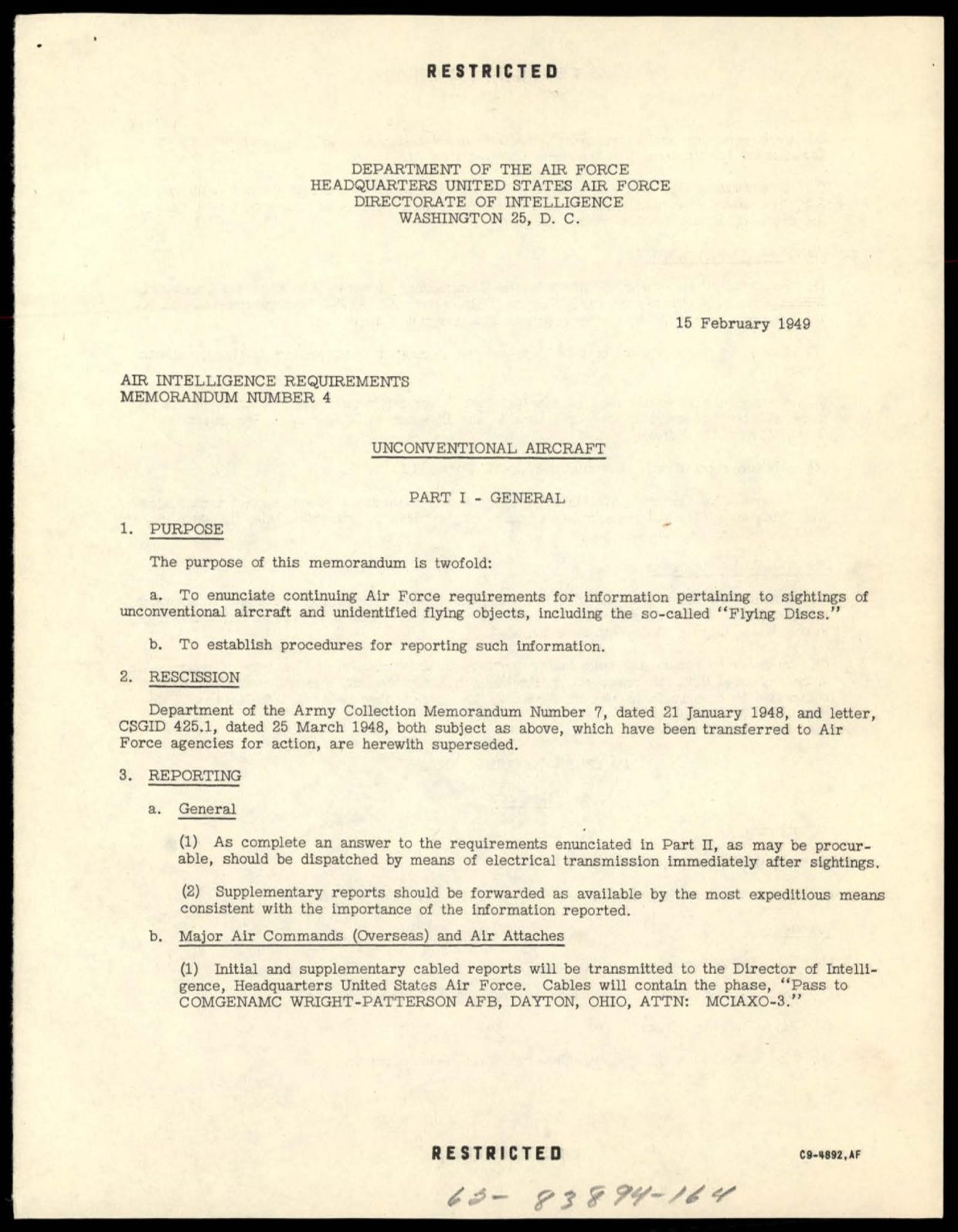
RESTRICTED DEPARTMENT OF THE AIR FORCE HEADQUARTERS UNITED STATES AIR FORCE DIRECTORATE OF INTELLIGENCE WASHINGTON 25, D. C. 15 February 1949 AIR INTELLIGENCE REQUIREMENTS MEMORANDUM NUMBER 4 UNCONVENTIONAL AIRCRAFT PART I - GENERAL 1. PURPOSE The purpose of this memorandum ls twofold: a. To enW1ciate continuing Alr Force requirements for information pertaining to sightings of Wlconventlonal aircraft and Wlidentified flying objects, including the so-called "Flying Discs." b. To establish procedures for reporting such informatlon. 2. RESCISSION Department of the Army Collection Memorandum Number 7, dated 21 January 1948, and letter, CSGID 425.1, dated 25 March 1948, both subject as above, which have been transferred to Air Force agencies for action, are herewith superseded. 3. REPORTING a. General (1) As complete an answer to the requirements enW1ciated in Part II, as may be procur able, should be dispatched by means of electrical transmission immediately after sightings. (2) Supplementary reports should be forwarded as available by the most expeditious means consistent with the importance of the information reported. b. Major Air . Commands (Overseas) and Air Attaches (1) Initial and supplementary cabled reports will be transmitted to the Director of Intelli gence, Headquarters United State:s Air Force. Cables wUl contain the phase, "Pass to COMGENAMC WRIGHT-PATTERSON AFB, DAYTON, OHIO, ATTN: MClAX0-3." RESTRICTED
PAGE 115 / 137
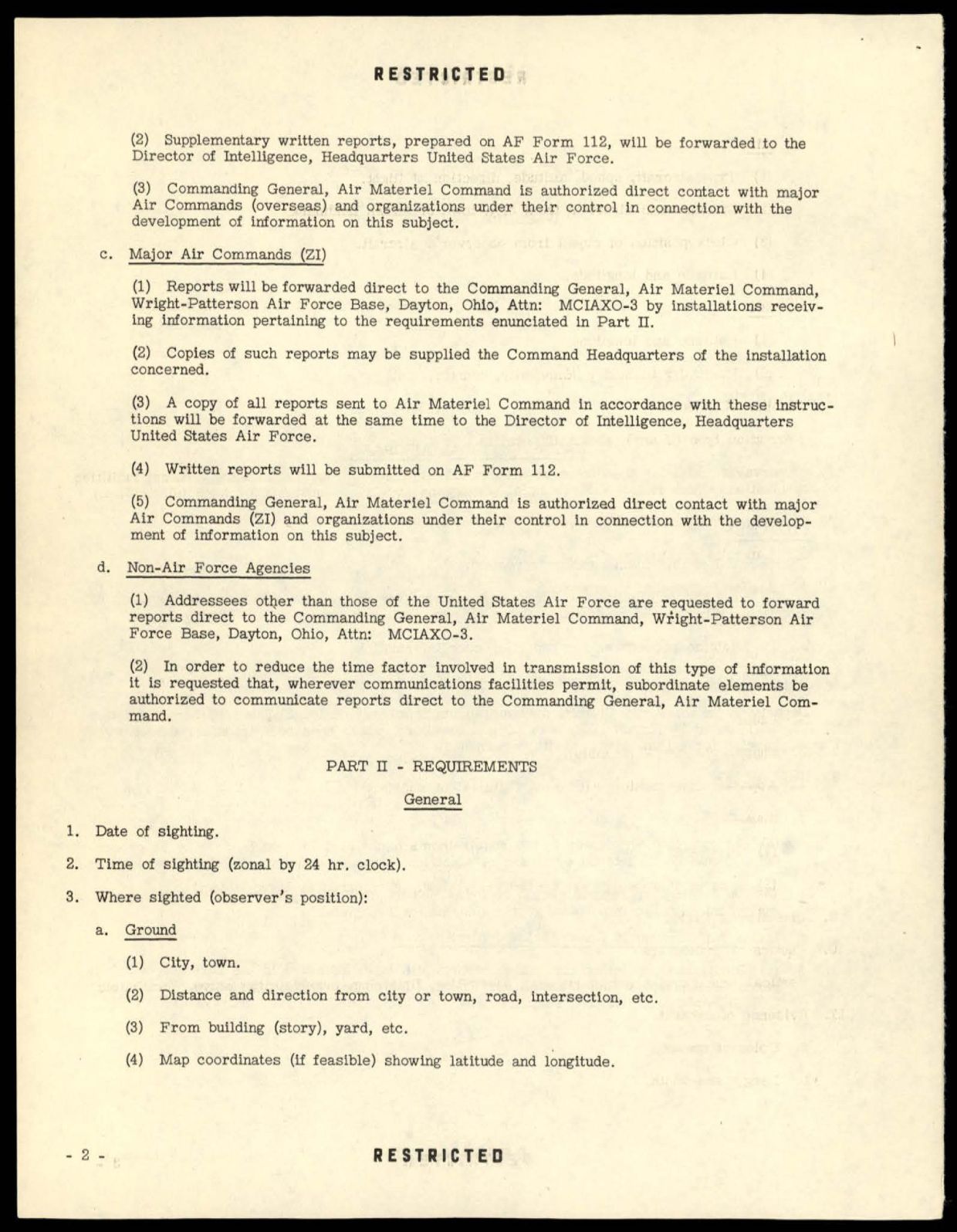
RESTRICTED (2) Supplementary written reports, prepared on AF Form 112, will be forwarded to the Director of Intelligence, Headquarters United States Air Force. (3) Commanding General, Air Materiel Command is authorized direct contact wlth major Air Commands (overseas) and organizations under their control in connection with the development of in.formation on this subject. c. Major Air Commands (ZI) (1) Reports wm be forwarded direct to the Commanding General, Air Materiel Command, Wright-Patterson Air Force Base, Dayton, Ohio, Attn: MCIAX0-3 by installations receiv ing information pertaining to the requirements enunciated in Part II. (2) Coples of such reports may be supplled the Command Headquarters of the installation concerned. (3) A copy of all reports sent to Air Materiel Command in accordance with these instruc tions will be forwarded at the same time to the Director of Intelligence, Headquarters United States Air Force. (4) Written reports will be submitted on AF Form 112. (5) Commanding General, Air Materiel Command is authorized direct contact with major Air Commands (ZI) and organizations under their control in connectlon with the develop ment of information on this subject. d. Non-Air Force Agencies (1) Addressees otQer than those of the United States Air Force are requested to forward reports direct to the Commanding General, Air Materiel Command, Wright-Patterson Air Force Base, Dayton, Ohio, Attn: MCIAX0-3. (2) In order to reduce the time factor involved in transmission of this type of information it is r equested that, wherever communications facilities permit, subordinate elements be authorized to communicate reports direct to the Commanding General, Air Materiel Com mand. PART ll - REQUIREMENTS General 1. Date of sighting. 2. Time of sighting (zonal by 24 hr. clock). 3. Where sighted (observer's position): a. Ground (1) City, town. (2) Distance and direction from city or town, road, intersection, etc. (3) From building (story), yard, etc. (4) Map coordinates (if feasible) showing latitude and longitude. - 2 - RESTRICTED
PAGE 116 / 137
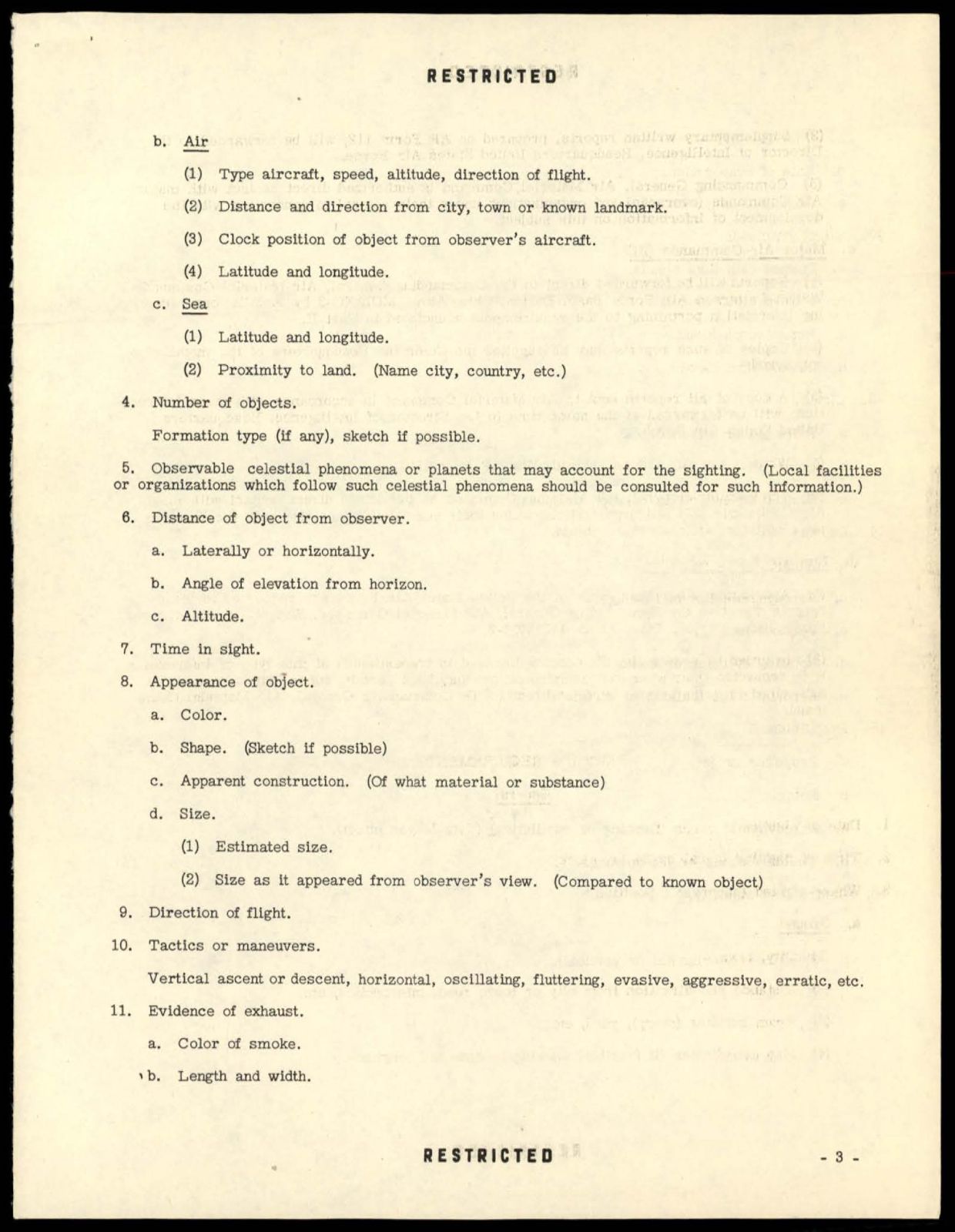
RESTRICTED
b , Air
(1)
Type aLrcraft, speed, altltude, direction of fllght.
(2)
Distance and direction from city, town or known landmark.
(3)
Clock positlon of object from observer's aircraft.
(4) Latitude and longitude.
c. Sea
(1) Latitude and longitude.
(2) Proximity to land.
(Name city, country, etc.)
4. Number of objects.
Formation type (1! any), sketch if possible.
5. Observable celestial phenomena or planets that may account for the sighting.
(Local facilities
or organizations which follow such celestial phenomena should be consulted for such information.)
6.
Distance of object from observer.
a. Laterally or horizontally.
b. Angle of elevation from horizon.
c. Altitude.
7. Time in sight.
8, Appearance of object.
a. Color.
b. Shape.
(Sketch if posslble)
c. Apparent constructlon.
(Of what material or substance)
d. Size.
(1) Estimated slze.
(2) Size as it appeared from observer's view. (Compared to known object)
9. Direction of fllght.
10. Tactics or maneuvers.
Vertical ascent or descent, horizontal, osclllat1ng, fluttering, evasive, aggressive, erratic, etc.
11. Evidence of exhaust.
a.
Color of smoke.
1 b. Length and width.
RESTRICTED
- 3 -
•
PAGE 117 / 137
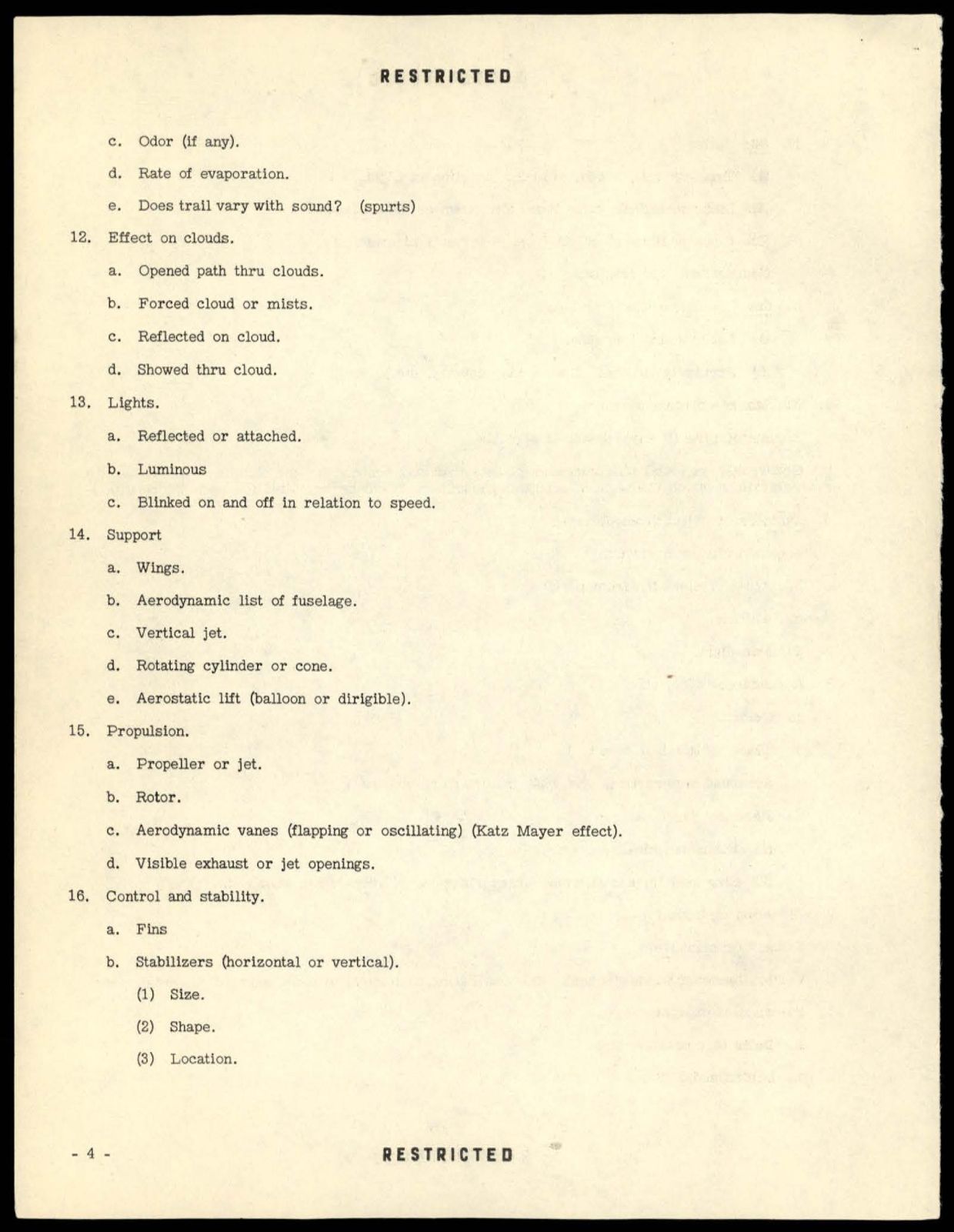
RESTRICTED
C.
Odor (1.f any).
d. Rate of evaporation.
e. Does trail vary wlth sound?
(spurts)
12. Effect on clouds.
a. Opened path thru clouds.
b. Forced cloud or mists.
c. Reflected on cloud.
d. Showed thru cloud.
13. Lights.
a. Reflected or attached.
b. Lumlnous
c. Blinked on and off ln relation to speed.
14. Support
a. Wings.
b. Aerodynamic list of fuselage.
c. Vertical jet.
d. Rotating cylinder or cone.
e . Aerostatlc llit (balloon or dlr1glble).
16. Propulsion.
a. Propeller or jet.
b. Rotor.
c. Aerodynamic vanes (flapping or oscillating) (Katz Mayer effect).
d. Visible exhaust or jet openings.
16. Control and stability.
a. Fins
b. Stab111zers (horizontal or vertical).
(1) Size.
(2) Shape.
(3) Location.
- 4 -
RESTRICTE D
PAGE 118 / 137
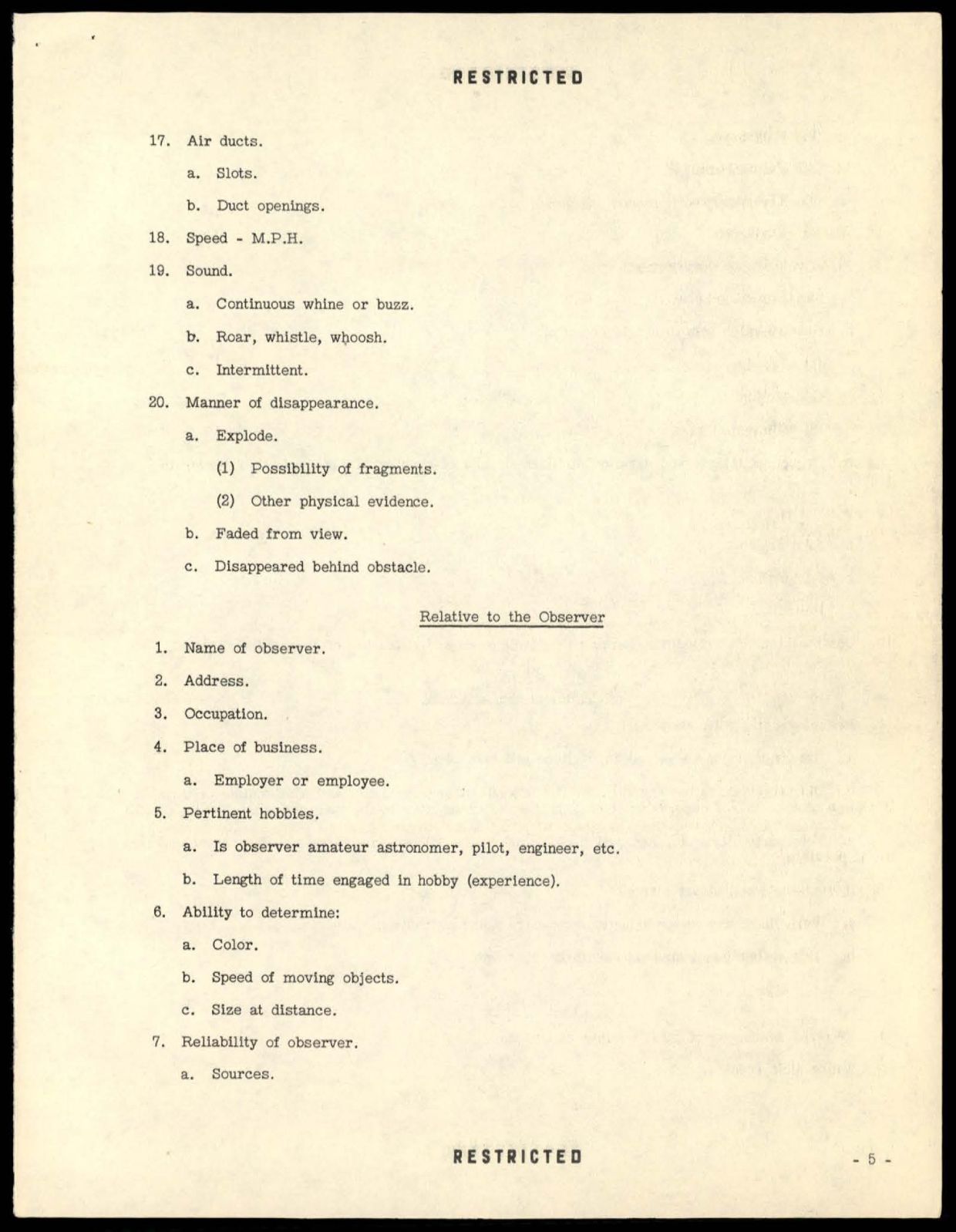
RESTRICTED
17. Air ducts.
a. Slots.
b. Duct openings.
18. Speed - M.P.H.
19. Sound.
a. Continuous whlne or buzz.
b. Roar I whistle, wooosh.
c. Intermittent.
20. Manner of disappearance.
a.
Explode.
(1) Possibility of fragments.
(2) Other physical evidence.
b.
Faded from view.
c. Disappeared behind obstacle.
Relatlve to the Observer
1. Name of observer.
2.
Address.
3.
Occupation.
4. Place of buslness.
a. Employer or employee.
5.
Pertinent hobbies.
a. Is observer amateur astronomer, pilot, engineer, etc.
b. Length of time engaged in hobby (experience).
e.
Ability to determine:
a. Color.
b. Speed of moving objects.
c. Size at distance.
7. Reliability of observer.
a.
Sources.
RESTRICTED
- 5 -
PAGE 119 / 137
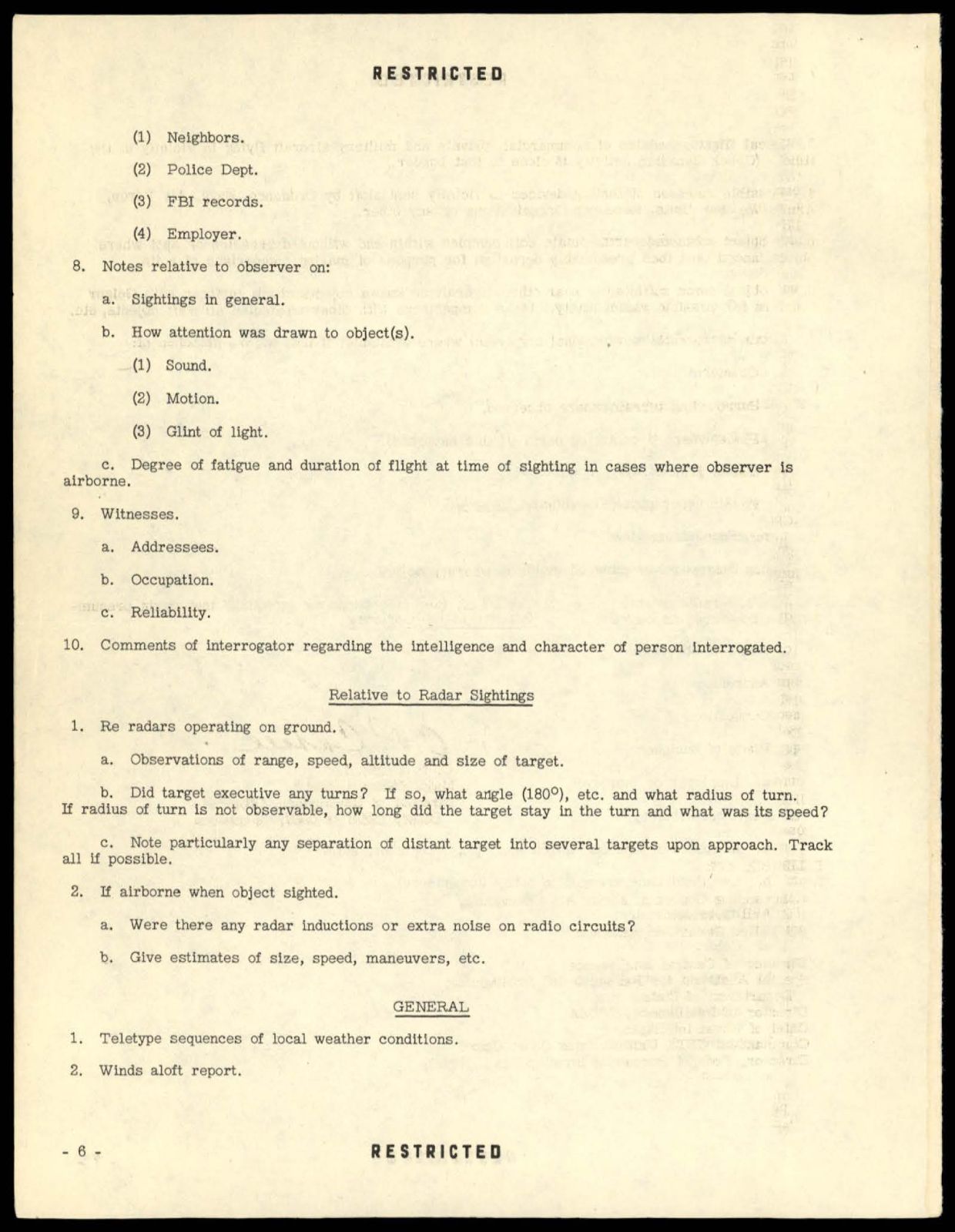
RESTRICTED
(1)
Neighbors.
(2) Police Dept.
(3) FBI records.
(4) Employer.
8. Notes relative to observer on:
a. Sightings in general.
b. How attention was drawn to object(s).
(1) Sound.
(2) Motion.
(3) Glint of light.
c. Degree of fatigue and duration of flight at time of sighting in cases where observer is
airborne.
9. Witnesses.
a. Addressees.
b. Occupation.
c. Reliability.
10. Comments of interrogator regarding the intelligence and character of person interrogated.
Relative to Radar Sightings
1. Re radars operating on ground.
a. Observations of range, speed, altitude and size of target.
b. Did target executive any turns? If so, what angle (180°), etc. and what radius of turn.
If radius of turn is not observable, how long did the target stay in the turn and what was its speed?
c . Note particularly any separation of distant target into several targets upon approach. Track
all Ii possible.
2. If airborne when object sighted.
a. Were there any radar inductions or extra noise on radio circuits?
b. Give estimates of size, speed, maneuvers, etc.
GENERAL
1. Teletype sequences of local weather conditions.
2. Winds aloft report.
- 6 -
RESTRICTED
PAGE 120 / 137
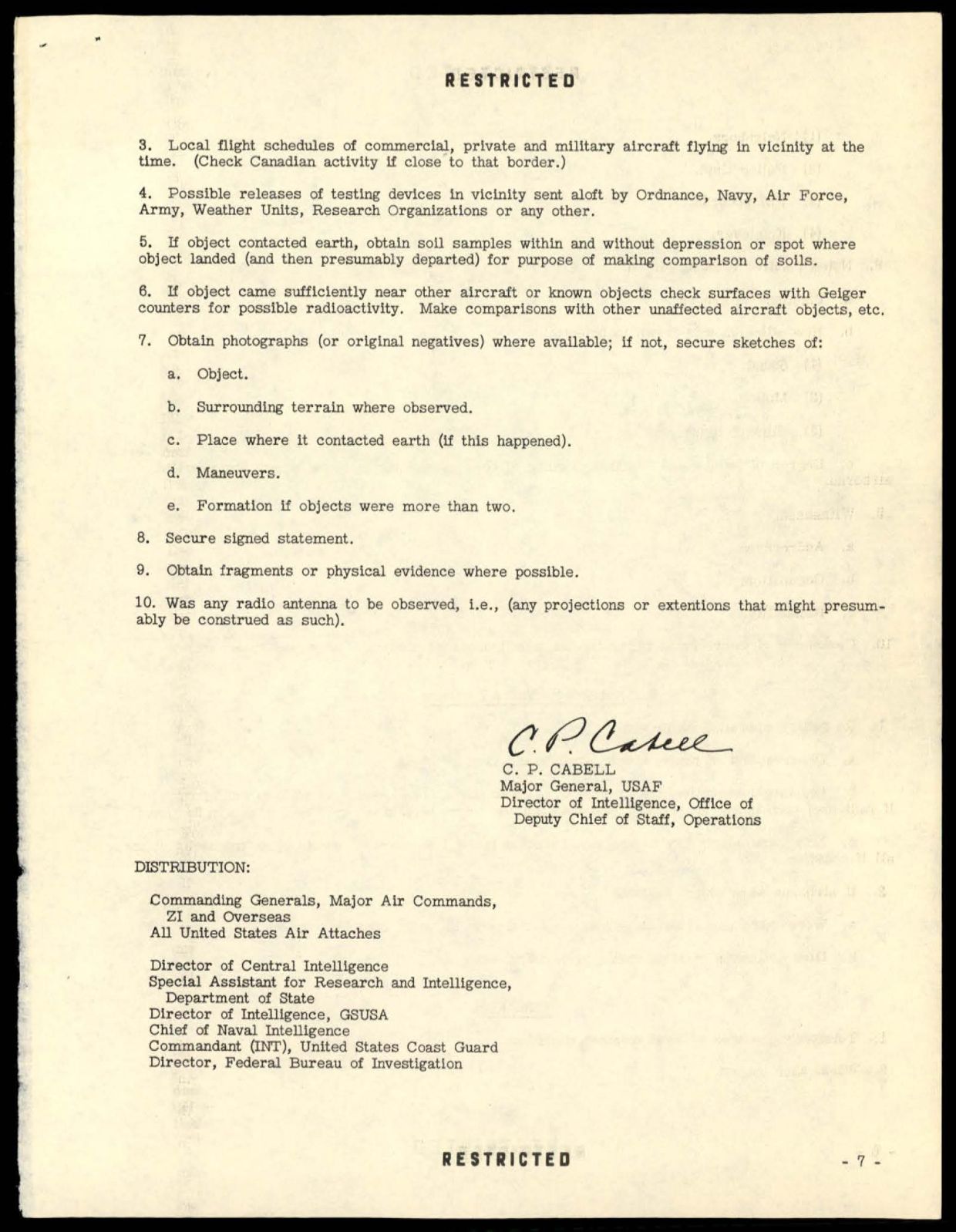
RESTRICTED 3. Local flight schedules of commercial, private and m.111tary aircraft flying In vicinity at the time. (Check Canadian activity 1f close to that border.) 4. Possible releases of testing devices 1n vicinity sent aloft by Ordnance, Navy, Air For ce, Army, Weather Units, Research Organizations or any other. 6. If object contacted earth, obtain son samples within and without depression or spot where object landed (and then presumably departed) for purpose of ma.king comparison of soils. 6. 11 object came sufficiently near other aircraft or known objects check surfaces with Geiger counters for possible radioactivity. Make comparisons with other unaffected aircraft objects, etc. 7. Obtain photographs (or original negatives) where available; if not, secure sketches of: a. Object. b. Surrounding terrain where observed. c. Place wher e it contacted earth (1.f this happened). d. Maneuvers. e. Formation if objects were more than two. 8. Secure signed statement. 9. Obtain fragments or physical evidence where possible. 10. Was any radio antenna to be observed, Le., (any projections or extentlons that might presum ably be construed as such). C. P . CABELL Major General, USAF Director of Intelligence, Office of Deputy Chief of Staff, Operations DISTRlBUTION: Commanding Generals, Major Alr Commands , ZI and overseas All United States Air Attaches Director of Central Intelligence Special Assistant for Research and Intelllgence, Department of State Director of Intelligence, GSUSA Chief of Naval Intelllgence Commandant (INT), United States Coast Guard Director, Federal Bureau of Investigation RES TRI CT ED - 7 -
PAGE 121 / 137
RESTRICTED
RESTRICTED
PAGE 122 / 137
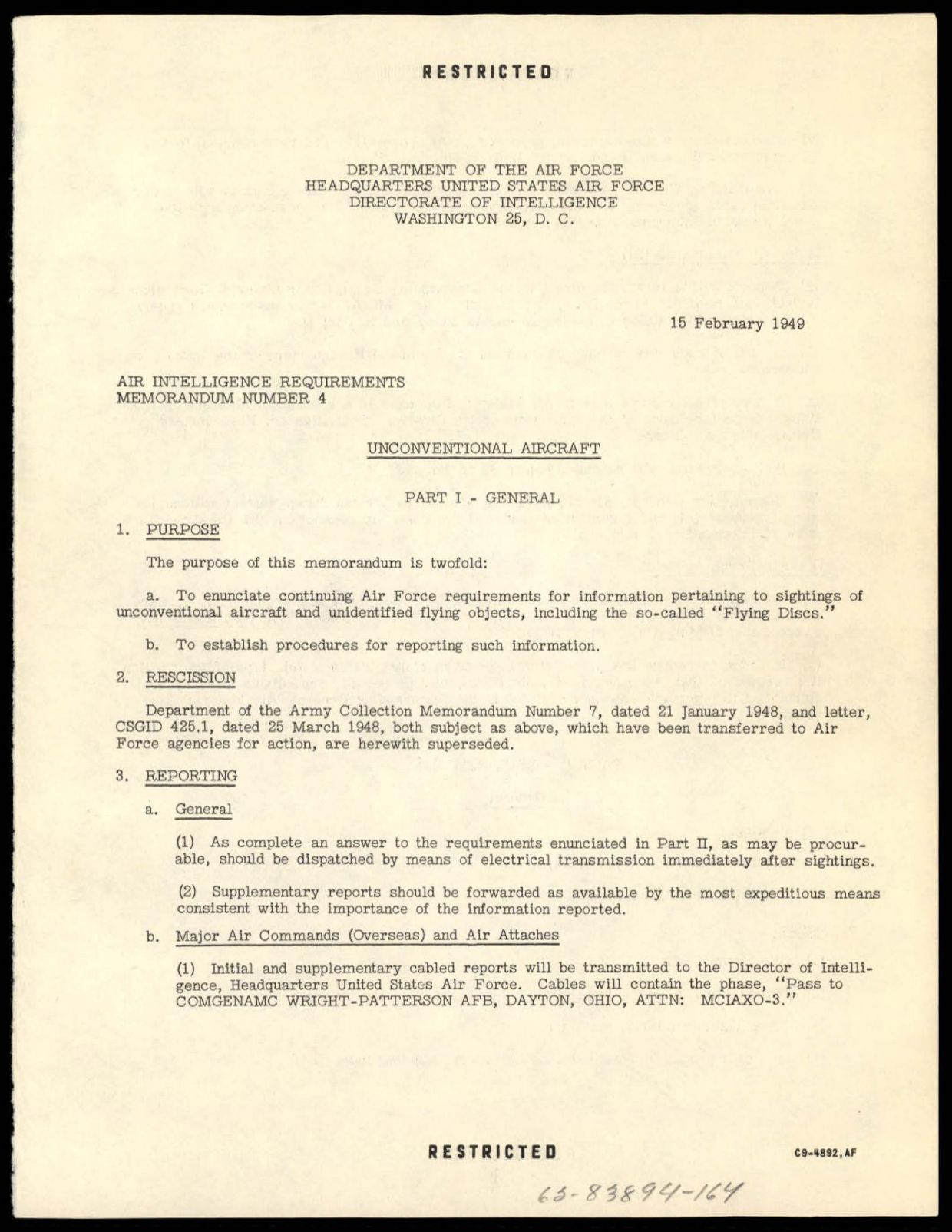
RESTRICTED DEPARTMENT OF THE Affi FORCE HEADQUARTERS UNITED STATES AIR FORCE DmECTORATE OF INTELLIGENCE WASHINGTON 26, D. C. 15 Febr uary Hl49 AIR INTELLIGENCE REQUIREMENTS MEMORANDUM NUMBER 4 UNCONVENTIONAL Am.CRAFT PART I - GENERAL 1. PURPOSE The purpose of this memorandum is twofold: a. To enunciate continuing Air Force requirements for information pertaining to sightings of unconventional aircraft and unidentified flying objects, including the so-called "Flying Discs.'' b. To establlsh procedures for reporting such information. 2. RESCISSION Department of the Army Collection Memorandum Number 7, dated 21 January 1948, and letter, CSGID 425.1, dated 25 March 1948, both subject as above, which have been transferred to Air Force agencies for action, are herewith superseded. 3. REPORTING a. General (1) As complete an answer to the requirements enunciated in Part II, as may be procur able, should be dispatched by means of electrical transmission immediately after sightings. (2) Supplementary reports should be forwarded as available by the most expeditious means consistent with the importance of the information reported. b. Major Air Commands (Overseas) and Air Attaches (1) Initial and supplementary cabled reports will be transmitted to the Dir ector of Intelli gence, Headquarters United Statc,s Air Force. Cables wm contain the phase, "Pass to COMGENAMC WRIGHT-PATTERSON AFB, DAYTON, OHIO, ATTN: MCIAX0-3." RESTRICTED C9•11892,AF b ~ - ff 1t- 9~-/t''/
PAGE 123 / 137
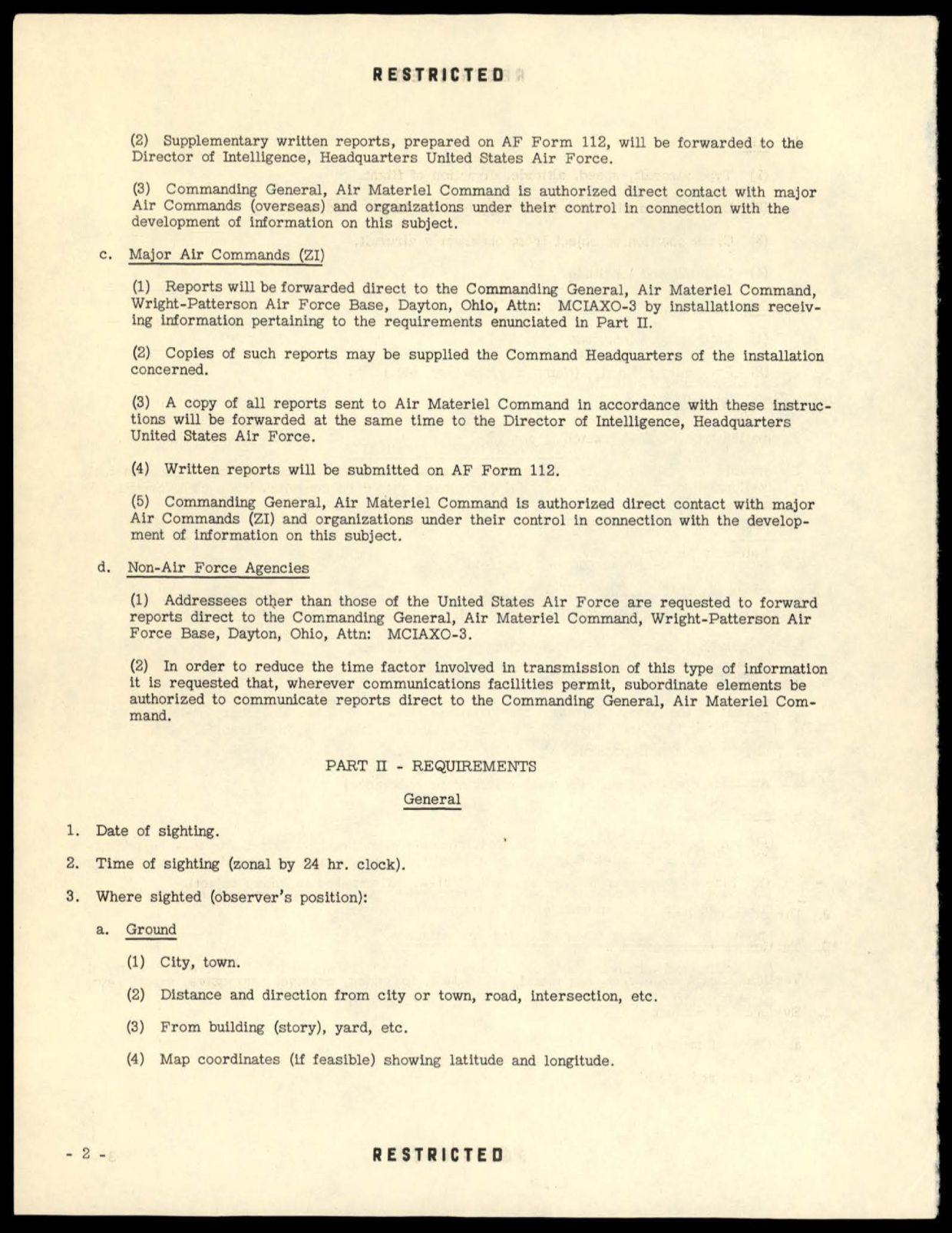
RESTRICTED (2) Supplementary written reports, prepared on AF Form 112, wlll be forwarded to the Director of Intelll.gence, Headquarters United States Air Force. (3) Commanding General, Air Materiel Command ls authorized direct contact WI.th major Air Commands (overseas) and organlzatl.ons under their control ln connection with the development of information on this subject. c. Major Air Commands (ZI) (1) Reports will be forwarded direct to the Commanding General, Air Materiel Command, Wright-Patterson Air Force Base, Dayton, Ohio, Attn: MCIAX0-3 by installations r eceiv ing information pertaining to the r equir ements enunciated in Part II. (2) Copies of such r eports may be supplied the Command Headquarter s of the installation concerned. (3) A copy of all reports sent to Air Materiel Command in accordance with these instruc tions wlll be forwarded at the same ti.me to the Director of Intelligence, Headquarters United States Air Force. (4) Written r eports wlll be submitted on AF Form 112. (6) Commanding General, Air Materiel Command is authorized direct contact with major Air Commands (Zl) and organizations under their control ln connection with the develop ment of information on this subject. d. Non-Air Force Agencies (1) Addressees ot~er than those of the United States Air Force are r equested to forward reports direct to the Commanding General, Air Materiel Command, Wright-Patterson Air Force Base, Dayton, Ohio, Attn: MCIAX0-3. (2) In order to r educe the ti.me factor involved in transmission of this type of information it is requested that, wher ever communications facilities permit, subordinate elements be authorized to communicate reports direct to the Commanding General, Air Materiel Com mand. PART II - REQUIB.EMENTS General 1. Date of sighting. 2. Tl.me of sighting (zonal by 24 hr. clock). 3. Where sighted (observer 's position): a. Ground (1) City, town. (2) Distance and direction from city or town, r oad, intersection, etc. (3) Fr om building (story), yard, etc. (4) Map coordinates (if feasible) showing latitude and longitude. - 2 - RESTRICTE D
PAGE 124 / 137
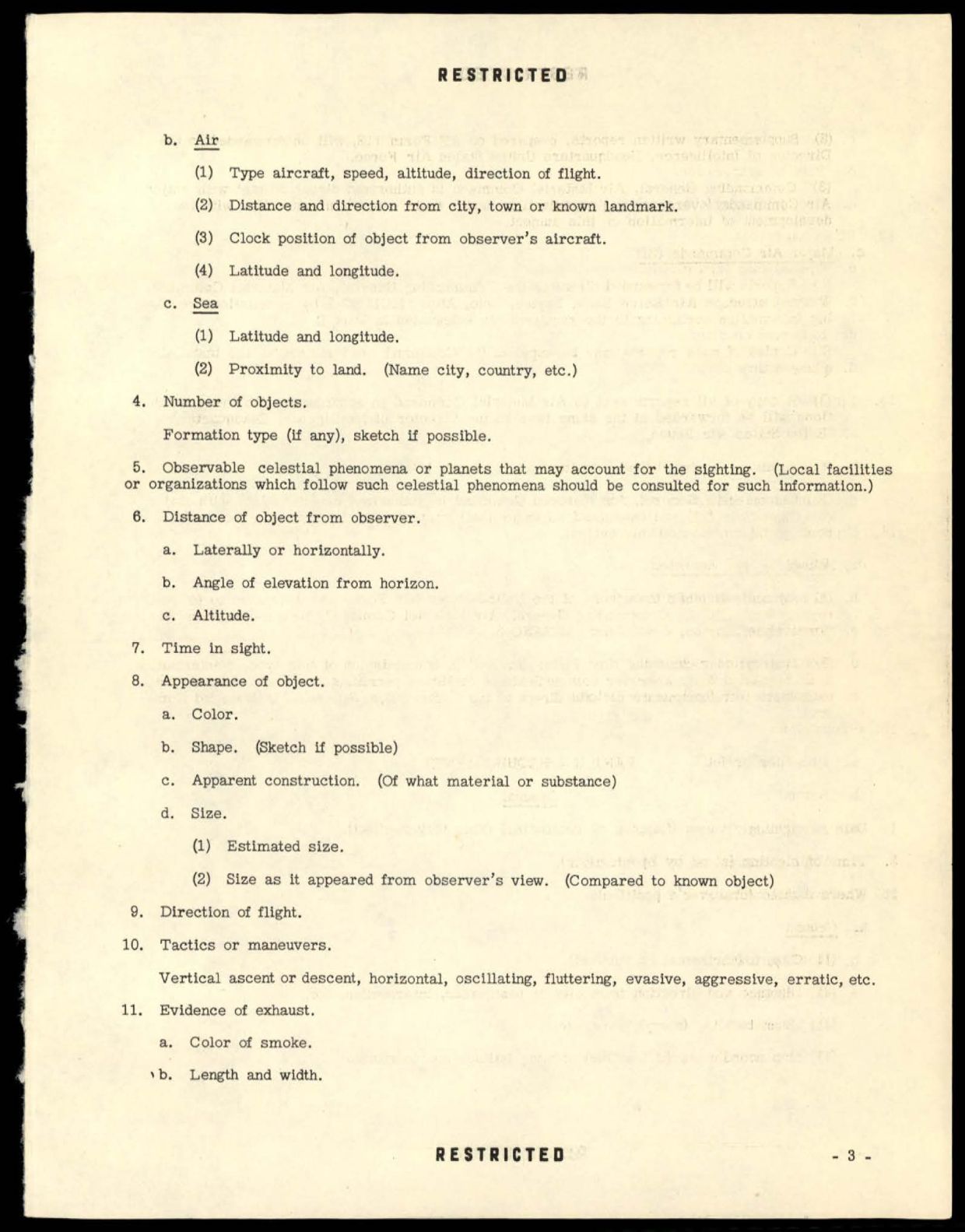
RESTRICTED b. Air (1) Type aircraft, speed, altitude, direction of flight. (2) Distance and dlrectlon from city, town or known landmark. (3) Clock position of object from observer's aircraft. (4) Latitude and longitude. c. Sea (1) Latitude and longitude. (2) Proximity to land. (Name city, country, etc.) 4. Number of objects. Formation type (Lf any), sketch if possible. 5. Observable celestial phenomena or planets that may account for the sighting. (Local facilities or organizations which follow such celestial phenomena should be consulted for such information.) 6. Distance of object from observer. a. Laterally or horizontally. b. Angle of elevation from horizon. c. Altitude. 7. Time 1n sight. 8. Appearance of object. a. Color. b. Shape. (Sketch if possible) c. Apparent construction. (Of what material or substance) d. Size. (1) Estimated size. (2) Size as it appeared from observer's view. (Compared to known object) 9. Direction of flight. 10. Tactics or maneuvers. Vertical ascent or descent, horizontal, oscillating, fluttering, evasive, aggressive, erratic, etc. 11. Evidence of exhaust. a. Color of smoke. , b. Length and width. RESTRICTED - 3
PAGE 125 / 137
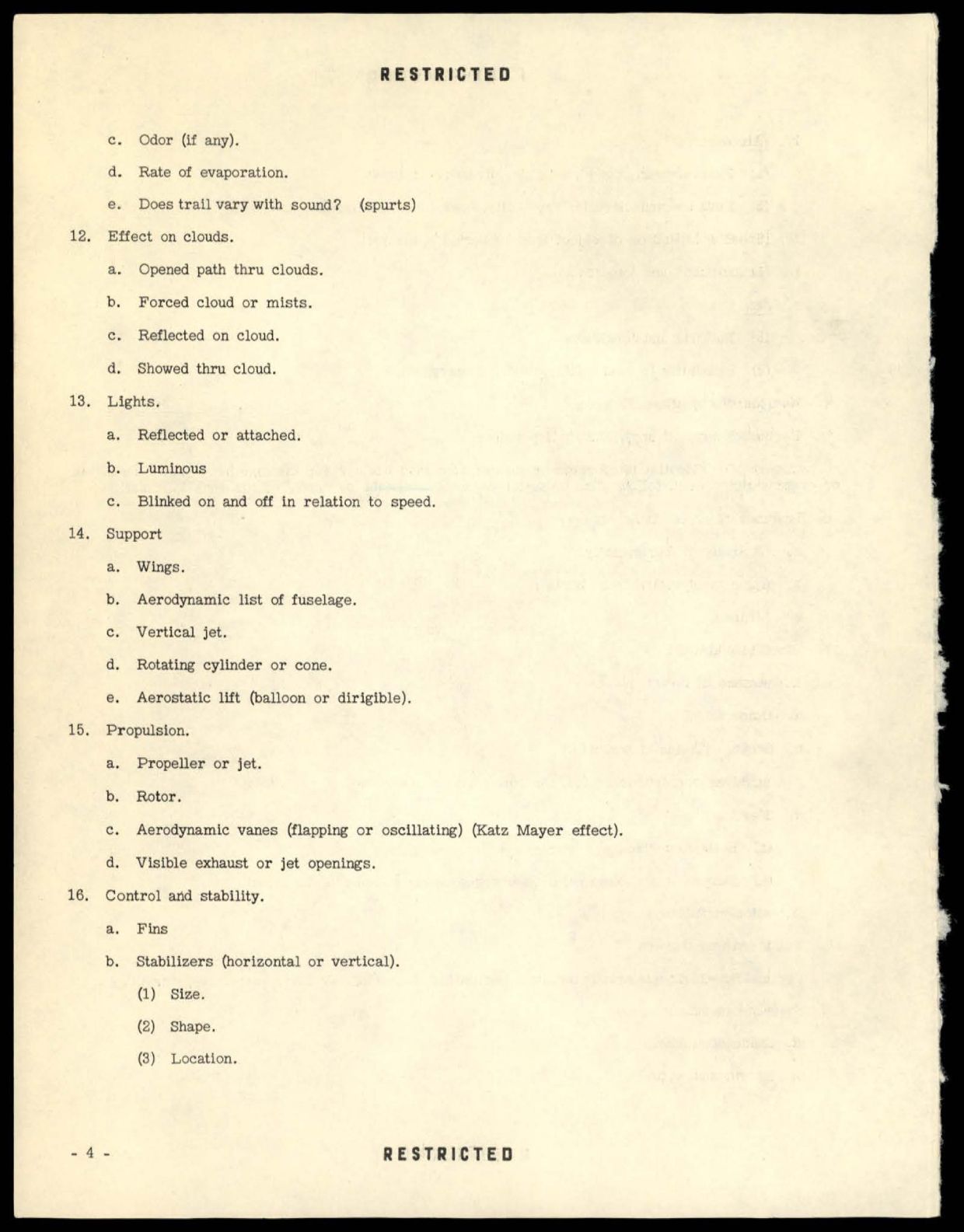
RESTRIC TE D
C.
Odor (if any).
d. Rate of evaporation.
e. Does trall vary with sound?
(spurts)
12. Effect on clouds.
a.
Opened path thru clouds.
b.
Forced cloud or mists .
c. Reflected on cloud.
d. Showed thru cloud.
13. Lights.
a.
Reflected or attached.
b.
Luminous
c.
Bllnked on and off in relation to speed.
14. Support
a. Wings.
b.
Aerodynamic list of fuselage.
c. Vertical jet.
d.
Rotating cylinder or cone.
e.
Aerostatic lift (balloon or dirigible).
15. Pr opulsion.
a.
Propeller or jet.
b.
Rotor .
c.
Aerodynamic vanes (flapping or oscillating) (Katz Mayer effect).
d. Vlslble exhaust or jet openings.
16.
Control and stability.
a. Fins
b.
Stabilizers (hor izontal or vertical).
(1) Size.
(2) Shape.
(3) Location.
- 4 -
RESTRICTED
PAGE 126 / 137
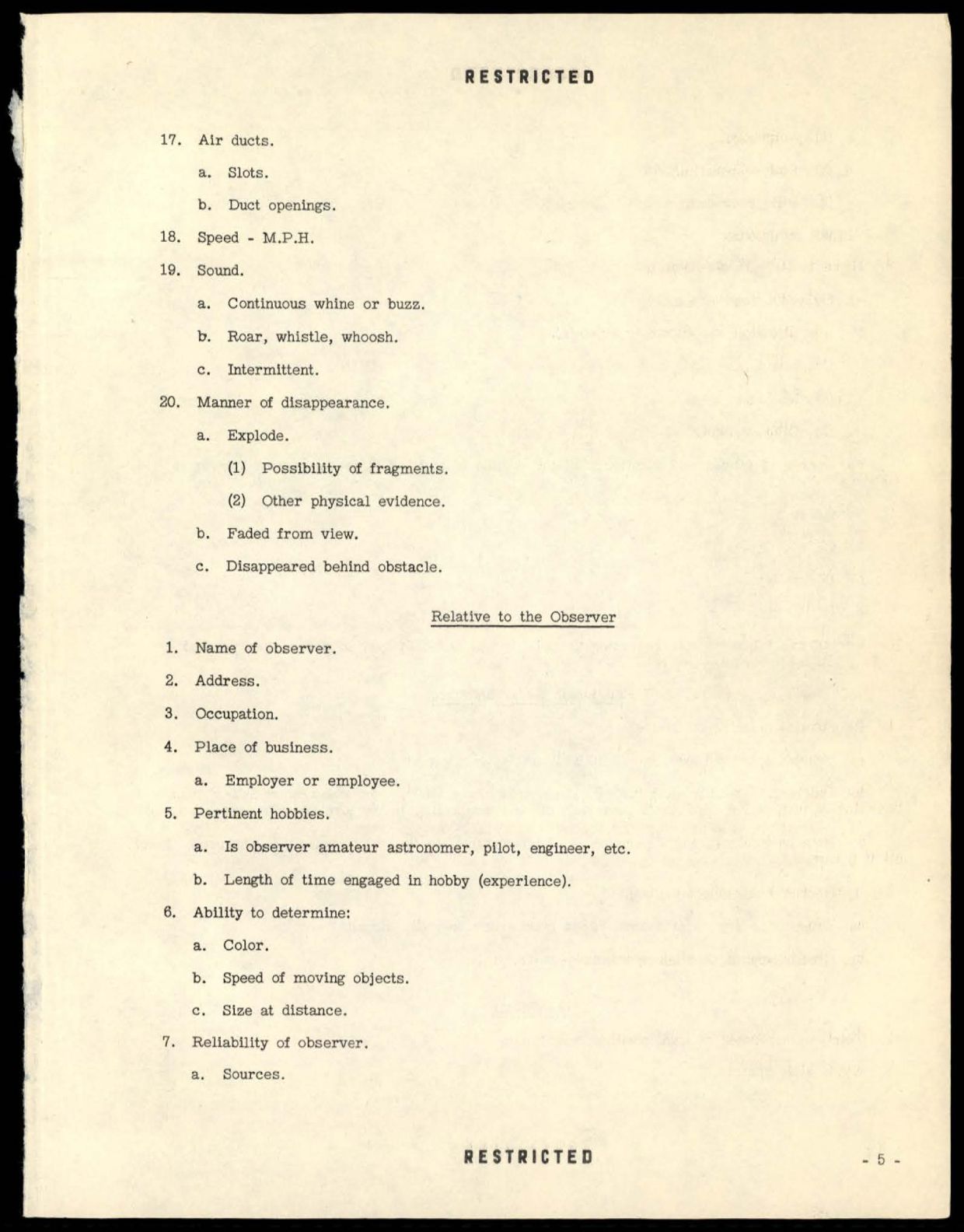
RESTRICTED
17. Air ducts.
a. Slots.
b. Duct openings.
18. Speed - M.P.H.
19. Sound.
a. Continuous whine or buzz.
b. Roar, whistle, whoosh.
C.
Intermittent.
20.
Manner of disappearance.
a. Explode.
(1) Possib111ty of fragments.
(2) Other physical evidence.
b. Faded from view.
c. Disappeared behind obstacle.
Relative to the Observer
1. Name of observer.
2. Address.
3.
Occupation.
4. Place of business.
a. Employer or employee.
5. Pertinent hobbies.
a. Is observer amateur astronomer, pUot, engineer, etc.
b. Length of time engaged in hobby (experience).
6.
Abllity to determine:
a. Color.
b. Speed of moving objects.
c . Size at distance.
7. Rellabllity of observer.
a.
Sources.
RESTRICTED
- 5 -
PAGE 127 / 137
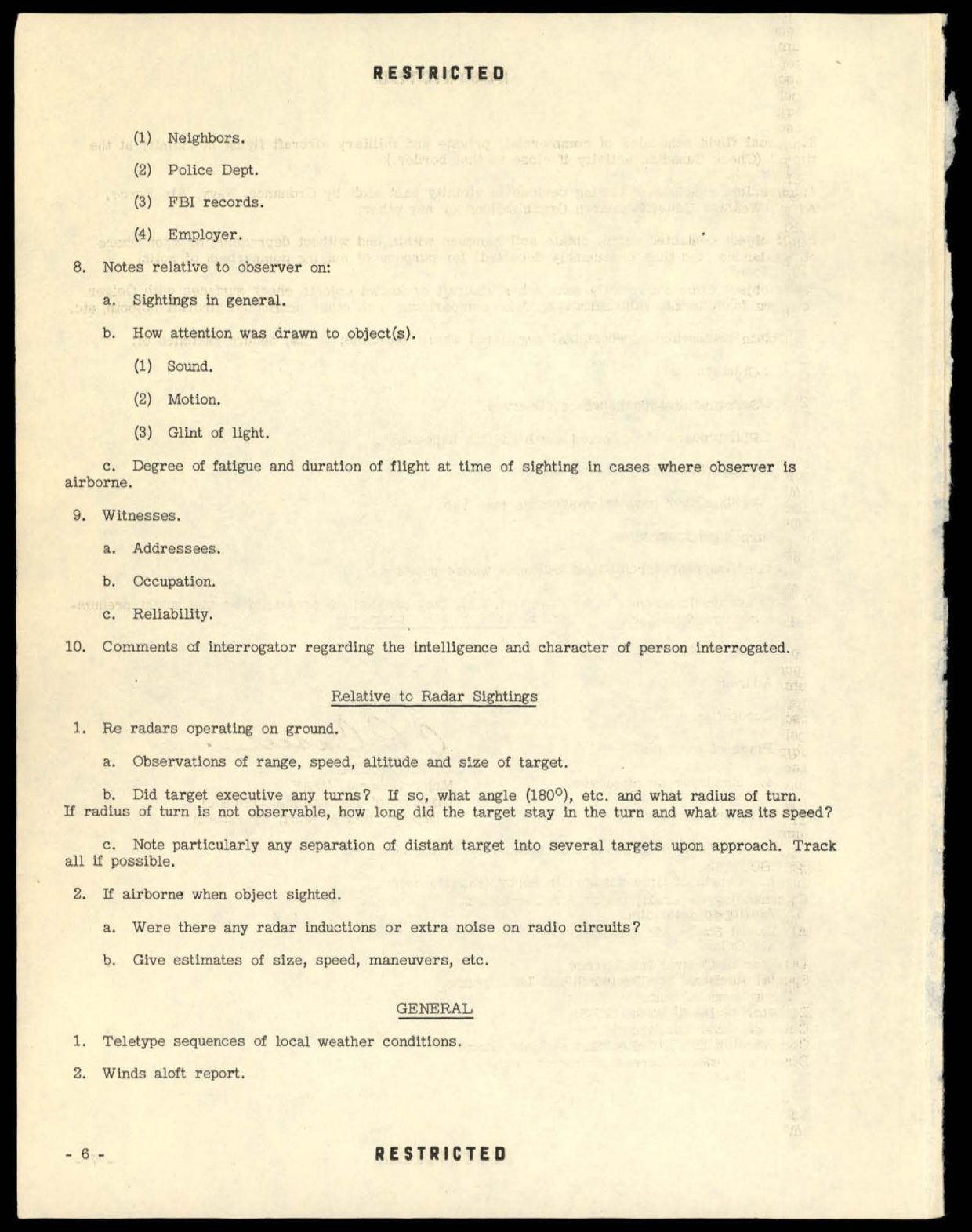
RESTRICTED
(1) Neighbors.
(2) Police Dept.
(3)
FBI records.
(4) Employer.
8. Notes relative to observer on:
a. Sightings in general.
b. How attention was drawn to object(s).
(1) Sound.
(2) Motion.
(3) Glint of light.
c. Degree of fatigue and duration of flight at time of sighting in cases where observer is
airborne.
9. Witnesses.
a. Addressees.
b. Occupation.
c. Reliability.
10. Comments of interrogator regarding the Lnte111gence and character of person interrogated.
Relative to Radar Sightings
1. Re radars operating on ground.
a. Observations of range, speed, altitude and size of target.
b. Did target executive any turns? If so, what angle (180°), etc. and what radius of turn.
If radius of turn is not observable, how long did the target stay 1n the turn and what was its speed?
c. Note particularly any separation of distant target into several targets upon approach. Track
all 1f possible.
2. If airborne when object sighted.
a. Were there any radar inductions or extra noise on radio circuits?
b. Give estimates of size, speed, maneuvers, etc.
GENERAL
1. Teletype sequences of local weather conditions.
2. Winds aloft report.
- 6 -
RESTRICTED
PAGE 128 / 137
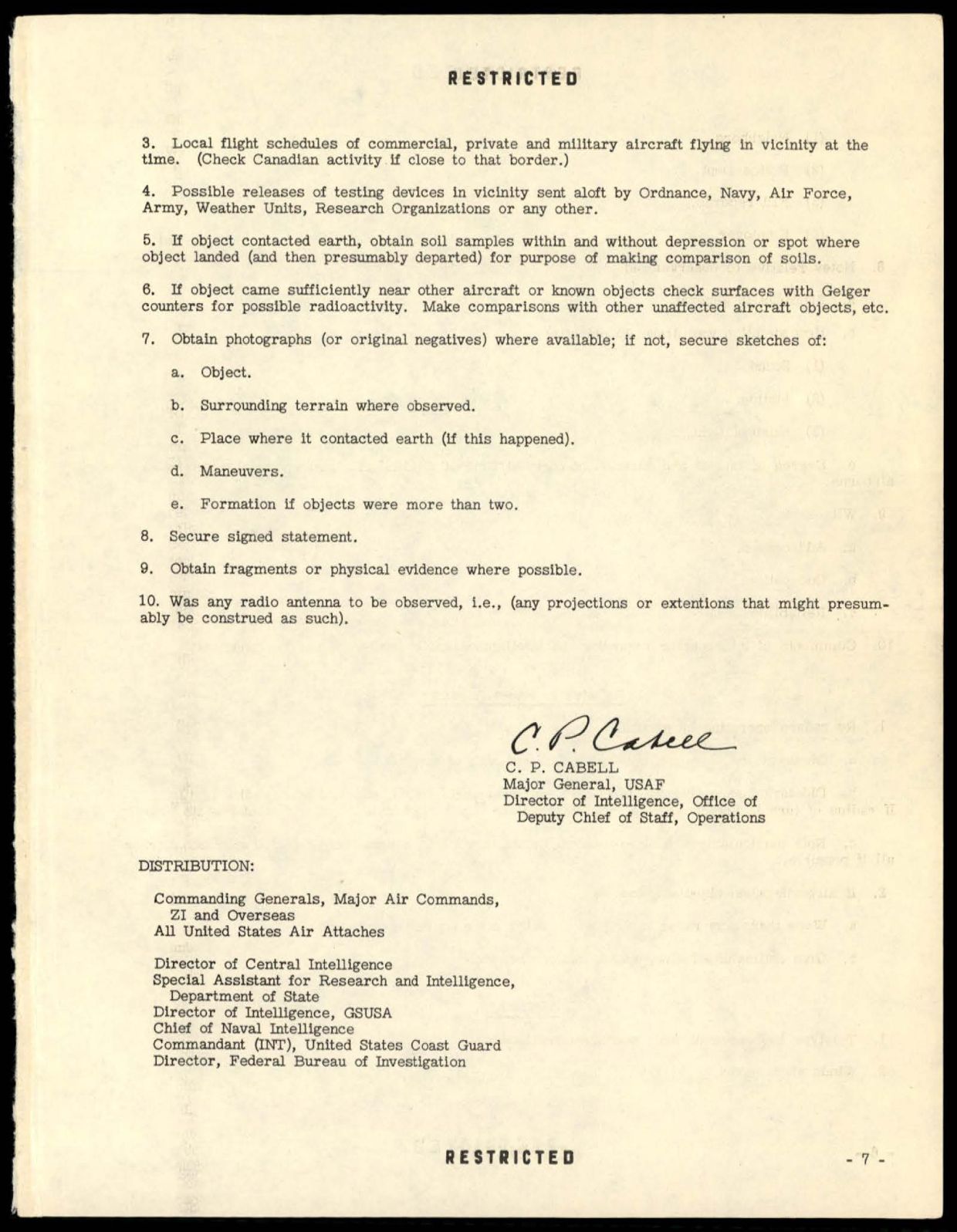
RESTRICTED 3. Local flight schedules of commercial, private and military aircraft flying in vic1n1ty at the tlme. (Check Canadian activity 1f close to that border.) 4. Possible releases o:f testing devices in vicinity sent aloft by Ordnance, Navy, Air Force, Army, Weather Units, Research Organizations or any other. 6. If object contacted earth, obtain son samples within and without depression or spot where object landed (and then presumably departed) for purpose of making comparison of soils. 6. If object came sufficiently near other aircraft or known objects check surfaces with Geiger counters :for possible radioactivity. Make comparisons with other unaffected aircraft objects, etc. 7. Obtain photographs (or original negatives) wher e available; if not, secure sketches of: a. Object. b. Surrounding terrain where observed. c. Place where it contacted earth (1:f this happened). d. Maneuvers. e. Formation 1:f objects were more than two. 8. Secure signed statement. 9. Obtain fragments or physical evidence where possible. 10. Was any radio antenna to be observed, Le., (any pr ojections or extentions that might presum ably be construed as such). e>:P~ C. P. CABELL Major General, USAF Director of IntelUgence, Office of Deputy Chief of Staff, Operations DISTRIBUTION: Commanding Generals, Major Air Commands, ZI and Overseas All United States Air Attaches Director of Central Intelligence Special Assistant for Research and Intelllgence, Department of State Director of Intelligence, GSUSA Chief of Naval Intelligence Commandant (I.NT), United States Coast Guard Director, Federal Bureau of Investigation RESTRICTED - 7 -
PAGE 129 / 137
RESTRICTED
RESTRICTED
PAGE 130 / 137
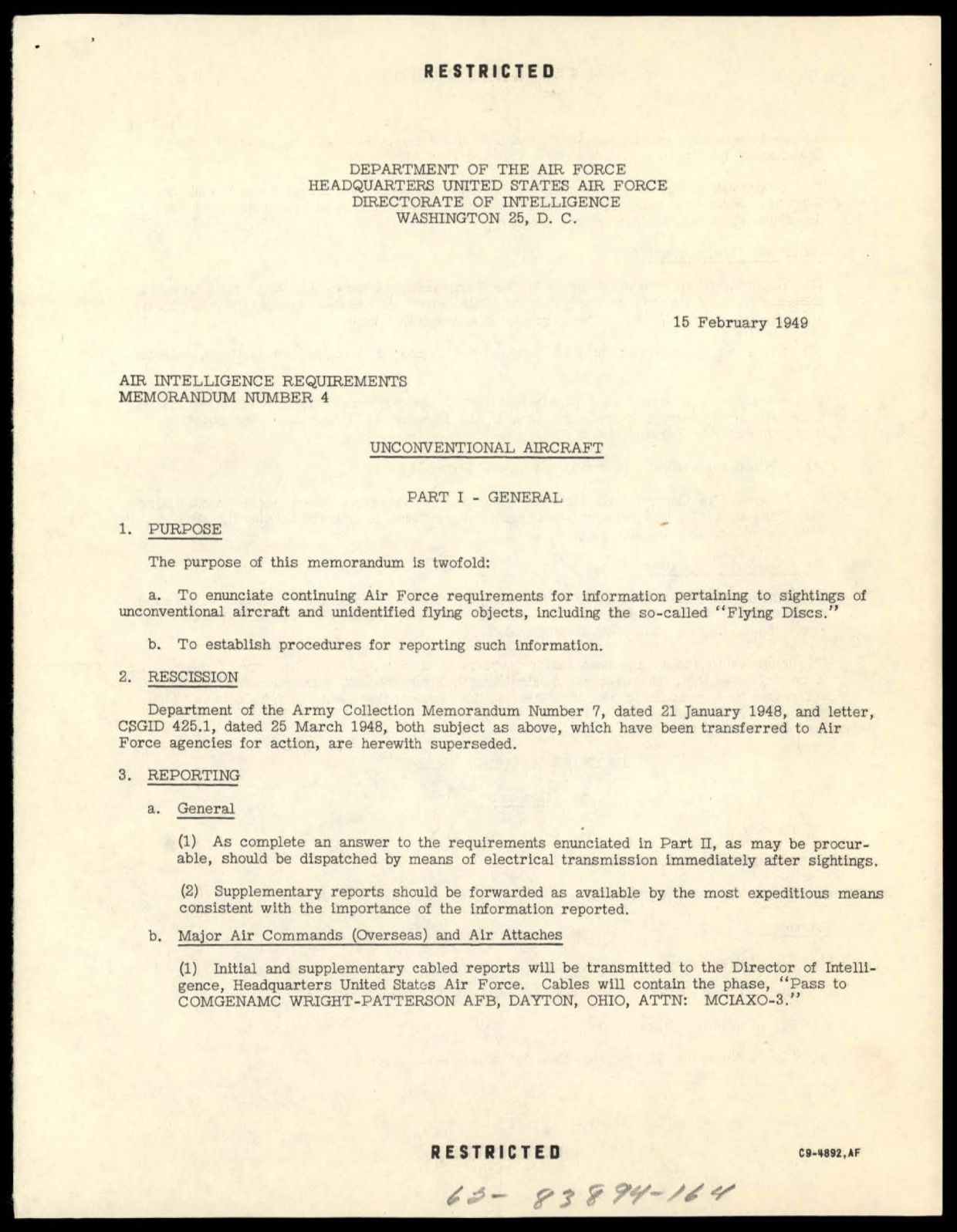
RESTRICTED DEPARTMENT OF THE Am FORCE HEADQUARTERS UNITED STATES Am FORCE DmECTORATE OF INTELLIGENCE WASHINGTON 25, D. C. 15 February 1949 AIR INTELLIGENCE REQUIREMENTS MEMORANDUM NUMBER 4 UNCONVENTIONAL AIRCRAFT PART I - GENERAL 1. PURPOSE The purpose of this memorandum is twofold: a. To enunciate continuing Air Force requirements for information pertaining to sightings of unconventional aircraft and unidentifled flying objects, including the so-called "Flying Discs." b. To establish procedures for reporting such information. 2. RESCISSION Department of the Army Collection Memorandum Number 7, dated 21 January 1948, and letter, CSGID 425.1, dated 25 March 1948, both subject as above, which have been transferred to Air Force agencies for action, are herewith superseded. 3. REPORTING a. General (1) As complete an answer to the requirements enunciated in Part II, as may be procur able, should be dispatched by means of electrical transmission immediately after sightings. (2) Supplementary reports should be forwarded as available by the most expeditious means consistent with the importance of the informaUon reported. b. Major Air Commands (Overseas) and Air Attaches (1) Initial and supplementary cabled reports will be transmitted to the Director of Intelli gence, Headquarters United States Air Force. Cables will contain the phase, "Pass to COMGENAMC WRIGHT-PATTERSON AFB, DAYTON, OHIO, ATTN: MCIAX0-3." RESTRICTED C9·'892,AF
PAGE 131 / 137
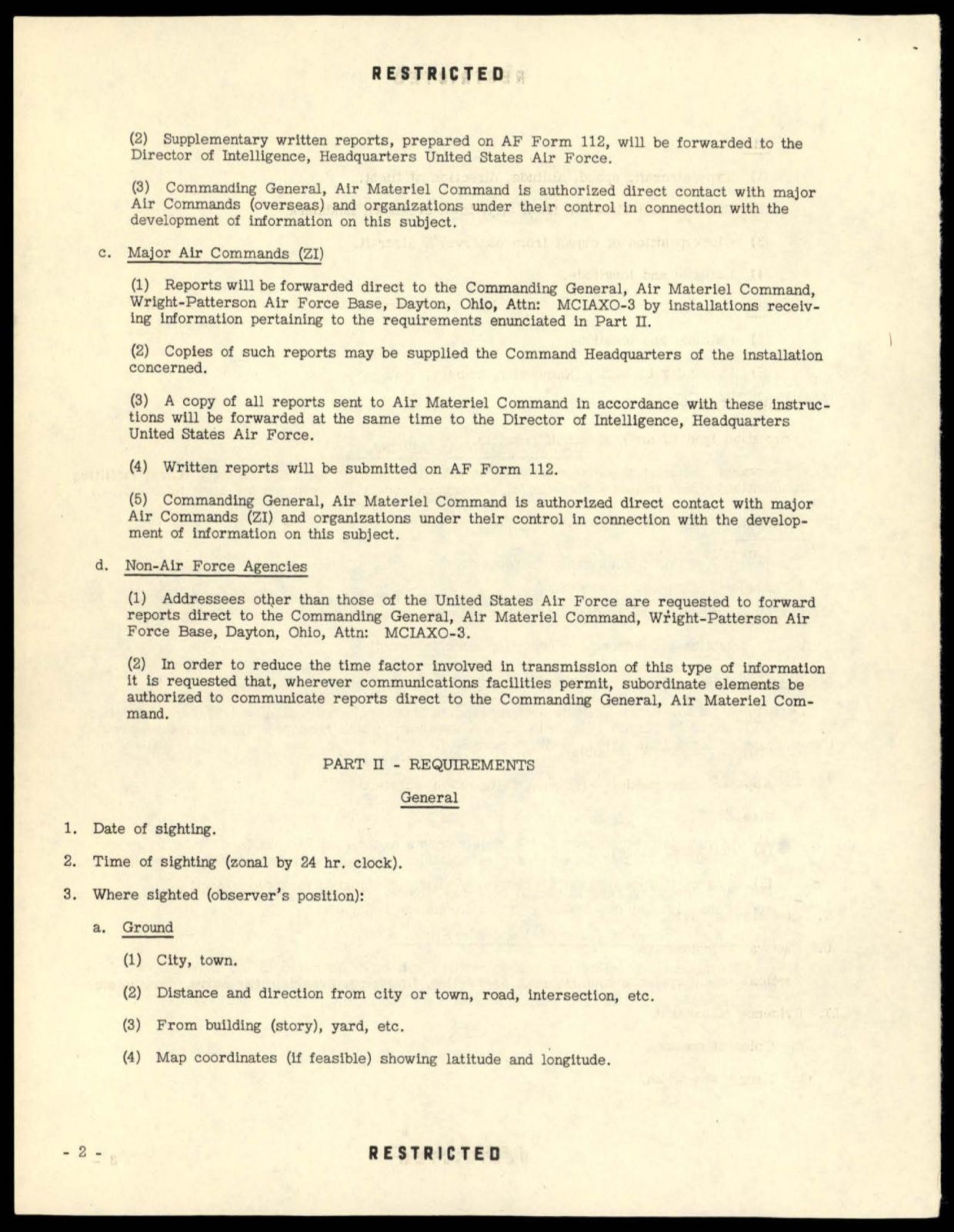
RESTRICTED (2) Supplementary written reports, prepared on AF Form 112, wlll be forwarded to the Director of Intelligence, Headquarters United States Alr Force. (3) Commanding General, Air Materiel Command ls authorized direct contact with major Alr Commands (overseas) and organizations under their control ln connection wlth the development of information on this subject. c. Major Air Commands (ZI) (1) Reports will be forwarded direct to the Commanding General, Alr Materiel Command, Wright-Patterson Air Force Base, Dayton, Ohio, Attn: MCIAXO-3 by installations receiv ing information pertaining to the r equirements enunciated in Part II. (2) Copies of such r eports may be supplied the Command Headquarters of the installation concerned. (3) A copy of all reports sent to Air Materiel Command ln accordance with these instruc tions will be forwarded at the same tlme to the Director of Intelllgence, Headquarters United States Air Force. (4) Written r eports wlll be submitted on AF Form 112. (5) Commanding General, Air Materiel Command is authorized direct contact with major Air Commands (ZI) and organizations under their control in connection with the develop ment of information on this subject. d. Non-Alr Force Agencies (1) Addressees ot~er than those of the United States Air Force are requested to forward reports direct to the Commanding General, Air Materiel Command, Wright-Patterson Air Force Base, Dayton, Ohio, Attn: MCIAXO-3. (2) In order to reduce the time factor involved in transmission of this type of information it is requested that, wher ever communications facilities permit, subordinate elements be authorized to communicate reports direct to the Commanding General, Air Materiel Com mand. PART II - REQUIREMENTS General 1. Date of sighting. 2. Time of sighting (zonal by 24 hr. clock). 3. Where sighted (observer's position): a. Ground (1) City, town. (2) DI.stance and direction from city or town, road, intersection, etc. (3) From building (story), yard, etc. (4) Map coordinates (l.f feasible) showing latitude and longitude. - 2 - RESTRICTED
PAGE 132 / 137
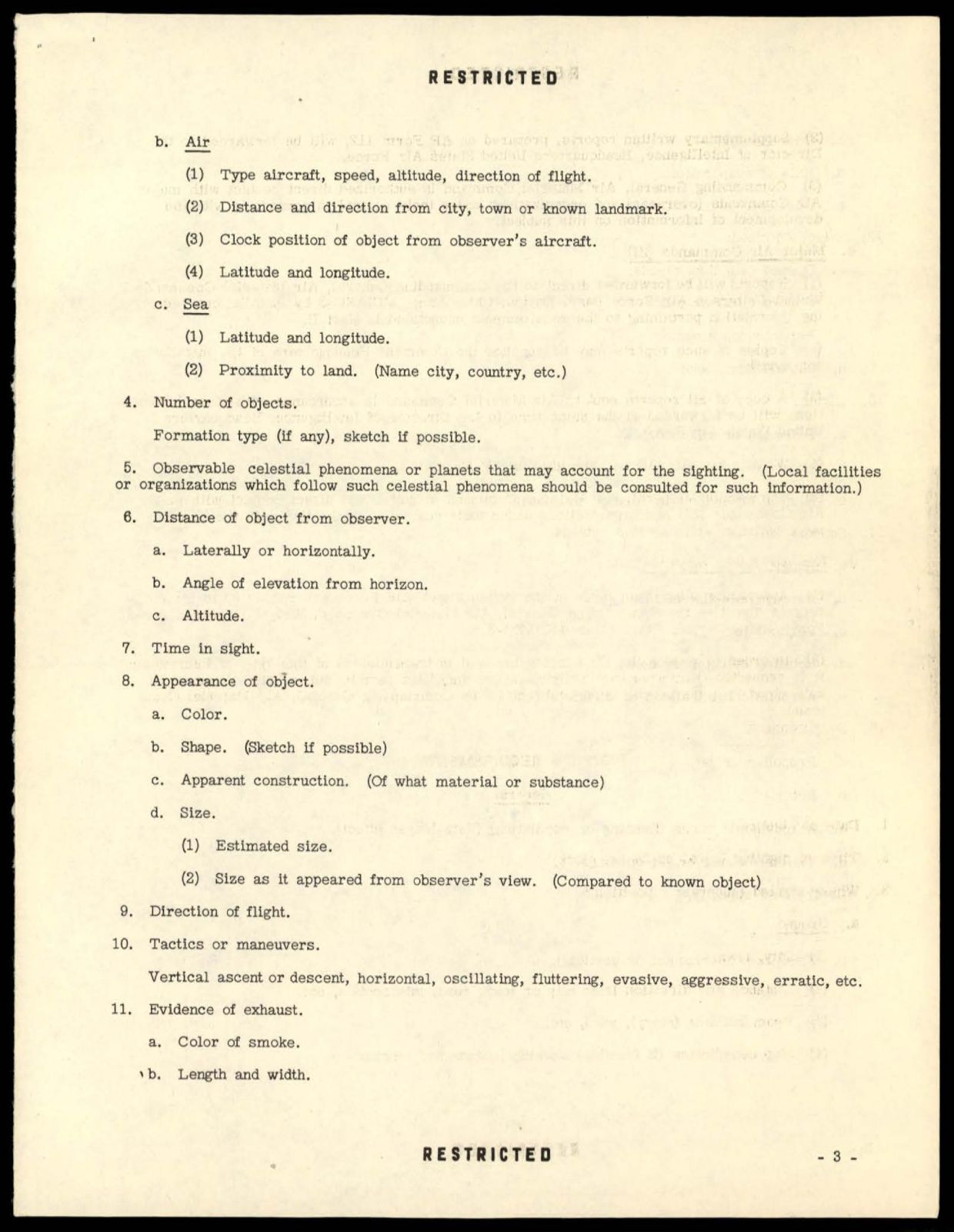
RESTRICTED
b. Air
(1) Type aircraft, speed, altitude, direction of flight.
(2) Distance and direction from city, town or known landmark.
(3) Clock posltlon of object from observer's aircraft.
(4) Latitude and longitude.
c. Sea
(1) Latitude and longitude.
(2) Proximity to land.
(Name city, country, etc.)
4. Number of objects.
Formation type (if any), sketch if possible.
5. Observable celestial phenomena or planets that may account for the sighting.
(Local facilities
or organizations which follow such celestial phenomena should be consulted for such information.)
6. Distance of object from observer.
a. Laterally or horizontally.
b. Angle of elevation from horizon.
c. Altitude.
7. Time in sight.
8. Appearance of object.
a. Color.
b. Shape.
(Sketch 1f possible)
c. Apparent construction.
(Of what material or substance)
d. Size.
(1) Estimated size.
(2) Size as it appeared from observer's view. (Compared to known object)
9, Direction of flight.
10. Tactics or maneuvers.
Vertical ascent or descent, horizontal, oscl.llating, fluttering, evasive, aggressive, erratic, etc.
11. Evidence of exhaust.
a. Color of smoke.
, b. Length and width,
RESTRICTED
- 3 -
•
PAGE 133 / 137
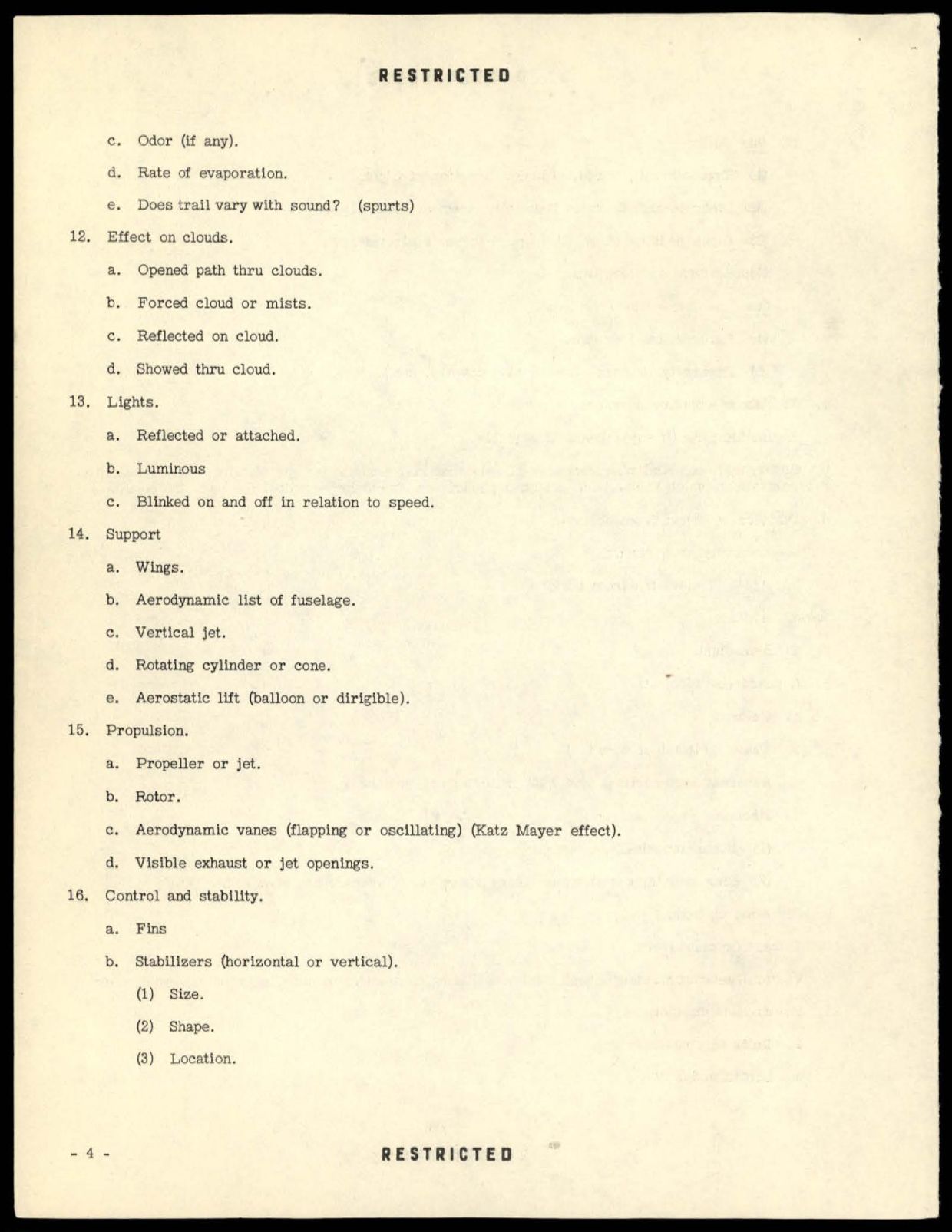
RESTRICTED
c. Odor (1f any).
d. Rate of evaporation.
e. Does trail vary with sound?
(spurts)
12. Effect on clouds.
a. Opened path thru clouds.
b. Forced cloud or mists.
C. Reflected on cloud.
d. Showed thru cloud.
13. Lights.
a . Reflected or attached.
b. Luminous
c. Blinked on and off in r elation to speed.
14. Support
a. Wings.
b. Aerodynamic list of fuselage.
I
c. Vertical jet.
d. Rotating cylinder or cone.
e. Aerostatic lift (balloon or dirigible).
15. Propulsion.
a. Propeller or jet.
b. Rotor.
c . Aerodynamic vanes (flapping or oscillating) (Katz Mayer effect).
d. Visible exhaust or jet openings.
16. Contr ol and stability.
a. Fins
b. Stabilizers (horizontal or vertical).
(1) Size.
(2) Shape.
(3)
Location.
- 4 -
RESTRICTED
PAGE 134 / 137
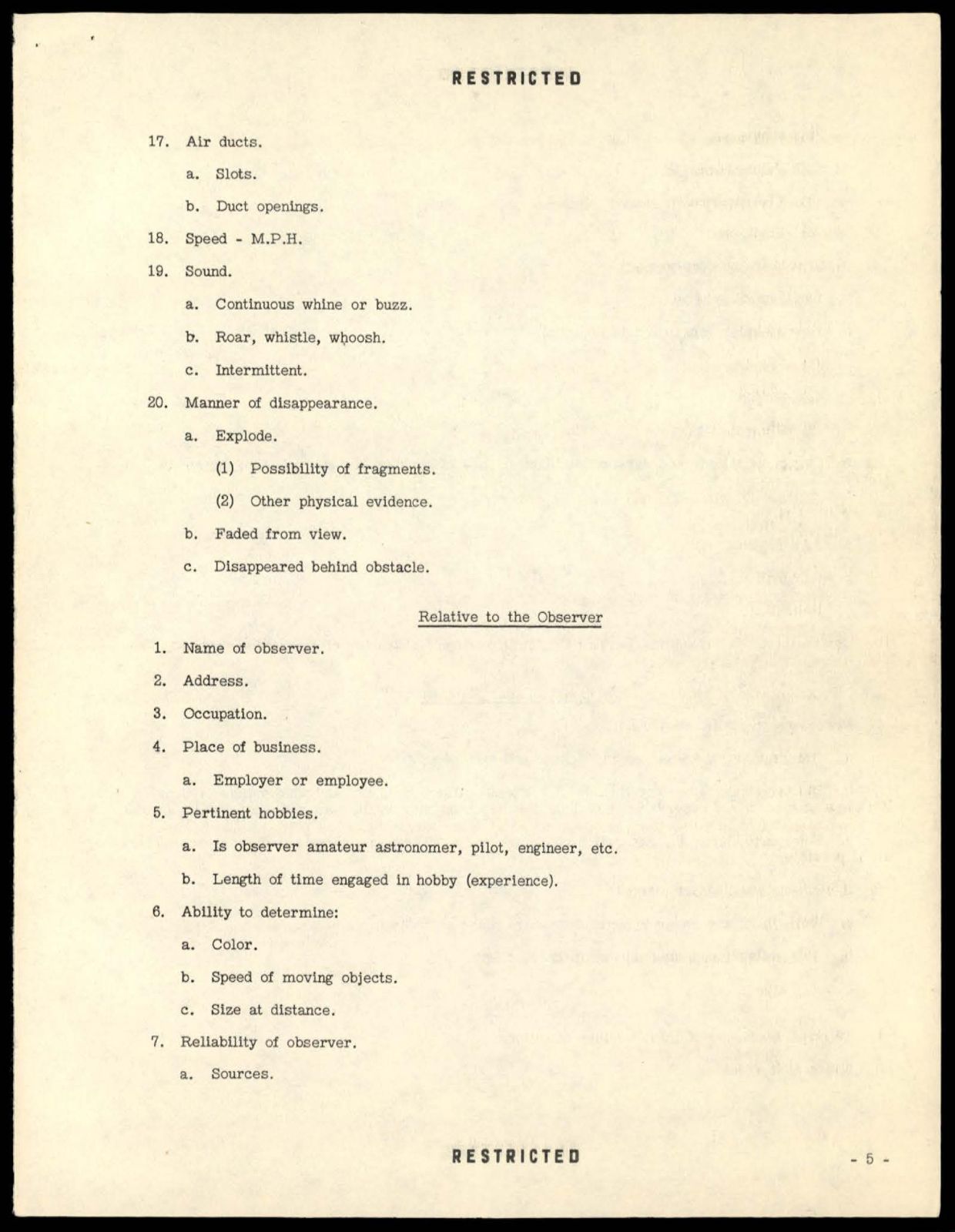
RESTRICTED
17. Alr ducts.
a. Slots.
b. Duct openings.
18. Speed - M.P.H.
19. Sound.
a. Continuous whine or buzz.
b. Roar, whistle, wl;loosh.
C.
Intermittent.
20. Manner of disappearance.
a.
Explode.
(1)
Posslblllty of fragments.
(2) Other physical evidence.
b. Faded from view.
c. Disappeared behind obstacle.
Relative to the Observer
1. Name of observer.
2. Address.
3.
Occupation.
4. Place of business.
a. Employer or employee.
5. Pertinent hobbles.
a. Is observer amateur astronomer , pilot, engineer, etc.
b. Length of time engaged in hobby (experience).
6. Abllity to determine:
a. Color.
b. Speed of moving objects.
c. Size at distance.
7. ReliabiUty of observer.
a. Sources.
RESTRICTED
- 5 -
PAGE 135 / 137
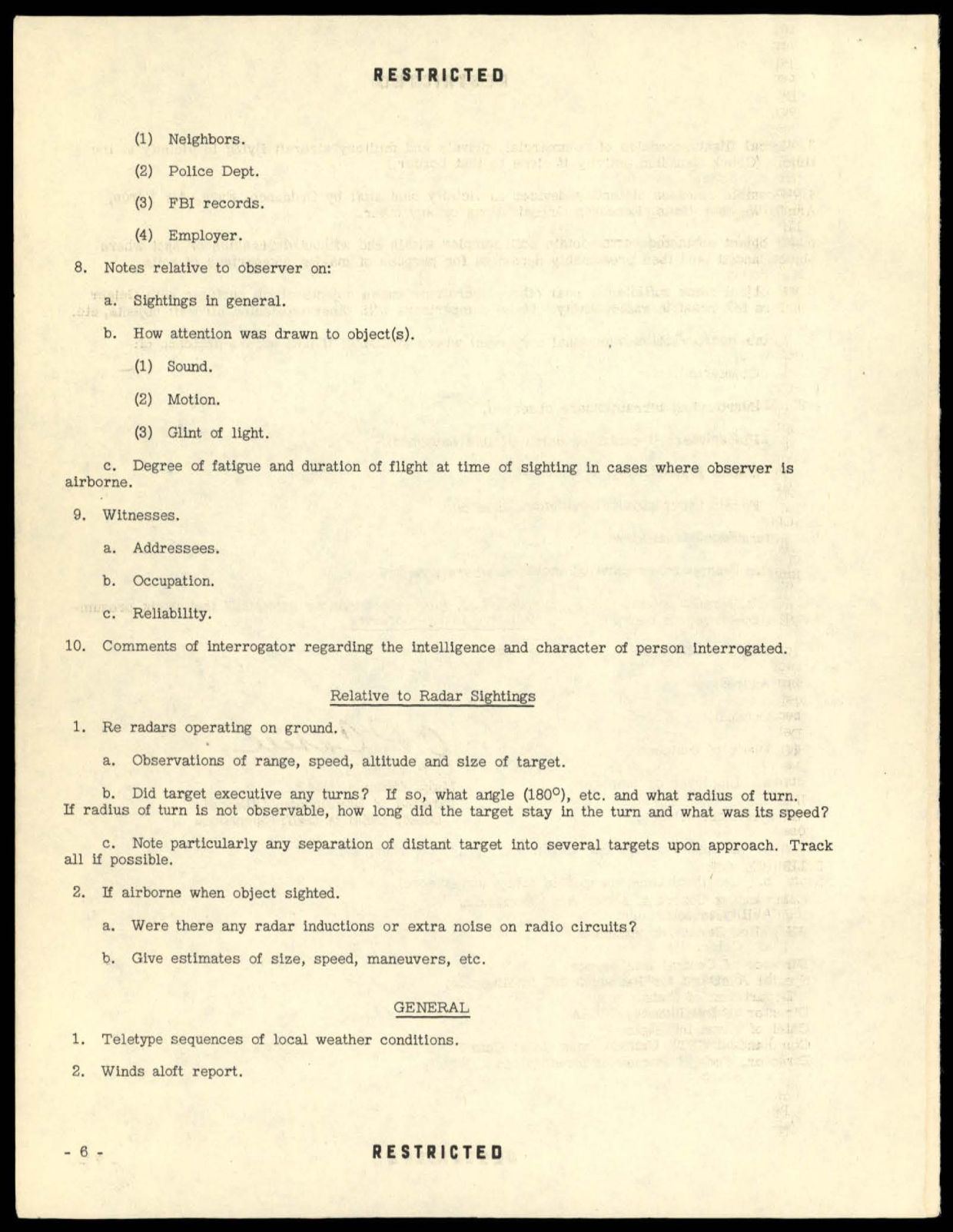
RESTRICTED
(1) Neighbors.
(2) PoUce Dept.
(3) FBI r ecords.
(4) Employer.
8. Notes relative to observer on:
a. Sightings 1n general.
b. How attention was drawn to object(s).
(1) Sound.
(2) Motion.
(3) Glint of light.
c. Degree of fatigue and duration of flight at time of sighting in cases where observer is
airborne.
9. Witnesses.
a. Addressees.
b.
Occupation.
c.
Reliab1Uty.
10. Comments of interrogator regarding the intelllgence and character of person interrogated.
Relative to Radar Sightings
1. Re radars operating on ground.
a. Observations of range, speed, altitude and size of target.
b. Did target executive any turns? If so, what angle (180°), etc. and what radius of turn.
If radius of turn is not observable, how long did the target stay in the turn and what was 1ts speed?
c. Note particularly any separation of distant target into several targets upon approach. Tr ack
all 1f possible.
2. If airborne when object sighted.
a. Were there any radar inductions or extra noise on radio circuits?
b. Glve estimates of size, speed, maneuvers, etc.
GENERAL
1. Teletype sequences of local weather conditions.
2. Winds a.loft report.
- 6 -
RESTRICTED
PAGE 136 / 137
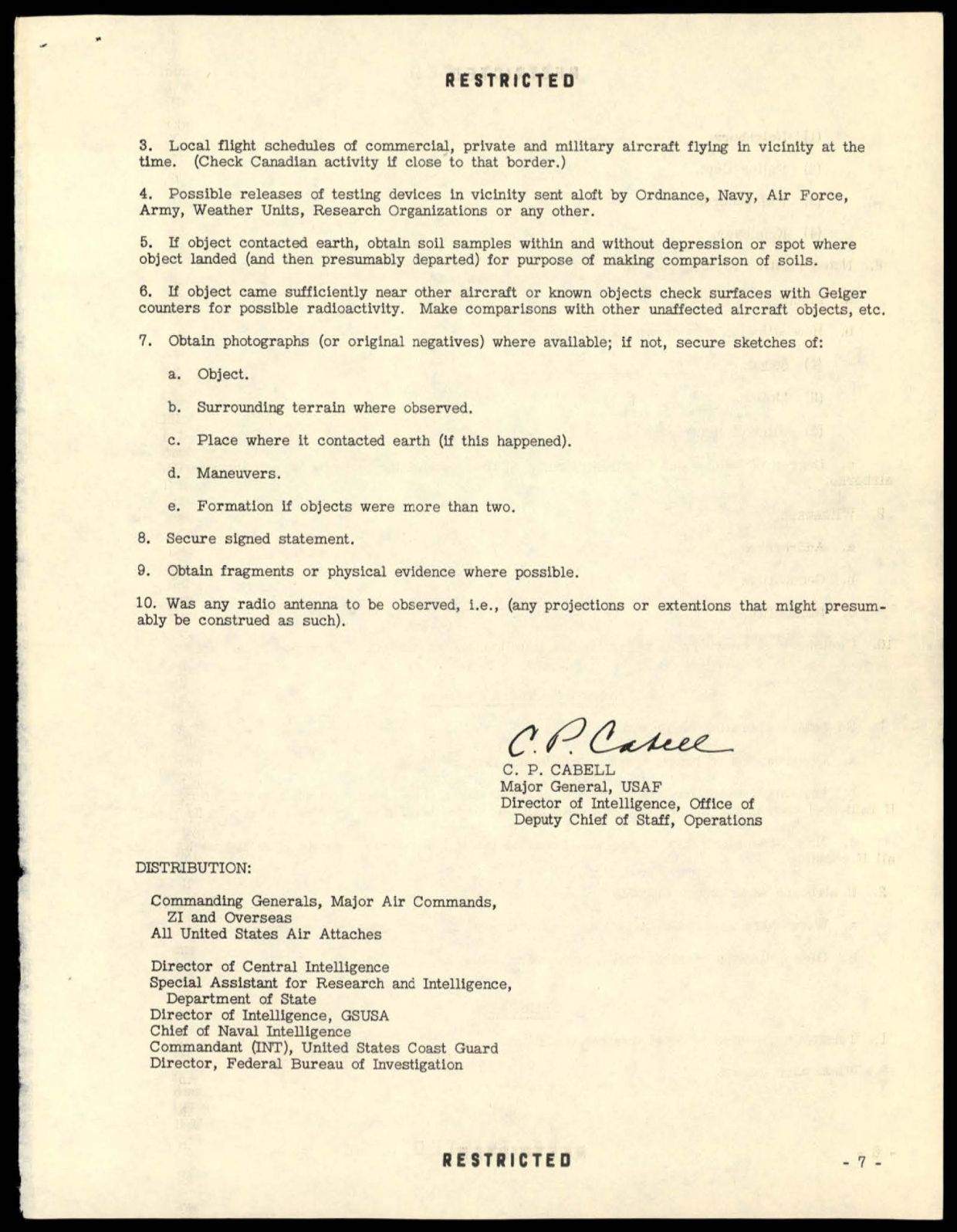
RESTRICTED 3. Local flight schedules of commercial, private and m111tary a1rcra!t flying in vicinity at the time. (Check Canadian activity 1f close to that border.) 4. Possible releases of testing devices 1n vicinity sent aloft by Ordnance, Navy, Air Force, Army, Weather Units, Research Organizatlons or any other. 5. If object contacted earth, obtain soil samples within and without depression or spot where object landed (and then presumably departed) for purpose of making comparison of solls. 6. I! object came sufficiently near other aircraft or known objects check surfaces with Gelger counters for possible radioactivity. Make comparisons with other unaffected alrcr att objects, etc. 7. Obtain photographs (or original negatives) where available; if not, secure sketches of: a. Object. b. Surrounding terrain where observed. c. Place wher e it contacted earth (if this happened). d. Maneuvers. e. Formation 1f objects were more than two. 8. Secure s igned statement. 9. Obtain fragments or physical evidence where possible. 10. Was any radio antenna to be observed, Le., (any projections or extentions that might presum ably be construed as such), c l?~ C. P. CABELL Major General, USAF Director of IntelHgence, Office of Deputy Chief of Sta!f, Operations DISTRIBUTION: Commanding Generals, Major Air Commands, ZI and Overseas All United States Air Attaches Director of Central Intell1gence Special Assistant for Research and Intelllgence, Department of State Director of IntelHgence, GSUSA Chief of Naval Intelligence Commandant (INT), United States Coast Guard Director, Federal Bureau of Investigation RESTRI CT ED - 7 -
PAGE 137 / 137
RESTRICTED
RESTRICTED
Original document
Record Data
Agency
NARA / Historical
Type
Document (pdf)
File size
21.7 MB
Release
Season 01
Hosting
Hosted on this site
U.S. Government work · Public domain · Part of the AARO / PURSUE releases.