pdfNASAWar.gov ↗⌕ Searchable transcript
NASA-UAP-D016 Preliminary-Gemini-4-Crew-Debriefing Part1 1965
NASA-UAP-D016 Preliminary-Gemini-4-Crew-Debriefing Part1 1965 — a NASA document (1965) from the U.S. Government's AARO / PURSUE UAP disclosure releases. Available from the official War.gov source.
Page-by-page transcription
Searchable text extracted from the original 340-page scan. The page images are the authoritative source; the text is machine OCR and may contain artifacts. Also available as downloadable JSON.
340 pages · machine OCR from the original scan
PAGE 1 / 340
I /00 Authority: DECLASSIFIED NW 91526 f Group 4: 82 CLASSIF!CAT:ON CHANGE o____ 3 8 By authority of--~4,...L.11.1-...___.~~L--L-....t.-e=---1 hanged by U~1:i:.~1 LDate 1973 42, / /4 PRELIMINARY GT-4 FLIGHT CREW DEBRIEFING TRANSCRIPI' PART I Prepared By Spacecraft Operat ions Branch Flight Crew Support Division June 16, 1965 This material contains information affecting the national defense of the United States within the meaning of the Espionage Laws , Title 18. U. S. C Section 793 and 794 , the transmission or revel a tion of which in any manner to an unaut horized person is prohi bi ted by law. Downgrade at 3 year intervals Declassified after 12 years NOTICE: This document may be exempt from public disclosure under the Freedom of lnfor• rnation Act (5 U.S.C. 552). Requests for Its ra• lec1~e to persons outside the U. S. Government should be handled under the provisions of NASA Polley Cir-ecti11e 1382.2, I
PAGE 2 / 340

(no extractable text)PAGE 3 / 340
COI\JFIDENTIAt PREFACE This preliminary transcript was made from voice tape recordings of the GT-4 flight crew debriefing conducted aboard the recovery ship, the USS Wasp, on June 9, 1965. Although all the material contained in this transcript has been edited, the urgent need for the preliminary transcript by mission analysis personnel precluded a thorough editorial review prior to its publication. Errors in this transcript will be corrected as soon as possible and an official transcript will be published at a later date. This document contains a transcript of the first part of the debriefing, during which the crew described the mission generally from an operational viewpoint . A preliminary transcript of the re mainder of the debriefing will be published by June 23, 1965. It will cover systems operations, operational checks, visual sightings, experiments , pre-mission planning, mission control, and training.
PAGE 4 / 340

(no extractable text)PAGE 5 / 340
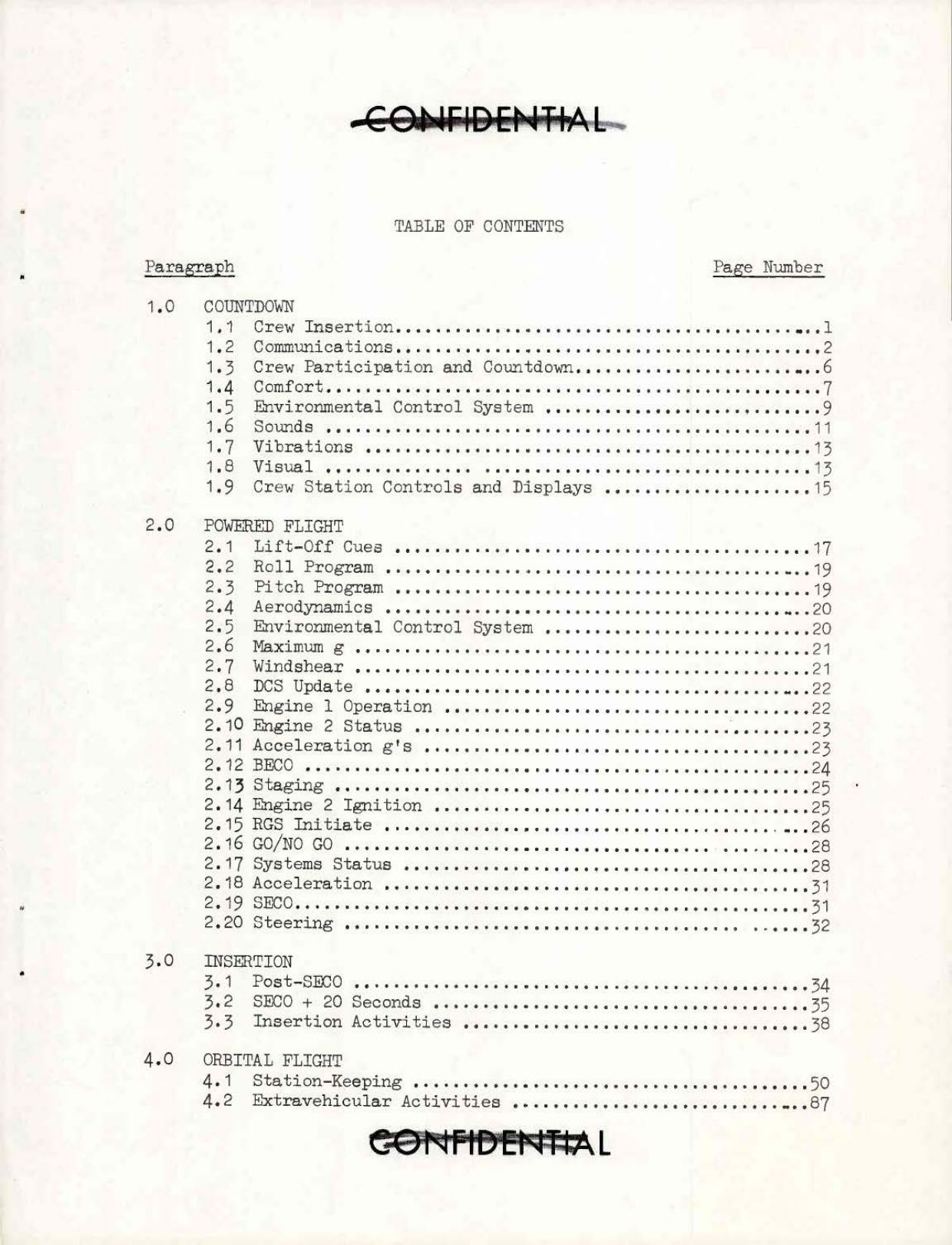
TABLE OF CONTENTS
Paragraph
Page Number
1.0
COUNTDOWN
1 . 1 Crew Insertion. ... ................... . . .
.. . 1
1. 2
Cornmlll1ications . . . . . ............... .. ... .
.. .. 2
1. 3 Crew Participation and Countdown....
..............-..6
1.4 Comfor t . ....................... .
.7
1. 5 Environmental Control System .................... ' ..... . ,9
1.6 Sounds ...... .
.... 11
1. 7 Vibrations .. .
. ... 13
1. 8
Visual .. . ....... .. .
. ... 13
1.9 Crew Station Controls and Displays
.1 5
2.0
POWERED FLIGHT
2. 1 Lift- Off Cues
....................... 17
2.2 Roll Program
2.3 Pitch Program ... .
..... 19
2.4 Aerodynamics .... .
20
•
•
M
•
•
2. 5 Environmental Control System
. .... "" ............... 20
2.6 Maximum g ....... .
....... 21
2. 7 Windshear ...... . .
. ...... 21
2.8
DCS Update
........................
22
•
•
•
•
•
•
•
M. •
2.9 Engine 1 Operation .....
. 22
2. 10 Engine 2 Status .. .
.23
2.11 Accel eration g's .. .
. ........ 23
2. 12 BECO ........ . ...... .
. ........ 24
2. 13 Staging . . . ...... .
.. .................... 25
2. 14 Engine 2 Ignition
. .. 25
2. 15 RGS Initiate .... .
... 26
2. 16 GO/NO GO . ............. .
.................
. .. 28
2.17 Systems Status ........ .
' ....
. ..... 28
2. 18 Acceleration ................... .
. .. .. 31
2.19 SECO. ....... .
......................
. .... 31
2. 20 Steering ....................................... . . .. .... 32
3.0
INSERTION
3.1 Post-S.EDO
•... 34
3.2 SECO + 20 Seconds
................ .. 35
3.3 Insertion Activities . . . . . . . . . . . . . . . . . . . . . . . . . . . . . . . . . . . 38
ORBITAL FLIGHT
4. 1 Station- Keeping ....... .... .. ......... .
.......... ... 50
4.2 Extravehicular Activities ............ .
. ......... - ..87
PAGE 6 / 340

(no extractable text)PAGE 7 / 340
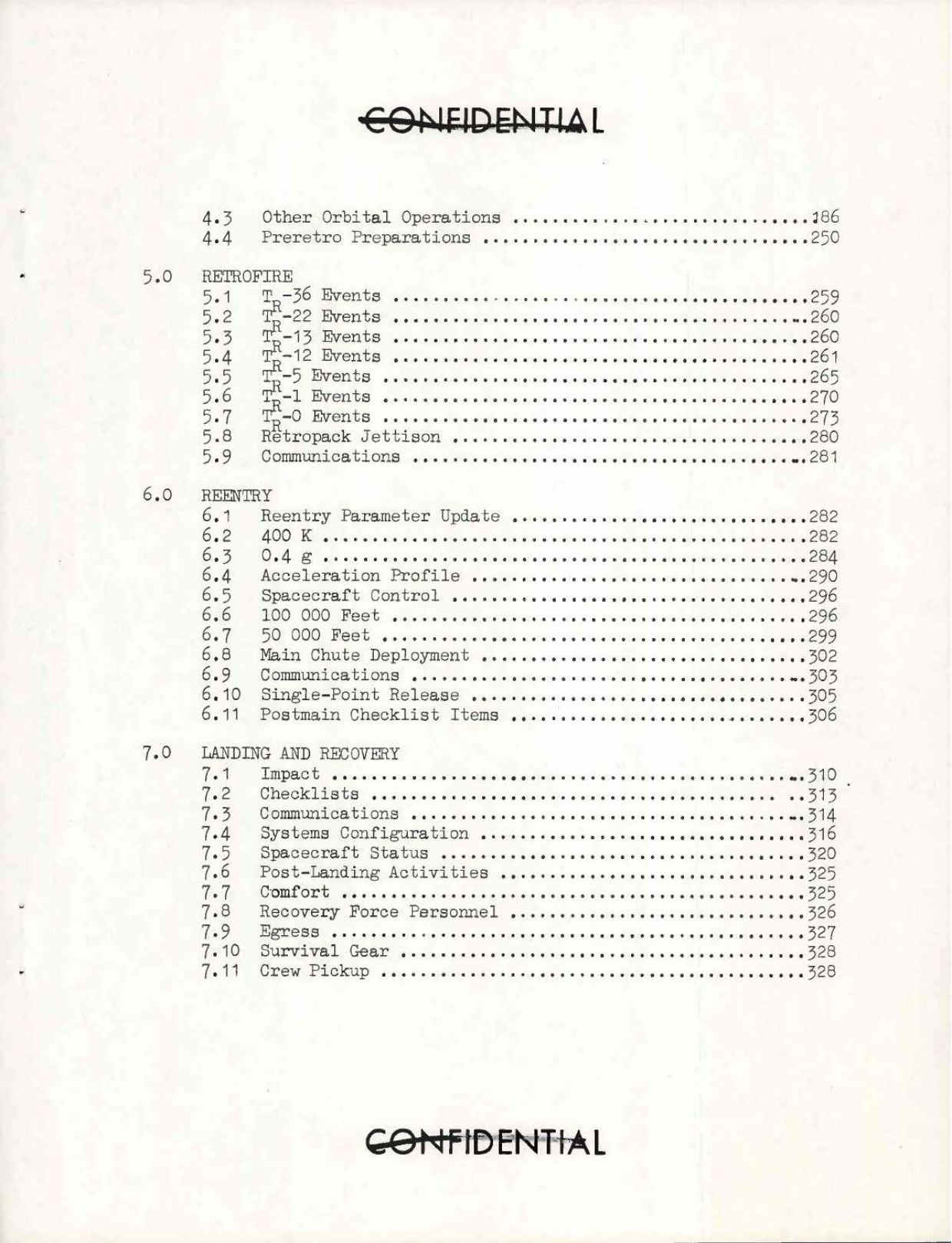
Ot her Orbital Operations
..... ~86
Preretro Preparations ...
. ........
..... 250
5.0
6.0
1.0
REI'ROFIRE
5.1
5. 2
5. 3
5.4
5.5
5. 6
5. 7
5.8
5.9
T - 36 Events ... .
~ - 22 Events .. .
:5:i- 13 Events
:5:i- 12 Event s ... .
!R-5 Events .. . ........ .
~R: 1 ~eennttss • ••• • • • • • • • • • • • • • • • • •
iir.: 0 .c, v
••••••••••••••••••••
Ret r opack Jettison ........... .
Communicat i ons ... . ........... .
REENTRY
6. 1
Reentry Parameter Update
6.2
400 K .................. .
6.3
0. 4 g ................ .
6.4
Acceleration Profile
6. 5
Spacecraft Control ........ .
6.6
100 000 Feet . . . . . . . . . . . . . . . ....... .
6.7
50 000 Feet ............. .
6.8
Main Chute Deployment . .
6.9
CommUJ1ications . . . . . . . . . . . . . ..
6.10 Singl e-Point Rel ease ....
6. 11 Pos tmain Checkli st Items
LANDI NG AND REDOVERY
7.1
7. 2
7.3
7.4
7. 5
7.6
7. 7
7.8
7.9
7. 10
7. 11
Impact ...... .
Checklists
Communi cations ...
. . ............ 259
. ... 260
... 260
.. 261
. ... 265
.... 270
.... 273
. ... 280
.••• 281
.•••• 282
. .... 282
. . .. 284
..... 290
.... 296
...... 296
.. •.. 299
. ...... 302
. .... 303
. ........... . .... 305
......... ·•....... 306
... 310
.. 313
... 314
Systems Configuration
..................... 316
Spacecraft Status ...... . .... .
. ............ 320
Post-Landing Activiti es ..... .
. ............... 325
C·omfort ............... .
. .. . .. .... ... 325
Recovery For ce Personnel
.. 326
Egress ......... . .. .
. . 327
Survival Gear ..... .
...• 328
Crew Pi ckup ......... .
. ....... 328
PAGE 8 / 340

(no extractable text)PAGE 9 / 340
1.1 Crew Insertion White McDivitt White CO ►~FIDE►~TIAb. 1.0 COUNTDOWN The only problem during insertion was that I fogged up again in my suit before we got the fans on. I think I'm just going to always fog up in that suit of mine. We turned the fans on quick, but with the visors closed it doesn't go out. We did have a problem with crew insertion on the Wet Mock and I think we had that probably pretty well taken care of. They put us on the suit loops and didn't turn the fans on. Normally you wait for a clearance from the 1:t>acecraft Test Conductor before you throw any switches. Well, after we almost "died" of carbon dioxide poison ing during this +,est~ we got this matter clarified. As soon as we got in the spacecraft and one of us was on the suit loop, we would go ahead and cut the switches on to put us on two fans. We did this during insertion in the Wet Mock. It really went well. We really went for a long time in Wet Mock. was beginning to wonder if I was going to have to open my visor. I was really uncomfortable. COt74 FIDEt~TIAsb I
PAGE 10 / 340
2
McDivitt
White
McDivitt
White
1. 2 Communications
White
McDivitt
White
McDivitt
But everything worked out okay on this one.
Yes.
The timing was excellent , I thought.
I didn't
think we had any probl em at all .
No.
I don ' t believe they missed a stroke on the
insertion.
I think the communications were pretty well
worked out, Jim?
Right.
One thing, the last three minutes or four
minutes, we got a little confused about who was
talking to who .
I was getting the Spacecraft
Test CJnductor, the Booster Test CJnductor and
the CAP COM at the same time.
We got a split count , too, on lif't--off.
The first three or four minutes I was hearing the
B)oster Tast C?nductor.
I heard what was going
on on his loop , and I was listening to him get
checks in f r om all of the guys .
I really wasn ' t
getting a clue as to what was going on.
I was
supposed to be getting the booster clues from the
test conductor.
I was supposed to find out when
the engines were going to gimbal and when they
-€9·NFl9E~TIA;t
PAGE 11 / 340
White McDivitt COl>J~IDENIIA~ 3 were going to open the prevalves and stuff. I wasn't getting it from him. We were getting a lot of other information that made a lot of sense to the Booster Test C:>nductor, but not an awful lot to us . There were cal l - outs l ikeVSequence 05003 complete." Well, this just didn' t mean any thing to us . On top of this we had the Spacecraft ~est Conductor calling out the times , and super imposed on all of this was Al Shephard, the Cape CAP COM, calling out events that he was reading off that went on at certain specified times . He called out','Stage 1 prevalvesVand we could hear the fuel gushing downstairs and the whole booster rumbling. He called out','Stage 2 prevalves','and you could hear the same thing all over again. I thought t hat was a lot more meaningful than the test conductor comments. I think that was wrong, the way they were doing it . I think we weren't supposed to be on any loop except CAP COM at that time. Well, I think what happened was that we got this thing over-coordinated. Al was going to give us all this information, but then as a result of GT-3, (Gus and Jolm said they didn ' t get enough -t:ON FI0 Er\JTl~L
PAGE 12 / 340
4 White McDivitt r<3 eI<i FltEt>I TIRt information about the boosters) they put this in formation on the test conductor' s loop too . We ha.d too many guys talking. I think if just CAP COM talked from thr ee minutes on down we would be all right . This is the way I thought it was going to happen, and then from three minutes on down it really got busy with the yak , yak, yak of everybody talking. I don't lmow whether we got off the Booster ~st C)nductor's loop or not, but at final countdown, Al gave me 2 minutes , 1 1/2, 1, 30, 20 , 10 , 9, 8, 7, 6, 5, 4, 3, 2, 1. I got a similar count from the Spacecraft Test C~nductor but it turned 01 ·.t that they were a second out of sequence on the countdown and Al was giving me 10 and our Spacecraft Test Conductor was giving me 9. So it went ten-nine, nine-eight, eight-seven. They were at the same t ime . All I knew was that we were getting close to engine ignition and then it started . So, we got a little over-communicated there . I think t hey kept us adequately informed on the hold. As a matter of fact , I ' d say we got over-informed there at the end. We had too many guys keeping us informed and I think the pendulum <Ol<:JFIDel'4TIAl
PAGE 13 / 340
5 White McDivitt White McDivitt swung from the GT-3 flight where nobody got in formed of anything over to our flight where we got i nformed by three different people about the same event. On our flight, too, we were really more aware of t he problem than those people were. We could sit right here and see the gantry come down and stop, that was really the only problem they had in the whole count . I don't think radio discipline is a problem, Each guy was disciplined on his own channel . They were conducting their tests on their own channel . But we were lis tening to three different communica tors at the same time. We should have had only one. I think probably what we will need to do is to get to about T-3, and then just cut in the CAP COM. That was the way it wa.s planned to be, I thought. That's the way Al planned it. That's correct. I think, because there had been some lack of information on GT-3, that it some how had been written into the SEDR so that we were also on the Booster Test Conductor's MOPS, so that we were also getting his countdown. I COrq--pf0f:Nfl1tt
PAGE 14 / 340
6 White McDivitt think CAP COM, 'alone, would have been sufficient . One further comment , I had to turn my ·11HF volume all the way up to hear anybody. I was at max. There we were sitting right on the pad , talking to a gu:y two miles away, and there I was with the volume full up . It didn ' t give me much confi dence as to reception I was going to get when I was 200 miles away , or three or four or five hundred miles away . I thought that the volume control on the radio was inadequate. We were wondering what we were going to have when we got up a hundred miles. That's right. At max volume we didn't have enough and at minimum volume it didn't shut it off. We will cover this later. 1.3 Crew Participation and Countdown McDivitt I think it was just about right . I don' t think we were over worked and I think we had enough to do to keep us busy. White Actually, all we really made was a check of switches . There wasn ' t really too much else. Having the back-up crew run that midcount was the the right solution. I wouldn't have wanted to participate in anymore of t he countdown than I -COt<JFtDEt'4flJ<l
PAGE 15 / 340
7 McDivitt 1.4 Comfor t White €O ► 4FIDE ► ~TI/>,~ did. That's an excellent point. The flight crew's participation should be the final count, not the midcount and precount. It doesn't tire the prime crew out doing a lot of chores that they don't really have to do. I think this is a good pro cedure. Initially, the first 20 or 30 minutes, I was squirming around and I felt a little uncomfor table. But after I had been in for 30 or 40 minutes I didn't feel there was a real restric tion on staying for several more hours. I would have been very disappointed if they had said, "Well you have been in there long enough and we will work on this gantry and try it again tomor row." I would have been happy to stay there several more hours while they fixed the gantry instead of pulling me out. After an hour and 40 minutes,which is the end of the normal countdown,I didn't feel uncomfortable. We sat in the simulator and were a lot more un comfortable than this. I didn't feel uncomfor table. I had a chance to take a couple of little CO ► 4FIDE~~TIA~
PAGE 16 / 340
8 McDivitt White McDivitt White COl'IFIDE~4TIAt naps. I noticed Jim was napping too. Yes. I concur with F.d, although I don't want to get carried overboard. We shouldn't scrub due to crew fatigue . I think it is up to the crew. If the crew is un comfortable they should come down. But I don't think he should say, "Okay, two hours and 30 minutes . You cut this off. ", because it is an operational procedure. When I first got assigned to the crew I always fel t one of the toughest things to do would be laying back for an hour and 40 minutes or so prior to launch. The time we spent in the simu lator laying on our back, I thought to be a very uncomfortable position. As we went through all the training and testing at McDonald, and again at the Cape , ;ny back got more callouses on it. I got used to laying with my feet over my head. At launch time I wasn't a bit tired from laying on my back. This is brought out in one of our last simulations , where we ran the whole four hour simulation and we forgot to have them tilt us up to 30 degrees. We just got used to running that way, COl"I P"te E~~Tl,\l
PAGE 17 / 340
9 €Otr4FIDEttftAl McDivitt That ' s right, I just don't think we should scrub the flight because of fatigue.I don ' t think we should do that. We weren ' t approaching this point. White We had a long way to go. 1. 5 Environmental Control System McDivitt I think we ought to get this water management panel squared away and everybody figure out what we are supposed to do with those switches. I don ' t think we should be arguing about where the switches are supposed to be on the launch pad. If I hadn't asked somebody where the waste manage ment switches should be we would have probably launched with it in · EVAPORATOR. I knew that i t wasn't supposed to be in the evaporator. At one of the ten thousand briefings we got on it, we were told it shouldn't be there. We ought to get· this kind of stuff squared away before launch day. Thirty minutes before lift-off we were arguing about where that switch was supposed to be. White I wasn't confident that they knew where they wanted that switch to be. McDivitt Well, I didn ' t think we should have it in the eva porator. So, I think that water panel could have cost as much as a wee~s slip on our launch because coNFIDENTIAt
PAGE 18 / 340
10 €01'1FIE>Et<ITtAt White McDivitt they didn't know where to put those valves and it's only got three valves on it. It ought to be made much simpli er than it is . I think they should get that squared away before the next flight. F,d and I knew where we wanted it. We wanted it off and the other two switches in NORMAL and leave it alone. That's what we flew with. That's the way it ought to be fixed . We can get canned , though, for not flying with it in the right position by the checklist . It didn't say that on the checklist Every check list we got was different . That ' s right! Fach one was different . Fi nally we decided we were going to do it as w.e did and left it thr ough out the whol e flight . Evel;'y thing worked fine . We had ECS briefings by a mul titude of peoples from MAC including the guys who designed it. Everyone of them dis agreed , It probably started out to be one of the simplest things in the whole spacecraft. By the time they got t hrough confusing us with it, I got the feeling nobody knew what was s_i,,.pposed to happen to it. I consider this the most danger ous of all. '€0 l<I F' IE> Et-q ftAt
PAGE 19 / 340
White McDivitt McDivitt 1.6 Sounds McDivitt 11 I was convinced of that, too, after the mix-up in putting all the water in the lithium hydroxide tan.ks. There would have been about a 30 minute four-day mission. The people that built the thing don't know how it is supposed to go. They had better decide this and let us know. I felt that George Roe at the Cape knew what was going on except the Cape personnel got the valves in the wrong position and almost lost the lithium hydroxide canister full of water with no water in the tanks. I ' m not pointing a finger at George Roe • I think he'·s pret.ty knowledgeable about the system.. Maybe somebody just wasn't following directions. But somebody ought to find out about the water management system and make it clear to everybody how it is supposed to be operated. You can hear the prevalve~ both first and second s tages. The prevalves and the fluid gushing are very loud noises comparable to the engine gim- baling. I wasn't really aware that they were ~ going to be that loud. C-0t~FIDf~qflAb
PAGE 20 / 340
12 'COI\IFIDE~◄ llAl White McDivitt White McDivitt White McDivitt I got that feeling when I read Gus and John ' s debriefing. Did you? I didn't. I got the impression that it was going to be a much quieter noise. Well, the whole noise level of the engine girnbal ing was louder than I thought it was going to be. It surprised me . Yes. Engine gimbaling was much louder than I heard before. We heard this during Wet Mock and during precount and at midcount. You can hear those engines gimbal around; they really shake the spacecraft. But, I really wasn't prepared for the big noise that the prevalves make, and such a long noise as that fuel gushed down to the bottom. I guess that was what it was. I didn't like t he sounds and vibrations we got when they raised and lowered the gantry. It shook the whole spacecraft. It shook the whole spacecraft--did you notice how it never came up straight? The spacecraft was supposed to line up kind of like this and then wham! I had visions of them knocking us off and laying us flat on the ground before we were launched, co~,Fl0Et'4TIAI:
PAGE 21 / 340
13 1,7 Vibrations White McDivitt White 1,8 Visual White McDivitt White McDivitt cor:,-~FIDEl'~TIA I Those are closely associated with the sounds. Yes. I think that the engine gimbaling makes a tremendous vibration in the spacecraft and pre valves on opening and make a tremendous vibration. The gantry going back and forth vibrated the spacecraft. I don ' t think there is anything else, do you? No. Well, you can sure see the gantry lower and the white room disappear. That is about all you can see besides the sky. That's pretty impressive. That's when I sort of got excited,when the gantry went down. That ' s a new realm. I thought they were going to launch me. You're sitting there by yourself then, instead of all those people milling around. I do want to make one other comment on this visual thing. We did Wet Mock about one or two o'clock in the afternoon. The sun was shining right in the window, almost straight down, such that the sun came across my visor from about just at the GOt~FIDEMTIM
PAGE 22 / 340
14 White McDivitt White McDivitt White McDivitt White McDivitt t:Ol-<IFIDEt'4T IAt bridge of my nose on down. I had a tremendous amount of reflection inside the helmet, and I had a great amount of difficulty seeing the instru- ment panel. As a matter of fact, I'm not sure I could have seen the instrument panel at all . ~ose first few seconds there are extremely cri tical on launch. You have to be able to see those tank pressure sages. We ought to keep this in mind for those late afternoon launches . That is a problem, but the g loads are so small at this time you could almost forget ab1ut look ing up. Did I fly like this for awhile during l aunch? I don't think so but you could have, The g load is so small. I'm not sure whether I did or not. "'his is what we had to do during Wet Mock. We had to put our hand up and cover the window to look down at our instruments to see them, I 'm not sure I didn ' t launch that way . I wouldn't be surprised if you did. I don't think I launched that way, but as we tilted over and we got in the sun, I think I put my hand up for awhile. COMftDEl'1 IIAI.
PAGE 23 / 340
15 White McDivitt White Well, if the g's are so low that- When sun gets in your face you can't see the in strument panels because they are just too dark. The sun gets in your eyes. The point that Jim was making is towards a late-in-the-day launch, which we might have later in the program, there might be a bit of a problem of seeing the instru ments during launch. Unless they put something up, which I really don't think you want to d~ You are just going to have to put your arms up and shield the sun out and concent~ate on your in struments or you won't see them. They are just gone. There is probably a point even in an early morn ing trajectory as you start to pitch over where the sun will come right in your window and you won't be able to see your instruments unless you shield your eyes. 1,9 Crew Station Controls and Display White McDivitt I found the switches all where they were supposed to be and the cockpit all set up. So did I, except the comment I made on the water management system. They didn't have the control where it was supposed to be. At least, they had
PAGE 24 / 340
16 White ~CNFIOEt~TIAt it in the place where everybody was arguing about whether or not it should be, I certainly appreciated the work the backup crew did getting the cockpit all set up for us. Every thing was ready to go when we stepped in. That ' s the way it should be. COl<:tll10E~4TIAL
PAGE 25 / 340
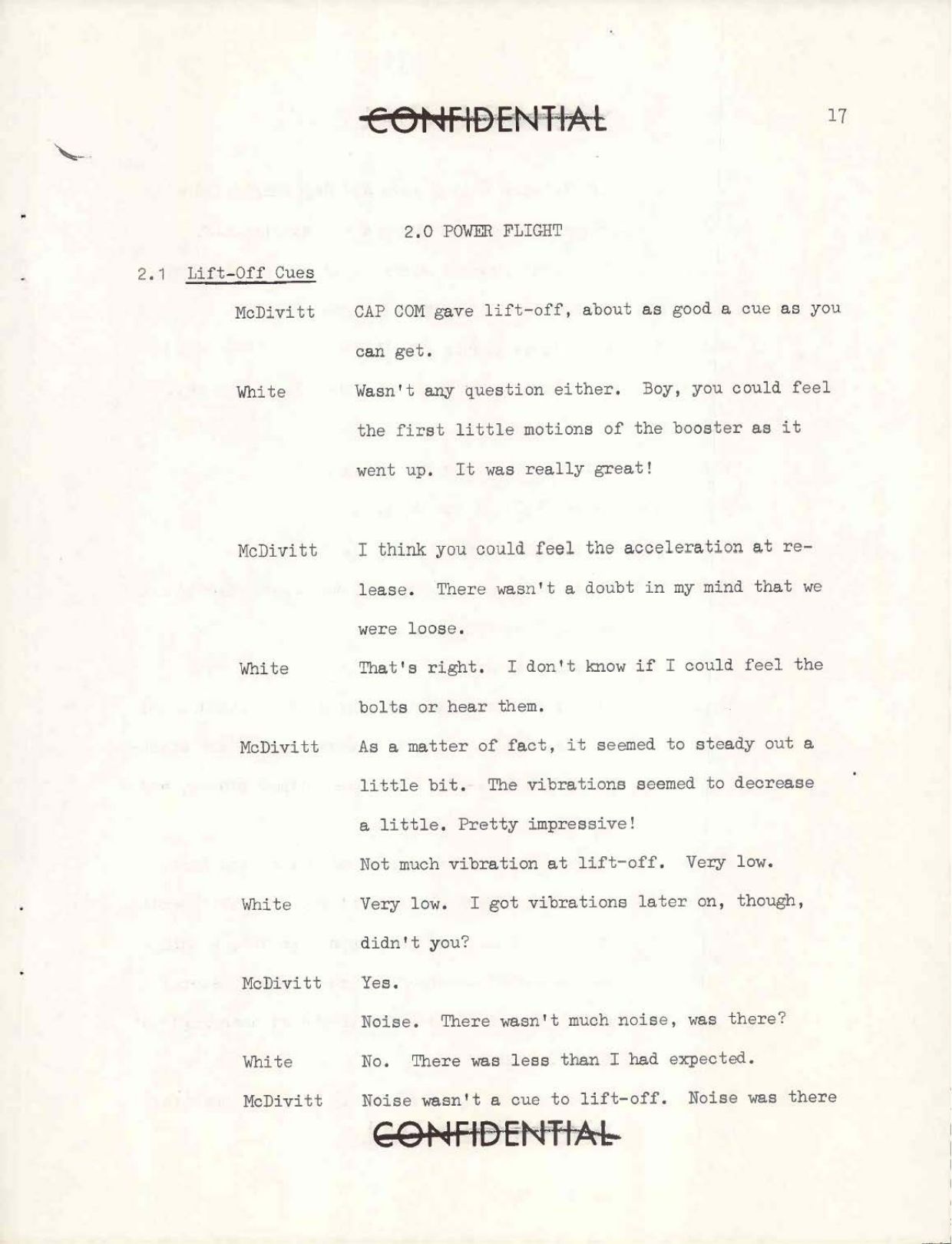
17 2.1 Lift-Off Cues McDivitt White McDivitt White McDivitt White McDivitt White McDivitt €Ot◄ Fl9ENllAl 2.0 POWER FLIGHT CAP COM gave lift-off, about as good a cue as you can get. Wasn't any question either. Boy, you could feel the first little motions of the booster as it went up. It was really great! I think you could feel the acceleration at re lease. There wasn't a doubt in my mind that we were loose. That 's right. I don't know if I could feel the bolts or hear them. As a matter of fact, it seemed to steady out a little bit. The vibrations seemed to decrease a little. Pretty impressive! Not much vibration at lift-off. Very low. Very low. I got vibrations later on, though, didn't you? Yes. Noise. There wasn't much noise, was there? No. There was less than I had expected. Noise wasn't a cue to lift-off. Noise was there
PAGE 26 / 340
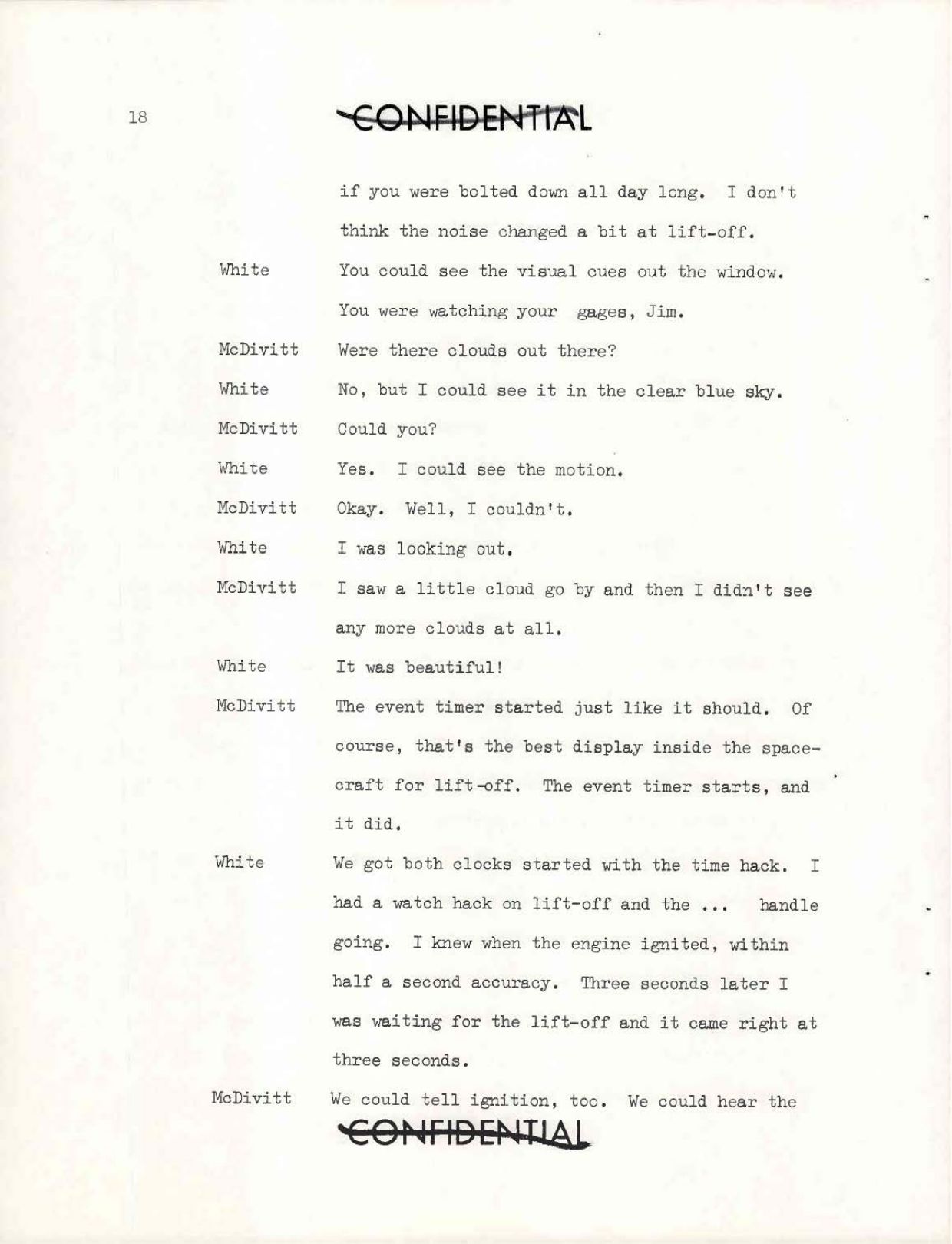
18 White McDivitt White McDivitt White McDivitt White McDivitt White McDivitt White McDivitt if you were bolted down all day long. I don't think the noise changed a bit at lift- off. You could see the visual cues out the window. You were watching your gages, Jim. Were there clouds out there? No, but I could see it in the clear blue sky. Could you? Yes. I could see the motion. Okay. Well, I couldn't. I was looking out, I saw a little cloud go by and then I didn ' t see any more clouds at all, It was beautiful! The event timer st arted just like it should, Of course, that 's the best display inside the space craft for lift-off. The event timer starts , and it did, We got both clocks started with the t ime hack. had a watch hack on lift-off and the ... handle going. I knew when the engine ignited, within half a second accuracy. Three seconds later I was waiting for the lift-off and it came right at three seconds, We could tell ignition, too . We could hear the '€0 ► ~FIDEJ>1TJAL I
PAGE 27 / 340
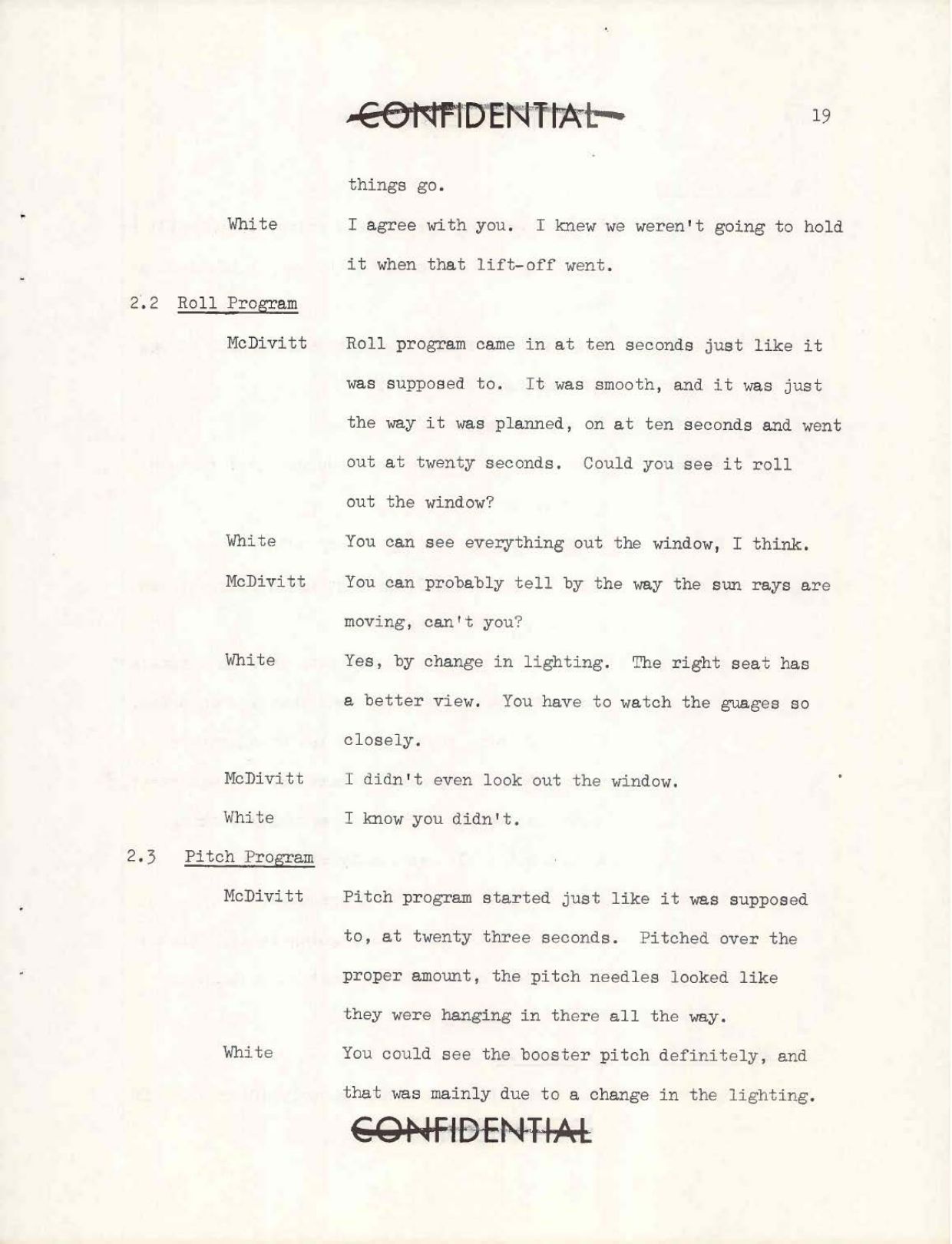
19
2·. 2
White
Roll Program
McDivitt
White
McDivitt
White
2. 3
McDivitt
White
Pitch Program
McDivitt
White
things go.
I agree with you.
I knew we weren ' t going to hold
it when that lift-off went.
Roll program came in at ten seconds just like it
was supposed to.
I t was smooth, and it was just
the way it was planned, on at ten seconds and went
out at twenty seconds.
Could you see it roll
out the window?
You can see everything out the window, I think.
You can probably tell by the way the sun rays are
moving, can't you?
Yes, by change in lighting.
The right seat has
a better view.
You have to watch the guages so
closely.
I didn ' t even look out the window.
I know you didn't.
Pitch program started just like it was supposed
to, at twenty three seconds.
Pitched over the
proper amount, the pitch needles looked like
they were hanging in there all the way.
You could see the booster pitch definitely, and
that was mainly due to a change in the lighting.
PAGE 28 / 340
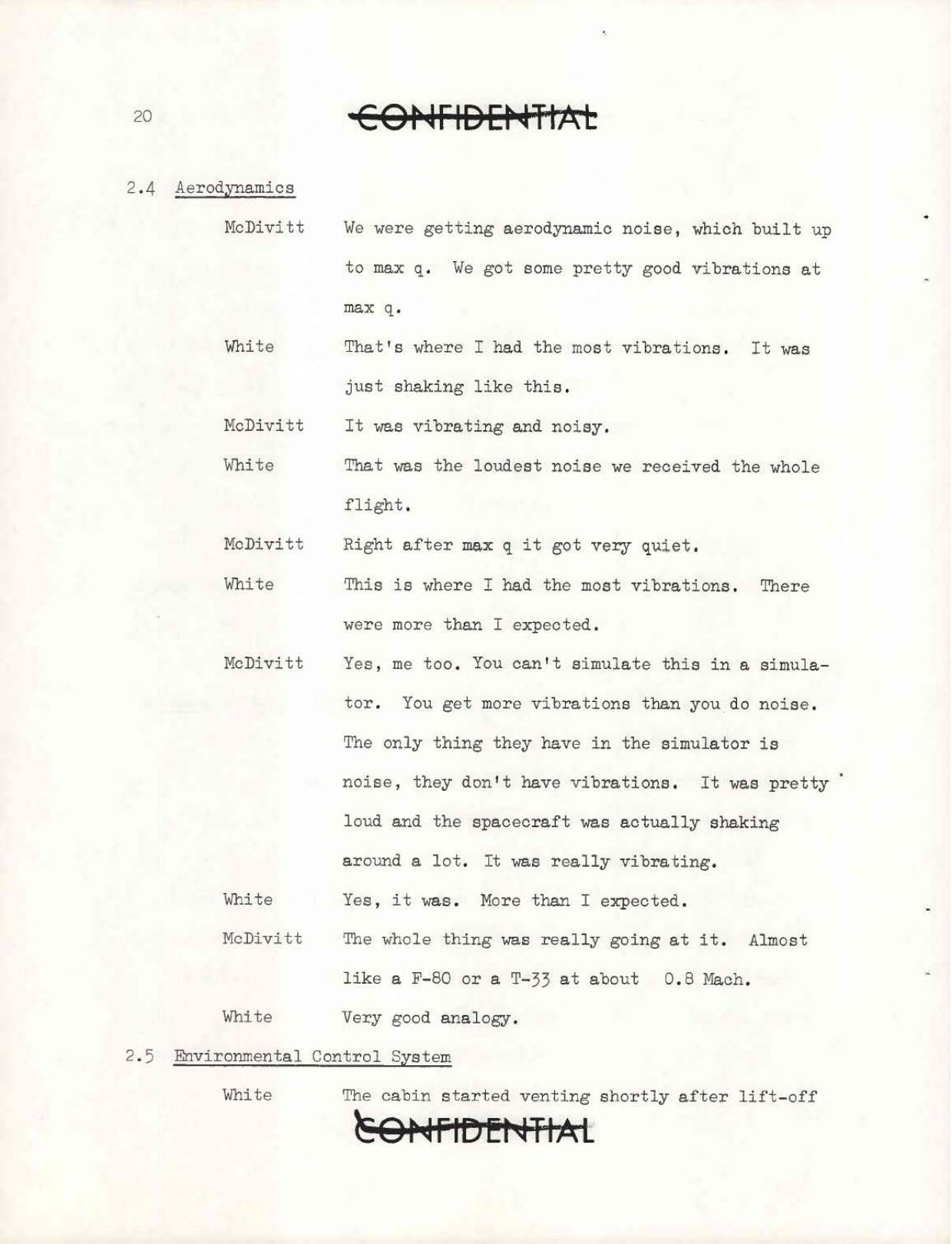
20 2 ,4 Aerodynamics McDivitt White McDivitt White McDivitt White McDivitt White McDivitt Whi te co~~FIDE~~TIAt: We were getting aerodynamic noise, which built up to max q. We got some pretty good vibrations at max q. That's where I had the most vibrations . It was just shaking like this. It was vibrating and noisy. That was the loudest noise we received the whole flight. Right after max q it got very qui et . This is where I had the most vibrations. There were more than I expected. Yes, me too. You can' t simulate this in a simula tor. You get more vibrations than you do noise. The only thing they have in the simulator is noise, they don't have vibrations. It was pretty loud and the spacecraft was actually shaking around a lot. It was really vibrating. Yes, it was. More than I expected. The whole thing was really going at it. Almost like a F-80 or a T-33 at a.bout 0.8 Mach. Very good analogy. 2. 5 Environmental Control System White The cabin started venting shortly after lift-off ~O~◄ FltJEf<tftAL
PAGE 29 / 340
21 McDivitt White McDivitt White McDivitt 2.6 Maximum q .... McDivitt White McDivitt White 2. 7 Windehea.r McDivitt and continued so until about 40 seconds and sta bilized out at 5.5 and I made my call in. I think I might have called in on RECORD. You did. I switched and made the final call at about 1:10, I realized I called on REDORD and switched over, How high did it go? Did it go to 5.5? 5. 5 and it stayed right there. And then I noticed later on it progressively leaked off until it got to 4.9 where it stayed. The suit? There really isn' t anything to say about the suit. No, I don' t have anything to say about the suit. It oi:erated like it was supposed to. The noise built up gradually until we got to max q , then it just dropped off. The deterioration of the noise was almost instan taneous. Very quick, It wasn ' t instantaneous , but it was very quick. In fact, it startled me when we separated. I didn't notice anything on the rate needles that had anything to do with the windshea.r I couldn't
PAGE 30 / 340
22 eot~FIDE~~"f1At pick out windshear • on them. How about you, Ed? White No. McDivitt Did you see any attitudes? White No . McDivitt No big divergences from windshear . 2.8 DC~ Updates White We got both of our ros updates right on time- H'45 a.nd 2: 25, McDivitt No comment. Ed is in charge of ros updates. White I 'm the button pusher. I do everything about pushing the buttons. McDivitt I can do this with this little stick. White You can do it unless I have my knee over it. 2. 9 Engin,®. 1 Operation McDivitt They operated the way they were supposed to as far as I could tell . The tank pressures stayed up fi~ on both Engine 1 and Engine 2. There was never any doubt in my mind that they were going to stay up there. There weren't any of those things like we saw in those simulations where they came on down pretty low on the gages when they were supposed to be at 18 or 15. There wasn't anything like that . They just stayed on up there. €0t'1Flf7ENf 1Al
PAGE 31 / 340
23 White Just where they were supposed to be. McDivitt Yes. I followed them a couple of times and said they were staying up fine. They were way up. There wasn't any problem there, 2.10 Engine 2 Status McDivitt Second stage pressure stayed right on up there very high. Just the way they were supposed to. There wasn't any problem there, They didn't decay all during the first stage. 2.11 Acceleration g's McDivitt They weren't bad and I don't know where they went to on the g meter. White Just like riding in an old saddle. McDivitt That's right. It's very comfortable. Steady on set. White Not very long. Gee, we were below-- McDivitt Wait a second. This might be a good place to cover the pogo. I felt the pogo just prior to staging, from about 2:15 on to 2:30. I could feel pogo. White How much were you getting? McDivitt Very little, I could just feel it pull like this. Did you feel it at all?
PAGE 32 / 340
24 White McDivitt White McDivitt White McDivitt 2.12 BEX;O McDivitt - COt~FIDEt ◄ TIM No . I could feel it . It wasn't uncomfortable enough where I had to l ift my head or anything. I wasn't thinking about a pogo at all. It wasn't like I was trying to sit there and think about it. But as we were going along I could feel this vi bration. And then it just crossed my mind, well there is pogo, and then we went on to staging. But it wasn ' t bad at all . The amplitude must have been- You were paying more attention to your clocks while I was watching the system ,gages and I wasn't really aware of the times that were going on. I had my eyes- It came around 2: 15 or so and lasted to about 2:30. Maybe it was 2: 10 or 2:05 , but it wasn't bad . We had one area that I will get into later that I haven't told you about and that I didn't like. Oh. So , I think we hit the pogo and the g ,. s . Engine shut down properly. The lights came on. Engine~- 2 light went out and the Engine 1 lights went out. Just the way it was supposed to at B~O and staging. Two Stage 1 lights ON , Stage 2 EOt<I flf)Et ◄ Tl1'c b
PAGE 33 / 340
25 COt ◄FIB~1'1llAl White McDivitt 2. 13 Staging McDivitt 2. 14 Engine 2 Ignition McDivitt White McDivitt White light OFF, Stage 1 lights OFF. At that time I realized that we were going to feel the pyros and stuf'f--feel the separation. It was a very distinct feeling when we sepa rated. Of course, we immediately dropped in the thrust . There wasn't any question,we had a good separation, in my mind. This is just the way it was for all of our separations. Ev-erytime we separated, it was very clear that was what had happened. Oh, yes, there wasn't a:ny doubt about it when that first stage shut off--Voom! Staging was just as it should have been. Engine 2 started right on up. Like I mentioned earlier~the light went out and the tank pressure went down just a tad, but it stayed way up there, about two or three times as high as was necessary for staging. It never really did decrease. It stayed up around 45 or 50 psi, and we need 20 for staging, so- I couldn' t hear anything. Didn't you hear the engine? No. I was listening but it still was quiet. €Ot~FIDENllAL -
PAGE 34 / 340
26 McDivitt Whit e McDivitt White McDivi tt 2 . 15 RGS Initiate McDivitt 'COl'4FIDEl'ffIA-t I didn't really get much of a cue out of it at all, except the lights went out and I could feel a lit tle bit of acceleration. The acceleration decreased. Another thing I didn't get--I got absolutely no pitch-up associ-· ated with the--the way the centrifuge does you at the end of an acceleration. I think that is associated with the cab on- Yes . I think that's the way they rotate those gimbals when you come on down. If they rotate them a certain way you can get that pitching-up- A very safe forward-type deceleration. I think that pitching up on the centrifuge is not a malfunction. It' s just the programing that's hooked into the gimbals during the stop program. You've got to get them all going the same way so that you keep the vectors through you. During l aunch the vector is right through you. It's not varying around , but in the shut-down on the cen trifuge those darn gimbals aren't always syn chronized together. They get shifted back there and it gives you that peculiar sensation. Well, I was really watching closely but my rate
PAGE 35 / 340
White McDivit t White McDivitt White McDivitt White McDivitt White McDivitt White McDivitt needles just barely changed . We mus t not have had any errors at al l . Yes , I got a full error. Did you have a full error? Yes, my pitch error went all the way down , and then it just steered slowly right back up. Re member you- You did call and tell me you had a saturated- Di d you call saturated , or did you say we had a bi g one? I called it saturated, I believe. That ' s right. I called a saturated error and then I called you that it was steering back to zer o. Yes . I remember that you did call that. That ' s the way they showed this on the plot, t hat i t would saturate there , am very quickly it seemed to gradually steer right back up. The steering rates that went in were on the order of less than half a degree/second. They were very low. Very, very low because I was on high scale. The needle just barely deviated at all at RGS GO~JFIDEN"flAl
PAGE 36 / 340
28 White McDivitt White McDivitt White McDivitt White 2. 16 GO/ NO GO McDivitt 2, 17 Systems Status White initiate. It was beautiful steering. Nominal, nominal, nominal, except like that saturation on the error needle, but we have been briefed on that. That ' s right. That ' s something to be expecterui When did it saturate? Right at staging. No, right at guidance initiate. Oh, okay. It saturated right there. Right there at guidance initiate, which is what you ' d except. They said they were GO and I said we were GO . There wasn't much problem. Ed and I had been checking back and forth on the systems . I knew they were all right. The systems were all pretty good. There was only one I didn ' t like and that was the stack readings on the main ammeters. One was reading about 28 and the other was reading about 14, But I felt that this was associated with bringing the batter ies on. I went through and checked everything. Everything was readi ng properly. The control bus
PAGE 37 / 340
McDivitt White McDivitt White McDivitt White McDivitt White and main bus were all reading all right. I felt it was just a misbalance of loading. I talked to somebody previous to this time and it was explained to me that this could happen this way. I felt perhaps it was in the adapter batteries- would feed through on one of the stacks causing one of them to take more than the other. Yes. You could have gotten into the knee of an adapter- This is what I had figured-- that a couple of my adapter aatteries were unbalanced, causing this to occur. I also had seen this on the simulator quite a few times. When did the unbalance start? When we got in they were-• As soon as we were on internal power? Right. And I didn't feel this was the time to talk about it. It was still under 30 amps, which was my point. So I didn't bring it up. You didn't want to worry me? I didn't want to worry you and I didn't want any body on the ground to start hollering about it. You should have written me a note. I did feel that this was exactly what it was- ~Q~~ftE)EN:rJAL
PAGE 38 / 340
30 McDivitt White McDivitt that it was adapter batteries. That was the only abnormal type of indication we had in the systems. They were all real good. Well, we had good communications with the ground during powered flight. We had pretty good communications. I called the "Roll Program", and nobody answered me. I said, "Well , to heck with it, maybe they just aren't ge t;ti.ng through." Then I was just starting to call Roll Program complete when Gus called and said,"Did you get the Roll Program?" Now that was the only transmission I made that wasn't acknow ledged. Yes, I heard you calling, too. So , if they lost communications it must have been right at the 10-seconds t i me , and it should have been for l ess than 10 seconds. It couldn't have been for more than 20 seconds. I heard the count down to lift-off and I heard Gus call and ask me if I had the Roll Program started . This was a little bit less t han 20 seconds-- around 18 or 19 seconds. That is the only period of time I didn' t hear anybody I should have heard. So , if we lost communications, that was where it was.
PAGE 39 / 340
31 2.18 Acceleration McDivitt White McDivitt White 2. 19 SECO McDivitt White McDivitt Well we got up to 7 1/2 g's. The acceleration wasn ' t bad at all. I guess when you are really interested in what you are doing like on the boost or reentry, those g's don't mean anything. I don't like to ride the centrifuge. 7 1/2 g's is 7 1/2 g's on the centrifuge, but on the booster- My vision was crystal clear. Me, too . I wasn't even breathing hard. I wasn ' t huffing or :pui'fing or anything. I was just laying <there relaxed . Particularly on this one, The acceleration burn during powered flight and insertion was very light . SECO occurred as it should have on my clock. Ed thought it ~s about--what did you say it was? I thought it was a second or so early and it concerned me because that meant we were going to have to burn. So I was quite expecting to hear a big 6V come up from the ground. There is no question on that SECO either. It shuts off and you get that linear straight deceleration. The thing that surprised me was that we weren ' t talking about it at all. We were just going as , CONFID·EN"TtAt
PAGE 40 / 340
32 White 2.20 Steering McDivitt White McDivitt Whi te straight as an arrow when that thing shut off. There weren't any oscillations or roll. I was getting a sinusoidal oscillation on my rate needles , and I don ' t know now whether it was pitch and yaw. I cal l ed it out a t the time , to you a:nyway, Eli . Right. And my attitude arrows were- Your attitude arrows were right on? Okay. But I was getting an oscillation, very small, about plus or minus a quarter degree in rates . Not so that the needle was actually moving back and forth across the dots. It was pretty obvious that it was. Now, I sort of felt that I could feel that movement a littl e bit, like this , but not annoy ingly and certainly the stabilization was holding i t close enough. But it wasn ' t that the rate needles were just constantly oscillating back and forth. It seems to me it was in pitch but I'm not really sure . A booster pitch, The attitude error needles were the only deviation we had at any time. Yaw was just about nominal all the time. We had the pitch deviation at guidance initiate. It went to full scale and steered right • COt~Ft0ENflAL
PAGE 41 / 340
33 McDivitt White McDivitt White McDivitt back in, and also right at the end we had, in pitch, a little bit of a pitch-down needle indi cation which increased to no more than about a degree at booster shutdown. You got about a degree,then,on shut down? Just about a degree. Yes. I kept glancing over to see how you were doing, They were always right near the center for me. Yeah. Right near the end they trailed do,.m just a little bit. I 'd be interested to see what the ground thought on this. Yes. You'll have to go over and look. I'm sure they have them. €6Nft[:)ENTI.AL
PAGE 42 / 340
34 3,1 Post- SECO McDivitt White 3.0 INSERTION Yes . There was a Post-SECO. In the period be tween SEX:!O and SECO + 20 seconds, I unstowed the maneuver controller. I don ' t know where our attitudes were. They were the same as they were a t SEX::O, and it was about 20 degrees pitch-down, wasn ' t it? The rates during this period were on the order of less than a half a degree/second. We really had a period of from SECO to SECO + 30. So, duri ng this time I actually fired the trans lations thrusters at least two times in one axis to kill off the rate in t hat axis, and I think it was probably the booster yaw or spacecraft pitch where I act ually fired the U,rusters once or twice to bring the rates back. It might have been the other way around. But, we didn't jetti son the fairings then. I did unstow the maneuver controller and the attitude was the booster burn out attitude and the rates were very low, less than a half a degr ee/second. I think we mentioned prior to this time the feeling that we came off a little half (Q~~IQFNTIAL
PAGE 43 / 340
35 3. 2 SECO + 20 Seconds McDivitt White McDi vitt White McDivitt cocked off the second stage. We were going to $ay on the booster until SECO + 30 instead of SECO + 20. At 20 seconds the IVI ' s started displaying and I read them off as 20 for ward, 11 right, and 5 down. Right , This was when we were still in the 90 degree bank position. Is that correct? Or was it after I had rolled right-side-up? It was after you had rolled right-side-up. Okay. Well, then the IVI's displayed when we were still on our side. It seems to me they were about 25 feet/second forward , and some other numbers, but anyway they were low enough where I felt we were certainly in orbit. At least the IGS was telling us we were in orbit. During this time, as I said earlier, I tried to damp the spacecraft rates, the spacecraft booster rates which were quite low. I checked to see that the OAMS Power Switch was in ATTITUDE and MANEUVER , and to see that Eli had switched over to DIRECT. I told him I was going to do some thrusting but I wasn't going to separate yet, so that when he € 0 ~~ FfDENT.I.Al
PAGE 44 / 340
White McDivitt White McDivitt White McDivitt White ~EIDENJl»,t heard the thrusters go off he wouldn't push the SPACECRAFT SEP. Then we did separate the space craft with the ·exact routine we practiced in the simulator. I said, "Thrusting, separate", and you punched the SEPARATE button and I guess you went to Rate Command. I thrusted straight ahead for about five seconds. This is where I think we came off crooked. This is the part Ed was men tioning before. We didn't seem to come off straight ahead. We seemed to be getting some sort of an oscillation that got us going in a dif ferent direction than what we had going on the booster. It seemed,, like one side of the separation plane came off with more force than the other. Yes. That's what it seemed like to me. It separated at a bit of an angle. That's right. We didn't separate fore and aft; we separated with a lot of rotation to this side. Yes. Air-ground communications were all right. We were talking to them and they were talking to us. I never had any problem there. Shortly thereafter they called up and told us we i C&MFfEiEM IIAL
PAGE 45 / 340
37 McDivitt White McDivitt White CO~ ◄ FIDEt><tTIAL had a 153 by 57 orbit. So, they were talking to us. I don't think I ought to read off this stuff now, but they gave us the 2-1 data and all the nominal data we were supposed to get. It came out fine. Say again what the IVI's were while we rolled right-side-up. Right . At the position we decided on taking our IVI readings, which was heads up in a zero-zero attitude, you read off the IVI's to me as 20 for ward, 11 right, and 5 down. Okay. Then I didn't bother nulling the pitch -· needle because we were really pressed for time to get around. No velocity correction was called up to us and since we had no velocity correction, and we were fairly busy at this time, I didn't even read out the 52 or 70. I wasn't particularly interested in them. It ' s a funny thing though--52 was punched in and had: been read out and it showed 30. It had been punched in so it read out, you see, as soon as something came in the quantity. So, did have a readout. I read out 30. I remember looking at that. I
PAGE 46 / 340
38
~O ► ~flDENTI~
3. 3 Insertion Activities
McDivitt
White
McDivitt
White
I
I
I thrusted and got off the booster.
Then I went
ahead for just a short time, and then I started
to turn around right away.
During the turn-around,
I jettisoned the fairings.
They went off with a
bang.
I could see the fairing over the horizon
scanner go, but I never did see the fairing off
the nose go.
I just assumed that it went.
We
were already in just a mass of debris up there,
because when we se:p3,rated from the booster there
was stuff all over.
All over. It really flew by to the side of the
spacecraft.
Yes. It was all over the place.
As we.were
turning around it looked like we were going
through a snow storm.
There was stuff all over.
Finally we got turned around, in about a minute
and a half, and we could see the booster there.
There ' s one thing I would certainly like to see
somebody do--I'd have give my right arm to have
had a camera when I turned around and saw tbe
booster.
I ' d like to see somebody carry a camera
in a semi-•stowed position so he could immediately
get it out and come around and take pictures of
•CO ►~FIDE~~TIAL
PAGE 47 / 340
39 McDivitt the booster. Either the camera, or better yet a 16 mm camera with a normal lens on it . Just tuck it to the side of your leg. If I had thought about it I think this is what I would have done- just connected the camera, tucked it by my leg, and taken pictures of the booster at this time. I think, Ed, this is probably one of those philo sophical things. On the first orbit you've got to save to prepare to come back in case you have a bad spacecraft. You 've got to be ready to reen ter during the first orbit . Tuis is the kind of bind we found ourselves in up there. During the first orbit we really had a lot to get ready for halfway through the second orbit, but on the other hand we had to be in good enough shape so we could reenter it at 2-1. Now, we didn't have anything to go wrong so there wasn't any problem, but I think when you first get into orbit you're in a problem. This kind of a thing, I think, is a problem you may have later on. You've got to be ready to eject at lift-off plus one second, and you don't want to be sitting there holding a camera or something like that. Both your hands are busy. But like you said we could stow it ~ONFtDf1'tliAt
PAGE 48 / 340
40 White McDivitt White McDivitt White McDivitt White 3omewhere. I think you could. You could stow it beside you in the seat . I think we over- emphasize the neces sity, particularly for ejection, of having to have everything stowed when you are only ejecting up to 12 000 feet and at very slow speeds. We certainly have a heck of a lot more working against us in our airplanes we ' re flying around. That's right . I agree with you. I ' m just saying this philosophy of being completely prepared to reenter during that first orbit is in conflict with doing this kind of stuff in the first orbit, too. We ought to get some of this, though. I think we are missing things . I would have really- Yes, I think so. We could have really had some beautiful pictures of that booster when we were close to it. I also want to comment a little bit on the booster itsel f . I looked as closely as I could at the nozzle skirt and the aft end of the booster, and I saw no damage whatsoever. No, neither did I from our vantage point . As far as I could see the nozzle skirt was com ,COI>~11;) El>fftAL
PAGE 49 / 340
41 McDivitt White McDivitt pletely intact. There was nothing wrong. Okay. Let ' s try to follow this insertion activi ties list here . I jettisoned the fairings , as I said, as soon as I started turning around. Then Ed went through the checklist for us. After I fired the fairings I turned off the BIA Switch and the retro rockets when he called. I was probably doing this before Ed called, wasn ' t I? We did things just like we had been doing them on the simulator. We don't just take a checklist and run down it item for item because there ' re things you have to be doing , and it just doesn ' t go in a sequence like that . I realized this was the way it was going to go, and I actually took a pencil and checked items off. If you did an item I checked it off, and if you didn't I left it un checked and we got it later. You just can' t ex pect to run down the checklist item for item because you ' re not ready to unstow your life vest or to get up out of your seat belt. You don't do that for some time. I think the logic on the check list we have here is a very good sequence--. We reviewed that checklist 50 times. That's 00tq ftf)ENftA-t
PAGE 50 / 340
42 White McDivitt White McDivitt cor<tFIDENTIAt probably the fiftieth checklist we ' ve got there, and I don ' t think i t could have been arranged any better for the two of us . I knew Jim wasn't going to undo his seat belt har ness and I knew I was going to have to because I had to do certain things that he didn ' t have to . The point that I ' m making is that the checklist doesn ' t have to be accomplished item for item, completely done in numerical sequence. Okay. I thi nk we ' ll revert back to the exact subject of 3,3 now. Safetying the switches . I saftied the swi t ches--the BIA Squib Switch and the four Retro Rocket Squibs Switches. I tested the sequential l i ghts, but at a later time because I was involved in turning the spacecraft around. But X did test them. As far as stowage, I stowed my left arm restraint and my D- ring, but I did not put my saf ety pin in. I went through and put my arm rest down , put my safety pin in. That was one of the first things I did. I might comment that I never did put my safety pin in. I never put the safety pin in the D- ring. I felt the D- ring cover was adequate, and it was . co ► ~fiilQ lil)l:rlsA<JL
PAGE 51 / 340
43 White I know, you never have been particularl y too hot on that. McDi vitt Noo White Then I went ahead and disconnected myself. I had a lot of things I had to squirm around and do. I left my life vest on as we had planned to do , then take them off leisurely at a different time. I did not find any reason to put the drogue pins in. I don't think they are satisfactory in any way. I don' t think the pin itself is sati sfactory, and I don ' t think the location or type of holes are satisfactory. I will elaborate on them a little further. We have had aircraft around for a long time and we have learned a lot about saf ety pins . We have come up with some pretty good designs on safety pins. We have a design on our drogue pin right now which is no more than the very first type of safety pin that I saw on an aircraft. I think that we are past the point where we should be starting right out at the beginning. We ought to put a properly designed safety pin in there that you can insert a little easier into the holes. I ' m not going to try to design the pin but I think that it should have some type of shaft on it that r€0NFll}ENftl(L
PAGE 52 / 340
44 McDivitt -E OI'~FI DE~ITIAL you can use to stabilize the pin when you insert it. And when I say the holes through which you insert the pins are unsatisfactory, I 'm referring to holes through a cylindr i cal shaft that is hollow inside so t hat you not only have t o find the hole to put it in on one side, but you have to work it around and find the hole that it goes through on the other side. I don ' t believe that's satisfactory. I don't think the opening into the hole is supposed to be beveled and they weren 't beveled on my seat and they weren't beveled on Jim ' s seat , either. I t hink a beveled hole is a hole that is bigger on the outside than it is on the inside. I don' t believe there is much dif ference between the outside and the inside of the holes for the drogue pins. I had a difficult time putting my own in. I put Jim's pins in. It took me awhile, but I put them in. I never did get one of mine in satisfactorily at this time , so I think we should do something better with the drogue pins. In addition I couldn' t even see the hole. You had an easier time putting my pin in t han you had putt ing your own pin in. GO~~FIDEl>ITIAL
PAGE 53 / 340
45 White McDivitt White McDivitt White .-CQ~qfl9tNTIAL That' s correct. I could put yours in fairly easy. That's right . I think that when you turn towards the center of the spacecraft , you end up with more room than if you turned to the outside. You can' t see a thing if you are turning toward the outside. This is probably covered later, but my hose lengths were not long enough to permit me to turn all the way around , I knew this when we went through Weight and Balance. I knew my hoses were not long enough but it was too late, as far as I was concerned, t o change them at that ti~ . But, I couldn't see the holes on my side to insert the drogue pin. I couldn' t see the holes for your drogue pin either, but I could get a better view of them over there so I knew approximately where t o put the pin, I think in all respects the drogue pins are not satisfactory. You just can't see them; the pins are incorrect, the holes are in correct, and I think we can certainly do better with them. I think what Ed is saying is that it 's lousy. That's right. In two letter words, it stinks ! This is the way the batteries were reading out when I checked them at insertion. And this is what CO ► 4FIDE~~rft"AI:
PAGE 54 / 340
€O ►~FIDEt4Tl~L I had suspected they were doing when we launched- why we had unbal anced stack readings. 1-A read 6 amps, 1-B read 10 , 1-C read 11. This accounts for your high reading on Stack 1. 2-A was 6, 2-B was 6, , and 2-C was 6. . Ttis was the way they were reading. I ran through a check on them when we were actually in the booster phase. So that is why I felt the reading wasn ' t bad. They were both reading about 23 1/2 or 24 volts . They looked pretty good. I got my 2-1 update. I got the t:N of 167, 6T of 3+35, and GMT to retro command of 14 48 34. I have the other times too. The time to 400 000 was 2+18, as read up to me and the time to reverse bank angle was 8+47. This is what we wrote down . This is one time I remember now when I was a little irritated, because they gave times to us in a manner in which I hadn 't wanted them toe They were supposed to give elapsed time but they gave it to us in GMT time for our retro. We had asked them to give it to us in elapsed, They came right back up and gave it to us both ways. I remember writing it down twice, on the elapsed time of 01 32 35. I can see why they did it because it
PAGE 55 / 340
47 McDivitt White CONFtf>E~ftAi. was two minutes past one hour 30 minutes, and I guess they weren't sure exactly what we wanted. So they gave it to us in GMT and elapsed time also . But that is the information we received, as far as our 2-1 area was concerned. I think Ed had better cover unstowage. I didn't unstow anything. I was just trying to stick with the booster at that time. The first thing I got into was my right-hand stowage compartment and I unstowed the blood pressure bulb. Then I started into the center section to get at the camera. The first thing I wanted to get out was the Hasselblad and the 16 mm. I was dying to get a picture of that booster. So , I unstowed the Hasselblad and got a good back on it and the 16 mm camera. I didn't unstow the urine nozzle as the flight plan had called. We both had decided we were going to use our launch day urine bags as long as we could, and we had hoped to use them right through the ENA. As it turned out, we did. That was about all I unstowed at this time. I unstowed the cameras, the blood pressure bulb and also got out the film cartridges and the tape cartridges. I put them on the side CONFIDENTIAb
PAGE 56 / 340
48
COt'4FI0EN-l+M.
of the foot well , where I planned to keep them,
so that we could keep a good tape cartridge
available.
PAGE 57 / 340
49 McDivitt ---G0NF-40 ENTIA L_, 4.0 ORBITAL FLIGHT I think that the orbital flight should be broken down into some very distinct sequences . I think there are really three of these. The first one is about the first three or four orbi ts where we were trying to stay with the booster, where we di d the FNA and where we finally got back in. The time that we finally got the spacecraft depressur ized ends one phase of the mission. The next phase or sequence of the things that come along is really the second phase. This is the middle 50 orbits or so, where we did the experiments and where we did the flight plan in a highly modified manner. We did the flight plan we started out to do . And the last phase or series of sequences was the ~et ro-preparation , retrofire and the reentry. The retro-preparation was actually another distinct phase of the mission. I think that we ought to divide it up into those three phases-- the station-keeping and FNA as Stage 1, general orbit as Stage 2, and retro-preparation and reentry as Stage 3. So I think we should CONFID ~~:rtAl
PAGE 58 / 340
50 4. 1 Station-Keeping McDivitt ~-IE>ENTIAL start in the orbital flight with the station keeping on the booster. I think that we should just pluck that thing out and follow it through in its entirety, and then come back and pick up these things like the thrusters , Control :fode Checks , Com Checks , and those things. The station-keeping with the booster--Well, as I said earlier on the insertion phase , I started turning around as soon as I completed the forward thrusting. I jettisoned the nose fairings after about 30 or 40 degrees of yaw. I rolled right side-up and then I started yawing around to the left. We saw all kinds of debris floating around and we finally saw the booster back behind us. It was already in a peculiar attitude. As Ed men tioned , when we separated from the booster, it didn·• t really feel like we came off straight ahead. It seemed like we got knocked off to the side of the thing. The spacecraft-booster combination sort of bent in half at the separation plane. We yawed on around and saw the booster, and I thought it was around 400 feet back. Eli thought it was a little closer. -€0·NFIDE~L
PAGE 59 / 340
51 White McDivitt £.ONfll)ENTIAf I would estimate it at between 200 and 250 feet. Okay. We were in pretty good shape right then and I applied about five or six seconds of thrusting that should have come out around 5~ feet/second . I was in a hurry trying to get our separation velocity stopped, so I was thrusting. I had it in Rate Command . I pointed the space craft at the booster and started thrusting, and by the time I got the computer in the Catch- Up Mode and the Start Comp button on, I had already thrusted ' 2 or 3 -~ feet/second out and I counted up another · 3 feet/second on the IVI's. It looked like we were probably stopped, although I couldn't tell tlBt quickly. I knew I had as much f::.V in there as I had at separation, and possibly a little more, because I tried to hold the separation f::.V down to no more than •5 feet/second. We watched it for just a short time and then it was obvious that we hadn't stopped our separation velocity--our relative velocity--so we were still separating. So , I applied about ano ther •• 3 or • 4 feet/second, which should have more than overcome the :4 or · 5 feet/second I put in initially. It looked like we had stopped .CO NFlD-E-~IlAL
PAGE 60 / 340
52 White McDivitt White McDivitt then. Our relative velocity looked like it went to zero. Here, I thought, we were out around 500 or 600 feet. F.d thought we were: probably in closer than that. Yes. I thought we were in a little closer. I put in a total of around· 9 feet/second in the first minute and a half after we turned around . I think we commented together on the speed with which the booster was going away ~om us . Right off the bat it looked like it wa.s- -it surprised me that it actually looked like it separated ·rrom us as fast as it really- It looked like it had a lot more velocity than the 4 or 5 J feet/second I added at t he separation. It looked to me , as an off- the- top- of:. my-head-guess , that something in the spacecraft separation thing had really built up a lot of relative velocity between the booster and the spacecraft. I don't know why or how. Al so , it looked like we weren ' t inplane anymore. It was actually out-of-plane so that we had an out- of plane relative velocity that I took out . I pointed at the booster because , obviously, if --EONffOfNTt~t.
PAGE 61 / 340
53
€0NftDEM11:At~
you're separating away from something, whichever
way you ' re going, if you point at the thing and
if you t hrust in that direction you are to take
out your relative velocity in all planes .
So , it
looked like the thing was off to the left or to the
south of our orbital track by a couple hundred
feet and it was going down rapidly.
Losing
altitude. After I thrusted this second time, I
knew I had more than enough velocity, much more
than I needed to kill off the
5 feet/second
we'd added .
I watched it and it looked like it
wasn ' t going away from us anymore. It looked like
our relative velocities had stopped.
I wanted to ··
get the platform alined somewhat in case we did
have---to come down in the 2~1.
We really hadn't
had much chance to check over the spacecraft yet.
So I quickly went to as close to zero-zero- zero
as I could get .
I used the zero yaw and the zero
roll off the ball and I went to a pitch att i tude
that looked like it was about zero and tried to
get the ball to aline to zero-zero- zero.
At that
time the booster was mostly behind us--mostly
back toward the Cape from us--back behind us with
respect to our velocity back there. It iwas in the
PAGE 62 / 340
-- 54 White McDivitt <coNFU)1:l'tllA.b window and I could see it. Well, I started alining the platform and left it there for a couple of minutes . The booster started falling again, descending below us. It actually went out of my view in the window. At the time though our relative velocities were quite small, so I felt I could let it go for another 30 seconds or a minute and not have it ge~~r away__!rom ...= ------ me . It looked like it was coming toward me again , but going below. So , I allowed myself about another minute and I pi tched down and looked for it. It appeared that during that minute it had gone a lot farther down than I had expected it to go . Yes , I was surprised. Remember that it looked like the orbit was sure something different than we predicted. Yes. It looked to me like the booster and the spacecraft weren't in anything that even resem bled the same orbit, at the rate it was descending. I don ' t know what the range rate was at that time. It looked like it was a lot more than a foot/ second, though. I don ' t know what it was. I quickly pitched back up to zero-zero-zero and C.ONF~DE~:r.lAL
PAGE 63 / 340
55 White McDivitt s tayed there for about another ten or fifteen seconds and went to Orbit Rate, I knew I didn ' t have a good alinement on the platform but I knew I couldn ' t stay there any longer and have the booster anywhere nea r us . So, I flipped around and pitched right straight down and here's where the problems started, To get down to the booster in a long rendezvous type maneuver, what I should have done was to jus t stay horizontal and fire retrograde and take some total velocity out of the spacecraft. But , when you do this the booster continues to pull away from you for a whil e , and then eventually you are going to drop down below it . Then you are going to be in a l ower-altitude orbit and you are going to pick up and catchup with the booster. Well, with the station-keeping we had to do and the fact that the darkness was only a matter of another few minutes- Boy it was fas t ! It wasn ' t any time a t all. I didn ' t have time to play a rendezvous game with it, I had to over come this relative velocity we had with sort of brute force , so I thrusted right at the booster again. I got going down and I used about 5 "CO t'-' FIO~NT+Al.
PAGE 64 / 340
56 White McDivitt White \ McDivitt I feet/second there. Here ' s where the numbers get a little vague. I thrusted down at it and I watched it go for awhile. I thought sure we 'd start closing on it again. We weren't closing, so I thrusted down on it again. I must have done this probably three or four times. I can't say exactly. I don ' t remember, precisely, how many times you thri1sted. I was keeping my eyes on the booster. And i t was a lot t ougher to see when it was down with the ground as a background, I t hought, than with the sky as a background. During this period of t i me its rotational velocity picked up con siderably, and during this time Fd checked it and got eight seconds for a complete revolution. A complete revolution. Yes. This was an estimate. This meant that in the first three minutes after we were in orbit the thing had gone up to a rota tional rate of 40 to 50 degrees/second. It seemed to stabilize at that rate. Its rotational rates stabilized but I don ' t believe its rotational mode ever stabilized. It didn't rotate in a plane as I thought a loµg body like that would rotate. It seemed to oscillate in just a random tumbling -CE7~1DENTIAL
PAGE 65 / 340
57 fashion. It was all over. It looked to me like i t was rotating in three axes in a completely unpro grarnmed manner. It might have been that the roll nozzle was flopping around and the fuel was turn ing it around in different directions. And as a matter of fact, at this time we should go back and draw a picture of what the fuel looked like and what was coming out of the nozzle. The booster was tumbling and you could see the fuel squirting out of the roll nozzle in a big fan like this. I had the impression that if the booster were per fectly stationary, the fuel would have been coming out of the nozzle in a great big cone the way you would expect it to, but because the booster was tumbling so rapidly it was coming out in a long, twisted- - l ike a horn of plenty. It was very ob vious; you could see it, and ther e wssn ' t any doubt about the fact that there was a lot of fuel coming out . Whether this was contributing some thrust to it or not I don't know. White I want to comment on something that was quite an experience for me. When I called out to you, I was looking down at what I thought , since it was pitch black, was the sky. I could see little cet-4PIDfNT~AL
PAGE 66 / 340
58 McDivitt White ~Ptt>fNT-l;4h sparkles everywhere. And it looked like almost a starlit sky, but it just didn't quite look right to me ; it looked like an artificial star lit sky. It looked like some of these star dis plays they have created for us . And I looked over at Jim and asked him if he was seeing this and about the same time I noticed that he had nothing but dayl ight out his window. This was the first time that I had the daylight-dark experience of one guy looking into pitch black night and the other guy looking into a complete daylight window over there. Jim remarked rather disgustedly to me, "We are pointed straight at the ground!" About the same time I realized I was looking out at the fire flies everybody had seen, but probably in a much more profuse quantity than had ever been seen before, because we were getting all this fuel that was vaporizing into many, many particles from the booster and a little bit of a contribution from the spacecraft also. And we were thrusting, too. I 'm sure we had all that junk on it from our launch. That ' s right . And the whole area out in front of my view was just entirely taken up with these CONFIOENft-AL
PAGE 67 / 340
McDivitt White McDivitt little par t icles , and this was at sunset . As the flight progressed, each time we had a particle or a group of particles such as a urine dump r ight at sunset or sunrise, the sun would pick these particles up and they would act just like littl e magnifying glasses and make very bright spots. This is exactly what happened. Did you ever see that then? I think you were more in the daylight side. No. I was on the daylight side. I didn't see what you were talking about. It was really something. The whole sky within my view was covered with these little particles- thousands of them. There was obviously a great deal of that stuff in the air all around. As soon as we got turned around I could see trat t he lights were flashing on the booster, and Ed saw them , too. It was pretty apparent . I call ed out r i ght away to the gruund that the lights were working. I don't know if they understood what I was talking about or not. I also called out shortly after we came off the booster and we saw it,that it didn't look like we were going to be able to touch it .. because of the high rotational
PAGE 68 / 340
60 CO·N·F~DENTIM White McDivitt rates that we already had. We were into darkness by the time that we got turned around, and I had thrusted just two or three times at the booster. We were still quite far above it--I would guess now on the order of 2000 feet or more and it was still dropping away from us rapidly; I had already used about 25 or 30 feet/second to get toward the booster. I knew I had to catch it during the night time because when we came out of the dark ness on the next pass, we had to be next to it , because we were supposed to take some photos of it around that time . So I thrusted some more right at the booster trying to just overcome orbital mechanics with brute force. It was too late to start playing fancy games with the orbital mechan ics. Finally, I got us down to what I considered a good position, and this was prior to Carnarvon, I believe. Remember when we finally got it on the horizon? It looked like it had finally stopped. The relative velocity had finally stopped. And let me now make a general comment about what I thought of the lights on it. We had two lights on the booster that flashed and they were diametrically CO~Fl0E~TtAL
PAGE 69 / 340
61 White McDivitt White McDivitt White McDivitt €01~FtDcNfJA~ opposed on the center of the booster . And when the booster was in such a manner that I could see both of the lights, I could tell relative rates and I had an idea of how far away I was. Did you find this to be true too, Ed , or not? Well , I can' t honestly say I was looking at it with that feeling. Okay. Well, what I am saying is that it was difficult- I want to hear what you are going to say. I 'm not sure what you ' re saying yet, It was difficult to tell how far I was away from it , at best , but when I had the booster in such a position that I could see both lights at the same time , I could tell by the distance between the lights whether I was close or far. Okay. I agree with that. And when I could see these lights flashing over a period of time , I could tell whether the distance between them was getting larger or smaller so that I knew i f I was closing or not . Unfortunately, because the booster was tumbling in this scre,ry manner, I couldn't maneuver around ~he booster because it was tumbling so fast ; I was just trying CONFtDENftt\L
PAGE 70 / 340
62 to get close to it and not even maneuver--not to pick specific positions . All I wanted to do was just get close enough so I wouldn ' t lose it. When I could see these two lights, I had a pretty good impression of whether I was closing or opening; for a long part of the early part of the mission in the night time it looked like we were holding our own, and then we finally started closing with it . I finally worked it down where we were at the same level , All this time I had been above the booster. I worked dovm until I was at the same altitude with it; at least it was on the horizon. I felt that by then I had gotten the thing under control and we stood a pretty good chance of still coming out on the daylight side with the booster. I can't tell you what the range was. It looked to me like I had worked the range back dovm (it had been opening up as· we went into darkness)- to 2000 or 3000 feet again--probably around 2000 feet . It might even have been as low as 1000 feet . It could have been lower than that . At one time I got the impression that we were quite close to it . White Yes. You were wondering whether you should retro grade away from it . 6ONFt01:M"flAL
PAGE 71 / 340
McDivitt
White
McDivitt
White
McDivitt
It looked to me like we could have gotten as close
as 200 feet .
It was extremely difficult to tell
how close we were. What's your guees , Ed? Just
pick a number.
I wouldn't say that close.
I 'd say you ' re more in
the ball park in the neighborhood of 700 to 1000
feet.
Okay.
You could be magnitudes off.
Before we got to Carnarvon, I remember, we were in
reasonably good shape, because I had finally
gotten down to the booster.
I felt if I could
just keep it down near the booster we would be all
right .
Then it looked to me l ike we were closing
rather rapidly. So I thought we were going to get
next to it and then we were going to be all right.
'I'he reason I felt this was because I could see the
two lights. It must have been rotating in such a
manner that I could see the two lights.
Almost
every fifth or tenth time they blinked I could see
them.
I could see two of them.
So I knew by the
distance that we were in quite close and everything
looked pretty good then.
And then for a long,
long, long period of time after that I never
PAGE 72 / 340
White McDivitt saw two lights again. I don ' t lmow if you did or not . I kept looking and there was a single light and a single light and a single light, and I didn't lmow where I was with respect to the boos ter. And then I started getting the impression without really seeing the double lights , I guess, that it was going away very rapidly. Maybe I did see two lights and I just don' t remember it now. My impression was that the light was getting fainter . I think that must have been it. I think that must have been it. But all of a sudden I got the impression that it was leaving me at a rapid rate . I It wasn't that easy to see. During the few times that the booster was up against the sky back- I ground it was easy to see , but when it was down against a ground background, it was very difficult to see . I think it was just before we got to Car narvon that I felt we were in good shape. And then as we passed Carnarvon , I remember calling I could see the lights of the city. Well, during this period of time all of a sudden I thought it was starting to pull away again. So I started thrusting at it again. And I never really got the ~itAL
PAGE 73 / 340
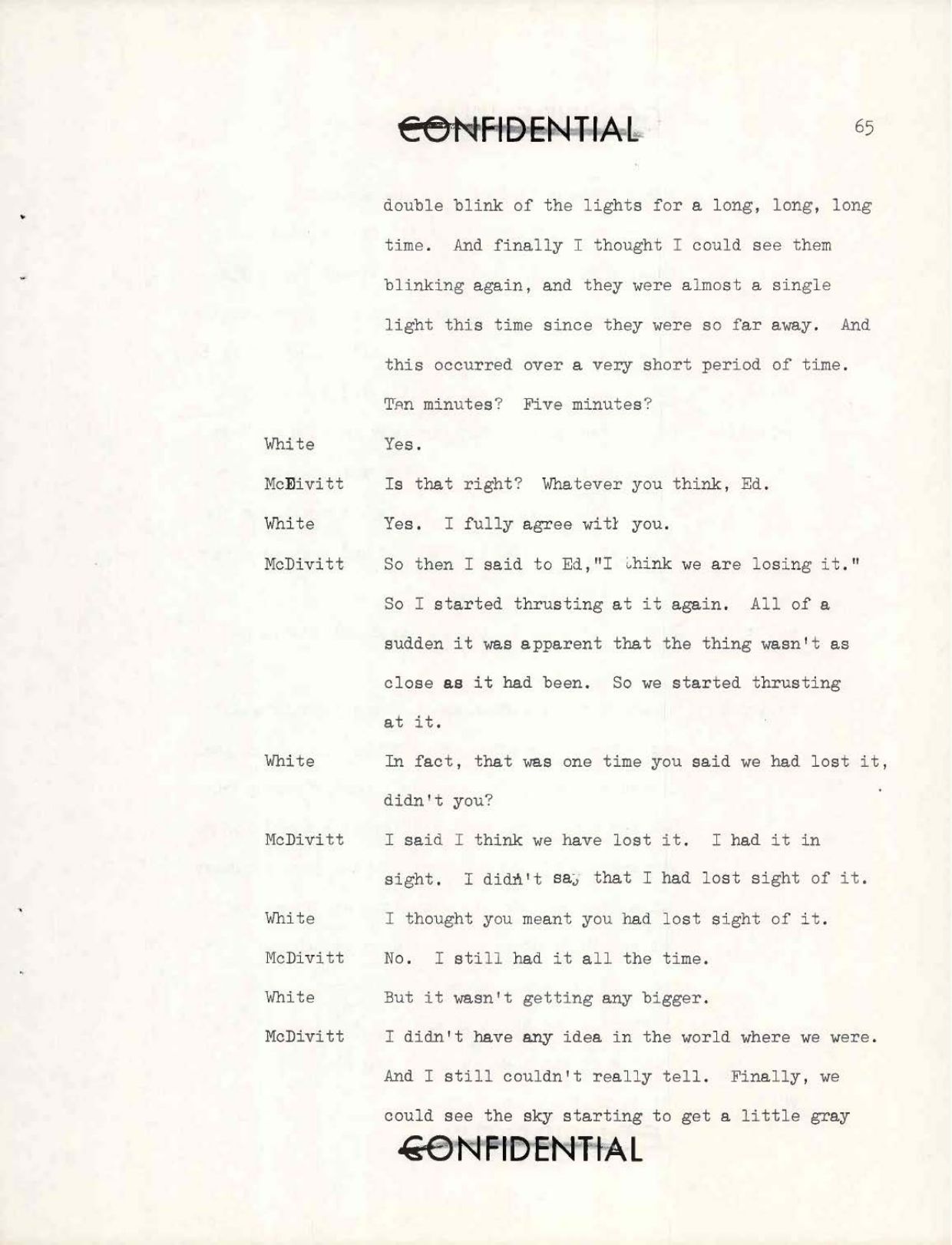
65
White
McEivitt
White
McDivitt
White
McDivitt
White
McDivitt
White
McDivitt
EONftE>ENllAL..
double blink of the lights for a l ong, long, long
time.
And finally I thought I could see them
blinking again, and they were almost a single
light this time since they were so far away.
And
this occurred over a very short period of time.
TRn minutes? Five minutes?
Yes .
Is that right? Whatever you think, Ed.
Yes .
I fully agree wit} you.
So then I said to Ed, "I ~hink we are losing it ."
So I started thrusting at it again. All of a
sudden it was apparent that the thing wasn't as
close as it had been.
So we started thrusting
at it.
In fact, that was one time you said we had lost it,
didn't you?
I said I think we have lost it.
I had it in
sight.
I didn't saj that I had lost sight of it.
I thought you meant you had lost sight of it.
No.
I still had it all the time.
But it wasn't getting any bigger.
I didn't have e:n:y idea in the world where we were.
And I still couldn't really tell. Finally, we
could see the sky starting to get a little gray
~NflDENTb\L
PAGE 74 / 340
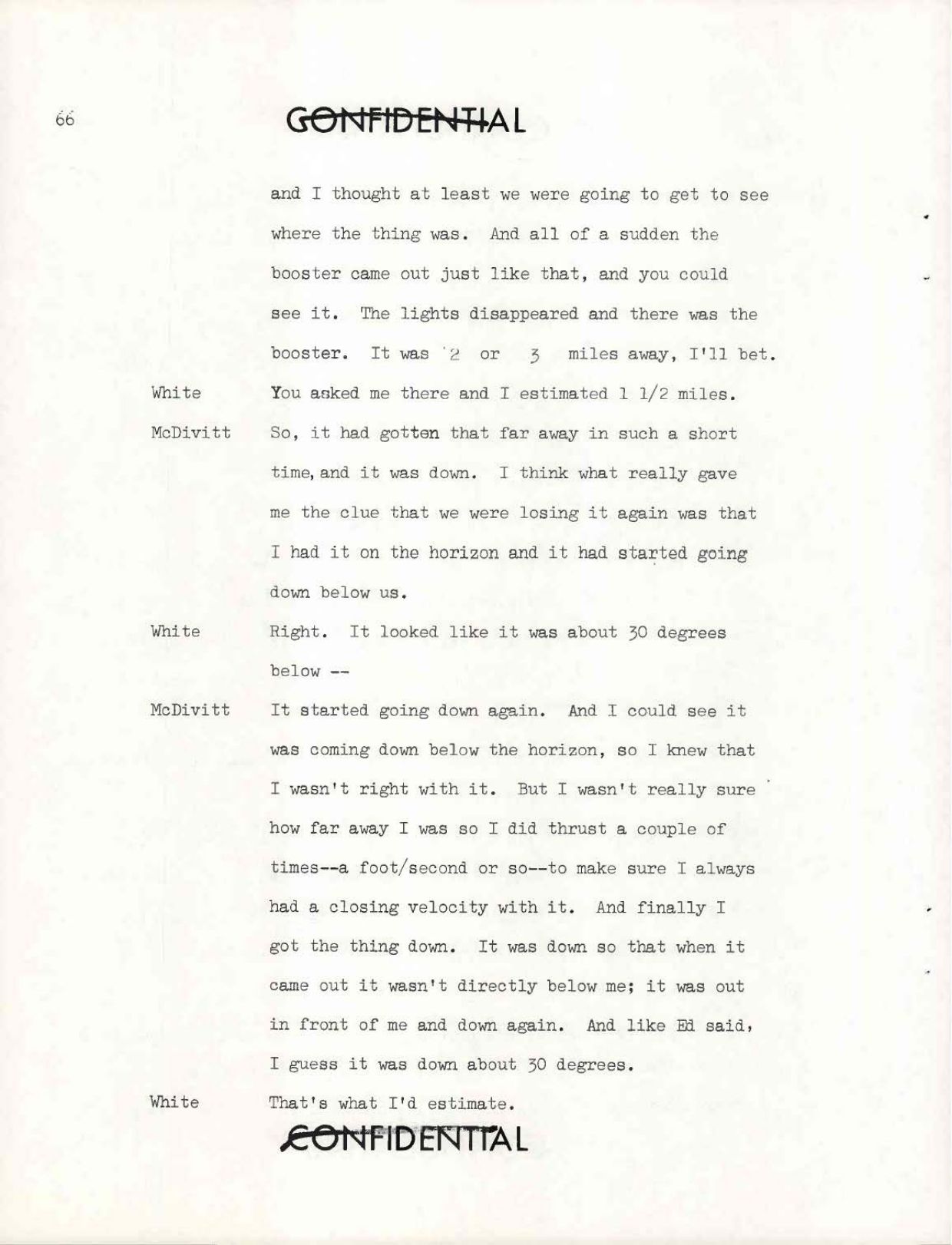
66 GOt\fPID Etft+AL White McDivitt White McDivitt and I thought at least we were going to get to see where the thing was. And all of a sudden the booster came out just like that, and you could see it. The lights disappeared and there was the booster. It was ·2 or 3 miles away, I'll bet . You asked me there and I estimated 1 1/2 miles. So, it had gotten that far away in such a short time, and it was down . I think what really gave me the clue that we were losing it again was that I had it on the horizon and it had sta~ted going down below us. Right. It looked like it was about 30 degrees below - It started going down again. And I could see it was coming down below the horizon, so I knew that I wasn't right with it. But I wasn't really sure how far away I was so I did thrust a couple of times--a foot/second or so--to make sure I always had a closing velocity with it. And finally I got the thing down. It was down so that when it came out it wasn't directly below me ; it was out in front of me and down again. And like Eli said, I guess it was down about 30 degrees. White That's what I ' d estimate.
PAGE 75 / 340
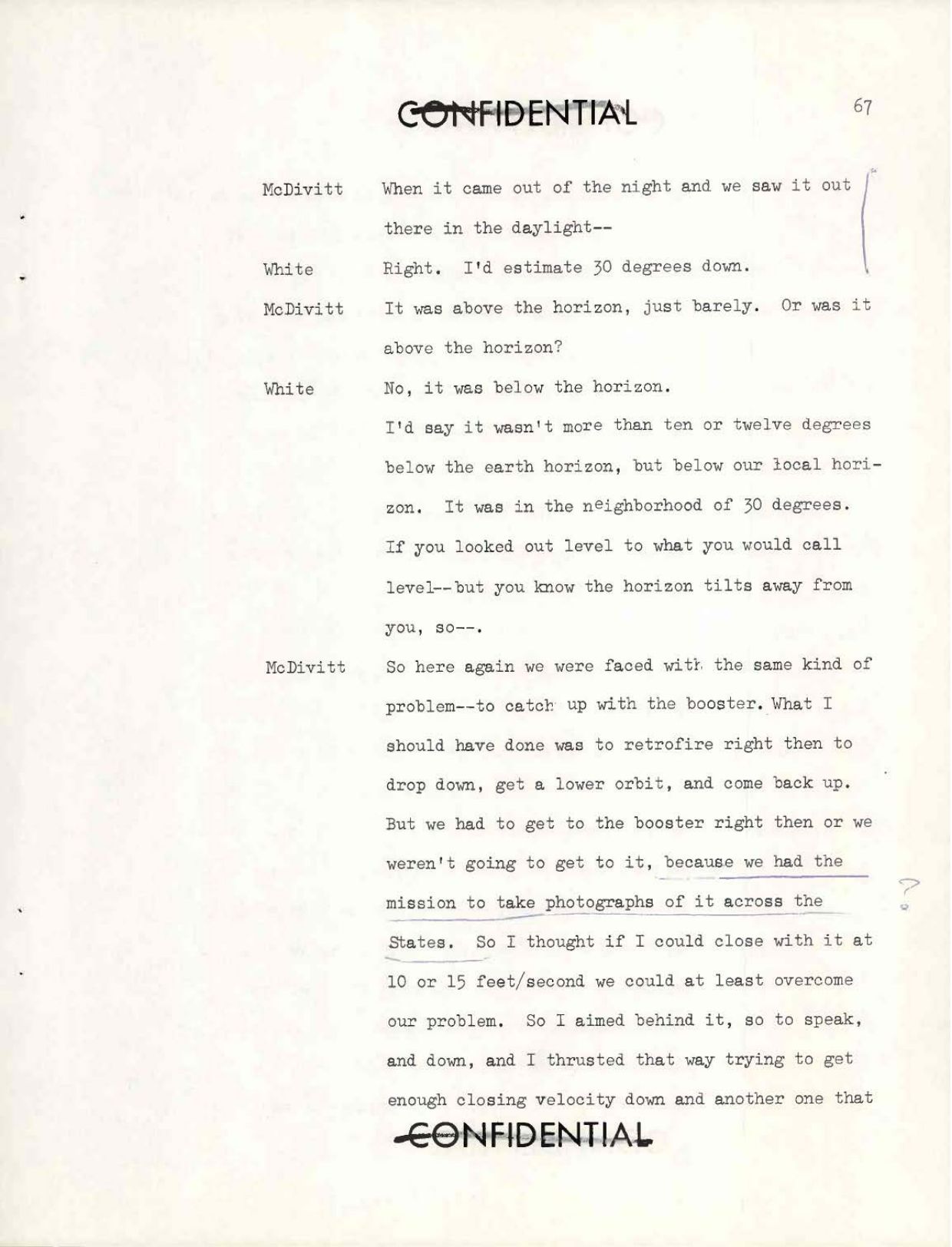
67
McDivitt
White
McDivitt
White
McDivitt
C-Ol<fFJ0ENT1Ai.
When it came out of the night and we saw it out ('"
there in the daylight-
Right .
I 'd estimate 30 degrees down.
It was above the horizon, just barely .
Or was it
above the horizon?
No, it was below the horizon.
I ' d say it wasn't more than ten or twelve degrees
below the earth horizon, but below our local hori
zon. It was in the neighborhood of 30 degrees .
If you looked out level to what you would call
level--but you lmow the horizon tilts away from
you , so- - .
So here again we were faced witr. the same kind of
problem- -to cater. up with the booster. _What I
should have done was to retrofire right then to
drop down , get a lower orbit, and come back up.
But we had to get to the booster right then or we
weren ' t going to get to it, becauae we had the
mission to take p~otographs of it across the
States .
So I thought if I could close with it at
10 or 15 feet/second we could at least overcome
our problem.
So I aimed behind it , so to speak,
and down , and I thrusted that way trying to get
enough closing velocity down and another one that
-E9NFJDE~llA~PAGE 76 / 340
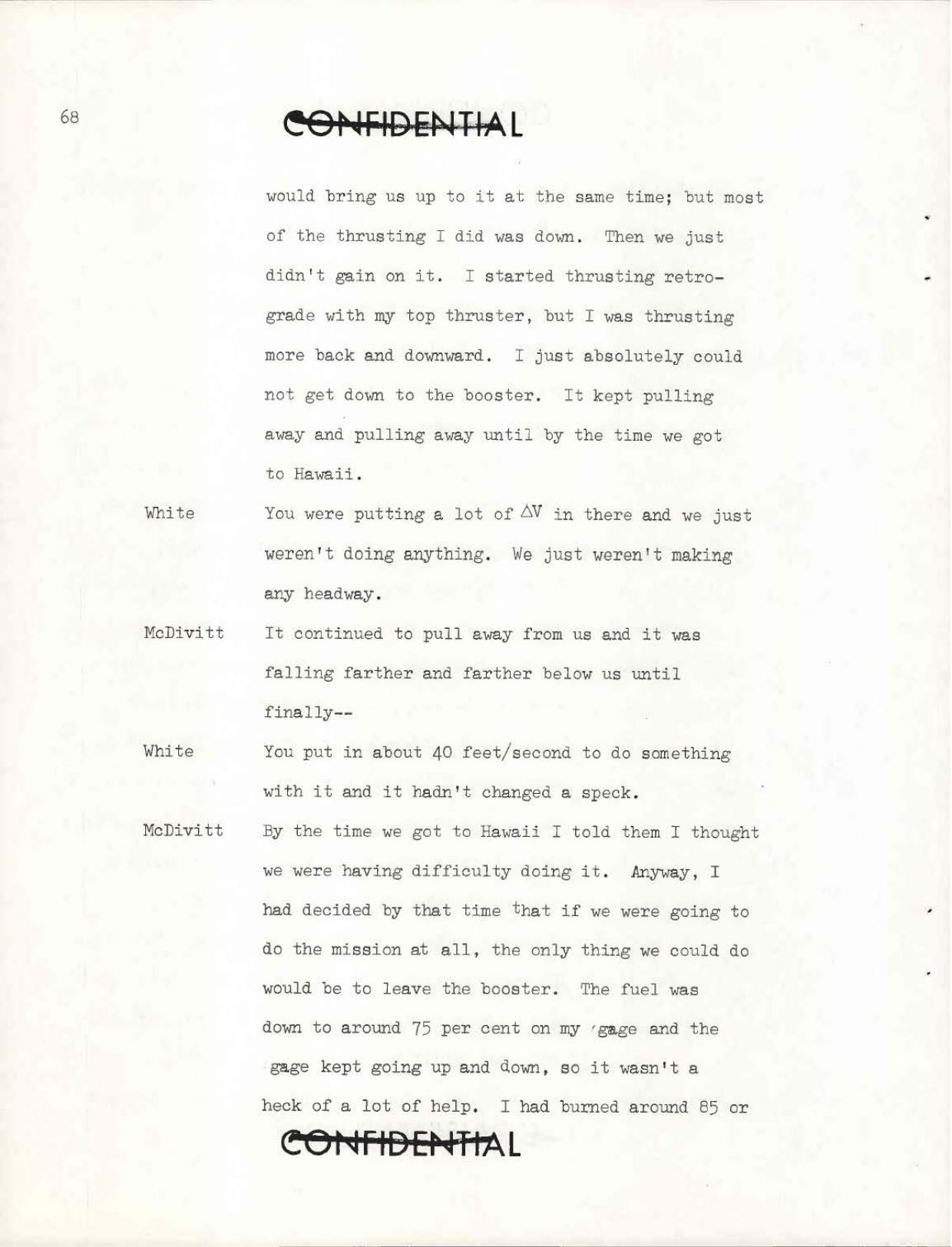
68 White McDivitt White McDivitt eo~~FtOENllAL would bring us up to it at the same time; but most of the thrusting I did was down . Then we just didn't gain on it . I started thrusting retro grade with my top thruster, but I was thrusting more back and downward. I just absolutely could not get down to the booster. It kept pulling away and pulling away until by the time we got to Hawaii . You were putting a lot of 6V in there and we just weren't doing anything. We just weren't making any headway. It continued to pull away from us and it was falling farther and farther below us until finally- You put in about 40 feet/second to do something with it and it hadn ' t changed a speck. By the time we got to Hawaii I told them I thought we were having difficulty doing it . k:J.yway, I had decided by that time that if we were going to do the mission at all, the only thing we could do would be to leave the booster. The fuel was down to around 75 per cent on my 'gage and the gage kept going up and down, so it wasn't a heck of a lot of help. I had burned around 85 or eor<IFIDE~~Tl:t\L
PAGE 77 / 340
90 feet/second . I had numbers in all three of the windows, and of course since I was changing atti tudes and thrusting in different directions those numbers were going all over the place. So I made up my mind then that i t looked like a hopeless task and that we had better stop this stuff or we were going to lose all the fuel for the whole mission. We probably wouldn't be able to catch it, and we wouldn't be able to do what we were going to do. I think the only thing we could have done to save the whole thing would nave been for us just to go forward on the local horizontal and retrograde a large amount on the order of 20 to 30 feet/second, fall down below the thing and catch it .an orbit or so later and actually perform rendezvous with it. But because the flight plan was such that we had to get all the EVA done in the first three orbits , and because Chris and I had talked this over and decided the EVA was the more important of the two things , I felt t hat the best thing to do woul d be to abandon trying to catch up with the booster. White Let me interject something else, too. See if you had the same feeling. I had the feeling that the ~QNFIDENT.IAL
PAGE 78 / 340
70
McDivitt
White
McDivitt
booster orbit had changed so much with respect to
our orbit that if we really went down after it, it
might jeopardize our lifetime.
Honestly, I was concerned about that too , because,
remember, I called and asked what the heck our
orbit was right then.
The booster looked like it
was going down at such a rapid rate.
By the time
we got to the States I would guess it was
5
miles below us at least.
My
impression was even more . I thought maybe it
wasn't more a t the time but it was going more.
felt that if we really got back with tbe booster we
might have a pretty good orbit , but we would be
down in the neighborhood of 130 and this wasn ' t
the altitude we wanted to be, .,for. the six-day
lifetime that we wanted.
The other thing that bothered me was that we were
going toward perigee where we should have been
coming back together.
And we weren't. We were
pulling away so fast that it wasn't even funny.
Frankly, I just couldn't figure out what kind of
orbit the booster was in. It looked to me like ,
if we were having trouble , the place where we
should have been the farthest from it was at Car-
C.O f)J FID E~ttIAL
I
PAGE 79 / 340
71
eo,~FtDENTIA'l
narvon.
Apogee should have been farthest apart .
Our perigee should have been closest together.
It was almost opposite.
We were with it at
Carnarvon, but we wer e way far away from it and
getting farther away from it as we crossed the
United States , or Mexico, or wherever we came.
I
wasn' t looking out at the scenery; I was looking
at the booster. It.was extremely difficul t to
t rack across the water and as we got to the land
it was almost an impossibility to track it , Here
the distance i s extremely difficult to judge.
It
It could have been anywhere from 5
to 15 miles
directly below us at this time.
If I had a range
rate I could have told where I was all the time
and with range rate I would have been able to
rendezvous with it from a mile.
I could have
done the things I lmew had to be done , rather than
try to do it .forcefully.
I sort of feel the big
problem was that we were so optimistic for those
first three orbits that it is almost unbelievable.
It became apparent when we tried to do the EVA
that we couldn' t do it in the t ime allotted.
But
anyway,I had decided by the time we had gone by
Hawaii, or wherever it was after we had been in the
C-eNFIDE-NTIAl
PAGE 80 / 340
72 White McDivitt daylight for ten minutes or so, that i t was hope less, and I told that t o F.d . I told him I thought we had lost the booster for good. I don ' t mean I didn ' t see i t but t hat we weren ' t going to get back down to it . He agreed with me . Yes. I think I could have gotten to the booster in a dignified , normal , slow, easy manner if we di dn ' t have the constraint on us of being next to the booster in the first daylight pass over the States, and taking pictures , prepare for the EVA , and be r eady to emerge from the spacecraft an hour after we came out of the daylight on our first pass , which was about two hours into the flight . I just felt that if I had had more time, I could have gone ahead and done some of this without using brute force to overcome the difference between the booster and myself. I could have gone into a l ower orbit and chased it t hat way. I could have just gone horizontal and r etrofired and fallen away from the thing initially and caught back up with it l ater on, but it was getting so far away from us to start with that to purposely put your self fart her away from it so that you could catch eor'4FIDEMT+AL
PAGE 81 / 340
White McDivitt White McDivitt JeG~-1DENT-IA~ 13 up later on was not the thing to do. We had to be all done at a certain time. We had to be with the booster when we came back into daylight. That was it; that was the thing. We had to be with the boost er, because we had to take those pictures . Then we had to be with the booster again an hour and a half after that so that we could do the EVA right next to it . And with those kinds of time constraints you don ' t have time to perform a ren dezvous. You've got to get with it right then, but we just couldn't get with it right then. \ You know another thing too; I'm darned glad we didn ' t use any 10 feet/second initially to sepa rate with. I think we could have used something in the terms of 1 or ·2, feet/second and that would have been fine. Don"-' t you? I cut it short . I only burned about 5 seconds, and I stopped. You have been doing that in all your simulations so I knew you were going to do that. You can even cut it less. It was amazing to me the separation you get i mmediately. I t almost seemed like we had a posigrade rocket on the spacecraft and a retrograde rocket on the GQ;NFt0ENllA~ \
PAGE 82 / 340
74 C.Qt~FIDEtfflAt' booster, the way we separated . Well, anyway, we told Guaymas that we had to get resolution i mme diately if they wanted us to continue to chase the booster because we had used a lot of fuel and we weren ' t getting any closer and it was still pulling away from us . If they wanted to go for i t they had to make up their minds and we would really go after it. But I didn ' t think it was wise. They confimed this and said,'Knock it off!' For cloeing rates at rendezvous, I think you could handle 20 , 30 , 40 feet/second if you are coming at it , not if you are gomg away from it . You see we never got a chance to do a rendezvous . We never rendezvoused with it . The best thing we ever did was to get close enough to it where I could at least say I was at the same al titude with· it for a change. It was the fir st t ime I had gotten back to tee same altitude since we left it at insertion. Yoo just can't equate it. You don't do an optical rendezvous with the booster below you. You try to put it above you so you have the stars and the sky background. It was below us . You couldn't do any line· of· sight nulling because there wasn't anything to null the
PAGE 83 / 340
• 75 H)EN=ttAL line of -sight w:ith . On the other hand I found that if the sun was on the window you couldn't see beyond the nose of the spacecraft. This satellite that I saw over around Ha¼~ii--I saw the thing and we were closing on it. We might have had a better rendezvous with it than with our own booster. We were closing on it and I was concerned enough that I checked to see where the a .c. Fower Switch was to see if I had maneuver capability at the time : The • sun came across the window and I lost it just like that. It might have been 5· miles out. I don't knov•. It might have been then. It might have been 50 miles out, but I had the im pression in the 30 or 40 seconds I saw it that it was quite close because I could make out the shape of it. Shoot! The sun came across the window and that was the last thing I saw out the window. I never saw another thing out the window until we were gone and until the sun finally came off the window. So, if you are doing an optical r endez vous and you've got the sun on the window, I don't know what you'd do. White And if you have as dirty windows as we had-- our windows had a white film of material on the GeNFIDENTIAt....
PAGE 84 / 340
76 COt#iDENTl,c\ I,,.. McDivitt outside , which made it very difficult to see out when the sun's rays reflected on these particles that were on the outside of the windshield. To just summarize this thing, I think that we came off the booster with a fully unknown relative velocity which was much greater than what we anticipated, and it didn't seem to be an inplane relative velocity. It didn ' t seem to be an inplane local horizontal relative velocity. It was out-of plane and it looked like the booster headed down , with respect to us because i t started separating from us so rapidly, I t al so had less total velo city. I think that this was the first sur prise . It started tumbling and immediately the rates built up in just a· very few minutes to something very high--40 to 50 degrees/second- but it never got any higher, at least the best we could tell. When we last saw it over Mexico or over southern United States it was still tumbling at about the same rate , I guess around 40 or 50 degrees/second. I felt tret I got down to it all right and I was in reasonably good shape prior to Carnarvon, and from that time on until we came out of the darkness I lost it , And I think I lost it
PAGE 85 / 340
77 White McDivitt £0N·~ll;)ENTIAl because looking at a single light at night doesn't give you any depth perception at all. You just don't know where the booster is. I think that summarizes it. Ed, you want to add anything? You weren't watching it as much as I was , but you saw enough of it to know exactly what was going on. Well, you see I wasn't able to put the pieces quite together because I was either looking out, and I couldn't see when you were thrusting, or I was looking in and watching you when you were thrusting and listening and not looking out. I tried to interJect my thoughts as we went along and I agree with what you said. I don't believe I want to add anything else. Now that we've covered the tracking and the losing of the booster, I think we ought to go back to the very beginning a t insertion and we will go through the checks that we went through as we proceeded along and the things that F,d and I were both doing aside from tracking the booster, the things that we were either doing to prepare to come back in at area 2-1 or t o stay in orbit and proceed with the FNA as we had planned, In looking over the fli ght plan that we had and the briefing guide on 1tONf'IDENTIAt
PAGE 86 / 340
78 \ White I ~ r:IcDivitt page six,I have already covered the things on platform alinement. I did not have time to aline the platform. I tried to get it to somewhere near the local horizontal so that in case we had to do a retrofire I ' d be able to do the Etrofire . I brought the spacecraft up to a pitch attitude that I hoped was zero,but I never got the spacecraft alined to see that it was zero. So we really went into this thing without my ever having seen a zero pitch attitude on the spacecraft . Obviously I didn ' t get a chance to see the 30 degree pitch down on the retrofire attitude. I didn't really have time to look out the window and do a single thing that would have prepared us to reenter at 2-1 because we were so busy keeping track of- You know another thing I ' d say also is that we were eternally optimistic. We felt we were going to aline the platform and watch the booster at the same time. As a matter of fact, while I was trying to get the alinement it became apparent to me that I could not aline it. I even thrusted vertically-
PAGE 87 / 340
79
McDivitt
White
McDivitt
White
I was in a horizontal position and I thrusted
down using my top thrusters, so that I would
try to keep the booster in my view.
Thrusting,
chasing the booster, and alining the platform
all at the same time--those are the kinds of
things you have to do.
So, I never did get the
platform alined.
I did not have time.
I got
it somewhere near local horizontal .
If I was
within pl us or minus 5 degrees in the axis, I
think I did a reasonably gooi job,
The
Thruster Control Mode Checks that took place at
15 minutes I didn't do as such.
I would just
thr ow it into a different mode and thrust.
I
just did it with a catch~as~atch-can.
I did
check out the different modes.
Everything seemed to be working.
You weren ' t
getting My thrusters that weren' t f iring, and
your modes all seemed to me to be working
pr operly.
It looked pretty good.
I had one comment on the Co~munications System
Check.
Remember we lost good communications
with No . 1 UHF and we switched to No . 2 and
seemed to have good communications with it
PAGE 88 / 340
80
McDivltt
White
McDivitt
White
McDtvitt
from th~~1 on?
Now this wasn ' t representative
that we lost UHF No . 1 beca1lse w0 used bo:h of
the sets at different tiJWS throughout the
mj_ssion later 0:1 .
But at this particula:-:- time ,
UHP 1 didn ' t give us good reception 13:1d we
swit<~hed .
I thought comm t"li:-:at.i::ms through the fi1•-it :liv
of the flight wi;re atrocious .
They were
terrible .
Finally we switcht~d to th•) .-~~en~ry
St ub Antenna and that seemed to fix L!w p:>oblern.
I
Didn t you thL1k so?
But you know we went back
to reentry a n tenna, over Carna:::-vo:i one tine .
WH got just as good r~cept i ::>:1 o.ff of it that
ti.me as we di.d any other ti-:ne .
I remember when you were rnak i.ne- yo·.1r
Cornmuni catio:J.s Check.
That wa.1 ·.-.r1hm I was
ai:;leep.
You were ,;hecki :,1g the two and you
end<id up with the r eentry antenna.
Yes , later on in the flight , as I said, at the
end o.f the fi r.st d9-Y or :30.
We seemed t o get better communications .
fact , I
W'.:iS a little concerned that the
comm..micati.ons w1;re so lousy th~t W'; might h1we
ce~~FIDEl~T~L
PAGE 89 / 340
81 White McDivitt White McDivitt White McDivitt White McDivitt White McDivitt to come back in, because we were really losing communic~tions. We were trying HF and all kinds of things. Information just wasn't getting up to us. That was after EVA. Right. Communications just weren ' t getting 11p to us. I figured we didn't have any communications with the ground during EVA. No, we didn' t . Our VOX blocked t hem out. I know it. But the Communications Systems Check that was supposed to be performed at 15 minutes- we sort of already accomplished the thing, because we 'd used UHF No. 1 and No. 2. I made the check with them. Did you make the check? -- that ' s right you made the check but we didn ' t use the HF because we weren't going to put the antenna out until after EVA. We didn ' t do anything with the urine bags except keep them right where they were. At this time we didn't pressure check both suits , because we did this later. We didn ' t aline the platform, as I mentioned. C:0NFt0ENlt~ L
PAGE 90 / 340
82 GQ ~<IFIDEl>JT IA.L White McDivitt White McDivitt McDivitt The Control Mode Check was a catch- as- catch can. You did unstow, the equip~ent that we were supposed to unstow. The bl ood pressure bulb, the Hasselblad camera and its packs , a11d a 16 mm camera. During this time when I was chasing the booster, I did manage to get to reach back behind my seat and pull out the bracket for the 16 mm camera. You tracked the booster while I smoothed the thi.ng out . That I s right . We didn ' t get out the urine nozzl e. How about the utility cord? Did you get out that fancy utility 0ord, the three- axis utility cord? Yes, I knew where i t was. I didn't give it to you beca~se you didn ' t need it . No, I didn ' t need it . That ' s right. As Ed said, we did not pressure check our suits at 30 minutes like we were supposed to. There ' s this little thing here that says meas11re all LV~ . All I did was put the co~puter in Catch- Up, hit the Start Comp button, and just l et the numbers fall where t hey would. At the time that we stopped chasing the booster around , I had about 60 feet/ second in one window, C-O~ ◄ Ftf}EMTIAL
PAGE 91 / 340
McDivitt White McDivitt -€0Nf-U)ENT1Al 03 30 in another, and 30 in another. I never really ea..11e to a positio:1. to try to ni1ll all these things out to see what the total 6V was. I was putting in the thrust with mostly the aft thrusters and the down-firing top thruster. I don't think I used the left and right thruster, at all. I don 1 t think I used the bottom thurster at all. There was no difficulty controlling a~y of them. I used the forward firing thrusters once or twice to try to slow dow:i, to take out total velocity. Then there was the Accelero~eter Bias Check l which was another one of those things. I don't know hon I let it get into the flight plan. We both joked about that one, huh, Mac? We were really going to get an Accelerometer Check when we were trying to track the booster. I was putting 16V ' s on the IVI 1s at a rate of a foot per minute at least. We ended up with over a foot per minute, I think, over that period of time. We couldn I t have checked anybody 1 s accelerometer bias, so I just didn't even fool around with it. We were supposed- to take a blood pressure. Did you take that blood ~F.10ENTIAL
PAGE 92 / 340
84 White McDivitt White McDivitt White McDivitt White McD.ivitt McDivitt White McDivitt OONFIDEN II.A:L pressure , Ed? Yes. You did ta!<e the blood pressure. I think I did. I had it out . I don ' t know whether they asked for it or not . Okay. I don 1t remember on that . Okey. We got the ~antity Read off. I guess we got a t.ime hack so:newhere in there . They called up I believe. I remember them calling the Quantity Read- Off, and I turned it 0?~'. That's right. Then it says at one hour we were supposed to W1stow and assemble the maneuvering unit in its 16 m:n mount. I don ' t think we had that stuff out by then, did we? No. You see, this whole flight plan was based on me being able to track the booster witho~t using any thrust , a~d essentially having the space craft stationary near the booster, without any maneuvering at all, where the station keeping was a matter of just looking out at the thing and co:1.trolling your attitude with pulse.
PAGE 93 / 340
85
White
McDivitt
White
McDivitt
White
We thought that if the booster was stationar~
we could get in close to it .
We could
essentially fly a formation by it with mo~e
a:titude co:1trol than translation control ,
which l eft me then free to help F.d assemble all
this stuff for the EV~.
Well, it turned out that
I didn ' t dare take my eyes off the booster for
half a second.
So all tne things that we were
supposed to do together up until the t ime we
f inally said goodby to the booster, Ed had to
accomplish himB11lf.
I was completely unable to
help him.
The only thing I ma.~aged to do was
to unstow the 16 lllDl camera bracket and put the
16 mm camera on.
I ~ouldn' t quite get at that one.
No .
I could nardly get to it.
So we w~re
probably behind at the hour mark.
Right?
Yes .
Not by an awful lo~.
I knew we had a probl em with the booster, and I
was more concerned with our problem with the
booster t han getting the gun and stuff o:it
then.
I felt that they w~re both tied together
and once w~ l ost t he booster we didn ' t have a
EONFIDEN:f.lAt"
PAGE 94 / 340
.
86
McDivHt
W"nite
McDivi t t
W!1ite
McDivitt
McDivitt
sweat time-wise on making o:1r EVA.
So , I was
trying to be of what assistance I could to Jim
on watching the booster during these first
..
critical periods.
Yes. It wasn ' t unappreciated because this
booster was becoming a speck on the horizon, and
if you blinked your eyes you co:1ld very well lose
thn dar.r1 thi"lg .
When wa were out that seconi day, I think you
said one tiine you did. lose it for a minute.
Tha~' s right.
I was lucky enough to still be seeing it , un~il
yo0.i started picking it up again.
That ' s r.·I.ght .
So, I'm saying it really took
t ~o pairs of eyes constantly looking at that
booster to keep it in sight. It's juAt one of
those thingH that just took so much time thkt
we hadn ' t planned on.
It was almost unbelievable.
In o:.ir flight plan from an ho:.ir to at1 hour and
twenty minutes we don't really show a'.1.ything.
Although, here again, we were busy with the
booster.
So, when we got l:l.1'.'0und to closing with
the boost~r, there wasn't any closing.
We
finally got clearance over the United States to stop
L
PAGE 95 / 340
McDivltt ~Ot~R0ENrtAf~ s1 fooling with the booster. I think this was ·.t.n extremely wise dP.cisioo. I got to Guaymas and I said the booster was pull ing aw,zy from us. We ' d already used abo~t 100 6.V to stay with it, and I r ecommended that w~ just give up on it. We had to get a deeision imm,0idiatel y because I couldn ' t stay with it and 11ot use f\1el at the same t Lme . They came back from Texas. I talked to Guaymas and got their confirmation from Texas, which was only a "Tlatter o.f a couple of m'i.nutes, saying leave the booster. Th9.t was about the only thing tney could 3ay. Wnite McDivitt And this was the time I went after the gun. Okay. At th9.t time we reve.rted fror:i station keeping, which we were both attempting to do to EVA preparation, which we both had to do . I Thats when Ed went after the gun, and we st8J'.'ted our ...,c,.;pa::at.i.0.11. We wc-::-do ' t .rea1 ly far bt-~h..:.nd llt this time. All WH had to do was get the gun out and get the m!'l.neuvering unit. The cameras we·c(: already out. You had the Zeiss too , didn ' t yo~? -E0NFIDENTJAL
PAGE 96 / 340
88 White McDiv"at t White McD:ivitt White McDivitt White McDivltt White McDivitt Yes. The Zeiss came out with the Hasselblq,d , from that S3Jlle package as the movie ca:nera. And the storagf~ certainly wan :i l ::>t easier. What do you think? Tbat ' s right . Particularly getti~g it out that center thing. You can just zip :hem o:.it of there with no probl1Jra ;lt all. So, a~ about 1: 30 we started to assHmble the gun. If you look at the checklist, yo:.i see that we probably gcit the gun assembled :Ln nothbg na.t. It 1s no problt:im to assemble the gun . We started our eg:-ess preparations essentially on time. As a mattHr df fact , I think we evtm got star ted a little earlier. Then, we weren ' t worrying abo-;.1t anythi11g else . Then, we w:ren I t worrying abo·J."!; staying with the booster. We probably started it abo~t 1:35 or 1: 40. Over the States we started our ~gress preparat io~. We went to our .Jther checklist. You were o,•er Ascension , calling off the check list. I sta::ted reading the checklist off to Ed and COl>IFJBEN+iN.
PAGE 97 / 340
89 EO·MFIDENTIA't: White McDivitt White McDiv.i.tt we w1:nt through it . He unntowed evet'ything. Why don ' t you tell them what you did there, Ed? I just read the checklist off to you, and you went a.head and riid i.t. Okey. I had to get bar.k .i.11":o the r"ight -h.md box, and I un:=i tow0d the item:, there . The first time I went back in there , I took the firs t items out, and I did :1ot unstow the full box. I rem,~mher I told you, II It I s all comi.r1g out , Jim. I ' m gol11g to bring them all out on the 19.11yard. " Remember? Right . We'd tak~ them o~f piece by piece if we need it. At that tim,1 I pill lfld the wh0l,'! lanyard out and the cockpit was full of little bags. I was qu.ite happy that they had prevailed upon me to put a lanyard on all this equipment. I had thought at one time that it woulri be mvt'd desiri-:l,bl~ not to p,1t a lanya.rcl on . We 'd been wo:::-k.ing a lot in our sim11lations without the lanyard and it seemed pretty easy. But looking at it now, I highly recom..n~nd that eve r-ybody k,-lep that stuff on a l anyard . We would have r eally had a mess if we 'd had all -€0NFl0ENflAt· -
PAGE 98 / 340
90
Wnito
McDivltt
Whi t e
McDivitt
those thitJ.gs floating ar.ound. It was bad
eno~gh as it was.
Yes , eight or ten of those little bags, and I
was glad they were all tied Jn to Jne string.
I could control them in t hat manner.
They were
quite simple to U'lsn3.p.
I thought the snap
attachmP-nt made it p:::-etty easy to UtJ.stow, and
selectively pick o~t the items that I wa~ ted .
I unstowed the pouches that I needed, and then
we g,)t ready to tak~ the long um'J ilical out .
h'ld a little difficulty.
It toJk m~ about
three trys to get it out .
It ' s f airly big
package to come through a small hole. It was a
good thing th~t we had tak~n the Velcro off of
the batch, beoause t here was no tendency for
any th i. ng to hang up as w,~ remewed it .
On the
third try I got it out .
I thought yo~ did an extremely good jJb getting
the bag ou~.
You got it out a l ot quicker than
TC'ai.nec in Houston or in the simlll ator at the
Cape.
You didn ' t know it .
It took m.1 th:::-ee tr.rs.
Wall , maybe it did , but it sure l:,okH1i like it
CQtqffDfNTtAtl
I
PAGE 99 / 340
91 White McDivltt White McDivitt Waite C~Ptl)E~TIAL camP. out a lot eaf-Jier. I thought you got it out in a big hurry. I didn ' t notice that it took yo:J. three trys. I saw you stat't, and then jllst a f-Jhort t.i.m,1 la7-er, it was out . Well , it d:id come out pretty easy, and I think the storage was .satisfactory, bllt I 'd certainly reco1nm,1ricl thA.t noth.i "lg b ~) on ';ht1 outside to k~ep it from coming vllt. It's a real tough- Yes, we need the velcro off of there. We ' re pretty wd1 sure of tha-~. The reGt of the ::iquipm•:111';- the "y" con:1ectors, the bag thA.t contained the "y" connectors, and the attachments for the chest pack, I handed to yot1. I thi'lk you wi;c~ k:➔ep.L ,1g tra,)k of most of those things 1mtil the time I needed them. Yes, I was. The storage of the ventilation module froc:i the fioor came off pr~tty easily. That ' s when 1 started goi!'lg ahead ;md putting it all on. You read the checklist off to me. I had gone ahead. and done a few things anyhow. As you read them off I checkP.d them off to be sllre that I had done them all. I think we h-':l.d 4€0NflDENTIAb
PAGE 100 / 340
92 I McDivitt White McDivitt White McDivitt cor ◄ FIE>f~IAL everything out without m~ch problem at all. think it took •ls longer actually to p1lt it all together.. That ' s right . It did. We started going through the checklist here and putting the things on and W'3 started getting more and more rushed. We were supposed to star.t the E[,rress Preparation Checklist at abo:it 1:44. We probsbly sta::-ted it at about 1:35 or so. We started it about 10 minutes early, roughly , maybe five to 10 min1tes early. We were supposed to be ready to start the depressu r.a7,a tion at 2: 30 over Carnarvvn . I think I could h.3,ve gone through ari:i l1ook2d ev8.rything all up , but I felt that we should go -:hc:-ough fairly close to the p~ocedure w1; had set up on the checklist. That I s r igh t . I think this slowed us down . Well, we set tht, procedure up so tha~ when we finished wlth it, it would be right. I think this helter- sk8lter thing that we were being forced into was for the birds. So an Ne g0t farther al:mg, it beca;n,~ .:i.ppar,mt to nt, that eot~Ftl:>ENll-AL
PAGE 101 / 340
93
~IDENf ~kl111
White
McDivltt
White
McDivlH
the thing to do wo~ld be to stop.
Right .
Go aht-,acl with the assembly of the stuff.
Why
d-:m
1 t you cor.1:nP.n~ on that?
I I ve co;::rnt'.!nted in my Self Debr: ~efing aboc1t th,?
equipment and the assembly of it .
I thought
thec-e was no d-i.fficulty at all in conrn-,cti 1g
the "y" connectord, the hoses, anj the chest
pack.
I thought the connection of th•e chest
pack to 11\Y harness was a good o~e.
With the
velcro I could m•,we it in and -:)Ut wheneve.c I
waa~ed to s:) that I could mak~ '!\}' connec tiorrn
on the i,il,?t side of the ECS hoses .
It w.mt
along pretty smoothl y , as a matter of fact .
think as we progressed along in it though , we
felt tha~; we hA.Cl r3ve.cythi'.'.lg d,me .
I didn
I t
rea.11.y feel that; w: hail 13verything done 1,n a
thorough manner .
And I think yo'J. had that sarnr~
feel i.ng.
That ' s right .
Wnen W8 got to Kan:) or Tana1.,;1.r·Lve
- ~I th::nk it was TananR:-'l. ve--I cal'led whoever
I was talking to and sai<l that we were :rLl.Ilfl.i.ng
late and I thought that we would probably not
do the EVA on thi.s particular .cev.
I krtew thn,t
• CONFIDENl~At
I
PAGE 102 / 340
94
Wh::.t':l
McDivitt
White
l:,okl~d to 1:1,? l i.kc~ we had ,il 1. the stuff hookr.d
up , but Wf; hl3.dn
I t really had a chance to check
it .
I also noticed , Ed , that you W':re gr~tting
this whol ~ thing off .
So I tol d them over
Tananar.ive- -I believe it was Tan~n~rive- -that
dP.pressurize at the ne xt station .
We went on
ahead and it looked to me like yo~ were all
hooked up and 9.bo11t ready to g';) except for. <me
thing.
W,~ for.got tht1 thi~rm.-.11 glOV':~ .
I d i.i not have
my ther.,n.-tl. gloves on.
You did not have the the::-m.,l gloves oa , which
is aor t of insigaif icant , but we hadn ' t really
sure that l t wa.~ l.n t"le ri.gh":; sp-:,t .
w,~l l , we talked a~d yo:.1 said , "~9.t d,:, you
think?"
We talked it over:- and I had the same
feeling. I though":: it sur.e wo~lld oe sm,1.rt if we
had abo11t W rni'lntes to just; sit her~ r,➔ al still
€eNft0EN=J:l-AL
PAGE 103 / 340
95
CONFIDE~il~l-
McDivitt
White
McDivitt
Whit9
McDivitt
befoce we go out .
I think w~ w·are in a situation w~ere it would
probably hava gone all right .
We hr-ui cor:ipl,3ted
hai rlo:w as far as the check.i.'lg w~nt , and I
juat di:in
1 t feel th'3.t we were i11 the right
shape .
Ed didn't think we were , and besides ,
could see Bd.
He coul,ln
I t see himself.
~d
look'.-!d a.wf0.1lly hot , s.rvl h;? l:iokt~d like he wa:1
getting a little pooped out from playl ng c1..-:-01md
with that big suit .
I tho~ght that the best
thing for his sake , e.nd I kn~w h~~ ·t1oul<'l.n ' t
ad.mi-'.; i.t , wa~, to l13t him r~st up for anot'1er
o.cb i. t .
I
agree that
was
the best judgment.
So , when w~ go-t to ~arnarvon--I g,1ess it was
Carnarvon--I called them A.'ld sa.:i.n r,m wc-Jra not
goi:1g !;o co □c out on tha:': or':>:.t .
It wa,, Carr1arv0n.
It was just before we
So , we postponed it until the next orbit.
As a
matter of fact , after that w~ j1rnt sat ther::!.
We d idri I t dn a thi-ig for abor.1: 10 mi.nutes .
I
let Ed cool off a li.ttle bit .
We were on two-
EON~l(;)ENTIAL
I
PAGE 104 / 340
96
fa'1 o;>eration ,q,-: the time.
We j·.1st sat there
and we were cooled o.!'f.
We went ~o,x1.d for
White
Okey.
The.n as w~ wr:n '; back around , I asked yo,J.
to go thro:;.gh the checklist ag-'3.in , a"'.ln. ·,m wen';
through item by item this time .
McDivltt
WhL te
McDivitt
Wo.ite
bi.11-:k to the beg-Lrming checkl i.st , the EgL·ess
Prepa':.'ati:>n Checklist .
We started at the
top 0111; , and we dU. every step on it again .
We verified every s tep to make s1u·e ,rn hr-tdn' t
left an;rthi--ig out .
We actually went in ~d check8d t his time .
Another thi ng ,m ha<ii'i' t r eally positively
check9d was the positio11 of all the locks on all
of the hose i.n~e ts and o•J.t.l,~ts .
This time ·,,e
ac tually chi,ck~d .<J.11 those lock~d .
Al 1 of them
W<:'t'e locked in , but it was a good t hing to do,
I believe .
You want to rnakA sure .
We di:i do ou:r Suit
h-tegi.'ity Check hefor,~ we started all this stuff.
That ' s rigbt .
We started before we actually went
to the unstowing of the stuff from the right-
hand af t food bo:x.
We went to the S:1it
GOr~Fl0EN-ltAL
PAGE 105 / 340
97 eo~+F-10-EN.TJAL McD:ivitt McDivitt White McDivitt White McDi vitt White It1 ~2gt'-i. ty Check. Well , I don ' t know 'tihere it is , but we did it when we were s111)posed to d·::> it . We did the .&lit I ntegrity heck befo:ce we started the .Egt•ess Pr~paration 0he.-;klist . That ' s when ·,.e did it , over the States. I think we d-Ld thA.t just about the t .ime you decided to give up on the booster. We di1 the Suit In~egTi.t;y Check. Both suits checkHd ::>ut all right . I t went up to 8.5 and it leaked do~ to about 8 . 3 Qr som,,thing l i.kH that . Same thing with mine. It went up to 8.5 and laak1--?d down ju:1t a little bit. Not enough to ~e concerned about . No. Oh, one thing that we did do on that extra orbit that w~ went around -- I discon_~ected the .0epress 0ystem 1ind we Wf.:mt back nn the- Oh , yes. We never e ·.ren got on the .;·_epress system, di.d we? Yes , I believe w•~ were , but then we turned it off. We w~re already to depressurize and then wcj wimt back on the spacecraft ECS system, full, and ~ent through and reverified the whole checklist again . The onl y thi 1gs that I would (;6)N.f-lDENTIM •
PAGE 106 / 340
.
98
McDivitt
White
say we h~dn
I t done to ffi3" sati.sfacti.,_.,n t"le fi.r;;t
time ,1as t:J check the inlet an<l 011tlet positions
of the locks , and I didn ' t have my tho?rmal
gloves on.
It turnAd out I didn ' t need them .
Also , d 1r.i11g this pe.clod of timr-i 1 R..l i.ned. tht,
pL1tfor1n, ;.rh.i.ch war. ~onpl ~tely in .i.s:i1 i.nP.d .
It
w:.:1s probably alined within a c-:iuple d,=1g1.-ees ,
but as we went a-r.ou:'1d in Orbit Rate it g0t
farthP.C' anrt farther 0;1-'; of tol?r-:in.~e .
So , I
m:uvv~d ·to a
1.i.1e the pl-:i.tfo.rra.
Here agllin , I
m.i..ght com,1.mt on the fan t that ou:::- ini ti,9.l
flight plan was so optimistic that it was
almoat unbelievable .
The both o~ ua wurk~d full
time :>n doing r10 tn; 'lg ex•)ept pc,~par.ine for EVA,
aJ1.11 we dldn ' t quite gHt thA job done .
I ca11 ' t
believe that we could ·'lA.ve poss ibly flown
f o:-mation w:i. th the booster and taken pictures
of it and all the other thi 'lgs t:i.at we had
and even comH close to compl-?ting it .
Well , the way we wo11ld h'3.ve had to do it, would
have been witho11t a checklist.
I would h~va had
to just go ahead :.md ~1:>ok c~verything •..p .
I
think tl'J could 111-w-3 do,w it satisfact)rily l-i
C~~ftDEN-l+AL
PAGE 107 / 340
99
EONfl0ENTIAL
McDivitt
White
McDivitt
this manner, but it wouldn ' t have been the way
we would have wanted it.
Yes, that ' s right .
I don't think that ' s the
way it should be done .
It was just too bad
that we had a time limit on it , but when we did
get rid of the booster, or the booster no
longer became a part of the flight plan, then the
time limit vanished.
We found out that we
really needed that extra orbit, or probably could
have used another 20 minutes.
Yes.
We went back.
And I remember as we came
over Carnarvon, we had about a 15 minute chat
back and forth- kind of a rest period.
We
were all hooked up at that time, and that ' s the
time we went on the ~epress flow, ready for the
depressurization.
I think they gave us a GO
then for our EVA.
That ' s right .
We depressurized the cabin and
got down to 2 psi to check our blood pressure.
We tried to put our blood pressure plugs in
the blood pressure plug port and found out that
we didn't have any blood pressure plugs on
either- suits.
This was quite a surpri se.
An
unpleasant one, I might add.
Well , we decided
PAGE 108 / 340
100 White McDivitt White McDivitt White McDivitt that from our past experience and our knowledge of the suit that even if we did spring a leak in the blood pressure cuff the size hole that we had in the suit would not be catastrophic , and we decided to go ahead with the EVA. It was within the·capability of the syst em we were using. At Carnarvon we not onl y got the go- ahead to start the depressurazation, we also got the go- ahead to open up the hatch , the go- ahead that we weren ' t supposed to get until Hawaii. So , we went ahead and did that . --._____ _ Yes. I ' m kind of curious of the whole time. We were out nearly an orbit , I think. We didn ' t get it closed back again till we got back around to Carnarvon. We were in a whole orbit depressurized. Yes, I don ' t think people quite realize that . We ' ll remind them. As we got to the hatch opening thi ng, we had our first difficulties with the hatch. The gain gear, I guess you want to call it--actually I call it the ratchet didn' t want to engage into the UNLOCK position.
PAGE 109 / 340
101
We fooled with it a f ew times a~d it f inally
engaged in the UID.iOCK position, and Ed was
able to go ahead and start.
White
The first indication of trouble was when I
unstowed the handle to open the hatch.
The
handle freely moved up and dovm with no tension
on it at all.
I knew right away where the
trouble was . It was up in that little spring
on the gain pawl.
So, I went up and manipulated
it back and forth in hopes that I could break
the lubrication loose in the spring to get it
to work.
We must have spent several minutes
with t he hatch.
I thought perhaps it might
have been stuck in the manner that the hatch got
stuck in the Wet M Ock, where it just was stuck.
You could ratchet it open, but the hatch itself
wouldn ' t open. It was pretty apparent the trouble
was in the gain pawl .
I jimmied it back and
forth, and then I decided to go ahead and try
the technique of actuating it in sequence
with the hatch handle . If you actually replaced
the operation of the spring with mechanically
moving the gain pawl up and down, you can do
the same work that the spring does.
EONFtDENTIA~
PAGE 110 / 340
102
McDivitt
White
McDivitt
Your fingers sort of take the place of the
spring and drive this l ittle pawl home.
This is the first time we actually tried this
in a suit.
It requires you to press up with
your left arm to get at the gain pawl, and at
the same time hold yourself down.
And I think
l ater on this was a source of some of our
problems which I brought out now so that we can
find out later on.
I f el t it start to engage ,
and start to ratchet the lugs out.
Jim also
verified that they were coming open.
I backed
them off , and I remember Jim saying "Ooop ! Not
so fast !", and at that time it popped .
The
hatch actually popped open, jumped open about
3 or 4 inches.
I was expecting the hatch t o come open with a
bang.
Although we had the cabin to vent and it
had bled on down to where there was nothing
indicated on the Cabin Pressure Gage , we still
really had the repress valve on.
He was
bleeding right into the spacecraft .
We never
got down to a vacuum and even though we had a
cabin pressure of only a tenth of a psi , we
spread it over t he entire area of that hatch,
OONFl0E~TV\L
PAGE 111 / 340
103
White
McDivitt
White
McDivitt
and that puts a pretty good size force on it .
I had a real tight hold on the hatch closing
device , and when it popped open I was able to
snub it .
It didn ' t really open with much force , did it?
Well, it did. It opened with a fair amount .
It
popped and I couldn ' t stop it the first inch
or so. Then, of course , as soon as it opened
that much pressure bled off.
I just sort of
snubbed the thing to keep it from flying all
the way open.
Now if I hadn ' t been holding onto
it, I don ' t think it would have gone open more
than two or three feet .
This is another point too.
There ' s more force
on the hatch actuator than I thought.
I didn ' t
just flip the door open with my hand.
I had to
actually forcibly push it open, similar to the
force with which I opened the hatch laying on
ti
II
my back under one g .
That ' s about the force
that I had to put on the hatch to open it .
This extra force that we are talking about is
due to the 0-rings they put in the pyres that
are used for jettisoning the hatch.
This is
something that they put in just before the
Ee-NFt0ENTIM.
PAGE 112 / 340
104
White
OO~~FK:>fN--TIAL
flight .
Something that we 'd gone out to the
spacecraft t o feel .
We knew just about what t he
force was , but it was pretty high.
Okay.
At this time I had certain things that I
had to accomplish .
I had to mount the camera
on the back of the adapter, and mount t he
umbilical guard on the edge of t he door . I
elected, as I had pl anned , to go ahead and mount
the camera f irst and then the umbilical guard .
I mounted the camera and it went on without too
much difficulty.
The t hree little lugs on the
bottom are a good mounting scheme.
I think I
would make a littl e easier engaging device for
working out in a hard suit.
I had familiarity
with it, and it did lock up there all right .
The umbilical guard for the umbilical on the
side of the door took me a little longer to
mount.
Back to opening the hatch--I had the
thermal gloves on when we were opening t he
hatch, and because of the fine work I had to do
with the little gain and the drive lugs up
there, I had to remove the thermal gloves so
thtt I could actually actuate those small
l evers.
I couldn ' t do them with any precision
EOl'JFIDEN+JAL
PAGE 113 / 340
105
G()NFIE>ENTIAt
with my gloved hand .
So, I took the thermal
gloves off at this time and I handed them to
Jim.
When I got back out I didn't notice
any temperature extremes.
I felt quite confident
that there wouldn
I t be any heat since we just
came out of the dark side, so I decided to do
the actual work in putting this equipment on
with my plain pressure suit gloves .
I had much
more feel with them.
Let me get back now to the
umbilical guard on the door.
I t went on pretty
well. It took me a little longer and it took
me four or five trys to get the little pin into
the hole that actually snubbed the guard down
on the door.
I did something then that I
hadn ' t planned to do.
The bag had floated up
and out of the spacecraft and now it was above
the point where the hose was going through the
umbilical guard .
I had planned to keep it down
inside .
I left it there for two reasons:
(1)
I figured it was there already and I would have
had to take the umbilical cord off again and
scooted it back down , and (2) I also felt that
Jim might have had a better view if it wasn't
sitting right in front of him on the hose coming
CONflDENTIA~
PAGE 114 / 340
106
McDivitt
up from th1~ r ~press v,1.lve.
I elect ed to go ahead
and leave the bag there.
I t hen reported to
Jim that I had everything all mounted and was
ready to go.
I had planned to take a short
series of pictures.
Since we had gotten out
early, I had a little extra time at this time ,
so I went ahead and turned the outside EVA
camera on.
I took a short sequence of pictures
that actually gives the egress up out of the
seat.
I kind of went back down and came out
again so they would get an actual picture
of it , and then I turned the camera off again.
I mounted the camera and I turned it on while it
was on the mount.
I took a short sequence when
I asked Jim to hand me my l eft thermal glove ,
which he did .
I put the thermal glove on while
the camera was running.
I t urned back around.
I wanted to be sure the camera was off, so I
took it off the mount and I turned the camera
off and actually visually took a look to see if
the switch was off.
Did you lmock it off one time? I thought you
said the camera f ell off.
GO MF tf}ENftA L
PAGE 115 / 340
White
McDivitt
White
McDivitt
€0tt<tFIDENTIA-6-
107
By golly , I did.
So I must of mounted it four
times.
That ' s right , I knocked it off one time
during this time when I was out there.
I got
the picture of the egress, and then I asked you
t o hand me the gun.
At this t ime the camera
wasn ' t running.
I had the glove on my l eft
hand , and I went ahead and t ook the gun and made
sure that it was ready to go.
I had the
camer a on at that time and the val ve was on.
I
checked the valve to be sure it was on and I
was essent iall y ready to go.
I don ' t know how
l ong this took, but it took me longer than I
thought .
We had had early egress and it wasn ' t
too much bef ore I got the GO t hat I was ready to
leave the spacecraft .
I ' m not sure whether we got that GO from
Hawaii or Guaymas.
I sort of suspect that we
got that GO f r om Hawaii, not Guaymas as we had
originally planned .
Well , it sure seemed short from the time I was
mounting all that stuff out there to the time
you told me go.
That ' s right.
I ' m sure we were talking to
Hawaii, and they said you' re clear to proceed
-ee·NFI0EN1=·1Ab.
PAGE 116 / 340
108
White
McDivitt
White
with EVA.
And that ' s when I went.
I bet we went out at
Hawaii.
I think we went out at Hawaii.
I delayed from the time you gave just a minute,
long enough to actuate the camera on the
outside.
This was kind of interesting.
When I
actuated that camera, I had D\Y gun tied to my
arm with the tether. It floated freely to my
right .
I turned back around and turned the switch
ON on the camera, and listened and made sure
the thing was running.
I knew it was running,
and put it down.
I think you'll see t his on
the film.
I wanted to be sure it was running
when I mounted it back there.
I actually took
it off and turned it on, and I remember it
jiggling up and down when I was trying to stick
it on there.
It ought to be a funny looking
film.
And it might even show the gun floating
beside me as I was mounting it.
That ' s when
you said, "Slow down.
You' re getting awfully
hot . "
I was working pretty hard to get that
on.
I mounted the camera again and this is
where I tried to actually maneuver right out
PAGE 117 / 340
109 of the spacecraft. I knew right away as soon as I got u~I felt even before - - that the technique of holding on to the bar in the spacecraft and sticking a finger in the RCS thruster wasn ' t going to wor k. I mentioned that to Jim before - that I didn ' t think I would be able to do it . McDivitt I think that you and I both knew how you were going to do, and ever-sbody else was planning for us how we were going to do it , but without any real experience in it. People. who didn I t know a lot about it were planning this sequence a~d it wasn ' t the way it should have been. White I couldn ' t have done that . I didn ' t have three hands. I couldn' t hold the gun and put a finger in the RCS nozzle, and hold the handle at the same t.ime. I thought it would be more d~sira.bl:'; anyhow to actually depart the space craft with no ·.relocity, other than that imparted by the gun. This is exactly what I did. I thought t hat I was free of the spacecraft , and I fired the gun. I real'i.zed that my legs were still dragging a little bit on the side of the seat, so I pulled myself out until I could see that my feet 1vere actual l'•' on!; 0f the
PAGE 118 / 340
110
McDivitt
White
McDivit t
White
McDivitt
White
CSl>,lflQEDlllA I
spacecraft.
I think you called me and said I
was out of the spacecraft.
I called and told you that you wer e cl,3n.r.
That ' s right.
And that ' s when I started firing the gw:i a"ld
act~ally pr~pelled myself under the influence
of the gun.
I don ' t believe I gave any input
into the spacecraf"t whm1 t 1,3ft that t Lne ,
did I?
No , you left as clea,1 as a whistle.
Later on, I gave you some pretty big ones.
You were re~lly boun0ing arou~d then.
Now at the tjme, J l ef t entirely under the
influence of the gun avid it 0arried me right
straight oat, a little higher tha"l I wanted
to go.
I wanted to ma:.~euver over to your side,
but I maneuv•;r~d out of the spacecraft and
forward ru1d pBrhaps a little higher· than I
wanted to be.
When I got out; to whst I estimate
•
as p~obablyone-half or two-thirds the way out on the
tether, I was out past the nose of ·t'ne
spacec:::-clft .
I started a yaw to the left with
the gun and that ' s when I reported th~t the
I
gun r 8al1J worked quite well. I believe that I
PAGE 119 / 340
~ONFl01:~TtAT 111 stopped that yaw, and I started t .1.·a.nsla:b.• 1-"' back toward the spacecraft . It was either on this translation or t~'1P. one following this that I got into a bit of a combination of a pi·tcl-i roll and the yaw together. I felt that I could have corrected it , but I knew tha.t i.t ww.~d h av0 ta.-<e.'1 mor,-: f...i.el than I had wanted to expend with the gun, so I gave a little tug Jn the tether and came back in. This is the first experience I had with tether dynamics and it brought me right back to where I did not want to be. It brought me right ba~k on the top of the sp~ce craft, by the adapter section. Jim was calling me and said that I was out of his sight. I told him that I was all right , that I was up above the spacecraft , I looked down and I could see attitude thrusters firing, littl-~ white puffs out o~ each o~e. I wasn I t very close. They looked just like what Chamberlain' s report told us. It looked just like about a foot and a half or maybe 2 feet of plume from the space craft and certainly didn I t look omin-.11H.~ to me at all. In fact it looked kind of like the spacecraft was really alive and working down <;.eN·FtDENTfA-t,.
PAGE 120 / 340
112 McDivitt CDr ◄ FIDiNI IAJ.. there. I knew Jim was doing his job holding attitude for me . Let me comment on the attitude- holding right now. Initially we started out in blunt-end forward. banked to the left about 30 degrees or so. This happened to be the attitude we were in. We wanted to be bl u:~t- end- forward for the sun . and they told me it didn' t make any difference what attitude that we were in when we opened up the hatch. We had originally planned on opening the hatch toward the ground. I was CRlled by some station that said it didn't make any difference what attitude I was in when I opened the hatch. We opened the hatch. We opened it in that particular attitude, and I held the attLtude for the f irst portion of the time that Ed was out . When you had th" gun you managed to stay reasonably well out in front . I held the sp~cecraft essentially stationary with respect to the local horizontal. After yvJ. ran out of fuel in the gun yo'J. were on top of the spacecraft all of the tim~ . I felt that unless you really had to have the thing stablized, to maintain your S•?nse of balance or EO~~FIBf~TiAL
PAGE 121 / 340
113
White
McDivitt
CO~◄ FH:>·EN'fl7'L
whatever you want to 8all it, I wouldn't fire
the thrusters.
You asked that already wnen I was out.
Yes.
I asked you if you needed it and you said
no.
So, then I felt it would be better not
to fire the thrusters, because you were drifting
back up over the co~kpit.
I could see that you
were going up over us.
I couldn' t see back
behind me , but I could see by the motions that
you had when you went by me that yuu were going
to continue on .
I felt th~t it would be a lot
safer if we just let the spacecraft drift
unless it got into very high rates.
I fired the
jets a couple of times just to bo~k ,:,.ft the
rates.
I let it start drifting when y0u got
on the tether so tha~ you wouldn
1 t get back
there on top of one of those thrusters when I
fired them.
From abou-: the time? you ran out of
fuel until you got back in I didn
1t do mu-:::h
attitude controlling.
I did some.
Everytime
the rates got up pretty high, I
1d knock them
off.
You were able to ma...~euver around the
spacecraft when the spacecraft itself had rates
of say plus or minus • 2 degrees/second in a
<;9·M'FID ENTIAl
PAGE 122 / 340
114
White
couple of the axes at the same time.
Here again
before the flight we discussed the axis system.
Ed selected the spacecraft as his axis system.
It didn ' t a:;:>pear that he was having a bit of
trouble with i t .
He was maneuvaring with
respect to it , regar,lless of what the earth,
sun , moon, a~d stars were doing.
It was
pretty ob\·i,..,us to me th:l.t was exactly what he
was doing.
Well, when I came back the firs t tims to ·~he
spacecraft with the gu-:r-- I had used the tether
to bring me back--I did go back up on the
adapter area.
This is the first time it had
happened.
I said , "All right .
I 'm ~omL'1g
back out again." This is one of the most
impressive uses of the gun that I had .
I
started back out with that gun, and I decided
that I would fire a pretty good burst too .
I
started back out with that g.m , a.~d I literally
•
f lew with the gun right down along the edge of
the spacecraft , right out to the front o~ the
nose, a..'1d out past the end of the nose.
I then
actually stopped myself with the gun.
That was
easier than I thought .
I must have been fairly
tD~L
PAGE 123 / 340
115 fortunate , because I must have f ired it right thro..igh my CG. I stopped out there and , if my memory serves me right , this is where I tried a couple of yaw maneuvers . I tried a couple of yaw and a co:..1.ple of pitch maneuvers, and then I started firing the gun to come back in. I think this was the time that the gun r an out. And I waa actually able to stop myself with it out there that second -';:irne too . The longest fir ing time that I put on the gun was the one that I used to start over the door s up by the adi=tpter section. I started back out then. I probably fired it for a one second burst or something like that . I used small burst all the time. You could put a little burst in and the response was t r emendous . You could start a slow yaw or a slow pitch. It seemed to be a rather efficient way to operate. I would have liked to have had a thre~ foot bottle out there- the bigger the better. It w~s quite easy to control . I f eel that with the gun there would be no dif ficul ty in maneuvering back to t he a.ft end of the spacecr:eif+, and r.h;.s was exactly what I did later oi-1 , just on the tether. I got CO~ff)EN"FIA~
PAGE 124 / 340
116
l~
CONEJDtNI-
McDivitt
all the way back.
So, I ran ou~ of air with
the g~n ani I reported this to Jim.
I didn ' t
attempt to take al}Y p-Lotures while I was
aotually maneuvering with the gun.
The
techniq·.1e th;,.t I used with the gun W3.S tne
te:.!h.aiq 1e ~hat we developed on the air- bearing
platform.
I kept my left hand out to the side,
and the gun as close to my cente::- of grcrrity
as I could.
I think l;hat the training I had ,)n
the air- bearing tables was very representative ,
especially in yaw and pitch.
I felt quite
confident with the g.m in yaw a:u pitch, but I
f elt a little l ess confident in roll .
I f elt
that I would have to use too mich of my fuel .
I f elt that it wo~ld be a little more difficult
to control and. I didn ' t ,,,ant to use my fuel
to take out my roll combination with the yaw.
We divided our plan so tha.t I would havd a part
of it on the ma.YJ.euver and a part of it on the
tether.
I don't know how far along we were
whP.n the gun ran out .
Right on schedule when the gun ran out .
We
planned f ollr minutes for the gun port ion of it.
We were just abQut on schedule .
GeNFID ENTIA-l
PAGE 125 / 340
117 White McDivitt White ..CE>-NFIDENTl~ l: I bet we used a little more than four , because I think we came out earlier th'll1 we thought. No , I sta~ted the event timer to time it . Well, this is where m:r control difficulty began. As soon as my gun ran out I wasn I t able to control myself the way I co-..1ld with the gun. With that gun, I coi.lld decide to go to a part of a spacecraft and very confidently go. I think right no·,. that .1. wish that I ha:i given Jim t he gun ,u1d taken t he camera off , Nov, I was working on taking some pict.1res and "lorking on the tethe:r dynamics. I immediately realized what was wrong. I realized that our tether was mounted on a pl ane ohlique .to the angle in which I wanted to translate . I remem·i:cL' i'.c-•.1::n our air-bea:::-ing work that every· time you got at an angle from the perpendicula-:7 where yom.· tether wafl r:iounted, it gave yo.1 a nice a::-cing trajectory back in t he opposite direction. You I re actually like a weight on the end of a str ing. If you push out in one direc;tion, and you ' re at 911 angle fron ~he perpendicular, when you reach the end of a tether, it neatly sends you in a long ar.c ba:k e6NFIDENrlAc-
PAGE 126 / 340
118
in ~he opposite dir ection.
Each time this arc
carried me right back to the top of the
ad.9,ptec-, to th~ i;np ,.:;(' 1,;he s_pa~e(;raft , in fact
toward the adapter section.
One time I w11s so
close to the t hrusters back there that I called
J •
I
• d
"D
I t f .
b
ti
:i.;n.
s,:u. ,
on
ire a.nymor:; . ,
eca.use
I was right on the thrusters.
I was even
closer than that f oot and a hal f wh.ich I had
noted to be tne leng!;1:1 of the thz-uster plumes ,
and I didn ' t want to sit on a firing thruster.
°CONFIDENT'IAL
PAGE 127 / 340
1
119
White
McDivitt
White
McDivi tt
We were discussing the EVA and I was si:1.ying that
I spent approximately 70 percent of my time , it
seemed, trying to get out of the area back a:1ove
the spacecraft in the adapter area .
Yes , you intended to go toward the position that
was directly over the cockpit .
You always arced
passed it beca. 1,•11~ y ::n
W1'lce coming from the front .
This was exa~ tly rig'•rl. because that ' s exacUy
wher e my tether was connected .
Chris had been
very emphatic that he wanted me to stay out of
this area, and I had agreed to stay out of there .
I tell you , I was doing my level best to keep
out but the tether dynamics just put me back
there all the time .
Let me inter ject something here.
When we were
talking about the control modes and how we were
going to control the spacecraft , we decided on
the Pulse Mode rather than the Horizon Scan
Mode , or anything like th..,t .
The Horizon Scan
Mode
would
leave me free to use both hands to
take pictures of you and that way I wouldn ' t
have had to control the spacecraft .
But since it
CONFl0EN-'flAL~
PAGE 128 / 340
120 White McDivitt White McDivitt McDivitt White McDivitt was an automatic mode and it fired whenever it felt like firing. It didn't give us any flexibil ity, and . this is why I felt that the best mode to be in was Pulse , in case you did get back there . That ' s exactly what happened . I didn't have to worry about the thruster going off in your face . I didn't want the thrust ers to fire and they didn't fire because I didn't touch t hem. It was a wise choice. I think this was good . When you look at it fr om a picture-taking viewpoint , it gave a wider spectrum of pictures. You got different views of the earth and the horizon. I ' m glad we weren 't held to a specific mode. I think that the picture we did take or the attitude that we started out , which is shown i n the newspaper , is just about right . I guess we banked over to the right, I don ' t know. That must have been just as I came out . I don't remember, but it had enough of the ground in the background so that it was certainly CO~FTDENT~L
PAGE 129 / 340
121
White
McDivitt
White
White
McDivitt
White
ce,~F~f>ENsrlAL
worthwhile.
On one of my passes back to the adapter area I
got so far back that I was about 3 or 4 feet from
the adapter separation plane, perpendicular to
it .
It was rather jagged .
There did appear
to be some sharp edges but it really didn't
look very imposing to me . I took a picture of it .
That's one picture that I believe was good and
should come out.
The trouble is it was probably set on infinity
and you were up about 5 feet .
No , I set the camera to about 15 feet or so. It
might be a little fuzzy because it was too close.
No, I didn ' t see the far side of the adapter. It
didn't go all the way around .
I think I could
have pushed off and gotten back that far.
No .
Better to st ay away from it.
Well, I felt that if I got going I could h~ve
swung all the way around and had my umbilical
right on the edge, without anything to hold on to
or any gun to control myself. This didn't seem
like it was at all safe and I had told Chris that
I wouldn ' t go behind the craft. So I didn ' t go
back there .
-e(:)'Nfro ENrttrt
PAGE 130 / 340
122
McDivitt
White
That must have bee~ just about the time I told
you to come back in.
No, I would estimate this was about two-thirds of
the way and about this time I was after pictures.
I knew this was a part of the flight plan that I
had, in my mind , fulfilled satisfactorilly. So
I tried to get some pictures and this is where I
really impar ted some velocities, trying to get
away from the spacecraft into a position so I
could take a picture. I went out to the end of
my tether cord quite a few times doing this .
I seemed like every time I would be completely
180 degrees to the spacecraft . I'd have
beautiful views of the ground but I couldn' t
see the spacecraft. It was a definite mistake
to mount the camera on the gun . That made it
very difficult to use the camera.
I had to
point not only the camera but the gun with the
long thrusters mounted out on the little arms.
I 'd want to take a picture of an object like t he
spacecraft, • and there were too many loos~ items
to get tangled up
in and block the camera.
I
know my tie-down strap was floating loose .
I
had left that out intentionally so that I could
PAGE 131 / 340
123 -CONFIBENf-1-M get it later on anytime I had to pull my helmet down . Occasionally when I got in close to the spacecraft, the bag and strings associated ..,,-; th the bag were tangling up around the vicinity of the gun and the camera. And it seemed like the umbilical was right in front of the camera all the time . So , I think the pictures will verify that I was flicking my right arm quite a bit in the l atter part of the flight , trying to clear things out from in front of it to get a picture . Whenever I was in a position to get a picture it seemed like I was facing away from the spacecraft . I took a couple of shots in desper ation and I think I might have gotten a piece of the spacecr aft . But I never got the picture that I was after . I wanted to get a picture of Jim sitting in that spacecr aft, through the open hatch, with the whole spacecraft . I know that I didn' t get that . In fact, as time went on I realized that I wasn ' t going to get much of a picture . I was trying everything I knew to get out there and get stabilized so that I could turn around and get a good picture . I just couldn't do this . This was at the time when I was looking ~F-tDEN+IAL
PAGE 132 / 340
124 McDivitt White a little into the tether dy,1amics , and I actually kicked off from the spacecraft pretty hard . I remember Jim saying, "Hey, you're imparting 2 degrees/second rotational velocity to the space craft when you depart . " I was pushing the space craft quite vigorously. I wanted to push off at an angle of about 30 to 40 degrees to the surface of the spacecraft , And anytime I pushed off from the surface of the spacecraft , my main velocity was perpendicular to the surface . It shot me straight out perpendicular to where the tether was attached . Again, this wasn' t in the position that Jim could take a picture of me, and it wasn't too good a position for myself . I usually ended up facing away from the spacecraft . Let me interject something here . In desperation I took the Hasselblad camera and stuck it over out through :Ed's open hatch, and asked him if he could see the camera and if he could tell me which way to point it. He couldn' t see the camera so he never really did tell me which way to point it . No . This was the time that ~rou said , "Hey, get in front of my windo;,.· ." It just so happened that co~~FtDENTl:AL
PAGE 133 / 340
125 McDivitt White McDivitt White McDivitt I was right up close to the spacecraft and that's when I came over. Do you remember me coming over and actually looking about a foot from your window, Jim? Yes . Looking right at you. Yes, I think that was the time the movie camera wasn't going and I was fooling around with it , trying to make sure that it was running. Oh, that would have been a very interesting picture. I'm not sure it was going, Ed , ~ecause, as you know, we had so much trouble making the left hand one run. We had that t rouble throughout the remainder of the flight. You pushed a switch over and it seemed to run so:netimes, but sometimes it wouldn't. I kept worrying about whether or not it was running so, I would grab a hold of it to see if I could feel it clicking over. I switched the ON-OFF switch on a couple of times to make sure I could tell the change in the feel of it. I'm afraid this time is one of the times that I didn't have the camera going, because I was trying to make sure that it was !eeNFl0ENTIAb-
PAGE 134 / 340
126 c»Ot\JFID l:t'4TIAL White McDivitt White McDivitt White McDivitt going. I ' m not positive . I hope I got :,he picture but I ' m not sure about it. That was the time that I came right in , and I couldn ' t have been more than a foot from your window , looking in . I could actually see you sitting there . That 's pr;.,bably :,..-hen you put a mark on my window . I think the way I did that--I could actually see you in there and I pushed away with :ny hands a little bit . I think this was t he time that eHher my arm or my shoulder contacted the upper part of your window and you called me a "dirty dog" because I had messed your window up. You know , as you look back in retrospect , I wish you ' d handed me a kleenex and I wish I'd cleaned up the outside of those two windows. I think we could have done it . Yes. We'd have never gotten to the kleenex at t hat time , but I think we might have done some thing about it . I think I might have but we might have smeared them so irrepairably that it might have-- . That ' s r ieht . When you looked at that wi ndow of mine from the inside while the sun was shining CO~~f1f}fI~TrAL
PAGE 135 / 340
127
White
McDivitt
White
McDivitt
White
McDivitt
C-O ►~FIDENll.Ab.
it looked like it was a black paint smear, such
as if you Id take a piece of v:hite linoleum
and a black rubber soled shoe and made a mark
on the linoleum. It had that kind of consistency.
It was absolutely opaque .
Just as black as it
could be .
Yes, I could tell .
When i hit it I could see
from the outside that it turned white .
It tu~ned black from the inside.
From the outside it was white.
From the inside it was black. When I got the
thing turned aro--.md a different way with the
sun on it , it was perfectly clear as if you
had taken the coating off, and what I ;.•as
seeing was through a perfectly clear surface. So ,
I don ' t know really whether the thing was black,
that you placed something on the window that
would make it blac~ or whether you ' d taken
something off that was very white , very thin .
I smeared the film that was on your window.
I 'm
quite confident that is what happened.
I looked at our spacecraft windows after they
got it onboard, and I could still see that
little hunk of window.
It looks to me like wh•1t
PAGE 136 / 340
128 White McDivitt Whi te COt'4FIDE~l·l1tt you did was remove a layer off the window, rat her than put something on it. You took something off it . Except I can't possibly imagine why it was so black and opaque with the sun shining on it at certain angles . I'd like to comment on the ease of operation outside on a tether . If you've ever tried to hang on the outside of a water tower , or about an 8- foot diameter tree , you can visualize the problem I had out there . The decision to leave the hatch open was probably one of the very best ~:1at we made . I had nothing outside the space craft to stabilize myself on. There just isn' t anything to hold onto. I think Jim will remember one time when I tr ied to hook my fingers in the RCS thrusters . I think Jim could see because- - . I could see . I was right out in front of Jim I s windo•,.r . This gave me really not hing particularly to hold ,):nto. I t didn't stabilize me at all . I had nothing really to hold onto, and so if you have ever tried to grasp an 8- foot diameter tree and shinny up it , you know the kind of feeling that I had -'ZO~<J FtDEf'<lflAt
PAGE 137 / 340
129 - ~ONFIDEN+IAl.- McDivitt White outside there. There just ,rasn' t anything for me to hold onto. One thing though that I ' ll say very emphatically- - there wasn't any tendency to recontact the spacecraft in anything but very gentle contacts . I made some q·,.ite interesting conta~ts. I made one that I recall on the bottomside of the right door in which I had kind of rolled around. I actually c8ntacted the bottom of the spacecraft with my back and the back of my head . I wa.1 faced away fror., the r..ipacecraft and I just drifted right up against it and just very lightly contacted it. I rebounded off. As long as the pushoffs are slow there just isn' t any tendency to get in an uncontrol lable attitude . It seemed Fd did hit it pretty hard at one time. I think that was after he pushed off violently; he went out and it seemed he came back and bashed it pretty hard. I remember a pretty solid thump. It seemed it was over the right hand hatch or just right behind--. I know a couple of times I kicked off with my feet , and I think I k~ow the time you are talking about. I came in with my foot . It wasn' t so much the contact with myself--. CONFIDENTIAl
PAGE 138 / 340
130
McDivitt
White
McDivitt
White
McDivitt
White
What did you do? Contact and pushoff?
I contacted and pushed with my foot .
I heard a big thump and I think I call ed you at
this time t o take it easy.
I believe that was on the fro~t end of the R & R
Section on my side where yo'.l couldn't see me .
It was a position that I couldn't see.
One of the pictures that I saw last night in the
movies , I think, was made at t hat time .
I was
coming in fair ly rapidly and I wanted to get back
out, so I kicked off again with my foot fairly
hard.
It was a vary good kick.
I felt th:3,,t
I.
certainly could have controlled myself without
the gun out there if I had just some type of
very insignificant hand-holds or someth.i.ng
that I could have held on to .
I believe that I
could have gone on back to the adapters with a
minimum of several hand-holds to go back ➔;he re,
going from one to the other.
I was actua,.1:r
looking for some type of himd-holdi: out th0re.
I remember that the only one that I saw was the
stub antenna on the nose of the spacecraft .
could see the ceramic covering ()Ver it, I believe
it was ceramic , or some kind of covering o,ar it .
I
PAGE 139 / 340
131 McDivitt White McDivitt White McDivitt White McDivitt White ,,CQ.N-FIE>fNll'M. Yes, it ' s white. I felt that this wasn' t quite the thing to grab onto, this was at the ti~e when I want ed to get out at about 10 or 12 feet directly in front of the spacecraft. I certainly had the urge to hang onto the antenna and push myself out. But I didn't and ther e really wasn't anything to hold onto . You really need somethine to stabilize yourself. I worked around the open hatch. Let me ask you a question? How about putting the hand-hold inside of the nose cone? A fairing is up there for launch, just the fairing.We could mount a hand-hold right inside. I think we could have rea'lly made som,~ money if we had had an attachment for the tether out there right on the nose o.f the spacecraft. Strong the tether out there and then attached there? Right . Rave a seoond attach point and put it right out there. It would give you something to hold onto out there. Yes . There wasn't anything to hold onto o~ the R & R Section. ..-::eeNFIDENTIAI:
PAGE 140 / 340
132 McDivitt White McDivitt White McDivitt W'nite McDivitt COt>~ ~IDENTt,AcL, I know it . It had smooth corners and the only thing I could have grabbed was the a 1ten1a, a:id I didn ' t want to grasp that . we tho·.1ght one ti:..e of holding oa out there and th:usting, but-- . There isn' t anything to hold onto. I think you pt'obc>.bly co'.lld have gotten a hold on the antenn'3. and held onto it witho~t hQrting it . I examined it pretty closely before the 1-3.'mch, and i t look ed pce~ty sturdy . I thought this was somet hing we needed and I didn't want to fool with it . As it turned out we really needed that antenna be~ause that was the antenna thu.t we used the whJle flight- -that stub antenna in the nose . Yes . When we opened up the spa~ecraft the hatch came open with a bang. The air that wa had inside was obviously of greater pressure tha':1 that o:1t sitle , and we had a great outflow of t hings inclu ding a piece of foam that we had used to pack our tnA.neuvering gun in it ' s box. It was the first thing t hat we put in o=bit . But then throughout the time thit Ed was out, he wanted the doJr wide CO ► ~FIE>ENTIAL
PAGE 141 / 340
133 White McDivitt White McDivitt open. It was pretty obvious that the flow was from the spacecraft to the outside because part way through his maneuvers his glove floated out and floated away from the spacecraft with area sonably good relative velocity. The entire time he was out , even after we h.'.l.d the hatch open fo~ 20 to 25 minutes, we were still getting particles floating out thxough the hatch. It was the flow. The streamlines were very obvious. It was from inside the spacecraft to the outside. I guess the spacecraft was out-gassing at a sufficient rate to cause a reasonably large pressu.re differ ential from inside to outside , and it was cer tainly relieving itself. I noticed this even as we were trying to get the hatch ~losed . There was still a flow from inside to outside. Okay. I think that pretty well covers most of the things that we actually did while I was out there. Now , as for getting back in--. Yes, let's go all the way back thxough and come back in . The time really did go faet! I had watches with :ne, but I dii:a ' t look at them. I was watching the time. I noticed my watch 1'f)N·FIDENTIA~
PAGE 142 / 340
134 White McDivitt Whi te McDivitt White McDivitt White around 4 minutes and 6 mi.nutes and 8 minutes . And t' .en you got involved in floating 1:3,ro'.l.Yld as we were t rying to get that last pict,\u'e . The tim,a really flew! You kept getting behi.nd me all the t ime and I became distracted from ;he t ime we were on VOX, co'llpletely blocking out the grou.'ld . Our VOX must have been triggered constantly, be::::ause whenever we were on it they coul::l:o' t tra.'lsmi t to us. That ' s where the time got away from me . That ' s right , and it was 15 minutes and 40 sec onds when I looked at my clock. So , I th::>'.lght that I had better g::> to the ground. I said to the ground, "Do you ha-.re any ,rn,ssage for us? 11 because I knew it was time to get back in. And th-9y just sai:i, "Yes . Get back in! " Right . I remember hearing Gus say,"Yes, get him back in ! " This is what all the fuss was about . They might have been transmitting to us to get back in hut we ware on VOX a.-id couldn' t hear a t hing. I did a few things after this time that I wasn ' t d·::>ing to deliberately stay out . Bc1t I was deliberately t rying to do one last thing. I was
PAGE 143 / 340
1 McDivitt White McDivitt 135 C-oNflDfz.NllAL t rying to get that last pi cture . And this was one of a couple of times that I kicked off the spacecraft really har.d, to get out to the cmd ·':l'!: the tether. And [ wasn 1 t successful in g~tting t he positi on so t hat I couli get a picture. I fel t this was the one part of the mission that I had:1 1 t completed. Everything else was successful and I wanted very badly to get that picture from outside . I spent a moment or so doing this. This was also the period of ti~e in which I called down to Jim a~d said, "I ' m actually walk ing o~ top of the spacecra.ft. 11 I took the tether heU onto it, and ui:ied it as a device to pull me down to the spacecraft. I walked from about where the angle starts to break be+ ·"l the nose section and the ca~in secti':ln. I walked from there ~robably about two-thirds of the way up the cabin, avid it was really quite strenuo'.ls, Could you see me walking along, Jim? No , I couldn't see but I could feel the thumping on the O'.ltside . That ' s when 1 got to la 1ghing so hard. This was when Jim \•tas sa,ying to com,, in. Yes , I think this is when T got a little ster n
PAGE 144 / 340
136
White
McDivitt
W':lite
McDivitt
White
and said, "Get in here! "
When I w,3,s •t1':ilking on the •:,op and w,3,3 .l:3.1.,5·!1ing ,
Jim pr:.>bably did·:1 1 t think I th:mght he wa.s
serious .
But i t was a very funny sensation.
Now
as far as delayi:ig, there were ce::::-tain things
that I ha1 to do befo~e I came in.
And there
wasn ' t anything in the world that was going to
hurPy me up in do:l.ng the;n .
We had just agr eed
that we'd do things in a slow manner and this is
the way we ' d do it .
Let me talk about the tine here. It is implied
in the ~apers that Ed didn ' t really wa"lt to come
ba.ck in, and didn ' t .
I think one of the things
is that we didn't hear .
We didn ' t have any
t ransmissions from the ground after he step~ed
outside until I went off VOX at 15:4) .
They
said , "Come back in . ", an:l I told him to come
back in .
I think that he pt•obably del q,yed .~'::>out
a minute or t w? minutes .
I thi nk so , trying to get the pictures .
And at that t imn I got a little i t-ritated a.."ld
hollered at Ed , too .
Th,~n he started back in.
But whe~ I came baJk 1 had things to do .
McDivitt
Yes .
I k-1ow it .
That 's what I ' m t rying to say
PAGE 145 / 340
137 COt<tFIDE~+~Al White McDivitt White McDivitt White to get tfuis thing in its proper perspective. Yes. We were 3 minutes 40 seconds late getting started back in because we just lost track of the tine. I couldn't see Ed any longer. I was trying to keep t rack of what he was doing without being able to see, and I lost track of time . Then I think he delayed p·:obably a _ni:mte o.!' a :nbnte and a half before he started back in. That ' s right. So , those are the two delays. We 'd agreed on that he'd start back in after 12 min:1tes. Fro!ll then on all the time was spent J.ist trying to g,~t back in. I had certain things to d-., . I hail to disassemble the camera that was on the spacecraft . I did this very slowly. I had to dis,::011J1eot the elect rical connection to it and hand the camera back in to Jim. Then 1 had to go out and disconnect the umbilical, and this really went pretty well. The little tether that I had them put on the ring, a pull ring, to disco:n:.~ect the pii worked pretty well. I disconnected the umbilical and discarded the umbilical cord.
PAGE 146 / 340
138 EO~~FIDENl~l>.L .. McDivitt White McD.ivitt McD:ivitt White McD:ivit t That was the last th.ing Ed put into orbit . Right . I put that L:1 o~bit. Earlier , it was r eally quite a sensation to see the glove float ing off. I asked Jim a few .nin.ltes before about 1 thf~ glova , ".>r Jim had asked me, "ne:v, do you want this other glove?" About a minute 1-9.t er, I saw it gQ floating o'.lt of the hatch . All I can say, Fil, war,, about a half hou.'..' 13.ter I was sure t hankful that we had g')tte!1 r id of so:ne thing. We had s·:i much other junk that we didn ' t want . I saw t he glove come fioating r)at of the righ> hand hatch , and it was a perfectly clear picture of t~ glo·,e as it floated out . It floated ::mt over my right shouLler arnl t1ut- -it l:ioked 1ike i t waG on a defL'li te trajecto:r-y going somewhere . I don't know where it was going. It floated very smartly out of -i:he :Jpa:~ecraft and ,:mt i.n-~o s pace . I thi n~-< this ha:l. a lot to do ·11ith that C'lt- gas sing. There was a definite stream--. Yes . It was following the s tream:..ine ri~ht :m~ of i:he sp~1i::ecraft . It went oat perpendicular to thP spacecraft , '~01\tffl,·l:NTt;~r
PAGE 147 / 340
139 White McDivitt White McDivitt White whichever direction that is . Back to getti'lg bade the 3pacecraft- -I hc:l,d the L°l one thermal glove o~ the on~:aand , my left hand. I always wanted my right hand to be free to op erate that g,m a--id the camera. The way the cam era was mow1ted on there, I had to use both h9.nds - one hand to actually stabilize it with the glll1 and the other ha.;1d to cea.ch over. Again, I think dynamics pl~yed a little bit of a role there. Everytime I brought my hand in from a position ou~ on my left, it tended to tur.n me a. little bit, which is exactly what we found happened on the air-bearing tables. I think that the camera should have been velcroed to my body somewhere and used independently of the gun. Yes . I g 1)t that same impression. I got the impression that what you reall y should have d•:me was--. Dropped the gun. Unhooked the camera out there floating around and j.1st throW!'l the g,m away. I don't think you ever should have tried to bring it back. Well , what I should have done was fold the g~n and handed it to y◊u, C~l'JFlDENTI.AL
PAGE 148 / 340
140 CO i'<I FIf)EMlt:itt McD:ivitt White White McDj_vitt White That would ·:iave ·j'.lSt taken longer. It wo'.l.ld have taken precious seco::ids out of the very few thA.t we had anyway . I th i.nk y0u sho'..lld ha•re j 1st unhook.~d it and throW!'t the g'1fl ::;,w:~y . This was probably the thing that I was most irritated with not completing. I dii.1 ' t .feel the pictu.ces were satisfactory with the can,~ra out side. But I think the reason was that my camera was not in a position so 1 could use it adeqciat ely. But coming back in was the last thing. As a matter-of-fact , before I dismounted the movie camera A-nd dismounted the urnb ~lic:,,1, I folded th,, gi.ln . I took the l::;,nyard off with the camera on it, and handed Jim the gun and the camera. A.11d I stuck it d:,wn between my legs . That was thfi first thing that I handed in . Then I handed in the 16 mm -~am•=ra , and then I threvt away the umbilical . Thls wa8 where the fun s l;,,u· ~..::.1. I f1)11nd it wa.r:i ::;, 1 )t mo:-::-e difficult coming b.3.ck in tha.::i I had :remembered in the zero g training. It seemed like I was contacting both sides of the hatch at the same time , much firmer than I had in the zero--g ai cplane. co~~FIOENflAl
PAGE 149 / 340
141
McD.ivi tt
White
McDivitt
McDivitt
White
McDivitt
White
You mean you were hitting the hatch o~ one side
and the hatch opening on the other side.
Coming back in, I was conta~ting the side of the
spacecraft o~ both sides .
Yes, that 's right.
Yo•.l weren't really hitting the hatch on both
sid,=.is, you were ht t ting the hatch opening on both
sides.
Yes.
I was coming down through there. I felt a
much fit'mer attachment wedging in there than
I 'd remembered from the zero-g training.
I think
this might be associated with the extr a 7/10 or
8/10 pound of pressurization on thf.l suit.
I
just mi6ht have been a little fatter.
I did
notice that the suit was a little harder. I felt
this type of suit before during my pre-work, so
this wasn't a su£p=ise to me at all .
But I did
feel like I was a little fatter getting in and
wedged a little tighter.
I really don't think Ed was ari:y fatter.
I think
that link in the suit holds the suit to whatever
volume it's going to go to.
And I don ' t th'ink
a couple psi are going--.
Well, I felt like I was hitting a little more as
-
PAGE 150 / 340
142
McDivitt
White
McDivitt
White
Mc:Divitt
White
McDivitt
Wnite
McDivitt
tOfqfl0Et ◄ TIAL
I came in .
Yes.
I think what happe:.e::1 ·,ms he was stiffer ,
and he wa.sn' t bending his legs and his arms ai:1y .
You mean with the harder suit I was stiffer?
Harder .
And your. arms were stiffe:::- a nd yo'J.weren't
bending them
around as much . It looked a lot
more rigid.
This mig~ ~ hav,3 been.
Not semi-rigi.:i--Ei w:3.s rigid .
All r ight .
This might have been.
And that looked to me like it might have been tht,
probl3m .
ThL, might have been part of the recontact 0::1 the
side of t;'.,e spacecraft that I noticed .
But
as I came back in, I noti-:::ed that I had to work
a little harder , and I hoped the tape was running·
because I think we had a very good commentary.
We were both talk ing very clearly bal)k a'ld forth
to ea-:::h ot~~er during this time and I w~s telling
Jim that I was go:'..ng''to com-3 in slow because it
waf-1 a little tought;r than t ha.:i tho 1ght .
We ·-'•=re
talking back and forth ab.::mt being slow and tak-·
ing it easy .
I actually helped pu:,h ~ down in there .
I d,,n ' t
€01'4FIDE~~TIM
PAGE 151 / 340
143
Whi t e
McDivltt
White
McDivitt
White
McDivitt
White
McD:i.vitt
know whether he felt it or not in that suit .
No , I couldn't.
I reached over and I steered his leg::i do,m in,
and I sort of got hi.n settled b the seat a
l ittle better than what he was getting himself.
Yes.
Right.
I was kind of free wheeli~g my feet
up there.
Yes . It looked to me like Ed was holding o~ to
the top of the open part of the hatch and j~st
swiveling around that pa-rt. It looked like he
didn ' t have enough mobility and strength in his
arms to actually t wist his body down against the
force of the suit into the seat.
After awh.Lle, I reached my left arm u.nderaeath,
the same techniq~e we had used in the zero-g
training, and actually I had my hands all over the •
ci rc1xi t breakers.
Yes.
Ed was a real hazard to the switches.
Yes, and I pulled myself do·..m in and that ' s when
I really started coming .Ln--when 1 gut hold. of the
underneath stde of that circuit breaker panel
and p~lled myself in. That's when my first real
progress was made toward actually getting d:>wn in.
Because, while I co1.1ld steer Ekl from where I was
--CONFIDE~
PAGE 152 / 340
144 McDivitt White McDivitt White McDivitt White (:O~FlDENTl~L I really didn ' t have the strength to pull him in . It was ';)0 degreea to the ·,my that he t:'ea.l.ly wanted to be pulling . I co'.lld steer. I did do a lj .,tle bit of pushing, but n::>t a heck of a lot . I w:as>1 1 t really contributing rn,wh to the effort t her.e ex-~ept-- . You were guiding me down into t he fcotwells . Yes . That was aoout it . B'J.t once I got my hand,, 11p 11:1dernP-ath the irrntcu ment panel , I was back pretty well in familiar groun:is--the work that we ' d done five dnen times in the zero-g air.pla,He ,and I kJ1ew the tecMi.que pretty well. 10 0::)0 tim,~s ! White does check pretty ...,ell . I really did it a lot;. Maybe the suit wa,3 stiffer, or maybe I was .fatter, b:.it I wasn ' t going in quite as easy as I had before--getting into the initial positio:1 to pull myself dow~1 in~o the seat . So it took ma a 1ittle longe.t:' . I f you recall , I had to go back o'.lt again one t ime . I got back do•,1a and started to wedge my self d::>wn anrl I got t wo fat cr-:1inps at the bot toms of my thi.gha in both legs , where the muscles star ted to bal l up a little . cer<lFrDENT11'L
PAGE 153 / 340
145 McDivltt Whi.te McD:i.vitt White McDivitt White Oh? Did you. get it in your. thighs o:':.' calves? Bo-th of thP. muscles in the back of my thighs balled up in a ball and I thought , "Well, I have to go back out and l et them straighten up." So, I straightened my legs out . We had that problem before in the zero•-g air plane. This is the time Jim said, "Hey while you' re up, why don't you throw the vlsor out?" I hesitated a minute because I thought, "Well, you son-of-a-buck, you might have problems here. You might have to be spending an orbit or so trylng to get in." No , as a matter of fa~t , I don ' t think th~t is when you did th.row it out . I think you threw it out when you ca.me back dow~ and you started to close the hatch. You were having trouble, It wouldn't close, and you said, "I'm going to have to take this visor off so that I can see these things." And I said, "Listen, if we get this thing closed we're not going to open it again . Throw the visor away." That ' s right. That was when I got the cramps , went back up again and then I came back down CQ N fff)ENTtA L
PAGE 154 / 340
146
McD:ivitt
White
McD:i.vltt
Whit e
McDivitt
White
McDivitt
White
M0Divitt
White
McD:ivitt
Whi.te
again , and said , "Hey, I can' t see them.
I ' m
going t.o have to take the v•; .~or off."
No ,
J t was a little bit 19.ter than that .
¥0'.l
ha:l all ready started to try to close it and you
were having difficulty 0losing .it .
Okay.
Let I s get thP. sequr-mce out .
We came dowi1
in.
I got up to st ~aighten my legs a little
bi. t , went back up , then I came back riown- - .
- -with all yot1r. equipment on--.
I hadn't hel d the handle yet, had I?
No .
You ha:ln ' t done a thing with it.
So I got back d '.)wn into positi'.)n- -.
~-with all yo~~ eq'.lipment o~ 9.rld pulled the
hatch down.
The hatch was dO\v.'1 far enough to close at th i.s
time .
I thought i.t was.
I did., too .
I felt it was d::r,m far e:1:>'.lgh.
can tell by looking right straight d:>1,m at the
edge--.
Yes .
I can tell by looki'lg ,111 llndernP.ath the
r ight- ha.':1d side to see where the dogs are.
Okay.
So I tho'.lght the hatch Has doW!l far
enough to close at that time.
I reached up and
CQ~lfif)·l:NflAL
I
PAGE 155 / 340
147 McDivltt White McDivltt White McDivltt got the handle , but I don'-c k11ow what I said to you. You didn't say anything . I do~ ' t know whether you said anything to me or not , bu"':. you didn ' t have to sa~ anything to me . I saw you move that ha.."'ldle and I saw how easy it was going and I saw that the dogs were~ ' t moving. I thLnk I said somethL'lg. I don ' t re1nember w:hat I said . But I said something anrl you knew right away what had happened. You didn't say a word. I waB watchi.'.l.g the dogs and that lever a"'ld I krle•,1 what the trouble was . Right . So I guess that ' s when I said , "I ' m going to ha·,re to take the visor off because I can't see." And then we went back up and Ji m said, "Well, we're not going to open the hatch again. Why don ' t you thro·,1 the visor out ." I hesitated for a mir'l.ute to throw it out because I thought that we might have a pt'oblem. Actually, we had a little more difficulty than we had explained . We fooled around for a min u~e or two or m~wbe even th:=ee or four with the handle. It was pretty apparent to us that we weren ' t going to get the hatch closed with nor eQtqFtDfNTIAb
PAGE 156 / 340
148 White McD:iv.itt COl<IFIE)Et ◄ TIAl mal st-rai.gh~- forward techniques , and tha~ 1ve were .. g0ing to have to s t art going to ot'·er t hings . Whi.le we say that we came d::>wn and mo·,ed the handle once or t wice , it was oYer about a three or four rnin11te period , at l east . The ~orinal meth::>d of closing the hatch is for me to co~e d::>wi.1 and wedg➔ ~yself down , hold onto the llttle canvas handle up t~ere , a."1d ,c1.ctL1ally aJply a <iownward fo::-ce on t he hatch to help close i t . Then with my right hand I use the hatch handl e to retche t the hatch down . This is no:"..' mal ly .:>ur techniq·.1e we wollld alway::; use , and !:ever i n t he past , has Jim had to help mo: with t he hatch closing device . Thi.;, ·11as'.l.' t the c>:3.se this tl!lle . As so-::>n as I ha:i go-l;ten np ~here to operate the gain lever, I co~ldn ' t ope~ate the canvas handle anymore . I co~li n't apply any torque O'."..' pull there beca,1se--. N-::>t only that, b:.it you were actually pushi.ng yourself up off the seat . And I 'm not sure that even the first ti.ne that WE; had the hatch closed far enough . It looked li.ke it was closed far eno•..igh . As a ms.tter of fac t , later on when we got it down to that posit:ion it looked li.ke it
PAGE 157 / 340
149
Whit e
McDivitt
White
McDi vitt
White
was closed fine. It really wasn ' t closed far
enough because you never did get those dogs out
until we- - .
No, the dogs came out, Jim, the first time 1 got
torque o~ it. Those dogs started out, then it
closed.
Did they? Okay.
Yes.
I think we had it down f~r enough.
It looked t :J me like we did, and I couldn't
unde~stand why they weren't coming out .
I knew
that the :oo.tchet wasn't engaged, but I got the
impressiJn that i t was from watching your hand
when you came down one time.
You had the ·ratchet
engaged and the littletit pin that sticks in the
doer that doesn't allow things to come closed
wasn ' t there.
No, the. ratchet wasn't engaged. There was nothing
on the handle at all. It was free, completely
free.
The s:ituation hadn't changed at all.
Another thing I'd like to point o·.lt now, too , was
the chest pack was in the way of bringing the
handle down to a full-crank position.
And I
wanted definit ely to do this because you can
interrupt the sequence of the dogs if you don ' t
PAGE 158 / 340
150 White McDivitt White fully stroke the ha"'l.dle each ti.maL \Je went back up so that I could "ictually see a"ld observe the levers . This was the time Jim sa..id to th.row the visor o·.1t because w,~ pr:)ba.bly would n ' t o_pe'!1 th1, hatch aga.i.n , onca w,3 g8t it closed . And this see~ed like very goo1 so:md advice to me . The o:':1.ly thing I was a little q·.1esti::m1ible abou ~ 1,1a::; that 'it this ti.mt, I ha.ii the inkling in my mind that we ~ight spend quite a bit of time g':tti ng this hatch closed , and I mi.gh·~ want t he visor when 1 was back out ~i1 j·1. . B'..lt I thoilght the judgmfmt to t hro·11 the v ls'.:>r out was best and I threw it 0'.1t--opaned the door abo'..lt a foot and a half and thr.ew the vlsor out . The next t ime we canlf? back dow:1, I was s t ill having the l i ttle bit of p:oblem with the cramps, but not ~-9arly the pr~obl:=:m 1 wa'9 having with the gain lever . One superseded the o LheT. That ' s right . 0~1e p.::-oblem became of much higher m:agnitude tha!l the other . So this was the t ime that we started ·Norking . I k."lew what I hai. to d-J . I knew I had to work the gai n lever in sequP.nce with the han1le again , juAt like ~e had w~en we ~ONFTDENf1AL
PAGE 159 / 340
151 McDivitt White McDivitt White opened it . We both had a.."l inklirig that this was going to happen when we opened it the first time . But this posed the problem of when I reached up with my left arm to work the gain lever. It takes a great deal :>f force . This isn' tthe direct io:2 that the suit is designed to reach in. And it tak~s a great deal of force to lift your arms up in the vicinity of your helmet to operate something there. In so doing it pulled me back up :)Ut of the seat . An1 I think this is the time that Jim noticed that I was up higher than I had ever been before, and he actual ly felt that my helmet was up against the hatch. I tend to agree that I was up in that posit ·ion. Yes . I actually pulled Ed 1own in the seat by pulling on the--. I think so. I did it in steps. I'd pull down and 3d woul-i cooe down. Then I'd pull some more, he'd ~ome down some more. I was actually pushing up with my left hand and IJl.Y helmet was wedged right up against the hA.tch. I had a little bit of area in which they actually see t he dogs that I was working with up there .
PAGE 160 / 340
152
McDivitt
White
McDivltt
White
McD.ivitt
-co~~FID[i'~rt,\L
You could see them though?
Yes, I could see them .
At least I coul:1 3ee what
positions they were in .
I could see the little
.,.
lever operating unde-r the spring:..._where I was
actually operating the spring on the g~in leve-r.
This is where I think we grJt some very good team
w~rk, because it was neces sary that Jim pull
do·tJn in conjunctio-:-i with the time that I pulled
down on the c,1osing handle and Jperated the
ga:i.n l ~ver .
I just hope that the tape worked
because I can rem~mber I was in there .
Jim was
talking to me , and. then when it came to ~he point
when we really had to make the big pull I felt a
little torque on the handle .
I knew that we had
it at that time if we co:.ild only get the hatch
down ,;lose enough so that the dogs W')uld engage .
And I ca..~ remember giving the old--I think I was
yelling HEAVE! HE.LIVE!
Is th13.t what I was yelling.'
I think so .
.And tt was in perfect ti~1d.,1ig, because I could see
Jim or I could see the hatch come do~n each time
that I was yelling IE.AVE !
I think it was
probably the mast--.
The most int eresting mome!'lt of the flight.
0 '~~'F--{;)ENA-ittbPAGE 161 / 340
153
White
McDivitt
White
McDivitt
Whi i;P
Yes . It was the most interesting moment of the
flight , but I think i.t was probably the m::.H,t , if
you wan~ to say, draimitic.
I don 1t know the
right word .
But it was probably the most
dramatjc moment of my life. About those 30
seco:i.ds we spent t'ight there.
The dogs started
l~tching.
I co~ld feel them going in, and then
I could feel them co~e over dead-center.
Jim
called out that the dogs were in.
I knew that once we got them moving we'd be all
right .
Yes , once they started coming in.
As long as
we got those dogs to engage , with the little
lever that permitted them to come out and l~ck,
I knew that we hn.d it hacked.
Yes .
So did I. Even i f
e "ould 'tave had to
reenter with the hatch in that position, we 1d
have been all right.
I don 1t thi.nk that the
heat leaks were that tremendous.
I knew we could continue and dog it on in all the
way. It seems like whenever you know you're
right on something, you want to be darn sure
that they fix it. This was going through my
mind then.
And I remembered that I felt I was
PAGE 162 / 340
154 McDivitt White McDivitt right in that the bar and the attachment on that bar and lanyard were not strong enough . I re membered that and I knew how hard you were pul ling on that thing. I t hink , if nothing else, they ought to :Je sure . How many times did we break that attachment at the bar? We br oke the attachm~:mt abod; three or four t imes on the zero-g airplane. Everytime they kept telling us it wasn't made out of the right kind of stuff and the st~ff we were going to have in the spacecraft would be the right material. ~•'ell , it didn't break in the spacecraft . Just coin cidently, or maybe because we both had doubts about the strength of that particular piece . The same thing crossed through my mind . I was thinking t hat the success or failure of this hatch closure depends on whether this hatch closing device st ays hooked onto t hat space craft and doesn ' t break offo We would have been flat out of luck! We would have been in deep trouble ! I 'm not sure we wouldn ' t have been able to get the hatch closed, because we had put that canvas strap on t here and I might have been able to pull you ~rbENIIAt
PAGE 163 / 340
155 White McDivitt White McDivitt White McDivitt White McDivitt down that way. But I had about all the pull I had in me on that last- I know you did . --on that last thing and I had a lot of mechanical advantage over it. When we went to that canvas strap we would have had to go with no mechanical advantage. As a matter of fact, a mechanical disadvantage. This is one thing that didn't fail, but I recommend that it be made stronger. Stronger anywny! I think so . For nothing else than a psychological purpose . Right. I'd like to take the spacecraft now and see if I could break it, because I had the feeling that I never had been confident that that • attachment nor the bar nor the lanyard were strong enough. When I say I was really pulling as strong as I could, I really had some pull left in me, but I guess what I should have said is that I was pulling about as hard as I dared pull at the time. I guess I could have pulled another few pounds, but I hated to apply more than was needed on
PAGE 164 / 340
White
McDivitt
White
White
~CYEFTTTAT
there because of the lack of confidence in the
strength of it.
Everything I had was in it over there .
I was
pulling down with my legs as hard as I could and
operating.
I was pulling on the handle .
I
remember one< time you said , "Hey don ' t pull on
that handle so hard ! You're going to break it! "
I was cautioning you to take it easy, which you
don't usually have to do.
This was when we were yelling HEAVE!
I was
heaving on the handle as I was pulling it down
each time . It felt like to me that the handle
was giving.
But I didn't give a darn! If it
broke, it was going to break.
So o:".e of the
points we learned out of this was we'd like to
see the bar and lanyard strengthened.
Let me say one thing about the decision to go
ahead and open up the latch.
I f we hadn ' t done so
much work together with this hatch and run t hrough
just about every problem that we could possibl y
have had , I would have decided to leave the hatch
closed and skip the EVA when we first started
having trouble with it .
We had encountered j , .st
every conceivable pr oblem that we could possibly
CONffDENl~
PAGE 165 / 340
157 McDivitt White McDivitt Whit e have with that hatch. If it failed we'd know exactly what it was. That ' s right. I personally had disassembled this cylinder and piston and spring combination up at McDonald prior to the altitude chamber, so I knew exactly what it was made of. I am sure the problem was t hat the dry lubrication coag ulated, or whatever a dry lube does, and was causing the piston to stick. I knew how we could do this thing. Carl Stone and I had dismantled it and put it back together, cleaned it out, put it back together, relubricated it , put it back toget her, and i t operated fine. I figured out how to make the t hing work with it not working properly by using your finger as the spring. That ' s the exact technique we had used. I f we hadn't had the training together that we had , and had not encountered all these problems before, I know darn well I would have decided not to open the hatch. Maybe we wound overdramatic about the effort we made getting me back i n, and I 'll honest ly say it ' s one of the biggest efforts I ever made in my life, but I don't think we were all done then. CONFIE>ENTIAL
PAGE 166 / 340
158
McDivitt
Whit e
McDivitt
White
McDivitt
There were a lot of things we could do.
We could have gone around several orbits working
on cl osing the hatch.
That wasn ' t the last time
we were going to get a chance to close it .
So ,
there were things left if we understood , and
ot her procedures we could have used to go ahead
and close it .
When we got it cl osed back in, I
was completely soaked wasn ' t I?
Yes .
You were really bushed .
Sweat was just pouri ng down.
In fact , I could
hardl y see . It was in my eyes .
So I told you, "Just sit ther e and I ' ll get a
r epr ess .
Don' t even move for 30 minutes ."
I just left the r epress valve wher e it was .
I
closed the vent valve and we had a lot of in••
structions from the ground to close the water
seal and e. A1ole bunch of other things that didn't
make any sense to me .
I knew that the spacecraft
was repressurizing.
I watched .
There wasn ' t
anything else ttat we had to do right then , and
we were both bushed, especially Fd.
He was
perspir'.ng so that I could hardly see him inside
the fact plate .
So, I just said ,"You sit there
and I ' ll sit here and we'll just coast around.
COl<IFIDEt•cFFi:A"l.
PAGE 167 / 340
159 White McDivitt White ~Ot~ftf)·ENT* L When we get the thing repr essurized , we'll start doing something." That was exactly what we did. I did finally extend the HF antenna and t ry to call somebody on HF and let them lmow that we were back in safely and that the t hing was re pressurizing. I didn ' t get any response until we got to CE:.r ".arvo·1 , which was about three minutes l ater. I called and told them that we were re pressurizi ng and had the hatch closed. You lmow, that was some pretty good gage reading that we saw when we got the first 1/2 psi. The first 1/2 psi. Ha! Ha! That was really a big one. Since we ' ve described the whole operation we 'd like to go back now and specifically point out the pieces of equip ment that we used and our opinions of them, a few · features that came out loud and clear to us i n operation, general conclusions on EVA as an operation, and what we have to 10 to make it an operational procedure. So the first thing I ' ll do is go down through the equipment. As an overall comment on the equipment, I would say I felt very confident the equipment i,:ould do the job. And without question the equipment performed
PAGE 168 / 340
160 ieeJI\JFID~NitAt 11.s it was <dvertised . It performed just exactly as it hsd been designed . There wasn ' t one thing on t hem as f ar as the VCM , the umbil ical, t he gloves , the gun , and the visor that didn ' t perform just exactly as it had been designed . ·1. 111 take them all one piece at a time , and dis cuss them a little . I ' ll start right with the visor . The visor was a rather controver sial piece of equipment from the beginning. And I, for one , doubted a little bit t he necessity for quite the pr otection t hat we were providi ng, although I had helped right from the beginning in the design wi th some of our ideas on the viso~ It turned out though , and I commented on this during the t i me that I was out , that I was very happy to have the visor, I was able to look directly into the suniight . 1 did so in instal•• ling the camer a on t he back of the adapter . I felt that the vision out of the visor , was about as it would be on a normal sunn;,r day. This is because it is so br ight up there in space . I fel t 2:>.s if my vision was what I would consider normal . I was looking at the different parts of the spacecraft and down at the ground, and ctJtffibEM I IAt
PAGE 169 / 340
- 161 McDivitt 6€01>-JFIO.ENTl.4 L the view that I received at this time vas what I would expect on a normal sunny day. I was cer tainly glad to have the visor and I left it down throughout EVA . I think on a later flight we might recommend going ahead and lifting the visor and observing any changes we might see in visual acuity when looking down at the ground . the ground vision through the visor really didn't seem to me to be degraded at all. Eviden tly just the intensity, and not what I was seeing, was cut down. Let me comment a little bit on that visor . I didn ' t have a visor and the bright sunlight that was in the cockpit didn't seem to bother me. imagine that the visor turned out just like a pair of sunglasses. You go outside on a normal d~y and wear a pair of sunglasses . If you don' t have them, you ' re squinting. But if you start out without them you tend to get accustomed to it. I think I was accustomed to what light there was coming through the space craft , admittedly much less than that outside. F,d was accustomed to the sun visor and it turned out just like two people with and without ,O~fi&EN+IAl I
PAGE 170 / 340
162
C~l'IFIOeNllAL
White
McDivitt
White
sunglasses. They both could have adapted.
I
didn't look into the bright sun straight ahead.
Well, the first time I looked into the bright sun,
the first thought I had was, "Boy!
Am I glad
I 've got this vis::>r on!"
I know you mentioned it on the radio.
--because I was looking right atraig-ht into the
sun. I had to look into it t o attach the camera
onto the a:iapter section.
I d-:m' t normally
wear sunglasses.
As you know, Jim, I have never
worn sunglasses very much , and I didn't n::>tice
it from then on, through·~ the t Lme I was out.
I hail n::> impulse whatever to lift my visor.
My
vision was a.s clear as I co·..i.ld have expected it
to be without the visor. There are a few design
points in the visor that we could make better and·
I'll briefly go into them right now.
When you
are seated in the spacecraft one visor slips up
underneath the other a~d back along the back of
your helmet, so th~t instead of resting on your
helmet on the headrest you're resting the visor
o~ the headrest.
You certainly aon't want to do
that. The visor should be restrained in some
manner from slipping up along the back of the
PAGE 171 / 340
163
McDivitt
White
McDivitt
White
helmet.
Also, my visor was quite difficult for
me to raise and lower.
Once it was dowr it fit
quite snugly, for which I was happy.
But it was
difficult for me to raise and lower. It was
actually a two-handed operation, which is one of
the reasons why I didn't raise it outside;
although, I had no impulse to raise it when I was
outside. I think that we might be able to design
them to be raised up and down more easily.
Let me make a comment on that visor.
I never
did see any need for the little lexion visor.
That's exactly the point I was going to get to
next.
I think that one single visor made as
close to the helmet liner as possible, p~oviding
the maximum amount of headroom and a minimum
amount of interference, is what we actually need.
I don ' t believe we need that lexion outer visor.
As they pointed out to us, it doesn't really
protect, because it bows in a.~d it doesn't
really give you the protection th~t it should
be affording. I would recommend one visor, one
sun visor only. It'll be simpler to operate.
I think so, too.
Okay.
The ·v;ntillation Control Module, I can say
CO ►~f JE>EN+IA..L
PAGE 172 / 340
164 White White CQtqflOr:NTl"L without qualification, worked exactly as it was planned to work. There was not one complaint that I had with it. It provided me with the proper flow. The flow was lass than with the no.:-mal ECS suit system, but it was adequate to keep me cool and ventilated, except for two times during the flight. Those times were when I atta~hed the camera right before departing the spacecraft and reenterdngthe spacecraft. But I think it performed without fault. The umbilical was another item that I thought performed its part of the flight quite well. had no complaints about it. I did tend to get it tangled up with the bag and the strings that were attached to the bag during EVA. I am very thankful that we decided to design the gloves in the manner in which we did, the two piece glove that was easily donned or doffed under pressurized conditions. As it turned out, I took them on and off twice while pressurized. I was quite happy that we had them designed in this manner. As it turned out, the heat on t he side of the spacecraft, or the cold on the side of the spacecraft when we ca.:ne out of the dark I
PAGE 173 / 340
COl<tFtOf:M'f lA'i. 165 side , were not noticeable to the touch at all . I didn't use a right hru1d thermal glove at any time during the flight . I took it off w~en I was opening the l'.e.tch and, as I pointed out earlier, it floated off during the EVA operation. I didn ' t have opportunity to use it again if I had wanted to. Coming back i n we had difficulty closing the h~tch, and I , at this time , removed my left hand glove and used the plain pressure s-.1it gloves for this operation . The press'.lre suit gloves were comfortable . In fact , there were no sen sations of either hot or cold through my gloves . White Th: gcU1 , I think , was an outstanding point in the flight, a highlight of the flight . It worked just as we had felt it would work and it was , I felt , simple to operate . The training t hat I had. on the air-bearing platform provided me adequate orientation in the use of the space gun. I think that now that we have a little more t ime to prepare ourselves for the next time we use this gun, t raining with it on zero-g flights would be appropriate . I don ' t believe we will have any t rouble using it in the zero-g aircraft . • COt«lf tf)[NTIAl ¥
PAGE 174 / 340
166 , CONflDE~ff~At- White One mistake lhat we made o~ our E'fA equip~ent was the rno·.mting of the Co, tarex camercl. . This camera s):-iould h,•,ve been attached by velcro to Ill:) , s o that I could use it independently of the gun . It W'.)Uld have been easier for m,3 to us9 and I would have had a nnlch higher probability of getting satisfactory pictures with it . It was a case of lumping too mu~h together--vJtting tha g-~n and the camera together . White The attachinAnt of the VCM to the h~rness was a good type of attachment . It was easy to dis co~nec' Lhe two velcro attachments anti move the che~t pack in and out . I hai to do this both when I opened the sp:1.cecraft hatch, so it would clear the hatch handle, a,d I had to ~)ve it out of the way when I cl osed the spacecraft and p~mp~d the hatch handle . White Now we can get into some concl usions . While I was out , I decided to put a piece of velcro strip on the side of the adapter to see if later on we might use this as a method for attaching i tern:, on tha outside of the spacecraft , if the velcro was still there and if it was in good shape . I think the velcro could be madeintoc.. very useful item for co~~Fi0£N-l1Al
PAGE 175 / 340
167 a type of tether. I think you m.ight even be able to do something alo~g the line of just having some fenale velcro on the gloves and pieces of the male velcro at points along th~ adapter. This might provide us at least some attach:nents so th~t we could maneuver o'.lrselves back to the adapter sect.i.oP.. This wo'.lli be about the sim• plest kind of handle that we could use. I do believe that we need some type of handles on the outside of the spacecraft . Jim suggested one o~ the nose and in the cover on the R & R section up there . I think this is an area that we cer tainly have a possibility of using. I certainly would have found it useful. I woul d still be a little h~sitant, though , o.f breaking the an tenna. You wo'..lld want to be sure that this wouldn't be hroken during EVA . I think the feeling I had o'..lt there, again, was like holding onto an 8-foot tree . There wasn't any thing to hold onto. You definitely need some kind of hand- holds . The decision to leave the hatch open was one of the best decisions that we made . It provided me with a center of oper ations for my work. I was able to stabilize my €Ot ◄ FIDEN--lJAI
PAGE 176 / 340
168
McDivitt
self by holding onto the hat ch. It was also
surprising to me how much force it took to open
the h.:i,tch the first time against the p·!'eload and
the actuaters , due to the seals.
One other very
good decision was to have me wear the heavy suit
and Jim the light suit.
I think thi~ was one
of the thine-s that made our opera.tio;1. easier. It
certainly m~de my getting back in the spacecraft
a::1d Jim's assista.1ce in closing the h;~tch much
easier for him ,
Hlso , I was handing him things
in a"'.ld out .
He was performing quite a bit
of coordination in the operation with pieces
of equ.ipt1ent thA-t were going in 'ind o·.1t of the
spacecraft , and I l:>elieve t hat by being in
that 1ight s:.ii t he ·11as able to do this tni.1,::h
easier than if he had been in a heavy suit .
I might make a comment on that suit, too.
When
we opened up t he hatch we were in~ vacuum.
n::iticed that the temperature of thA suit dropped
slightly so thci.t the suit was a little bit
cooler inside .
I was w)ndering if I was going
to get too cold through the suit, but the rest of
the time we were out the the temperature never
changed .
I don ' t remember looking ~t the suit
I
PAGE 177 / 340
169
White
McDivitt
White
McDivitt
White
White
inlet temperature, but the suit itself stayed
reasonably warm.
I had sun in the cockpit and I
had the cockpit open w:i.thout the s1.m iii it for a
rel.:1.tively long period of time, four or five
minutes at a time. This didn't seem to affect
my temperature inside the suit.
I think you felt the temperature more than I did.
I felt the temperature go down, rather than up.
I felt that also while outside.
I would say
H was lery co::nfortable figu.re.
I figure that I
was probably at 68 degrees temperature out
there inside the suit , which was cooler than I
had been anytime during the flight . It wasn't
a cold feeling, just a very natural comfortable
temperatnre .
~uit inlet temperature was running about 55
degrees during most of the flight . It got d•:>wn
around 52, s0 it probably might have even been
cooler than yo'ir 68.
Wel l, it was cooler insi1e the suit when I was
outsi:ie the spacecraft thn.n at any other time
during the flight . It wasn't uncomfortably cool
there at all.
I t hink that we can go on with some co::1clusions .
PAGE 178 / 340
170
McDivitt
White
McDivitt
Some conclusions that I had were:
1.
I didn ' t notice any extremely hot temperatures
on the outside of the spacecraft .
I al so
didn' t co~tact surfaces for any period of
time to tra~sfer much in the way of a hea~
load to any part of my suit including the
gloYes .
2. There I s a de.fi·-iite req-.ii rement for som(3 type
of hand holds outside the spacecraft .
3.
We should think a little more o~ where we want
to operate during EVA and where to attach
the tether .
The tether was not attached at
a po.int that wo·.1ld provide me the capability
to operate in the area that I wanted to .
You coul dn't get to the nose. It p.i:-ovided great
operatio~ for directly above.
Straight above.
I just don ' t know how you would get the thing
out there .
You would have to run it along the
spacecraft , then attach it somewhere at thfi
"
front .
It would preclude operations in other areas.
You
would either have to accept ,,,here we a.re going
to operate or-- .
PAGE 179 / 340
171 €0~4FIOENT+AL M.oDiv:itt White McDivitt White McDivitt ·::·ou conld have n::..lt iple attachment points around the spacecraft . Of course , now , if you have a g-..m with a good air sour0e, I wouldn't particularl y care where it was attached . I thi.nk you could go ahead a..'ld, maneuver to a:ny point you want if you have a gun. Again, when you're p~shing off of surfaces , you tend to go perpendicular to the surface from which you push off. I found when I p·.lshed as hard as I wanted to I'd still tend to go straight up above that hatch instead of ou t toward the fron·~. I think this is a fairly obvious con clusion, but it proved out . Everytime I pushed off I went straight up instead of at an angle to the surface where I wanted to go . So!lle thi.ag that you should bear in mind is that yo•.1 were pushing off fro!ll the front whi.ch tended to make the front go down as you went out . Yes. Everything was working against getting where I wanted to go. Everything I did tended to put me up. When you started you went in a straight li.ne forward and tended to p~sh the spacecraft down.
PAGE 180 / 340
172 White McDivitt White McDivitt White McDivitt White CO ►J Flf)fNf1M I think, initially, where I was holding the attitude, yo'J. didn't have that much trouble. Of course, you weren ' t pushing 13.S hard ei·~her, be cause you had the gun . No , I wasn't . Later on , when we started free drifting, you w,~re ba~k behind m~J where I couldn' t see. Did you feel me stomping around back on the adapter and hitting the adapter. Weil, I felt you hitting things back behind me and once you went behind the line thEit was dir ectly over'.,.ead the spacecraft. l cottldn' t see you t hrough your open hatch. I never reaEy had a good co.!ltact with the adapter back there . Just as -:,.r,21 l . We W':r:.ildn ' t want to disturb those • radiator tubes too much . No, Well, now that we 're back, we'll have some conclusions on the adapter area. I made it a point right from the beginning -~o take a look at the thermal lines , the thermal p~int on the adapter. It looked like it was in good shape . It was all there. There was discolor ation arou.~d the attitude thrusters , particularly, GONFIDEt>ilTIA!
PAGE 181 / 340
173
McDivitt
White
from the thrusting. The color of the thrusting
is just like the RCS thruating--nice and clear
plume. It looked lik~ from o~tside, thu".lgh, that
I could see a lot more of the plume than I could
when I w~s sitting inside the spacecraft looking
out at the RCS thrusters firing.
Again, the
cam,era was not attached in a.n opportune ma.n'ler
to operate.
Which camera? The camera on the spacecraft?
I'm really after that camera on the gun.
That
one wasn't attached gooa.
The cam-era on the spacecraft was okay. It was a
little difficult to attach because of the
attach'Dent on the bottom of it .
You can't have
it at any angle to make it engage. It has to
be perfectly flat with the mounting plate on the
bottom.
A big co:!1.clusion that I came to-- and
I' 11 see how you feel ab.:mt this one, Jim --I
feel that storage in the back of the adapter
section wa:s certainly a very high priority for
l ater missio:!1.s .
I feel that we can adequately
store eq·.1ipment in the adapter area, particularly
larger pieces of equipment that we don't have
room for in the crew station or pieces we don't
PAGE 182 / 340
174 co~~FIDENllAb-.. McDivitt White have particular use for in the early part of the flight . If we ca~ lick the p~oblems in opening and closing of the hatch, we can store equipment in the back of the adapter section as a routine operation . That ' s right . I think the extravehicul ar activ ities have proved to other people what we all ready knew a long time ago--that 'FNA is quite simple . I think the thing we ' ve got to iron out is the hatch opening and closing. This is really our. problem. I don ' t think you or I will ever have any doubt about the extravehicular activity. That was , I thought , going to be pretty straightforward . It looked like to me it was pretty straightforward. I felt that I could operate equipment 01.1t there. I co,1ld assemble equipment . I could put pins in, pull pins o~t, and screw thLngs in. I did all these things during the flight. I tu.rn~d th.a gun ::m , a::i.d I put i n the pin to operate the um bilical guide . I attachad the camera. I don ' t think yo~ could do these operations very effect ively with big heavy gloves on. Alth:>Ugh my gloves oper ated satisfactorily, I think that for CONFl0-Et+T-tAl
PAGE 183 / 340
175 McDivitt White assembly of i terns you wa.---it to have ....--you ought to look into the glove area a little more thoro'.lg'hly anii try to get a piece of a glo-re ·,1ith so:ne type of a surface that will give us some heat protection and gives us a high sensitivlty of feel through it . The big conclusions , the final co~~lusions , that I ' d like to draw are that EVA can be made a normal routine operation if the following modificatio~s are made to the space craft : 1. The highest priority is that the spring back there on the gain lug has convicted itself and I don't believe that that's a good design. There should be s:>me way ths.t either the l ub ricatio:?1 is :nA.de foolproof or the spring mH.de stronger . I think what we really want to say here is that the locking mechanism is inadequate as it is , compl etely inadequate . Until i t is fixed , I think we should take it easy. Th11.t 1s right . I think we almost had a bad experi m:,e with ths.t gain thing. We knew about it ahead of ti.me . We thought we had it fixed, but it ' s not fixed . I think it convicted itself and it's ,oMftOf:NllAL
PAGE 184 / 340
176 McDivitt White White guilty and it has -Lo be fixed. 2. I recommend that at least the egress kit on the right of the crew compartment be remo·red to provide more room in the spacecraft . see no reason for it being in t here. I think it wo•.1ld be worth the effort a~d the ajdition- al money to p.rovlde the extra room .in the spacecraft. So , my second recommendation ,::m EVA is to remove the egress k.Lt, at least from the right -hand side, to provide more head room. Yes, that ' s good. I might add that it ' s a good thi.ng that we had that egress kit modified- to the m:i.nimu.11 height, because without that we would have been in deep trouble. That's right. Yes . You and I had been telling each other t hat that was the biggest thing we did on our whole nine months prior to the f l ight- -to get that thing cut rlown . I ·t1.1ink it sure paid for itself on ou:r. flight . 3. My third item is to make the bar and lanyard completely foolproof in strength. That was a device that provided us with the added force Get:Jf:IDENJ]A-1: I
PAGE 185 / 340
177
07COt~ft0ENftAL
McDivitt
White
McDivitt
White
McDivitt
we !leeded to close the hatch, just as we sat
there and said we might need during the SAR
of thfl spacecraft in St . Louis.
I think the
attachrnl'9nts of the bat' and the cable to the
spacecraft sho~ld probably be at least doubled
in strength, so there just isn 't any question
in the pilots' minds or the engineers' minds .
I guess the eng:ineers were co::winced that
you didn ' t have Jim and I co!'lvinced that those
tw~ attachme!lt points--.
We've seen it break too many times, I think.
We've broken the bar and we've broken that
atta::)hn:ent point. I ha::!. actually physically
twisted the attachment right off the spacecraft
up in the zero-g airplane.
I certainly wouldn't
have put my full strength into it if I knew
my life depended on that attachment. It should
be ma.de absolutely foolproof.
Well , that was t l,'.e point I was trying to make
earlier when I said I was pulling as hard as
I could.
Then I said that I really wasn't
pulling as hard as I was capable of.
You did::1 1 t have confidence in that attachment.
I didn't really think that I shouln p~ll O!l it
PAGE 186 / 340
178 €0NflDENitM White McDivitt White McDivitt any harder . No . I think that shouli be t he third recommen dation and it should be corrected . I think we could spare a couple of extra po1.1.-.ida of weight there , just for the pilots ' peace of mind . That 's right . Take the time it takes to put a new attachment on there . They told us they d.idn ' t want to do it beca~lse they ' d have to re rig it . I ·~hink t hey ' d better re-rig it and take the tim~ to put a good attachment o~ there. 4. The final thing really doesn ' t fit in with the first three recommendations , but I would sure like to have the opportllnity to use that gun 9gain with about a 10-times supply of oxy~n in a great big canister. I think that maybe this is one of the items wa could carry in the back of the aiapter. We could use a small supply to provide t ~e means to go back there to get a great big canister. Then we ' d have a :mit that we co'.lld actually do some maneuvering with. That ' s r ight . I think that , in essence, we proved the usefulness of a self-stabilized or a ~OENflAl
PAGE 187 / 340
179 White McDivitt Whi.te White McDivitt White McDivitt eQN=F19-ENTIAL man-stabilized maneuvering unit- Yes . - -rather than o.na that is gyro-stabilized with automatic stability features. I think that al tho'.lgh you did·'.1 1 t burn up a lot of fuel , you certainly p~oved the feasibility of this type of ma.neuveri ng unit . We had a1 awfully small amcr.1i.'1t . We j..lst had the 6 feet/second- We p~oved, in my mind, that I had the capability to go .fr om Point A t::> Poi nt B with that mr1.neuver ing U."lit . Let me ask you thi8 question, a.."ld be ho::1est about it . Would yo'.l detach yo'..lr tether and _go without i.t? Don ' t be too optimistic , because other people ' s lives may depe::1d on it. I think that we probably have not done enough investigati on to do that at this time, but I feel we are p:.:-ogr essing toward the point . We made the first , say 50 percent, of th~ step toward being able to detach the tether and go. I don ' t believe that I wouli deta:::h the tether aJld 5o ·,.ii.th that 6 feet/seco::1d-- . Oh, no . I didn' t mea."l t hat . I mean with that -,Qt\lFtDENflAb
PAGE 188 / 340
180 White White McDi vitt White McDivi tt White type of a unit . If T had some more !:::,,V in a U:'lit like that I think that I would be ,.:illing t o detach myself on the next fli.gh t , right n::>w , fr,Jm the space craft and go . That ' s com'bined with tw-) things, you see . You h<1:ve two th.ings working for you. You have the capability to maneuver yourself , and if you should get out of control the space craft still has the capability to come over a~d get close en::>'.lgh so that you could get yo".1.c-self baGk .Ln control and get in the spacecraft . I think that 40 or 50 feet/second would be a minim'.l.,n. I hnd 6 and I ' d like to see, pcobably, a capability of about 10 times that . _That may be a little--. It ' s diffi~ult. I wo~ld think it would be difficult to fix a number on it until you fixed the jo'b . Yes . If you want;ed to go to som.-1thing that was 1::> feet g;way and come back, you ' d probably get by with 20 feet/second . If I wa-:1ted to get out of the spacecraft and g•> along to the back of the a:lapter and get in the ~ONftDENTIAt
PAGE 189 / 340
181 McDivitt Whi.te cor~FIDENTI QJ.,. adapter without being attached to the space craft, I ' d only need two or thr-ee time the a'.'llount . I'd be happy co go with that. There are some problems in th,~ capability to alin9 on,3 1s self onto an object . I think chasing the booster around points this o~t. You say you'd be willing to go away becaur-Je the spacecraft can oome and g~t you. Admittedly it can, but kseping in mind the difficulty wa had with th9 booster . I don' t really an~i~Lpate us ever get ting into the situat Lon like that beca~1se ;rou I d never get so far away that you're in different orbits, like we were with the booster--. What I vis·,.1al i.ze is a 25 to 50 foot operation where you' re goL'lg ou.t to investigate ei-l:her a.."lot~1er spacecraft or another satellite up there, or making a trans.fer similar to the type of trans fer that we visualize as a backup mode for Apollo. I think with the gun I had, if tbc LEM and the Com mand Module were there , I'd be satisfi ed, .i,0 d9part the Command Module aJ.l.d maneuver over to the LEM situated 10 t0 20 feet away from the Comma·'ld Module. I feel I coul::l io that at the present time. I d:m ' t think it would be a very smart -=cot~FH)ENT+Ab
PAGE 190 / 340
182
McDivitt
White
McDivitt
White
McDivitt
White
McDivitt
White
thing at the pcesent time to go m~neuvering off
200 to 300 feet away from the spacecraft with
this type of device. I , think this device is
designed and has its greatest usefulness in close
operation around the spacecraft .
That ' s right. There is no need to maneuver off
about 4-00 or 50-0 feet away because if you want
to go that far, use the spacecraft. This gun
is for a close working job .
I think it's a valuable tool in this manner.
Okay .
That's the same conclusion I came to .
We'd be willing to do it at close range .
I ' d be willing to do it right now .
I might not
go tell somebody else to god~ it , but I 'd
be willing, with the training that I had with
it , to transfer 15 or 20 feet without a te'Lher.
But , I think we sho~ld spend mome more time ·..nth
the gu..-i .
I think so , too .
I also think it would be of value to go in the
zero-g airplane with it .
Yes , I think so, too .
I think the work that we might do in the z.aro- g
airplane doesn't necessarily have to be done in
CONFI0El'<JTl~t
PAGE 191 / 340
183 full regalia, with all the pressut'e s·.lits in a. pressurized ~onditio:n. I think we can go up there and learn a lot abo"..lt the gun wit ],.out pr essure suits on, in a plain flying suit type operation. Perhaps polish the training off with a 1i t tle ·,1or k in press'.l:rized S 0.lits. If yo"..l work in the zero--g airplane with ':I. p:.-essurized su.Lt it ' s pretty awkward . White In pitch and yaw I felt I could maintain effect iv~ly zero rates. I don ' t k:no·.., how it looked to you Jim, but it looked like I could establ ish a rate and take the rate out without too much trou'ol~. The yaw is the lowest moment o.f them all, Pitch was very easy, j''..lst to pitch the. th.ing ,1p and down . I ' m still a little suspicious of roll. That's the area that I wo"..lld like to look into a little more . I think that yo"..l could get yo"..lrself into a kind of balled up situation with pitch, roll, and yaw all coupled up. It might take a little bit of fuel to get yourself straightened back out again. But just in translating from Point A to Point B, you could care less if you roll ed, as long as you kept pitch and yaw straight . And that ' s why I say I think you can
PAGE 192 / 340
184 White McDivitt translate and correct pitch a.'1d yaw -,rery succes.s fully and effectively forget about roll, just as we do .in our reentries or our retros. The questio~ is: Was there any problem with the g-..m of maintaining a fairly well stabilized at titude and sti11 get my tra~sla.tion inP'.it? I did this actually three different times and this was what I had done when I was coming back to the spacecraft the last time. I had to put in both pitch and yaw and had ta..~en them out and I was coming back. I was going to fire my last thrust to·,mrd the spacecraft. I got a little burst. I could feel a little bt'..rat and than it petered out . B-:it you can put a tra.-isl.~tion in. I was also s~rp~ised that I was able to stop at the time I tried to stop it out there about one half or two-thirds of the way out on the end of the lanyard . It seemed to stop pretty well. It was either the gun or the lanyard dampening me . It didn ' t dampen me in roll, so I think it was the gun that actually did it. I think that this previous bunch of words just spoken covers a lot of de tail, of the first three or four orbits of our f l ight, and it covers '5~FIDEN-l~L
PAGE 193 / 340
185 McDivitt that first phase of mission sequen~es that I first mentioned. I think the next thing we should do :;s go through the interim o~bits, about 50 or 55 , or ho~ever many there were, where we set abo~.1t to save up enough fuel to do soJ1ething con structive, to check on our orbit to see what it was, to see how we were d,3caying, what our life time expecta':lcy would be, and perform the exper iments that we'd initial ly set out to do on ~ur flight plan. Although, it's not going to be of much use to go through it in a chronological ord.er, I suppose that is probably the best way. As I just finished saying, we're not going to get a.'1 awful lot 0 1.1t of going thro·.1gh the flight plan sequentially, but we'll do it quickly and then we ' ll co:ne back and discuss each experiment o~ operation, check as entity in itself, a"ld we'll dis8uss the systems as an entity, too . We ' ll do this, generally, in elapsed time . Going back to the EJVA for J.1st one moment . I'd like to say that the use of the ma'111al heaters on ECS o bottle was abo'.lt two f ive-min1te periods 2 separated by about 10 min:.ites. We really did~1.' t need an awful lot of ma.ni.lal heater when wa
PAGE 194 / 340
186 eONF·roeNfl'At.' were doing the extravehicular activity. 4.3 Other Orbital Operations McDivitt White McDivitt McDivitt McDivitt Let's see . One thing that we did was to turn off the ES Sensor at 6:35. You have notes along here? I got all the Rensor stuff down, I think, pretty well. Okay , I have the ES Sensor and the Bio-Med Recorder No. 1 going off at 6:35, At about 7 hours elapsed time, I checked the OAMS fuel remaining. We had about 62 percent indicat ed, 2100 psi, and 88 degrees t emperature . We kept getting our GO and NO GO checks as per flight plan. At about 7:30 Ed went to sleep. We didn't do any lifetime adjust maneuvers. I turned the spectrometer-magnetometer on. This was while Ed was asleep. Extended the boom, got the ES Sensor on, and we left the spectrometer- magnetometer on for three passes through the ~outh Atlantic Anamoly. I couldn' t really see any increase in the ammeter when we extended the thing. We went through a number of extension cycles throughout the flight to make sure that we got the thing out. At no time during the flight did we ever see a rise in the ammeter when
PAGE 195 / 340
187 White McDivitt we extended it . The way it operates is, it has three positions: EXTEND, OFF, and REI'RACT. I t was in the OFF position and I put it to the EX TEND position . Then I put it back to the OFF position. Periodically, throughout 7-he flight we put it to the EXTEND position and back to OFF to make sure that if it got screwed up the first time that it would go on out. The first extension was supposed to be with the spectrometer-magnetom eter on . So, I checked to see the circuit breakers were on, and they were on. I turned the spectrometer-magnetometer on and then I ex t ended the boom. And in this way the experiment ers hope to get some indication from the lines of force that they were picking up if the thing actually extended at that time . I hope t hey got it . Incidentally, you got a pretty good operation on the swizzle stick, I was asleep and Jim was doing that on my side . That's right . I did it with the swizzle stick way over on Ed' s side. I didn't aline the platform or anything. We were in free drifting flight at this time . As soon as we finished the
PAGE 196 / 340
188 McDivitt Wnite McDivitt €01\IFIDENfl~ l- EVA we went into free drifting flight . We powered down the platf orm and the computer, shut off the attitude indicator lights--we went through a complete power-down procedure . We were really trying to save bettery power, 0AMS fuel , and everything else we had . We went on a complete power-down, down the checklist, and we just didn ' t have anything on. And we stayed in this free drifting mode for about two days . That right , Ed? Closer to 2 1/2 days . Mostly for the first 2 1/2 days we were in a free dri fting mode . We didn ' t do the platform aline ment and the translation at around 8:10--8: 20 in the flight plan. We did not obtain any booster star measurements . As a matter of fact, I'd like to comment on the booster-star sightings , or just the booster sightings . We saw the l ights of the booster definitely on the first pass as we were tracking it . The second pas~ RS Ed sai~ he saw them, and he said he was sure he saw them because they were flashing . I was pretty sure i: saw what he was talking about. However, this occurred just at sundown. Every other time at COtfftOE~TI~
PAGE 197 / 340
189 White McDivitt White McDivitt White McDivitt White McDivitt sundown we'd call out the booster a couple of more times before we finally figured out that this was not the booster, but a planet . One or two times I'm fairly confident I saw the booster. You're pretty sure you saw it? Yes. That was the booster. Well, I was pretty confident that I saw it flashing, too . But later on I watched th2,t star, that particular planet, come up. I sat right there and watched i t, and it flickered as it came up t hrough the atmosphere . Yes, I agree with you. So, it could have been that we were just really looking for the booster and at that particular time we looked out and saw this thing and it flickered. I spent one whole sunset doing nothing but keeping my eye out for that planet. Sure enough it popped up and I saw it. But, you know never flickered . It flickered . I watched it as it flickered. It flickered all the way up I watched the t hing as it set, and it flickered all the way down- the last at 10 degrees or so. This is exactly ~Fif)ENTIAt
PAGE 198 / 340
190 White McDivitt White McDi vitt White McDivitt White McDivitt eorqFIDENf~L wher e we thought we were seeing the booster , right where it was low on the horizon, as you would expect to see a booster . That old thing was flickering away like mad . I think that was Venus , too . It was t he planet that was trai ling the sun by just a very slight amount . I made it a point to check during the remainder of the flight , two or three times to see if that thing flickered as it came up. It really did. So , the more I saw it flicker the more I began to doubt that we had really seen the booster on that second pass . Maybe we did , and maybe we didn' t . Well, it's not really too impor tant . No, it ' s not . But the fact is , that little plan et was flickering away like mad. Let me ask you one more question about the flick er. Did you see it coming up through the air glow? Was that where you felt it flickered? Yes . Everytime it was above the air glow it was loud and clear to me . Yes , except that you couldn' t see t he air glow as the sun was setting. -COMFID'ENT~
PAGE 199 / 340
191
White
McDivitt
White
McDivitt
White
McDivitt
White
McDivitt
That's right .
Initially you saw the sun out there and you saw
this thing looking like it was flashing.
Once
it got above the air glow, the planet did not
flicker anymore. It was perfectly bright .
Very hright .
When we saw that thing that looked like the
booster, it was very low on the horizon. It
always popped out .
Remember how that bright
light used to pop out? You'd have t he light
sky and all of a sudden t here 'd be a bright
light there .
\Te saw that planet come up so many t imes during
the flight, I feel quite convinced that the
first sighting or two weren't of the planet.
Well, maybe it wasn't.
Actually, I continued to see the blinking on it
after the stars were out .
Wait , let ' s take a look and see which way the
booster would be .
The booster was bel ow us so
it should be going out in front of us l ike mad .
You're looking into the sunset which was behind
us .
The booster shouldn' t have been there.
The
booster should have been out to the fr ont of us .
CO~ftl}ENTIAb
PAGE 200 / 340
192 White McDivitt White McDivitt White McDivitt White McDivitt €9-NF~DENTIAt. It should have been in the opposite direction. I ' m : ot convinced which way we were looking. We had to be looking to the rear. The sun sets to the rear. We had to be BEF to see the sun when it set . You see, ;,,·ou ' re BEF to watch it set . Were we BEF for the full time or were we in free drift? We were in free drift but this was near the sun when this thing came out . No , they always come out loud and clear when you ' re away fr om the sun, when you' re looking away from the sun. Yes . I lmow it , but at that one time when you sai d, "There ' s the booster.", you were looking at the sun. Remember , I had turned around? They told us that they wanted us to be BEF and heads down when we opened up the hatch. That ' s where we were . I turned around to be BEF. We were BEF when we saw that thing. We'd better l ook at the tapes . I think we can probably get better information on this when we check. I think we were even looking in the wrong dir eeNFIBENflAf
PAGE 201 / 340
193 White McDivitt White McDivitt White McDivitt Whit e McDivitt Whit e McDivitt ~ ONFl(:)ENl~Al ection . The next pass around I called out and said, 111 see the booster on top at 9 o' clock, perpendicular to our flight path." I don ' t think that ,.ias the booster either. It's kind of academic. Yes . The reason that I broughtthe thing back up again is I wanted to be sure it ' s brought out that the planets are so clear and so bright, even far more brighter than they are looking at them from the ground . Looking at them up there, it really is striking the first time you see them. If we took a l ot of pictures of anything, i t was a pictl:re of that planet . Sunrise and sunset . The sunsets all had the planet in it . That ' s right. That planet has always been there . Very pretty. It certainly was . Okay, I got a call after Ed went t o sleep that we were going to pass by myr.hnl"r. :.:. u.:-o which would be north of track, at 7:56. I wasn't sleeping. I heard it . Did you? Okay . Well , I didn't have any fuel to e-0NFl0ENf lAL-
PAGE 202 / 340
194
GOt'4FIDENll:A:l
point the spacecraft at Typhoon Babe so that was
that .
I f I had drifted around so I could see it,
I was going to take a picture of it but I never
drifted around so I could see it .
I just
passed on by .
A little bit later on, I was
call ed up and told that at 23:55 GMT my
ascending node would be at 83 degrees East an
my 6th Rev .
This was just a map update .
I
was told I should eat at some particular time .
I t hink it was 00 :15 t o 01:00 . It was
already past that time, so, I ate \-1hen I felt
like it. The pilot was supposed to do a No .
1 Aero-Med Pass at 02 17 43. This was the first
instance of us running into a case where a man
was supposed to do an aero-med pass when he
was asleep.
This continued on intermittently
throughout the flight .
White
It seems like I was always asleep when I was
supposed to be doing an aero-med pass.
McDivitt
This continued on intermi ttently during the
flight .
As the flight progressed, the doctors
got more coordiarted on the ground and we got
more coordinated with them to tell them who
was sleeping and how long we were going to be
' Ctm:&¥«1'41'L
PAGE 203 / 340
195 ..Ee~FlD'ENTIAl:. White McDivitt White McDivitt sleeping. We had less requests for aero-med passes of guys that were sleeping. We, in general, refused to wake the other person up to do an aero-med pass . We were told by the doctors and the flight planners on the ground, that at 02 30 59 we were supposed to turn on D-8 . Now, I don ' t know why we had to have this to the nearest second. I was also supposed to go to sleep at this time, to t he nearest second . It seemed a little academic to me. So I w., !<e Ed up at 02:30 Greenwich Time. He turned on the D-8 Experim~rut and I didn't go to sleep until I did something else. I think I had something to eat but I'm not real sure . But I didn ' t get off to sleep right away . Then I told Ed he was supposed to turn that MSC 2 and 3 off at 03 :00. I awoke at 06:15 . But what happened in between that elapsed tim~ Fil.? Shoot, that's not right 06: 15? I must have awaken - About four hours is what you rad. Right. Looking through my notes here I see that I wrote down "Awake at 06: 15," and I
PAGE 204 / 340
196
I
White
McDivitt
White
didn ' t get to sleep at 2: 30 and Ed didn't
wake me up at 6:1 5.
So I guess we were down
from anywhere from 3: 30 and 4:30 .
Right .
You slept approximately four hours .
let you go about 30 or 45 minutes after that
time of 6:15 , as far as getting you up. While
y~1 were asleep, the things that I did:
I
believe that I had a meal which you had gotten
out.
I believe we had one before this, though.
Di dn ' t we have one after EVA before I went to
sleep? Or, did I just drink a lot of water and
go to sleep?
No , I think we had a meal before you went to
sl eep .
That was my second meal that I had shortly
after I got up.
I believe ihey called and
asked me to give them an aero-med pass, which
I don ' t have the time logged on.
I imagine
the medics will have that.
I ran through a
D-8 Experiment at 02 30 59.
The MSC 2 and 3
recorders were supposed to come off at 3
o'clock, but I didn ' t turn them off til 04 19 40 .
It didn ' t seem like that was particularly
important a:.-..yhow to get them off.
I guess that's
PAGE 205 / 340
191 C6~+Fl,0EN:r+A-b McDivitt White McDivitt White why I didn.' t t:iL:k about it. I got instruct ions from the ground to maintain the oxygen pressure at between 930 and 960 with the o2 High Rate . This is the time I told them that the Command Pilot was asleep and I ' d prefer to do it at a later time . I think they called me back a few times on it ; finallJ, when it got up to about 960 I went ahead and dumped it . It scared me to death! The o2 High Rate started filling the cabin up , pressurizing it up around 5.4. At 5,4 on the button the vent valve relieved and Jim about came through the top of the hatch. I was there half asleep with my gl oves off, my visor down , and a cover over . Trie cabin vented and the cabin pressur e dropped about 3/10 of a pound. I knew that I didn ' t have my gloves on and I figure , "Boy, I am going to have to get those gloves on in the next half a second or I'm going to be--" He didn ' t get his gloves on but he sure was thrashing around for a littl e while til I got him the word. I didn ' t want to wake him up.
PAGE 206 / 340
198 McDivitt White McDivitt White McDivitt White McDivitt White COt'-f FIDEl>Jl.lAL I didn't want to wake him up. I was hoping it would go through without waking him, but it sure didn't . Man! It liked to have scared me so bad I don't think I went back to sleep. No, you went back. You slept better at the end of your sleep cycle than at the beginning. So you were trying to get to my end earlier. I think I did the other. I always slept best at the beginning of my sleep. No, I al..ra.ys slept best at the beginning. You did too? There was a period where I had to get to sleep, then there was a period of solid sleep, sometimes 15 minutes, sometimes an hour. But after I went by that first bunch, then I was in a state of semi wakeness . Kind of like dopey, fitfull sleep. That's the same type of sleep I had , at least until the last time. Okay. There really wasn' t anything else that went on except a few tape dumps and an update for the orbital plotboard. I found this to be very use ful. I used the plotboard to keep track of my orbits , where I was during the first part of the ~Otv4FIDEt'~TJAL
PAGE 207 / 340
199 McDivitt White McDivitt CUNFIDl:~L mission , exclusively. It was very accurate . You could check the times in the plotboard as against what you saw on the ground and you could locate yourself quite adequately. How about you? While I 'm thinking about it, I thought the plot board information early in the flight was excellent. But I thought that the plotboard i nformation at t he end of the flight was not correct . As a matter of fact , I started ~o call them a couple of times , but I never did. By the time I would get the stuff plotted , and get the map put where I wanted it , we would be someplace else . I 'm sure that that in formati on they were sending up to me wasn't right ; I ' d be off an orbit or two . After about the last day and a half, I used the nominal orbit plot maps exclusively. I could see the time and the location. I could spot it right with the ground. And I think I figured it was seven minutes behind near the l atter part of the mission. This didn't bother me . I could tell how far it was behind, and then update my position on the map quite easil y . I thought those pre-plots were real good. So did I . I thought they were, too . But I was a OONFIBENTIAL,
PAGE 208 / 340
200 White McDivitt White little disappointed with the map information at the end of the flight . I don ' t know exactly what was hap~ening. But I ' m convinced that it wasn ' t right . As a matter of fact, a couple of times I was even on the wrong orbit . They' d give me a time and a l ongi tude and I'd plot it. I wasn' t even over that part of the world. I'd be over a whole orbit from that. Jim, I made this mistake once , too. I was using my plotboard. I ' d plot evecything out a.nd I came down in a place in Mexico at night, Tampico, Mexico. So I told them something about seeing t his spot in Mexico. T:!ey didn't pick up my mistake. I was back checking over and I got to looking at my map and said, "What the heck are we doing here at night?" I was actually on the other side. I was clear around in Australia. Had you plotted east instead of west? No, I don't think I did. I think I plotted it correctly. I went back and checked it and I never did get the plot . I went on to do something else and I didn ' t get the plotboard squared away on that . But I realized that instead of passing over Tampico, Mexico, what I was really seeing on the ground was
PAGE 209 / 340
201 McDivitt White McDivitt White McDivitt White McDivitt White McDivitt White Sidney. You only missed it by half the world. That 's right. It was exactly on the other side. But not exactly. It was about 120 degrees off. Mine was something like this . One that I remember specifically--they gave me a map update and they wanted me to do a check over El Paso and El Centro. Looking at this I could see that if I was at the right time, I would have come up from the south; whereas, my pass was down l ike this , and I was an orbit or two off. Well then , we're not talking about the same thing. I think I had probably slipped it somehow on here. You might have plotted 60 Fast instead of 60 West, or something like that. Yes. But I was off by a time fact or. It w~sn ' t too hard to realize that Mexico wasn ' t at night. I have a net! here that says , "RKV tape dump and a No. 1 Medical Pass on the Command Pilot at 07:02 GMT." That's right. And I got you up a few minutes before 07:00, if you recall . In fact , just before
PAGE 210 / 340
202 ~QNElDENll~ McDivitt White McDivitt Whit e McDivitt Whi te McDivitt White McDivi tt White you had to make your Medical Pass I woke you up , So I'd est imate that Jim got up around 6:55, just enough time t o transfer the equipment to him and let him make his Medical Pass . At 7:15 Greenwich Time I was supposed to eat. Right . At 11:15 Greenwi ch Time I was supposed to go back to s leep. I s that when you did? I don't even see that on here . Where it says "Pilot sleep". Is that a penciled- in note? Ther e was just a seri es of instructions that we got from them. Okay. Good, because I don ' t have that . It doesn ' t really mean that ' s when we went to sleep because you know we did things somewhat out of sequence. At 8:55 over the RKV we got a list of PLA's and CLA ' s . Was this one of' our first big batches of them? You know, initially, we di dn ' t get too many of them, and then we started getting them on a very regular basis throughout the flight . I thought that com munications of those was quite good , once we started .
PAGE 211 / 340
203 McDivitt White I have a list of notes here that say: Rev 12 was over the RKV where we were supposed to get the CLA's and PLA 1s. We did. Rev 13 was over Canary where we were supposed to have a C-Band track. I think that meant C-Band went to CONTINUOUS , but I'm not really sure. • This is the time at about 17 or 18 hours that I called down and asked them how the tape dumps were coming out, because we weren't holding any attitude for them. We were holding nothing more than a drifting attitude and I know that over some stations we were blunt-end-down and rolled upside down. We were talking, I know, upside do~m to the stations and getting good transmissions through. They came back and
PAGE 212 / 340
204 McDivitt said all of the tape dumps to this time had been exce11en t . At a GMT of 12 16 00 I got a comment : "No fuel , but do a Flight Track Orientation. " This is like saying, drive from here t o ~he drug store, but don ' t use any gasoline--a.~d don't take the car. So as I flopped over near around 12:16, I looked down to the ground . We could do a Flight Track Orientation pretty well, considering that we had this movable orbital map and we had a pretty good idea of where we were going to be to start with so we could pick out where we were. Got a map update at 10 17 49, ·73 degrees West. A tape dump at Canaries on Rev 13 and at Carnarvon at Rev 14, Around 19 hours , I checked on our orbit and it was 155.7 by 88. At 11 52 43, turned the C-Band Adapter Switch to CONTINUOUS . At 11 59 23 we turned it back to COMMAND . This is Greenwich time. All the stuff in the flight plan such as the Orbit Navigational Checks and the Apollo Landmark Invest igation were not done. We were doing tape -EQNFIDENTtAL
PAGE 213 / 340
205 EOt~FIDENf~L White McDivitt McDivitt White McD:i vit t White McDivitt Whit e McDivitt Whi te McDivitt dumps , medical data passes and that was a bout it . The next M- 3 Experiment s wer e all par t of medical data passes. I don't even lrnow why they ' re in the flight plan . I couldn ' t figur e that o:1t either. We did an HF Check. Check began at 16 58 30 GMT, and ran on t hrough 19 07 00 GMT; this included the sunrise , sunset , day , night--all the HF checks and we' ll cover those in the experiment part of our debrief ing. During this period of 16 58 30 GMT to 19 07 00 GMT , we did the HF Checks . Oh, here it is! Command Pilot asleep. Where? At 11 :45 Zulu. Pilot awake at 11 : 30, I do~'t know when I went to sleep here . Okay. Let's check that some other time. Okay. It'll take a long t i me to sort that out and I don ' t think he needs that right away. All right. I got Command Pilot asleep at 11 :45, Okay. I don't have me up or asl eep or anything. What I ' ve got here in my notes is , Ed to bed at
PAGE 214 / 340
206 White McDivitt White McDi.vitt White 20 :15, up at 22:15 , back at 23:15 , These are Zebra times , I ' m sure . So I don ' t know exactly what happened in there. Well , you ' re clear over on 24 now . Okay, you ' ve skipped the time when you were asleep. That ' s r i ght . I don ' t have anythi ng on that . Okay, I have you going to sleep. I logged myself awake at 11: 30, Command Pilot asleep at 11:45, These are Greenwich times . If you add 8:45 onto that , it comes out 20 hours and 30 minutes , elapsed time. You gave me the instructions for the C-Band adapter times . I did turn those on at 11 52 43 to continuous C-Band ori the adapter , and at 11 59 23 to COMMAND . Also during that peri od of time, I had been told to go ahead and run Apollo L~ndrnark Investigation without any fuel . But luckily, the spacecraft rotated right around as we came up to it and I was looking right down at the junction of, I believe, the ... and the White Nile. That ' s right . That was the first task we had of finding something on the ground. Yes , it r eally worked.
PAGE 215 / 340
207 McDivitt White McDivitt White I t was no trouble. It -really worked . That was the one that I was probably most famili ar with. It's such an obvious one. It's out in t he middle of t he desert and it ' s t he intersection of the big Nile, where it junctions into two other sections, a little island and a northern tip of the island . I was able t o pick the island up from the t i p quite clearly. I did take a couple pictures , I believe, of it , but we were just passing and I wasn ' t tracking. I did r eport that it was a good landmark and qui te easy to see . We did get an instruction at this time to go to the normal flight plan at 22 hours. This was something that was kind of hard to do . I don't t hink we really ever got back on much of a normal flight plan for the whole flight , but we did get instructions at 22 hours elapsed time to r eturn t o our normal flight plan . At this time Jim was still asleep. We got the update th9.t the Hawks won 3 to 2 . Ha ha ha ha h9.. I r elayed t hat information to Jim when he woke up. "€76MflDEMTtAi:-
PAGE 216 / 340
208 McDivitt White McDivitt White McDivitt White McDivitt White That ' s right. Okay, I think we've already covered our HF Checks , which were part of the regular flight plan. Yes , we did that . I said they were between 16 58 30 GMT and 19 07 00 GMT . Right . We scrubbed the Apollo Landmark Investigation at 28:40 and again at 29:10 . We were allowed to do the D-9 at about 29:30 in irifting flight o~ly. Doing the D-9 in drifting flight means that you look outside w:ith the sextant and you pick out whatever two s~aTs are there and you measure an angle betw8en them. It was a qU1:1.litative rather than a quantitative type investigation for the experiment. I ' m telling you , with D- 9 it was mostly qualitative throughout the whole missi on. We did a few quantitative things , but the number of quantitative things that w~ ·quld do were very limited . The HF Test took us one and a half orbits . Yes . It took t wo hours and 15 minutes at least . I t hink around 28 : 30 , we had a call up for D-9 .
PAGE 217 / 340
209 McDivitt White McDivitt White McDivitt White McDivitt White McDivitt Yes . This is where we did D-9 i n drifting flight only. Yes , and again t hat was like taki ng the car out of the garage without gasoline. All it amou:~ted to was looking t hrough the window and picking out two stars that you can see and taking a sighting between them. Jus t a qualitative check t o see what the sextant woul d do . We di d t hat . D- 9 turned out to be a qualitative, rather than a quantitative experiment , except in a very isolated instance. We weran' t even stabilized. You were t rying to talk me through some of the thines , but I had the helmet off and on- This was when we firs t discoverad that. the light bulb in t he readout P'Jrtion :,f the sextant was burned out or something was wrong. Right . We couldn ' t read out t he angle. We called down, but we nevar got a call up on t hat or any instructions. Well, there weren't any. Ha ha ha. Okay, then I have in my notes here , as I mentioned earlier: " 'Ed went t o bed at 20 :15 , got up at 22:15 and went GONA0ENllAI..
PAGE 218 / 340
210 White McDivitt White McDivitt White McDivitt White McDi v.itt back to bed at 23:15 , " That ' s all Zulu time, but I don ' t see when he finally got up for the last time. Maybe I 've got it in here. We had another map update in there but it's really not important . We scratchsd the Apollo Lanirnark Investigation- What time did yo~ have me asleep? 23:15 , Jim? Okay, well I obviously was up shortly ther eafter because I got on the horn and you were asleep when t hey called us up and told us we ' d. passed the U.S. space record- That's rig},t . At a little past 32 hours,which is 23:15 . That ' s 32 hours . The space r ecord was 32 h~ur s . We cancelled the Apollo La1dma:rk Investigation, Run 3, a t 30 hours and 10 minutes . Got t hat , Ed? Yes . We didn' t switch to bio-med r ecorders . I made a note here early i n the flight plan on the bio- med r ecorders, "Ed slept f irst and turned No . 1 off." When I slept , we forgot to turn it back Ofl , so we had No. l off, and No . 2 on for a long t ime,
PAGE 219 / 340
211 CO~lf.ll:lE~TlAL-. Whi t e McDi vitt White McDivitt for a peri od of about eight or Len hours. Then when 1 went to sleep t he second Lime , we turned N) . 1 on and No. 2 of f , whi ch is the way i t should have bPen . Bu'.; as soon as I wok8 up, we t uraed No . ? on agai n and No. 1 off, because you wer e g 0i r,g t o go to bed. Now you •iidn' t go right back to sleep again so I have a note here, "We h'l ve to t ur r. or. No. 1 as soon as he .,_,akes up. fl We did. Ran No. 1 r o' awhile with No. 2 off. We t u.med them bot h back on, and 1 eft them r ur1 ning for the r emainder of the flight . What we di d i s t h9,t we pi ck'=d up a cushi on of about eight hour s on each -recorder and .let them r.un th,? r es t of the flight . The D- 8 Experiment a t 2300 ho'..lrs- Ed w1.s asl eep then. I t ol d t hem t hat Ed was sl eeping and coul dn' t make it. Right. I t hink I probably di d t hat later on. Tha t ' s right . Remember we discussed t h~t you would turn o~ thP- experiment later on when you went through the Sout h Atlant ic Anomaly? Right . You plotted it out on the map and turned it on your self. The port ion of the flight plan at 31
PAGE 220 / 340
212 White McDivitt White Mc"Divitt White McDivitt White bout's elapsed time says , "Prepare for S-6 Experiment , update D-8 , MSC 2 and 3 on . " Now- I turned MSC 2 and 3 on again, about then . We did not do an Orbit Nav Check, Run 3, b,:.cause we dldn ' t want to use any fuel . We scrubbed Experiment D-8 and w2 ware going to turn i t on at 23:00 or do it at 2300 . But, I guess Ed ·v1as still asleep, so we didn ' t do it then . At this t .i.me we were both in pretty bad shape as far as rest went , s•:> I felt it much better to get some sleep th~n to fool with the experiments . Then going through- Okay , this is the period of time whea you were asleep. Yes , because I don ' t have any notes there. Go ahead. Right . I had a very busy time shortly after I got up. I had a requirement to , ~t 00:15 , Oh , yes . They called the update to me and I passed it on to you and then I went to sleep. That ' s right . I turned on the MSC 2 and 3, and then I went D-8 at 02 :15 . 00:15 Greenwich time , you were supposed to take some pictures of cellular clouds . No fuel all otted. I think I took some pictures of clouds. CQbJ.-f.lDEN·l+Al
PAGE 221 / 340
213 McDivitt White McDivitt White McDivitt White McDivitt White McDivitt ~ot;R-E>ENT-IA.J. MSC 2 and 3 wera supposed t o go on at a GMT of 00: 30 , and yo~ were supposed to control the spacecraft to BEF for that pass . That ' s right, and we went with BEF for that pass , for MSC- 2 and 3 Experiments . At 02:15 I was supposed to do D- 8. That's right. I did D- 8 at 02:18, as a matter of fact, and it ' s logged in the D-8 card. Then at 22: 35 GMT, w,~ were supposed to do S- 6- I see that I ' ve got a scratch through it. I think that you weren't up. I was up and I tried to do it, but there weren ' t any clouds around. I wasn't pointed in the right direction, so I just scratched it out . Yes , this is where I went back to sleep and you got up. We had a very important tape dump at 03:03. I think I relayed that to you before I went to sleep. Yes. 1 must have really snoozed here. I was gone for four hours. I'm on 36 right now. We had a tape playback. We 11.. '- C0Mft0fNTiM
PAGE 222 / 340
214 ~OHFtDENTIAC White McDivitt White McDivitt White McDivitt White were eating along in here and I can ' t tell you where we ate because we ate whenever we fel t like it. We always ate when we woke up and usually before we went to sleep. That 's right . That I s when we were eating and that's when we had originally planned on it . That' s the way it went in the original flight plan. At this time of the mission I guess we weren' t doing much except staying alive. My impression of what we were doing was eating, sleeping, and dumping tapes. and looking at the ground as it went by. As a matter of fact, w1~ were still pretty well pooped out from that long per iod right there- Your eyes were just getting better. Your eye looked l ousy at that time, the first 24-hour point. Your left eye was as red as can be. At about 36 hours it was still pretty bad, but from there on it improved continuously. I noticed that whenever I slept, I got much hotter when I had my faceplate closed and my EONF+E>ENf-lM
PAGE 223 / 340
McDivitt White McDivitt White McD:ivitt 2 15 €0t4FIDEN'.flAL gloves on. Remember? I kept turning on the double fans. Even when you didn't sleep in that configuration, you got hotter when you slept than when you were awake, which is the reverse of what I figured it would be. I figured that when you slept , we 'd want to go to one fan all the time. Well , I slept good when I had my visor open. Did you? The last day or so, though, we had two fans on every time you slept. The last day we did. Of course, I slept the best then too as a matter of fact. After the first day, I had my faceplate open more often than I had my faceplate closed. I wasn't . I had a problem that whe.v1 Pd put my visor up, I was really crunched down in the seat, because I'm quite a bit taller than you. It was more ,Jomfortable for me to keep my visor down than it wau t,c, keep it up. We had an RKV tape dump , around 36 hours , and I have an Orbit Nav Check, Run 4, here. I don't believe we did thA.t , did we, F.d, at 36 hours and 50 minutes? I was asleep and I can't tell you. White
PAGE 224 / 340
216 McDivitt White McDivitt White GO t◄f-tB ENTIltt- We didn't do any of the Orbit Nav Checks with fuel so it was just a matter if you could see the ground you did one. They called up some more S-6 information for me, but I wasn ' t to use any fuel on it . They said I was to pass Typhoon Babe at 06:06, point of closest approach, and there was a new storm brewing. I ' d have rny closest approach to it at 06 :13. Oh, yes . I also have a period that Ed slept here. Which time was that? Well, you got up at 08:15, Zebra time . That 's about 40 hours and 30 minutes elapsed time. I drifted around to where I could see Typhoon Babe, but there wasn ' t anything to take a picture of, There was just a mass of clouds down below; smooth tops and nothing worth even a frame . I got another update that said: "Over Cairo on the 26th Rev I ' d have rny closest approach at 07 13 37. It would be 90 miles slant range on the closest approach. Don ' t use any fuel . We were just supposed to look at it. We did pick up Cairo and Alexandria both . I think you were awake at that time, weren't you? It was the tail end of my sleep cycle.
PAGE 225 / 340
217 ~ENttAt- McDivitt White McDivitt White McDivitt White McDivitt Well , you weren't awake then. What time wa.s it, Jim? It says 07 18 37. You should have been asleep then. I have in my notes that you slept to 08:15, Well, I was like you were. I wasn ' t sleeping very good the last--quite often, I had my cover up watching out the window. You could al ways hear everything that was going on the radio, so you knew pretty well what was going on. Well, anyway, Cairo and Alexandria were both clear, but this was the first time we'd seen them and it took a long time to find the targets- the particular target that we were looking for. We could find the Red Sea and we could .find the Mediterranean, obviously. You could see the Suez Canal . You could see the river. I had difficulty finding the town of Cairo . How about you, Fil., with Alexandria? You were looking for Alexandria. I found that one. You found the town all right, but finding the airfield that we were supposed to take a picture of was pretty difficult the first time. Later on eet<mDENTl,t(l.
PAGE 226 / 340
218 White McDivitt White McDivitt White McDivitt White when we'll discuss the experiments, we'll comment on that . It looks like I was asleep here for awhile because I don't have any notes . Okay. I have a set here. I was given the first time to take a look at some of the D-6 targets . I had No. 1, No . 12, and No. 13, and I had all the times for them. I think No. 1 is Tripoli . We ' ll go over these in a little more detail when we go to the experiments . Tripoli was covered by clouds . Alexandria was pretty good , and I was able to follow it pretty well. Did you take any pictures of it? Yes. I took some pictures. Actually, I think we should go back and look at these. I got several passes. This was the D-6 Experiment. No. 12 was Tripoli and it was covered with clouds. No . 13 was Alexandria, and I took manual pictures with the 20 mm Contarex. I didn't actually see- The 50 mm Contarex? No, the 200 mm Contarex. The 200 mm. Hand-held? No, I had it mounted. I didn't actually see the airport but I had seen it before. I was
PAGE 227 / 340
219 McDivitt White McDivitt White McDivitt White McDivitt White McDivitt Whi te actually looking at the camera when I was firing it, so I - Did you see anything in the ground glass? Not very much. Were you trying to track that way or were you just looking out the window. No . Just looking out the window. The point that I brought out is that they gave me four targets. The t argets should be far enough apart so that you can actually get set for each one. I had four targets here but I could only use- Oh, that was when you zapped from Tripoli to Alexandria to Tel-Aviv to - Tel- Aviv and a whole bunch of them all in a row. You could have a thousand miles between targets to evaluate. You finish one and you're starting to take pictures of the other ones. I had them at 10 61 51, 10 21 50, 10 25 30 and 10 30 15. Well, that was a beautiful row of targets in there but- A pair though or every other one would have been enough. And we were still being very parsimonious on fuel if10-ENTI-Al
PAGE 228 / 340
220 McDivitt White McDivitt White McDivitt White McDivitt White McDivitt White and I didn't feel like zapping the spacecraft all around. We had some more updates , tape, and a medical data pass for myself at 45:45. We got the word to delete Translations 2-A. At that time they put in D- 9--the first D-9 with fuel . We also scrubbed the Horizon Scan Moonset Check at 46: 33, or whenever that is. Right . It was schedul ed with the platform up and we didn ' t have it up. Also I ' ve got the Scanner Thruster Plum Checks scrubbed at 47:40, Also a deletion of the ES Sensor - ON because we weren' t going to translate. So at 14:14 we had our first D- 9 Experiment with OAMS . We were both up. Right . This was the first one with fuel and the first big disappointment of the experiments . Right. It was certainly very difficult to use. This is where we tried to do the dayside pass when we had stars , and we couldn' t see past the nose of the spacecraft. We didn ' t get any stars so actually the run was
PAGE 229 / 340
221 McDivi tt White McDivitt White McDivitt White McDivitt White CONf-IDENTtA-L quite short. We were not able t o see any stars so we weren ' t able to do much on that run at all . This is the t ime we !mocked off any more day star sightings. We were supposed t o turn on MSC 1 and acq aid off for five minutes between Tananarive and Carnarvon, I guess. Oh! This is where I missed a sleep period. This i s where we missed a sleep period. We got busy and ran the D-9 right through the sleep period. Then I got back to sleep at 54: 55 to 60:65 elapsed time. Oh , yes. You got about one hour's worth of sleep between 49:40 elapsed and 50: 20 elapsed , or some thing like that. Right before D-9, I got a little sleep. That 's right. I 've got a little note in here that says, "Ed got about one hour of sleep." That I s right . We were supposed to do S-5 over t he States on Rev 32. Start at 17:40. We were supposed t o do Apollo Landmark No. 4 starting at 15:00 Zebra on Rev 33. That was El Paso. That's right . We were both up for that . t::OMFIDENTtM
PAGE 230 / 340
222 McDivitt White McDivitt White McDivitt White McDivitt White McDivitt We did the S-5 Experiment together and that was the best series of pictures we got on the whole flight. It was really fabulous . We got good pictures both for the S-5 and S-6 on this one. They should really come out good. I did the Apollo Landmark Area No . 4. I did the tracking task with it at 19 16 42 on El Paso, and it turned out pretty well. We tried to make a tracking pass on El Paso International Airport, and we never even saw El Paso. This was a very big surprise to both of us because we though we ' d nail that one cold. That's right. We've been in and out of there so often, you lmow, it's just like another home base. Which leads to one of your conclusions, which is- You can' t have targets out in the middle of a land mass . They've got to be near a body of water. You need something to identify the landmark. There are some beautiful topographical features near El Paso . There' s a range of mountains just to the west that show up and the white sands are out there to the west--Shoot! We never saw any thing. I think I saw El Paso when we were right COt'4·Fl0EN1°1AL
PAGE 231 / 340
223 FtDENflAL White McDivitt White McDivitt White McDivitt White over it. I said, "I think there goes El Paso. I think we missed it ." The next thing we said was, "Yes, it is. There ' s Texas." We could see Corpus Christi coming up on us. That 's where you took it. That ' s right . So then I went to a tracking task on a pair of sand pits, with a channel between them, right on the coast--around Corpus somewhere. So, we did a tracking pass on it because we were all set up and we 'd already used the fuel to get stabilized. We were all set to do something so we went ahead and did something. We took some 200 mm pictures of this. I took about 10 pictures, We'll just see how the target stayed in sight. This was our first real tracking pass, wasn't it? I had one good one on Tel- Aviv. Did you use the fuel required to do it and all that s tuff or did you try to chintz on it? I tried to chintz on it, but I think it was good tracking. I actually tracked the airport at Haifa instead of Tel- Aviv. I realized it at the last minute that I didn ' t have Tel- Aviv, I had Haifa, but CO'Mfl0ENTIM
PAGE 232 / 340
224 COf~ftf)'EMTt,tt- McDivitt White McDivitt White McDivitt White McDivitt White I had an airfield and I had a town so I- You took some fixed-molll'lted 200 mm pictures . Yes . I took about two pictures of it. I couldn't take a series. I- That ' s right. You didn ' t have the gunsight to t r ack with either. No . I just put it in the middle of the window. At this time our orbit was 88. 1 by 148. 7, so we had come down about 7 or 8 miles. D-9 and Apollo 4, were around 51 hours. I don't know exactly how that fit into this schedule that we were doing. We were switching back and forth from elapsed time to Greenwich Mean Time so we got a little confused on these. We got updates of the PLA ' s and CLA ' s. This plan says , "Prepare for D-6." Well, we didn't have a D-6 Experiment anymore. Ed went to sleep again at 54 hours . Yes. At 54: 30 I' ve got myself asleep. Ed asl eep at 54, and I have him waking up at 59:15. That was when we started trying to nake you sleep a little longer, Ed. Half our notes here are elapsed time and half of them are in Greenwich Mean Time. I think this is COl'fF1D1:Ml+AL
PAGE 233 / 340
225 McDivitt probably one of the weakest points in our flight planning-- trying to get times correlated . This correlation between one time and the other time is hard to handle. We were getting start times in GMT. We sai d that we wanted these start times in GMT because this i s the only official time that we had. The elapsed times were just for planning. We only kept them to the nearest two or three minutes . I started my Omega watch on elapsed time at take-off, and I just let it run through the whole flight. I never set it. I never checked elapsed time or anything. It could have been off two or three minutes , but I was doing the flight plan to the nearest iO minutes off the book here. When we got retrofire times and when we got start t imes for things, we got them in GMT . It made it awfully confusing in the flight plan by switching back and forth, Fortunately, we got off at 15:15 which is better than getting off at 12:36 or something like that. On the Apollo mission we 've got a better set of clocks . We're going to have Mission Time and Phase Time , so whenever you start a new phase CONFtDENlJ.M
PAGE 234 / 340
226 White McDivit t White McDivitt White McDivitt White McDivitt White McDivitt you go back and start all over again. Wel l, I 'm not convinced that we couldn ' t have even handled this one on elapsed time. We did. Well, I mean let everything go elapsed time. Forget about your Greenwich Mean Time. No . I don't know what we would have lost . The retrofire times. Put the retrofire time on elapsed time. Like you say, it was much clearer to you using that one watch on 12- ho11r increments , and it was to me too. That 's the one I used. I used this one watch right here on elapsed time, Well , let ' s get into that as a separate thing at the end . We had the MSC Experiment 2 and 3 off at 02: 25 , We turned it on at 22:14, These are Zebra times now. I have a note here, "Perform D-8 Experiment, Radiation Exper iment, at 55:30 elapsed time , " and I 've got , "No. Pilot asleep. " Did you do that experiment later on, Ed? Which one was that, Jim? D-8 Experiment . CONFIDENTl~ L
PAGE 235 / 340
227 White McDivitt White McDivitt White McDivitt White McDivitt White McDivitt White At what time? At 55 : 30 elapsed. I 've got them in Greenwich Mean Time here again. That's around 22 or 23:00. Something like that. Yes. I 've got one. I did it at 23: 58 GMT. How did you do that? You were supposed to be asleep then. Maybe you woke up and did it and went back to sleep. You know, this was the time when you went to sleep, I 've got you asleep on the fourth day at 03:30 Greenwich Mean Time. We ' re not on the fourth day. We're still on the third day. I 'm between 54 and 59 elapsed. All right. That's the period of time I'm asleep. I've got the D-9 Experiment was run between 22:43 and 23:22. I must have done that. Okay. We got Ed up at about 59 hours elapsed time, and did a Medical Data No. 2 Pass on m~ except by then I think they were Medical Data No. 1 Passes. went to sleep at about 60:15 elapsed, and I got up about 65 : 30 elapsed. I had about five hours there when I was supposed to sleep. Shortly after you went to sleep we started having I
PAGE 236 / 340
228 McDivitt White the RCS heater troubles and we had them coming on for the next three to four hours. We had them cycled on and I called the times down. I don ' t believe we want to go over them all right now. I had them cycled on and off at intervals of about 15 minutes, for a total of eight different times . They started coming on exactly at 06:47 and the last one I had was on at 08:23. That was the last time we had any RCS heaters. It was rather peculiar because they alternated. First the A-Ring would come on and the B-Ring would come on and the A-Ring would come on, and so on. Is that right? They came on at approximately 15-minute intervals and it took approximately five minutes to bring the temperature down to within limits. I reported those down and they seemed to be interested in getting exact on/off times of our heaters to plot our electrical profile curve. I ran an Apollo Landmark Run Noo 6 with yaw 15 and pitch 30. I think the results of that are in the other log book. I reported down at this time that ~im had a successful bowel movement . I already had one. to'&flDENTIA-t!t
PAGE 237 / 340
229 McDivitt White McDivitt White McDivitt White COt~F·IOENllAl I had an HF Check at Ascension at 05:09 , which didn't work out- How could I have a successful BM if I was asleep? You had already had it. I reported it at that time. I wasn ' t able to read Ascension on this HF Check. I got the okay for an Apollo D-9 Run No. 2 for 06 01 44. I called down to get clarification on it and they said I could use stars of opportunity. This is what I did. I ran the D-9 with the stars of opportunity. Why we did this will be brought out in the D- 9 de briefing. This was a no-fuel D-9? No. This was with fuel . But, remember, the stars were placed so it was hard to get much. Yes. We scrubbed the Apollo Landmark Investigation No . l . We didn't do that. We gave a Medical Data Pass. Ran the D-9 Experiment , I believe, and got fairly good information back on that. As a matter of fact, I did do the Apollo Landmark Run No. 6 and that information is in the flight log. I got Jim up, it says, at 08:31 . This doesn't sound right to me .
PAGE 238 / 340
230 CGNFIDENTIAt McDivitt White McDivitt White McDivitt I got myself up around 65:40 something elapsed time . I just drew a mark there. That's exactly where I've got you up--at about I got a comment here. This is something that went on throughout the flight . I went to sleep and I looked at the OAMS Quantity Gage and it was reading 60 percent. When I woke up it read 56 percent. This meant a 4 percent drop and it was somewhat alarming since we were saving fuel so much. He accused me of having to use all the fuel up while he was asleep. Ha, ha. No . I'd noticed that the gage went up and down before, but it never had gone up and down so much in such a short time. It would move up and down by 2 percent quite frequently over a period of 15 minutes to an hour. It would change by 2 percent. It did this between 60 and 70 percent for a long, long, long t ime. We were going pretty easy on the fuel . It did move up and down like this quite a bit. This is just a comment that throughout the flight the OAMS Quantity Gage did fluctuate quite a bit. We had the uncertainty ~fl01:Nt lA!
PAGE 239 / 340
White McDivitt White 231 .eOMrtf>·eNTtA L in the system and this 2 per cent was, in general, about 7 pounds . That was really quite a bit of fuel. 4 percent was between 12 and 15 pounds, depending where you were on the scale. This was and awful lot of fuel to have suddenly disappear. I just wanted to comment on that . It was an interes ting thing. . We'd been dumping our ECS o2 pressure. We'd gone to High Rate or cabin repress and dumping the stuff overboard--overpressurizing the cabin and having the cabin vent to keep the pres sure down. Finally around this 66 hours, we'd dumped the thing down to 880 psi on the gage. This was why we didn't have to dump it so often. We'd been dumping it before around 960 psi--dump it there and bring it back to around 930 psi and let it build up, and then repeat the cycle again. That was about every 4 hours. Yes. We had to dump at least every 4 hours. We brought it dovm to 880 psi and this gave us a period of around 12 hours. You know, I thought this was a very clever method of holding the cabin at a higher pressure than normal by McDonnell--putting the vent down so low that it vented in a normal mode. You ~itw:rb\l
PAGE 240 / 340
232 McDivitt White McDivitt White McDivitt White McDivitt White McDivitt certainly could tell on the gage when it was going to vent . It vented right down there at about 960. Yes . I thought we ' d really hack that apart when we got to the systems . Yes . All r ight . I wanted to be sure that we didn ' t forget it. I guess we were both awake at this time . We did MSC-10 some place. Here 's where we got into a bunch of bad flight planning. Someone on the ground screwed up. They ran our Horizon Scanner and MSC- 10 Checks right together. We started out our MSC-10 Check and at the same time we were supposed to start powering up the platform and alining it . What time did you have MSC-10 Experiment? We were supposed to power up the platform at 10:15 , Let ' s see if I got the start times here for MSC-10. We'd have it in the book. Well, we didn't get a start time because MSC-10 starts when the horizon comes into view, when we could see the first light . We started the MSC-10 EONflDENTIAJ.
PAGE 241 / 340
233
White
McDivitt
White
McDivitt
as a sequence of pictures every five minutes.
The sequence is three pictures every five minutes,
for as many passes as you can get .
So you have to
start this thing at sunup, or as soon as the hor
izon becomes light.
We took our first three pic
tures .
We went on through and we were supposed
to start our Horizon $canner Check--.
Jim, the time we started you ' ve logged in here as
11:04.
Okay, at 11 :04 we started our MSC- 10 Experiment .
We were given instructions to start the Horizon
Scanner Sunset Check at 11:54. It just so turned
out that we were going along and we weren ' t out
of frames of film yet for MSC- 10 .
It was still daylight.
Yes, it was st.ill daylight, that's right, and we
could still get some more good pictures, I thought.
Here we had instructions to start our Horizon
Scanner Sunset Check, and in looking through this
thing, it looked to me like that was the only
place we were going to get it; so I don't under
stand exactly why we had to run MSC-10 and the
Horizon Scanner Check simultaneously. They
<iONfJ{)ENl~ALPAGE 242 / 340
234 C01'4Flf>ENTIAl White McDivitt couldn' t be run simultaneously! It looked like somebody with a little foresight on the ground could have seen this . That was really the only bad screwup, I think, in our flight planning. It was right there . I think so , too . So we terminated MSC- 10, al though we had enough pictures , I'm sure , to have completed the experiment . It would have been nice to use up all the film . There ' s no sense in carrying it and not using it . At 11 :54 we did the Horizon Scanner Sunset Check--the plat form up and alined . At 12:15 we did the Horizon Scanner Moonset Check. At 12: 22 we did the Apollo Yaw Orientation. At 12: 58 we did the Horizon Scanner Thruster Check. At 12: 59 we did the Horizon Scanner Track Check. At 13:14 we did the Attitude Thruster Check. At 13: 20 we were supposed to power down and at 13: 20 were supposed to turn off the MSC No . 1 Experiment . What happened as we went through here--we got a little behind because it took a little longer to do some of these things , especially this Horizon Scanner Track Check. It was taktng so long that ~hlFIDENTl~l
PAGE 243 / 340
White McDivitt White McDivitt White McDivitt White we eliminated the last two steps in it. We did the zero bank angle and the pitch up and down. We did the zero pitch angle and the roll left and right . We did the bank to one side and the pitch up and down ,and we did the pitch up and the bank on both sides . We didn ' t do the pitch down and the bank on both sides ,and we didn't do the roll left and the pitch up and down. We were running late and at that time I didn ' t know how we were doing on electrical' power and everything,so I elected not to do the last two portions of the check. We had it pretty well ironed out , anyhow. Yes . Surprisingly broad bands , too. The scanners seemed to be working perfectly. The attitude thruster check was just as it should have been. We powered down the platform and turned off the MSC Experiment No . 1 about two minutes late. We powered down at 13:27. Okay, seven minutes late. We never did take any 16 mm photos of the plumes . Before you went to sleep on t his one. <iONFIDENTIA~
PAGE 244 / 340
236 C6~4flDENl~AL McDivitt White McDivitt White McDivitt White McDivitt White McDivitt White McDivit t White McDivitt White McDivitt I hadn ' t gone to sleep on that one. Before I went to sleep. Before you went t o sleep, yes. Okay D- 9 - Wr-: were really busy at this period of time. Yes, a D- 9 at 20: 51 Zulu.· I have a feel ing I was asleep here, Jim. I think you were, Ed. You went to sleep at 71 : 15. 71 : 15? Right. I did the D- 9 Experiment at 20: 15. At what time, Jim? At 20: 15, So you di d the D- 9 while I was asleep. I have a note here that we ' re going to be over Guaymas at 15 44 55 . They wanted a No . 1 Medical Pass f r om me. They wanted me to turn the TM switch to REAL TIME and ACQUISITION for three minutes over Guaymas. Guaymas must have lost it ' s command function or something -- not for the whole time though. Yes, t his is where I was asleep, Jim. I remember that now. Okay, now I have a comment here . I turned on our horizon scanner at 16:03 with about a 25 degree
PAGE 245 / 340
237 White McDivitt White McDivitt nose down attitude, with a pitch up rate of about two degrees/second , in the Horizon Scanner Mode . The thing caught and held the spacecraft within the deadhand and finally damped it down , and we stayed in the Horizon Scanner Mode. I think that this is about the time that we went to Horizon Scanner, isn ' t it? You were in Horizon Scanner while I was asleep. Yes . I don ' t have that in my notes, but we went in the Horizon Scan Mode around 72 hours , I think. I think it was at 16: 03 GMT that I mentioned it. I didn ' t do an O .rbi t Nav Check at the 72 hours and 50 minutes as shown in the flight plan . Oh , here ' s where you were up again, Ed. Because you were up when the computer screwed up , wer en ' t you? Yes. I saw the light. Okay. During the course of our passes over the States , here, around 75 hours , I was told to do Orbital Nav Check N:l.9 at about 75: 30, and I was to do Or bital Nav Check NolO at about 75: 50, Okay. I completed the Orbital Nav Check, Run No. 9, and then you must have waked up , I think. I think you wer e asleep when I did that.
PAGE 246 / 340
White McDivitt White McDivitt White McDivitt White McDivitt White McDivitt What time do you have me waking up? I know about what time I woke up. You woke up around 75 :30 or so. I was going to do an Orbit Nav Check No. 10, and we were over the States. They wanted us to turn on the computer to send us a load, so I did . That 's probably what woke you up , when I was trying to turn on the computer with the swizzle stick. Yes. But this time the computer stuck in the on position. When you tried to turn it off. And it wouldn ' t go off. I remember watching. I saw the mal light go on. So it stayed on, and that ' s when we had all of our computer trouble , which you'll check and cover in systems. Oh, the time the malfunction light came on was right when we were about to turn it off. I 'd say around 75:15 or something. In that area? 75:50 CS~-Hawaii. I think it was about 75:50 or thereabouts. They sure do have some peculiar times here. It only takes , according to flight FlOENf lAb
PAGE 247 / 340
White McDivitt White McDivitt White McDivitt White McDivitt White 239 ~K)ENTIM. plan, 30 minutes to go from Guaymas back to Guaymas. That's a high speed orbit . That ' s right. It does have that, doesn't it? Looks like a goof, doesn ' t it? It only takes 40 minutes to go from Hawaii to Hawaii. We were really traveling! I don't know what time the computer stopped. I think they've got it on the ground. They can read the ma.l light. We were talking to them on the ground. It should be on the air to ground tape. Then we were cleared to do Apollo D-9 in the orbit that covered the night time around 77 1/2 hours or so . That was my D-9 at night, wasn't it? That's right. Ed did this. Before you went to sleep, though, we had one other thing. We had the zodiacal light photographs that we took, and we had a special procedure called up where we pointed straight down. Oh, yes . That's right. Pulsed it , with the shutter speed of the Hassel blad open. You operated the Hasselblad and I operated the spacecraft . We pitched down and EO~F1D·EN11AL
PAGE 248 / 340
240 C@t ◄ Fi0EN-llAk= McDivitt White McDivitt White McDivitt White McDi vitt White ran through this test and pitched up and ran through --. The Contarex. You used the Contarex. T hat ' s right. We did this at about 78: 30 , and I went to sleep at 79- No , we didn ' t . We did this at 76: 30 , Jim. 76: 30? I have 78: 30. I just took on Rev 51. You 're correct . That Rev 51 they called up wasn ' t right . Okay , we did it at 21 :40, which I have as equivalent to 78: 25. Then at 80 hour s I went to sleep. You went to sleep about 80 hours elapsed time. That' s r ight . Okay, while you were asleep, I ran a D-8. In fact , I had quite a bit to do while you were asleep this time. I ran a D-8 at 23: 57, These are all Zulu times. I turned on the MSC- 2 and 3 at 23: 57, This is where I had the requirement to attitude hold, small-end forward , thr ough the anomaly. On the first pass through at 23: 57 to 01 : 30, I didn ' t feel that I had a good atti tude. From 23:57 to 01:15 I di dn ' t feel my attitude smal l-end-f or ward was satisfactory. G20t<iFIDENTIAt
PAGE 249 / 340
McDivitt 241 -cet"'4FIE>Ei'JTIAL I elected'to make a similar pass through on the following orbit, watching the stars and making sure that I had a good small-end-forward. I found out that the first pass through was pretty good until the tail end, where I thought the stars were in the wrong position. It turned out that this is just the way they came up, and I was good for both of them except for the tail end of the first run through, I logged in two small end passes through the South Atlantic Anomaly. I also ran the D-9 Experiment and I found that by using the fuel and having the H0rizon Scan to hold when you wanted it to hold, the use of the sextant and horizon in making measurements was considerably easier. I made what I feel was a good Apollo D-9 run. I ran the D-8 Experiment. I had two times to run the D-8 Experiment. I ran it at the Greenwich Mean Time of 01:30, I was to look for Pegasus at O2:28,straight up at 268 nautical miles, and I was all hot to watch Pegasus go over and was just approaching my straight up attitude when- The sun shined on the window.
PAGE 250 / 340
242 White No , I was called and t hey said, "Say we got a critical tape dump. We want you in a level attitude for it." And I said, "Well, you just gave me instructions to watch Pegasus. " And they said, "No, we want the critical tape dump. " So I went right down to that attitude, and we got the dump off in time for me to go back up to the attitude prior to 02:28. I got up there about . 5 minutes prior to that time, but the sun, as Jim said , was up and was reflecting off the particles on the windshield, and I really couldn't see very much. I tried to see Pegasus , but I couldn't see it. I turned MSC- 2 and ~ off at the appropriate times . We got instructions from Houston CAP COM to t ry a few things with the computer. We were to turn the computer off , the IGS on, the computer on at 20 minute intervals to try to r ecycle the mal l ight off. They thought that it might have been cold. €0Nft0·cNll~
PAGE 251 / 340
243 -CONfteiENTl~L McDivitt White McDivitt Let me step back a little bit to this computer problem. The computer stuck c.wer the States at around 75 1/2 hours or so. The computer was stuck on. If you've got to have something stick, you're better off to have it stick on, I guess, than off. Especially if you ever want it to work again. As we went out of earshot of the ground UHF radio range in the States, I asked them if that they had any instructions. They said, "Stand by. " I sort of felt that the thing that we ought to do was just leave it on for a while. We got a call from Tananarive and they said to place the computer switch to the ON position and a. a . Power Switch to the ACME. I said that ' s certainly a peculiar place to put the switch and they said these are the instructtons from Houston. I think we had a good computer at that time. I know darn well we had a good computer at that time . I think this is like getting your landing gear stuck up and you fool around with C-ONFIDENTD\t-~
PAGE 252 / 340
244 it and it comes down and then just for the hell of it you pull it up again to see if it's going to come up. I don't think we should have ever turned off the computer. Unfortunate ly, I didn' t have all the infonnation at my fingertips that I needed to really make a de cision on it. When we got to the next station, which was Hawaii, I asked them how we were doing on electrical power. They sai d that we were 160 amp-hours ahead of the curve. We had a 200 amp-hour cushion, so that meant that we had a 360 amp-hour pad on our flight pl an. In the meantime, I had checked to see what the computer- ON, IGS Power Supply-ON took. It took 5. 6 amp-hours to power this thing. We were at 76 hours on a 96-hour mission and we had about 20 hours to go. Twenty times 5.6 is a little over 100. So, if we had used up these 100 amp-hours , we'd still finish up with a better electrical pad than we started out with, or than we expected when we started out. So, I sort of feel that we needlessly threw the computer down the drain. After we got the
PAGE 253 / 340
245 McDivitt White GNFIDENTIAt thing turned off and ruined, we went ahead and turned the IGS Power Supply on, the computer on, and left it on the rest of the flight anyway. So, whoever sent those instructions accomplished it. I guess what he wanted to do was turn off the computer. He sure accomplished that. It seemed to me like it would have been more worthwhile to leave the thing on till we got a little more data out of the thing, instead of rushing to get it turned of f the way they d.L<.l, I don't understand it . I don't feel that it was a wise decision. Unfortunately, I didn ' t have the electrical power consumption at my fingertips right then, or I never would have turned the thing off. Okay, I guess we're over about 86 hours. I got up at 86 hours. That ' s one of the longest rest periods that I ' ve had . At 05 48 45 Zulu we were supposed to perform a D-9 Experiment , and I guess we did. Then I have in my notes that Ed went to sleep at 87 hours elapsed time . And this was my five hours of very good sleep. ~ONFIDENT~A4,
PAGE 254 / 340
McDivitt White McDivitt White McDivitt White McDivitt Whit e McDivitt co,~Fl0EN·l+AL It's my best and last . You must have let me sleep till when? I don't even have when I got you up, but it was about five or six hours. I think it was around six hours. No , it wasn't that long, was i t ? Because that would have run us a little short . You had about an hour 45 minutes or two - I had an hour and a half nap. I got up at three hours before retrofire. Retrofired at 97:45, I went to sleep at 93 hours. Okay. So, I got up - Ed got about six hours nap. I got up about 95:05 that time. You went to sleep about - No , you went to sleep at 87 hours and got up at about 92 -- a little past 92. This is what I 1d estimate, Jim. A little past 92. So, you had about a good 5 hours. I lmow that you were still sleeping at 92, because that ' s when the urine system stopped up, and you were asleep then. So, think you got up -- I ' d guess, around 92:30, OO~~FIE>ENTIAL... I
PAGE 255 / 340
White McDivitt White I lmow I went to sleep at 93. I went to sleep in pm GMT and 15 after the hour, whatever the hour was , and I woke up again. During the time that Ed was asleep, I did two Apollo Landmark runs using Area No. 16 for the first one. This was on Basrah. It was a good run. We'll go into this a lot more in detail later on. I did the second one on Cairo . This was a good run. I went through some more computer mode checks. Every ten seconds, I changed the computer modes and turned the switches on and off, pushed the malfunction lights , hit the Start C-omp button, turned the switches on and off, ran the IVI's and a whole bunch of other things. The computer was dead and ±twas pretty obvious that it was. At 92 hours, the urine flush system stopped up. Just prior to that Ed had urinated and we had a big bellows full. As it started going overboard, it always went overboard in squirts. Did you have it at 92 or 95? 92. Okay, that was when I was asleep. CON·FIBENTIA~
PAGE 256 / 340
248 'CONFtDt:t+l~Al:-- McDivitt You were still asleep, and I think you got up around 92: 3(), I would guess . Sometime around in there. I know that I got up three hours before retrofire and I slept about an hour and a half. You can go back and say that you got up about 92: 30 or 93 elapsed. Ed had urinated in the bladder and the bell ows was full . As it got towards the end, i t started going out very slowly, but it did all go out . So , I turned the thing off normally. I l eft preheat on for a short time, two or three minutes , and then turned it off. After my urine dump, I had about half air and half urine in the bladder, and the bellows filled out. It just.stopped. It was pretty obvious that it wasn't going to go any farther . I turned off the OVERBOARD position and went to PREHEA:T on the other switch. I then went over to the evaporator and dumped through the evaporator and it dumped right overboard. We used the evaporator dump system one other time during the flight . We played back the tapes and the things we were supposed to do unt il about 93 hours, I CONF-10EN"FIAl...
PAGE 257 / 340
-----ceNFl0EN·;pJAL 249 believe, and that ' s when I went to sleep. I woke Ed up and I went to sleep at this time . White Actually we got our update while you were asleep the time before. We got the update for how to perform the retro. We figured that with the procedure they gave ue, if we followed it, we would get a three- sigma miss distance of 70 nautical miles. We were to use an 0AMS r etor with a manual retro. At this time, we were going to push the manuel button. They didn ' t know at this time that the TRS was working all right . They later came in and told us to use the automatic mode of time. We were to use zero-lift rolling. We were to start the terminal maneuver at the 400 000 foot marker. They told us to expect to encounter about 8 g's during the reentry. We were told the recovery area had three to four foot waves, 18 knot winds, and good weather. I 1 ll cover this more later. White There wasn ' t much more. We got an update. I took a few more pictures, and I did a medi cal pass. During that hour and 40 minutes there,·wasn ' t CONFl0ENTIAL
PAGE 258 / 340
250 McDivitt White White McDivitt .u1.ything else. Nothing else was scheduled. We wer e down through what we felt was all the fuel we wanted to use , so about all I did was a couple of tracking tasks. Going back for a moment, - at 17:19 I did an Apollo D- 6 on Yuma. Okay, I think that bri ngs us t o the preretro portion of the mission. Right , Ed? Yes, sir. I think you 'll find there are ~uite a few errors and omissions in what we've put on the tape right now. I think you have to com pare them both--the two tapes together--to get anything. That's like air to ground tape, also .· That ' s right. It has to all be put together . This is just a piece right here. White We really started our preretro preparation about three hours prior to preretro . At this time we started stowing equipment and pre paring the spacecraft and ourselves for the retrofire. I think we worked for probably 30 ±o 45 minutes without making a very bi g CQ~~F-IDENTI--Ab
PAGE 259 / 340
251 White McDivitt -eOl'<tflDENTl~L dent in the pile of junk that we had in the spacecraft. IL.was apparent to1,me at ·I.hat time that we were going to have to go a lot faster than we were going or we'd still be up there stowing stuff away at retrofire time. So , Ed and I then went into high gear and we really started stuffing stuff away. We put the film in the middle food box, and we put the caJDeras and some of the refuse, including three defecation bags, exerciser, and some other things, in the left-hand aft food b·ox. I took a lot 1,nger to stow the equipment than we had planned. Do you have any comments on that? Yes , I thought this also . We had just every thing out prior to this time. We hadn ' t really been able to stow anything. We used every piece of our equipment right up to the time we started our stowage. In fact, I think you were getting a little uneasy there for a little while that we weren ' t going to get it all in, That's right. At the rate we were going, we c,;J ~~FI f:}E·NT·IAL-..
PAGE 260 / 340
252 White McDivitt White McDivitt White COl<IFIDEt\fltAL wouldn ' t have. That' s right. We had to accelerate our pace a l ittle bit and perhaps get a little faster and not quite as thorough in o~r stowage as we would liked to have been. I think everything was put away. Everything was put away except for the umbilical . We knew we weren't going to stow the urine hose, so we put that in the umbilical bag. The two meals that we had left we put in the umbilical bag aleo . We had some other things. We had the extra vehicular sleeves off your sujt, the blanket that went over my leg, the launch- day urine bags , and a couple of other things were down underneath my legs. They were between my l egs and the seat. Right. I put my launch-day urine bng in the bag also , so that things wouldn ' t ric.oohet·. around. I think we had all your stuff in the bag and I had all my stuff wedged between my legs and the seat. We both also had a trash bag on either side. €0~<1FIDENTIAL
PAGE 261 / 340
253 McDivitt White McDivitt White McDivitt White McDivitt White McDivitt We had that on the l aunch also. The trash bag was full . Did yours stick on the side? It stuck. So di d mine. I put mine further up - It didn ' t have anything heavy in it. It was light weight. It was all trash. Dry trash. It all stayed there pretty well. We di d get the stowage done in time. I think we had about 10 or 15 minutes in which to collect our wits f or the - That' s right. I was trying to make an -effort such that at the time we arrived over Carnarvon the greatest part of the stowage would be down. However, we didn ' t quite make this. I had a time powering up the spacecraft, and I had the IGS power on. I had already turned the IMlJ on. I was beginning to warm it up, and had it in the Cage Mode . When we got to Carnarvon we were still stowing things away. I t hink by that time I had al t0NF1Dc1'ff~L
PAGE 262 / 340
254 I GOt\J FIDE~I-A=l White McDivitt Whit e ready strapped myself into the spacecraft. had my survival gear hooked up, my shoulder harness hooked up and my lap belt on loosely. We did the things that I could do by myself, such as stow·ing the ventilation module and stowing the cabl e. You were doing other things. That's what I said. We were coming up to Carnarvon. I was shooting to have all this stuff put away by then. We didn't have it all put away but we had most of it done, where I could actual ly get around to flying the space craft again. We checked in with Carnarvon , and confirmed our retrofire time. We weren't really supposed to pick up our retrofire dat a until we passed over the States . From Car narvon on up to the States, we ~ontinued to stow away little bits of pieces that we had. I think you were still eating. We finally de cided that you ' d better stop eating or we weren't going to be ready for reentry. With a little prethought I had taken one meal , prepared it and set it aside so I could eat it just before reentry. This is what I was
PAGE 263 / 340
255 McDivitt White McDivitt White doing. As we came up on Carnarvon, I thought that we were in excellent shape. We had a lot of spare time . We could get ready for retrofire. We came up to the United States and ran a pass across the United States. We got the updat e times and we got all the reentry quantities ~hat we needed, both with and without OAMS . They told us that they had a valid load in the TRS . At this time, I assumed that they checked the TRS, but when we got our early retrofire, I wondered if anyone really had checked the time. I know it was off at least a second. · I'd estimate it was off a little more than a second. A second and a half, probably. No more than two seconds because we didn't arm it until three seconds• But it sure fired shor tly after that. Yes. One thing that we got was different. All our quantities checked out except for one. They called up a landing time which, the first
PAGE 264 / 340
256 McDivitt C.QNFIDENT~AI. time , I copied it as 15: 55 , and the sec.;ond time I copied it as 17:10 . This was prior to firing anything, so I think they corrected one time only. I thought the rest of it was very well h8J1dled. We had the times called up and verified several times . As we started our pass across the States , I started alining the :EDJ.atform.. We had the best alined platform although we didn ' t really need an alined platform since we didn't have a closed loop guidance system. But we sure had the best alined platform at retrofire that the space business will probably ever see . I alined the platform across the United States , and then I went to Orbit Rate. I had about a 20-minute alinement on it and went to Orbit Rate. We left it in Orbit Rate. I did this alinement small-end-forward because I wanted to see where I was going for a change. We went into the dark side, and we really got into our checklist then. We performed the P~e r etro Checklist well in advance of when it was supposed to be done. It shows it in the flight
PAGE 265 / 340
257 ,.CO~ F ID"EMltAt plan at about 96:40 with the retrofire at about 97:45. I think we did the Re,tro Check list right after we completed our pass across the States. We did it right at about 1+30. Then I did it at one hour. At TA-1 hour we went through the checklist again, and got· all those things that we skipped. Some of them we didn't want to do as early as an hour and a half. We went through it again in an hour, and we did the Preretro Checklist step by step. I think at that time we had everything stowed away. We took a couple last drinks of water, and put the water gun away, and then proceeded on down. White I had one comment on that checklist. I still think our HF procedures are not too well de fined--when we do and when we don' t put the !::IF out. Not out, but when we put No . 2 on HF. It popped up in the checklist again and we questioned this prior to the flight. Why put No . 2 audio on HF during this time? I do not feel we want to be on HF. We had the HF on. We could hear them calling us , if they did call
PAGE 266 / 340
McDivi tt White McDivitt us on it. We could switch over t o it quite quickly. This wasn't on the checklist , but we put my switch on RECORD and recorded the whole sequence of events. That' s right. I think that was sort of a needless position. You could l isten on HF without having the transmitter on. That was the only discrepancy t hat I fow1d in our checklist. Everything else we went through. One other thing. They had, "Insert a new voice tape , " and we both felt we wanted the full reentry on one tape. If we put a new voice tape at this time we wouldn' t have gotten it. So , I inserted a new voice tape at the Minus 36 Checklist and I think this is a good time to do it on future flights. Yes, the TR-36 Checklist was to be done over Carnarvon. We decided that we would check the maneuver thrusters prior to Carnarvon since we had a lot of time. There was no sense in waiting until the checklist time ca.me around. Since we had a lot of time , which was the thing I was striving for , I went ahead and COl\lftD·EN--T~L
PAGE 267 / 340
259 5, 1 Zt-36 Events McDivitt CONFteENTlAL checked the aft- firing thrusters No . 9 and 10 as we had in the TR- 36 Checklist, except we did it between TR-45 and 40. Got them all checked out, so that by the time we came over Carnarvon we just went ahead and started up our event timer on their mark. We confirmed with Carnarvon that we had indeed checked on maneuver thrusters and that they were all right. We got this checklist completed well in advance too . We went through it a couple of t imes , although there really wasn ' t much to it after the Man euver Thruster Check, I guess we could proba bly follow the retrofire itself here . 5,0 Retrofire I juet covered most of this. I set the event timer up well in advance of Carnarvon. At Carnarvon, I got the TR-36 hack. I got the event timer started right on the money. We got a hack on it later and it was indeed with the ground times . I checked the aft-firing thrusters prior to reaching Carnarvon, and I told Carnarvon that I had indeed checked them -CONFt0ENflAL
PAGE 268 / 340
260 COt~FIOf:m1"AL 5. 2 TR- 22 Events McDivitt 5.3 Tlt-13 Events McDivitt and they were operating properly. At TR-22 I was alining the platform. I started alining the platform over the States, and I put it in Orbit Rate for a while. Final ly we got over to the dark side and there wasn ' t anything else to do , so I alined it some more . I alined that platform for an hour and a half. We had the best alined platform at retrofire in the world . We were in pretty good shape by the t ime we got to the T - 22 checklist, R which is really nothing at all. It 's just another platform alinement. We checked our ground updates, and again Carnarvon told us that we had a good load in the TRS. At TR-13 minutes we started the computer. We started our TR- 13 minute checklist at about TR-1 4 to make sure we didn ' t run into any problems. We got into Orbit Rate, and I got all the things out just like the T - 12 checklist R says. We had an OAMS burn of 2 minutes and 40 seconds. They called it up and I
PAGE 269 / 340
261 5.4 !R-12 Events McDivitt .CONFIDENTlAt' checked it. I was exactly right. They were obviously flying it off the same card that we were, because I checked it and it was exactly 2 minutes and 40 seconds. Hawaii said they would give me a countdown to TR-12, and they gaye me the 3, 2, 1 Mark. I started thrusting at that time. Ed had planned to give me a check at one minute elapsed time, two minutes elapsed t ime, and at 30 seconds to g o, 20 seconds to go, 10 seconds to go, 5, 4, 3, 2, 1, and off. That's exactly what we did. He called me at one minute, and again at two minutes. We went right on down, and he gave me the mark. I was checking the t i me as he gave me the counts. It was agreeing exactly with my event timer. At Ed' s mark, I released the attitude controller :end we were within tenths of seconds of exactly 2 minutes and 40 seconds of burn time. During this period of time, I think I held the attitudP-s probably within plus or minus a degree. It was very easy to control . The thing that I noticed most about it was the
PAGE 270 / 340
262 White McDivitt White McDivitt Whi te McDivitt White McDivitt White McDivitt absence of noise from the aft-firing thrusters . I could hear the RCS firing, but I could not hear the aft- firing thrusters . I could hear them. You know how the "x" is like this? My ears were plugged up throughout the flight , so maybe you could hear t hem. I could hear them. That was in Rate Command. And stopping? Yes, I heard Rate Command. I knew what I was doing with the stick. Maybe what you were hearing was Rate Command. I was going to comment that the way that I was l istening to t hem':!: thought they were just cutting out. You were hearing the attitude thrusters , Ed. Here' s what would happen. I would be thrusting along and the thing would st art deviating. It has a tendency to deviate more in yaw. I s i t continual? Did you hear it all the time? Yes, almost all the time except for pauses t hat were frightening, as the attitude would ~Nlf~
PAGE 271 / 340
263 White McDivitt White ~ IDENTIAt drift off just a slight amount, around a degree . It wasn't deviating a lot so I was making small corrections. It would deviate in yaw so I would control it back. It tended to deviate slightly to the left all the time. I controll ed it over to the right and I would bring the ball back underneath the dot . Then I would even go back to zero. Then I would release it . I would bring the stick ·back to neutral, and for a shor t time, the rates would bui ld up and the silence would be deafening. There would be no noise whatsoever. I would think, "God bless it . Have the aft- firing thrusters stopped firing?" Then the thrusters tended to yaw the spacecraft some more. As it came around , it got past 2/10 1 s of a degree/second deadband and the Rate Command started firing Main. Okay, that ' s what I heard. That ' s right. That was Rate Command. When I yawed back around, it was really going. I'd come back to neutral and it would stop. All right. Then I couldn't hear them. I didn't hear them when we took the check on them. ceNFIE>ENTIAL
PAGE 272 / 340
264 McDivitt White McDivitt White McDivitt White Neither did I . I didn ' t hear a thing. I agree 100 per cent with Gus that you absolutely can' t hear those aft-firing thrusters. My ear muffs are loose. They are always loose on my ears. So if you could hear it outside, I would have heard it. I didn ' t hear it. I heard Rate Command. Those attitude thrusters really make a noise. They make a big noise. It sounded to me like I could hear the thrusters firing and I was also detecting these pauses evecy so often. Several times I thought, "Oh , heck, it's stopped! " That' s right , Especially, when we started getting down towards the bottom. The old fuel gages were going down toward zero and the ti me was running around. It looked like it was going to be a dead heat between which went .out first. There was one··particularly J.ong pause ,. at about 2 minutes and 30 seconds, I thought , "There it goes ," a.nd we made a quick correction. .And when I stopped, I couldn' t hear a thing. Nothing changed. That ' s all it was. Okay. I retract my statement. COMF fDEN-slUa. L
PAGE 273 / 340
265 McDivitt White McDivitt White McDivitt 5. 5 TR- 5 Events McDivitt Well , not knowing exactly what I was doi ng with the hand controller, you--I was making small corrections. That ' s the first time I'd heard that kind of a sound. We were getting it when we wer e chasing that thing around, too--when we were chasing the booster around. You were thrusting again. I thought this was the other one. Yes, that ' s right. So we got through the TR-13 and TR-12 Checklist s. ~e TR-13 and the TR- 12 Checklists really should be grouped together--the preparat ion and the OAMS retrofire. Once more we started doing our checklist a little early. Since we had the t i me there was no since in wasting it and then rushing at the end. So we went through what we could in advance of T -5. The things we couldn't do or that didn't R need to be done in advance we waited for until exactly TR-5. I guess this is where Ed got the
PAGE 274 / 340
266 White McDivitt first clue that the TRS was ahead of the ground time. This is an area where I particularly watch the time. This is an a.:-ea where I 'm making a time check to start the elapsed timer going in order to get our time after retrofire. I was watch ing it pretty close. The indication on my watch was that the TRS vi.as about a second or so early. I felt we had a good Green·..n.ch Mean Time hack. We checked it several times and I thought we had a good one. With my time refer ence it was approximately a second to a little better early. At this time I had about half of the checklist completed before we got to the time for it. I verified it several times. It's not a hurried time at all, from 36 down, I don't believe. There ' s no time in there when you're really rushed unless it- Yes. It is not hurried, provided you have everything else completed and you' re not doing anything else but preparing for the retrofire- you have nothing going wrong during this period. At TR-5 the sequence lights came on a little CONFIO-EN:f~AL
PAGE 275 / 340
267 White McDivitt bit early and that's where Ed got his first clue tr·at the TRS was ahead of the other thing. I didn' t notice it because I wasn ' t watching my event timer that closely. Ed got his GMT sto¥ watch started. Why don I t you go ahead with the electrical , Ed? I turned the main batteries on, verified them on, and verified t hey were taking the load. They were in good shape. This is where we turned the OAMS off and the RCS on. Let me talk about the checkout on the RCS now. We had armed the RCS prior to the TR- 36 Checklist, and checked out each ring. When I was checking the rings out, I felt that I might have a thruster out. That was because when I pitched up or down, my top left yaw thruster was firing in one ring. I felt that I might be generating a rolling moment by having one of my pitch jets out and the yaw jets were having to take out this rolling moment . I checked it in one ripg. I don't remember whi ch ring it was. I went to Direct 8lld did it again. It didn ' t seem to do it, but on the
PAGE 276 / 340
268 other hand, it didn't seem to make the space craft roll either. Then I turned that ring off and went over and ddd it on the other ring. Identically the same thing happened. I thought I might have trouble with the roll -gyro . I turmid the roll gyro to SECONDARY. That didn 't seem to make any difference. We went back to PRIMARY . I remember commenting at that time that the RCS was a lot looser in control than the OAMS. It seemed to me that the OAMS held the spacecraft attitude better. It seemed like it controlled to a rate deadband that was smaller than the RCS deadband. I don't know why you're using the same gyros and the same electronics. The only thing that could be different would be the attitude drivers on the RCS might be activiating slower than they are in the OAMS. It seemed like the rates were such a--seems like there must be a lag in the whole system. It seemed like the deadband in the RCS was twice what it was in the OAMS . It operated properly. There's so much difference between looking at that ball on firing retros ~N-FIE>ENl~L
PAGE 277 / 340
269 White McDivitt White McDivitt White McDivitt and looking out and actually seeing the nose of the spacecraft moving around out there. There's no comparison with t he simulator. You just can't simul ate this. When I looked down at the ball and did t he retrofire, i t was just l ike the simulator. When I was l ooking outside and actually seeing what the spacecraft was do ing as I cont rol led i t , it seemed like it was a lot sloppier with the RCS than it was wi th the OAMS . We must have fired over New Mexico or Texas. Our retrofire? Yes. I could see the old brown sandy earth down right under us. Yes, Guaymas gave us our countdown, so we were over northern Mexico . That ' s the area that I thought we were over. Actually, it may even look almost a littl e like west Texas. It could have been. Then I did TR-5. I went to our retro attitude. We reported our TR- 5 Checklist complete. I don ' t know exactly when Guaymas came on the radio . -€0-NFf'DEN·f~l
PAGE 278 / 340
270 5, 6 TR- 1 Events McDivitt White McDivitt White McDivitt White COt\JFtE>l:N!TtAI' Yes. At TR-1 there wasn't really much that we could do in advance, but whatever we could do , we did . There weren I t many steps. We just waited for minus 1 minute. All you have to do is really just prepare your self mentally, but at T - 1 I told Ed , "We ' re R at a minute. " , and I guess F,d already knew we were at a minute. Yes. F,d did it just exactly as we'd briefed it many times. You punched the SEP OAMS. We heard the bang. He followed wit h a SEP ELECTRIC, rather quickly afterward as we had planned. We heard the bang. Then we waited a short t ime as we had planned, and fired the SEP ADAPrER. Then there was a great big bang. The tendancy is to punch those buttons 1, 2, 3. We decided that we didn ' t want to go 1,2, 3. We wanted t o go 1, 2, (pause) 3. That was exactly what we did , and there wasn I t any doubt whether the equipment adapter separated. I had no incl ination to look around. I knew it Ee·N-FiDENTIAb
PAGE 279 / 340
271 McDivitt White McDivitt White McDivitt Whi t e McDivitt was gone. That' s when Ed hollered, "'l'here go the pump packages ! I see two pump packages out there. Just exactly what John Young said!" They separate right off to the left side. Jim couldn ' t see them because of the position of his head. I could see them. That 's right. I never saw them at all . I could clearly see the t wo pumps together on the mounting and mounted together. They were right together. And I'll back John up to hilt on that one. I saw them too . We got the ad~pter separated with all the at tendent flying pump packages. Quite a flourish, isn' t it? Right. I t sure is . It was a big bang. There ' s no doubt about it. At TR- 30 , the TR- 30 Sequence Light s ceme on, and at that t:Lme Ed said, "The s aquence 1ights came on about a second or a second and a half in advance. " So , I armed retro squibs , and we discussed whether or not to punch off the Auto- retr o Button or not. If the TRS was fast, I didn't
PAGE 280 / 340
272 White McDivitt want to p,mch it off ahead and have t he retro rockets go off early, but I figured that it· wasn't in a hurry that much. But if it c8Jlle on much earlier than that, i t was really going to make us short. So, I finally decided that we'd go ahead and ann the Auto-retro Button at about three seconds so that we weren' t going to be any more than 15 or 20 miles short as a result of the retrorockets going off early. We'd still get the auto- retrofire, signal through, so that if something went ·,:rong with the manual retrofire signal we'd still get the retrorockets fired . I felt that three seconds early would be better than a possible 15 or 20 second one in case we had to go through some non-nominal method of firing the retros in case the manual button didn't make it work. I told Ed to arm the auto-retrofire, a.nd he did this at about three seconds and i t fired automati cally at between two and one seconds, I think, in the count. Yes. I felt that we got a one-plus second early eo·~Ft0E~TIA1
PAGE 281 / 340
273 \ohite McDivitt 5.7 TR-0 Events McDivitt auto-retrofire. Ri ght. I did too . We went through the little discussion there from minus 30 down, and I knew what Jim's point was. I think I distrusted the system a tad more than Jim did, but I thought his logic was good. We had two systems work ing to fire the rockets. i was in full agree ment. We went through and saved fuel for four days so we could do an OAMS retrofire. I felt if we're going to adopt that sort of philosophy and go through that long of a lean fuel period, then we could afford another few miles of in accuracy thrown in by an early retrofire if we got the redundancy that you would get from a double-firing. So , I elected to go ahead and have Ed push it. Al though it probably con tributed on the order of 8 to 10 miles to our miss distance, I don ' t think it really hurt us that bad. I had the spacecraft in the retrofire attitude, and when the retrorockets f ired, I- 'Ee·NFl0 ENTtft:t:-'
PAGE 282 / 340
274 White I had also pushed the man1lal b'uttG::·. on time. • McDivitt Whit e McDivitt White So, it was about a second after they actually fired. Excellent. The spacecraft was in the proper retro-attitude and we got a real good push from the retrorockets. There are four distinct pushes, and I never felt a pause between any one of them. Did you? Yes, a little pause between each one. I think my cues wei:e tuned llp in a different manner than yours. Yours were working on the controls. Did you feel that you could actual ly see the acceleration? You weren' t looking out the window. I was a little bit. It looked like we were actually turned around and started back the other way. ila, ha! I really could feel the g ' s . Nothing that was uncomfortable, but I felt each one of them and I al so felt looking out that I could see the spacecraft sl owing down. I know i t was such a pityingly amount compared to our velocity, but I was looking down on the ground when they fired .
PAGE 283 / 340
275 roNE,IQENTIA::~ - McDivitt White McDivi";~ White McDivitt Mcnivi";• Your view of the ground is considerable at minus 30 degrees, a~i it did seem like I could see the spacecraft actually slow down. I don't know what the magnitude of the g's was during retrofire. We were super- sensitive, I'll tell you that. We'll get to that later. As a matter of fact, later on when I was debating about whether or not the g meter worked, I stopped and hit the reset button, and it did ·:1come down. It came down f:r, ~ic. something less than oL-s· to zero. I 'd say bet;.reen 2/10 of a g and 1/2 g dtiring" retrofire. 'I 'd guess something about that order too . It sure seems a lot. Your cues a=e really up,,fo r the g's. You've been at zero e for so long, anything feels like it ' s a lot. I was at zero rates ani in the proper attitud~. I was in Rate Command when the retrorocket s fired . I maintained the attitude very well. It was very ea$y. There ·were no deviations at all . Ed was standing by on the roll rate gyro --COl>al~IDENl lAL
PAGE 284 / 340
276 CO ► lFIDEN·f~At • White McDi vitt White in case it looked like I was loosing control in yaw. He could turn off the roll rate gyro and get all the authority that I needed in yaw. As far as I could see, it never deviated more than a degree from where I was supposed to be. I don ' t think it ever got off that center bar in yaw, :ind it never got a dot- that little dot- -away from the 30 degree mark as far as I could tell. Could you see any, Ed? I was sitting there watching it and enjoying it at that t~me tecause the attitude was stay ing right on. Yes. It was right on. We got the 6V in the right direction. N,:-w, the IVI' s didn't read out, because we didn ' t have the computer on, so we really couldn't tell. It was as steady as a rock. You could see the decelerations and looking out the window, I couldn' t detect any movement in attitude. I was looking right down on the ground several times during several of the retros, and I think you could detect motion fairly well . I didn't see any. C.Qt> jJ; I9-ENlLA.L.
PAGE 285 / 340
277 cer~ftDENT~Ai. McDivitt White McDivitt White I'll tell you. I was really happy after that OAMS retrofire and the retrorocket retrofire . I figured that we had exactly what we were supposed to , and I was positive we were going to come down on that cotton-picking carrier. I was really quite happy after that , because I don't think 3ven i :c.. t:'1"" simulator we ever had on0 t~.d-~· easy. Shall we make 01lr admission on OAMS retro at this time, Jim? Yes. As a matter of fact it might be appro priate. I'm probably one of the biggest an tagonists to the OAMS retrofire that there possibly is at the Manned Spacecraft ·center, because I think it's a fuel wasting ma~euver and a lot .-:,f other things. I still think it is. I ' ll still say one thing--after I fired the OAMS retrofire and I knew I was going to come down, I was a l •::>t more relaxed than I had been before I got there. I ' m going to have to tell Dr. Gilruth that , but I still think we can get by without it. It was nice to see tt work. It was nice. CONRDENTJAL
PAGE 286 / 340
278 McDivitt Whi te McDivitt White McDivitt White It was , and I was real sorry we d:idn'·t havG a computer because after those two thingn , which I thought were done certainly as good as I could possibly do them. I felt sure that ~e could have landed right on the cotton-pickin~ car rier ' s deck if we just had a computer to tell us wher e t o go . I would have liked to have tried the guidance. I worked hard eno,.1g'.l on that reentry guidance and I didn't get to use it . Jim, I think there is one thing that we left out - -the reading of the percentage of 0AMS fuel left. I think we called out --3 or 4 per cent. That ' s right. I had 3 or . 4 pe·rcen t remaining on the gage . We called it out and it will be on the tape . I wrote it down ~t 3 percent. Here it is. 3 percent of the fuel left after 0AMS. Yes , an1 it wa~ a little hard to rea1 down there and parallax was pretty bad. I estima ted that it was 3 per cent. I read off the g_uantity on the gage and it was a little over 1100.
PAGE 287 / 340
279 fl McDivitt Wh1te McDivitt White McDivitt White McDivitt White McDivitt 1100 psi? Yes. I'll tell you one thing about the out-the window view at 30 degrees pitch-down attitude. You're really pitched down at 30 degrees . That's another thing that I noticed. I was looking out the window, and I s~rely wasn ' t obse~ving much in the way of a horizon. I was looking at the ground. The top · 2 inches of the window has the hori zon in it. So , if you really had a bad r etro and you get scr ewed up a l i ttle bi t , you coul d lose your horizon. You could lose your horizon, but I think you've got a good enough view of the motion of the ground az1d an object on the ground. I thl.nk you could do a very effective job. If I really hai to do a..~ out-the-window retro I ' m 11.)t even sure that I ' d look out and use the hori zon. I think I ' d pick a spot on the ground. That' s the point I was making. You' d put a grease pencil on your window. You'd have to use both . @9NFll:)ENtL~L
PAGE 288 / 340
280 Whi.te I LM.nk you'd find a spot on the ground, and. hold it. McDivitt Because the spot on the ground is going to move. Whi.te Yes, it's going to move during the fir~ . That's exactly what you do on an attitude ball. you know . You have a horizm1 and you have a spot and then you fly tha":; :~pot. So, it sounds kind of l ike the thing I think you can do. McDivitt The retrorockets fired, as I said, in the order 1, 2, 3, 4. We got the manual fit'e out- button punched. Ed got that. We had said that because we're getting a countdown we were going to fire the Manual. Retrofire Button ex1L,tly when we got to zero. We weren' t going to wait aro,md a second af ter that so that we got the computer and all that jazz on the line. We didn ' t have .any ,;01:iputer to get on the line. We weren't going to read out anyth:i.ng on the IVI' s or anything else. All we were concerned with was firing the retrorockets . 5,8 Retropack Jettison McDivitt I waited 45 seconds. I started rolling over at this time. When 45 seconds crune, I had t~e CONf~DfENTIAb.
PAGE 289 / 340
281 White McDivitt McDi vitt 5.9 Communications McDivitt White McDivitt 5. 10 Update /4ONFl0-ENflAt retro-;;ett squib on, and I punched off tho retro- - The light came on And you punched it . That 's right. The light came on at 45 seconds and I punched it. There was a real solid bang, and I knew we separated from the retropack. No doubt there either. As we went on down , we finally sa•,r the retropack com,::- on around behind us . Do you have anything else on the retropack jettison? I guess not. That ' s pretty simple. We got the com from t:~e ground. I thought we had good communicat.tons with the ground. No problems with the communications. I was a little concerned with the communications earlier in the flight , because we wer en' t get-• ting anything. We weren't getting retrofire times or any other information. But to~ards the end of the f light coouwmica.tio:is wer,1 8iC cellent. -EONFIDENTI-Al!
PAGE 290 / 340
282 McDi vitt The update was awful , I think. As I mentioned earlier, they updated our TRS but the TRS was obviously not running with the ground. 6.0 REENTRY 6.1 Reent:cy Par ameters Update Mc:Divitt We really didn't have a reentrs parameters up dl:l.te post-retro . We went intn black-out pretty quick. There wasn ' t anything to update. We were going to st art rolling at 400 000 . Re gardless of anything else, we had a pre• program_~ed reentry. 6.2 400K White We were at 400K before you got your 3 Minute Update. McDivitt That's right. At two minutes a~d 38 secondA we were through 400 000 feet. We got there in a hurry. I roll ed upside down, and I flew do,m to 400 000 feet , which was to be at 2:38, How ever, I thought that we ' d retrofired a little early, so I wasn ' t in any great rush to start my rolling reentry. I dela¥ed about :another 30 or 40 secondA. The only reason I delayed was because I knew there wasn't any rush to get eeMfteENl-lAJ_
PAGE 291 / 340
283 C6 ► ~Fl0ENTIA " White McDivitt White McDivitt over, because if we were going to be nnypl a~e , we were going to be short. I j".1st wanted to get over a.nd get in a good attitude. So , I r olled the thing upside down, got the- One thing---on the Post- retro Checklist, we dedded this time to use Reentry Rate Command rather than Direct. That ' s r ight. That ' s a deviation on our checklist. When I got the thing upside dow:n, I was still in Rate Co!llllla.nd. I held the lift vect or up, heads down, until I got down to· about 3 minutes and 15 seconds . I got my 3 minute time hack from the ground. I got my clock counting up a 3 minutes . At about 3 minutes and 15 seconds I started th0 roll. What I did was, I put in aoout 15 degrees/second, and then we turned off the roll gyro . I just left the · thing rolling. I controlled the pitch and yaw inside the rate deadba.nd, which was plus or minus 4 degrees , just a3 you would in Direct. still had the rate deadba.nd t o take care of any wild pertubations that we got into . -€0NFl0ENllAL I
PAGE 292 / 340
6. 3 .04 g White McDivitt White McDivitt White McDivitt White McDivitt We didn ' t even have a time for .04 g's did we? No . We d.id:a' t h:we ::1.ny-thing like that. We started rolling reentcy at 400 000 feet, except that I didn ' t start it until ah-.ut 45 seconds after that to make sure that I had good atti bd9. I started the thing around the way I wanted it. Just .<.i,lxmt this tim,~, we saw the retro adapter start floating back past us. I figured the other day that thing was small-end- forward rather than blunt-end-forward. I'd sa:y it was front-end- forward too. We saw the spherical end of the retrorockets. Remember? Yes. All four of them. All fo·..1r of them. We didn ' t see the nozzle. It had done a 180-degree turn small-end forward and it was as stable a8 a rock. We could see the whip antennas sticking out to the side. Exactly the position it should go to . That's the heaviest end, I would presume. It would tend to trim that way too. Except that EONi;,IDENTIAL
PAGE 293 / 340
285 CONFtDENTl;ttt- I didn ' t think there would be any aerodynamics at 400 000 feet . But it was turned around 180 degrees and was perfectly stable with the whip antenna sticking out, which at that iime was up to the right. White Yes. McDivitt We were upside down. It sure was a funny look~ ing sight. White It sure was. It was really pretty. McDivitt And it was as stable as a rock and very slowly d:t'ifting behind us . As a matter of fact, for a while I thought that our opening velocities were too slow, and I thought it would just come back and hit us. But, it just stayed out there, and we started our rolling reentry there. We were coming on down and we were rolling around and before I got any noticeable g ' s at all--Isn' t that right--before we got any notice able g ' s it s t arted burning? White Okay. We saw the reddish pink layer come a round the spacecraft-- McDivitt Well, didn ' t we see the retropack start burning before the - ? -CONFtDENllM
PAGE 294 / 340
286 White McDivitt McDivitt White McDivitt White McDivitt White ~ 0 t>J FI l;)fNTIAi. Whichever way we saw it , it's on the tapes , because we discussed it pretty thoroughly. That ' s right , as we were doing it. But I sort of vaguely recall that watching the retros after us as we s]!lllrl around , it started glowing a little bit and then you could see this big spray come off the front--shock or something. It looked like it was just melting and corning away. It just looked like a great big orange mushroom back there, and that's when it really started falling behind us. We hadn ' t felt any g ' s at all. Had you felt any Igs? Not that time . I ' m sure that I hadn ' t felt any g' s . I was wondering why we were so light . We were looking down at Florida. We had watched Florida go by and commented on it . Shoot , we real ly made a low altitude pass across the States. We should have probably filed a DD 175 to get clearance. We had to come through the control zone, you know, at Eglin. They're kind of sensitive about
PAGE 295 / 340
287 McDivitt White McDivitt White McDivitt White McDivitt White McDivitt White McDivitt CONf-H~ENl-lAL- lower altitudes. ... started glowing and burning and it was as stable as a rock as long as I could see it. Did you ever see it tumbl e? No , never did. Okay. It was behind us and it looked like it just ate the front tight off, and I guess when we first saw it , it was on the order of 200 feet , maybe? Yes. And the last time I saw it , it looked like it was about 3/4 .. .. That was about the position that I saw the booster for the first time. I think you ' re right. I guess we could see the dome on it and all that stuff. As a matter of fact , it was a pretty good reentry shape. It looked stable as a rock. I t stabilized right out . So, we finally saw it drop behind us and burn up. As it finally started drawing behind us. We started to get The first thing I saw was the orange flame- - the - CONFl0ENTl~t
PAGE 296 / 340
288 White McDivitt White McDivitt orange or pinkish flames coming out. It looked like the flame was coming up around my side of the spacecraft like this . Was it doing that on your side , too? Yes . It looked like it was almost coming from three points . Okay. Probably what it was doing was corning around both sides because of the angle of attack and going out this way. But I definitely could see the orange fire come up around the l eft hand side of the spacecraft and out in front of the window, and pretty soon I saw some green fire- Coming out of the top - Oh, is that where you saw it? I didn't. I saw the green fire down close to the left- hand side coming up over the nose inside of the red fire , and then it was all swirling around there. Then while we were coming down, we were coming down in a r oll, but with our relatively high L/D, we were in a great big roll with a big wallow. guess this is really indicative of how much lift we had. ~FfDl:NrtA~ I
PAGE 297 / 340
289 White McDivitt White McDivitt White It looked to me l ike we were getting a lot of lift out of it. It looked to me we were getting an awful lot of lift out of it. It was really whipping around there. And we were going around at a pretty good rate. The needle was off to the left . That ' s right . It moved out sl owly , slowly and got out t o about 2 degrees and it just held there . The spacecraft was as stable as a rock. I damped the thing a couple of times in pitch and yaw and it just stablized right on down there. I don ' t think I even t ouched the pitch again . I think I maybe touched the pitch four times all the way down and the yaw maybe six or seven times. What I was looking at was just a huge portion of the sky. I could see the ground, then I could see the sky, and I really saw a lot of the country as we came rolling by. What surprised me is how much it was. I knew why it was doing it but I thought it was eeNFtofNllAL..
PAGE 298 / 340
290 arc was that this thing cut out. That thing was a real lifting body. You ' re really getting a lot of lift initially, and if you roll around there, you 'd kill it all off; and your aero dynamics is such that you really can't tell, because the stability is so loose right there . White You know you're going to get some lift if you have an offset CG, but you couldn't tell where it was going, McDivitt You ' re in the area where you're getting a lot of lift so i f you do a roll , you've lost that range right off the bat . We came down on this great big spiral, and here I think we ought to get into 6.4 Acceleration Profile McDivitt - - the acceleration at retrofire. I called down on the ground and told them that we had four retros. We got automatic. We got auto retro. We got all four in sequence . We got auto- retro. Auto- retrofire appeared to be about a second and a half early. In the acceleration profile I said, "Well, here come the g ' s, Ed. " and I felt the g ' s going up. He said yes.
PAGE 299 / 340
291 White McDivitt White McDivitt White McDivitt White McDivitt White I said, "Yes . There are two of them, aren't there?" Yes, and then we waited a while longer and- I said, "Gee, there ' s nothing on the g- meter. " I said, "The g-meter must be broken " ,so that ' s why I reached up and reset it . It actually went down a little bit. So we went a little while longer, and I said, "Ed, I feel a lot of g ' s ", and he said , "So do I ." Then he said 1:We must be up between three and four. " If felt like that. And I said, "Yes, I think we're up about that high too ." And the g-meter was still reading zero for all pratical purposes . Pretty soon it started building up slowly. It went up to 2, 3, 4, and I called out at 2, and I called out at 4, and I called out at 6, and I think I called out at 7. About the time you called out the 2, I knew we had been had. Yes. It's just that we were super-sensitive to g's and the load pulling us into the seat was on .the order of a tenth of a g. It ' s true. CONFIDENTIAt-'
PAGE 300 / 340
292 McDivitt White cor~FtOENr~~ So , we had 1/10 g and we thought· we had 3 . .And we both felt this way . The g 's went up to a bout 7 1/2. They told us we would probably get 8 g ' s coming down . When we got the instrument positions back from the spacecraft , the post landing switch positions, they had the g- meter marked at 7 1/2 g ' s , and I suspect that ' s probably about as high as it went. Now , I ' m telling you this was really a piece of cake. I thought that maybe 7 1/2 g ' s aft~r being out there for so long would be tough , but I di.dn ' t even have to breathe hard to get any air, I just lay there and relaxed and enjoyed the whole thing, and I really got a big kick out of that reentry. We chatted back and forth . We talked through the whole g-load, and I was watching outside and inside . I was looking out quite a bit of the time when things were going so smoothly, particularly the g- load. When you get to the high g's , you might as well look out, because you ' re not going to do anything about it , and I noticed no dimming in vision . Everything was as clear as a bell . Not a speck. I could see -CONfJDENTIJXt
PAGE 301 / 340
293 _c:GNFIDENJIAL McDivitt White McDivitt White White everything on the instrument panel , and I could see things very clearly outside . Things were going so smoothly on the inside that I looked out too . I enjoyed the scenery on the way down . Once you get in that position and you get the high g ' s you ' re not going to do anything inside . In the amplitude of the oscillations, --all the simulations show that they tend to decrease as you get to high g ' s and the fr equency picks up. So the only thing you could do is hurt things if you start screwing around with it , except we didn ' t have any oscillations anyway. It was just as stable as a rock. I think at this point I ' d like to put something in. I ' d like to find out when they analyze the data whether the upper right-firing thrusters on my side were firing a whole magnitude more than the right-hand upward-fir ing thrusters . In fact, they very early in the pr ofile became a cherry red and just stayed red hot , even a little bit white hot all the way down . There was no frequency to it at all . It appeared to me they were firing continually and I think L'ONFIDEN:J:IAl
PAGE 302 / 340
294 McDivitt maybe this might associate itself in some wa;y with something in the system prior. I think it was prior, because we were in Reentry Rate Command and we started the roll. Then the yaw needle drifted on out and it looked to me like it never got over about 3 degrees/second. I was trying to read the 0.1 degree/second seal~ It might have gone on to 4 degrees/second with the roll rate we had in there , and the jets just kept right on firing constantly. What I had done when we started was to leave the roll gyro on, and I rolled the thing over till I got almost full deflection on the needle . Then I put the roll gyro off so I'd have 15 degrees and we wouldn't tend to overrate the thing so t hat the Reentry Rate Command was firing all the time . What I think happened was that as we went on down, the yaw rate needle tended to drift on out . I don't know if you noticed it or not , but it tended to drift out . It started at around 2 degrees/second, and it drifted on out slowly until it got to about 4 degrees. I thought it never got out to more than 3 degrees/ second . Later on, when we started oscillating CO~ ◄ ftOENf~AL
PAGE 303 / 340
295 CONFt-DENTiA-1. White McDivitt McDivitt White McDivitt around like we did, if the thing were out at 3 degrees and started banging back and forth at all , the yaw thrusters would be on constantly; and also that ' s the side that they'd be on. It would have been on the right-hand side. Are you sure that it was red that high up, or did it get red when we started getting down where we got all those oscillations? Because there I ' m sure it was firing all the time. It was red for a long time, Jim, Was it? I was actually watching it, waiting for one of them to bust loose, because it was really firing a lot more than I thought it was out there. Jim asked me about the frequency of it, and I could n't tell whether it was on or off . It was r ed all the time. The other one was hardly heated up at all. Shoot . There wasn't any need for any kind of firing then. It would be interesting to see if the other yaw thrusters were. Well, it ' ll be interesting when they cut these things apart to see what kind of life cycle - (!IQl'IFIDENJIAL.
PAGE 304 / 340
296 White I t really had a good workout. 6.5 Spacecraft control McDivitt McDivitt White 6.6 100 000 feet McDivitt Spacecraft control was like a dream. A good engineering description. There weren't any oscillations. It was as stable as a rock. I don't think we need to say much more about that . It wasn' t like any failure simulation we've seen . It was the easiest thing to control, easier than any simulation I 've seen. Shoot! A baby could have done it. We started getting oscillations around then and the Reentry Rate Command fired a few times and I d~mped it in pitch and yaw. There really wasn't any control problem to it at all, I didn ' t feel. Did you think there was? No . I would have been watching closer if I had thought there was . The altimeter was at 96 700 feet throughout the entire flight. It started on down,and we were still at about 5 or 6 g's when that thing started on down. It went on down to about 92 000 feet, and then the g's started off, and the altimeter started back up again.
PAGE 305 / 340
297 McDivitt 6.7 50 000 feet McDivitt It went all the way back to about 96 000 feet again, and then it started down again. The second time it started down, it really started down in a hurry, and I was sure that we were still at 100 000 feet. So , I waited until the g level got about 3, which is around 80 or 90 thousand feet. I started slow ing the roll rate there. I wanted to get the thing to a zero roll rate by the time we got to 40 or 50 thousand feet, certainly by the time we got to 40. We started gyrating around some more, but I didn't think it was exceptional. The Reentry Rate Command started firing. As a matter of fact, I said!'H?re comes the Reentry Rate Command, " and then I was firing on top of .it so that we really weren't oscillating too much. Then we got to 40 000 feet and I put the drogue chute out, and that's where things really got exciting. I put the drogue out at 40 000 feet. We were nice and stable as we went down. We were a heck of a lot more stable than we were when we put the drogue chute out.
PAGE 306 / 340
298 White McDivitt White McDivitt White That ' s right by several orders of magnitude. When we put t he drogue chute out, we were concerned about the thing destabilizing rather than stabilizing. So I intended to put the drogue out and leave the control at Reentry Rate Command . This I did, and we oscillated all over the sky. We estimat ed pl us or minus 40 degrees , and I t hink we were at least every bit of that . We were, and when the drogue chute came out , I was right in the sun so I couldn ' t see i t , and I didn't know whether we had one or not, You called it out , and about t he t ime you cal led it out , I coul d see it up there gyrating wildly around . I never could tell whether the thing dereefed or not. I had a lot of goop on my window and the sun was out , and all I could see was the shape of the dr ogue up there , and it really was fluttering around . We wer e plus or minus 40 degrees to it without any doubt , and I wouldn' t be a bit sur prised if we wer en' t plus or minus 60 degrees to it . We wer e r eal ly getting tossed around. It was just jer king al l around . It was fast , but I don ' t think it was that big a GOMftB·Et'4TIAt
PAGE 307 / 340
299 McDivitt White McDivitt White White McDivitt White White McDivitt 'EON·Fl0ENTIM magnitude. (McDivitt is making a noise to des cribe it.) About like that. I was really surprised the thing held on there, to tell you the truth. So was I. I was expecting the drogue chute to fall off any minute. I was, too. It worked all right. It held us together. If I went through it again, I'd be perfectly happy sitting there riding through it, to tell you the truth. The way I looked at it, it was rather interesting. I hadn't quite expected that. Neither did I. I know that Gus said that he had a pretty wild ride and he thought the thing was destabilizing him. He had a scheme where he just turned off the propellent valves to stop the propellent flow. That meant that he had to wait about 10 or 15 seconds to get the propellent valves back open again to get the jets firing. Well, I wasn't going to do that. I thought the thing to do was to turn off the electronics COMF10cNTIAt
PAGE 308 / 340
300 White McDivitt White McDivitt White OOt◄ FIDE~rtAL and see if the thing was going to become unstabl~ This is what I did . I turned off the RCS elec tronics . The thing was that they didn't get any worse . It didn ' t get any worse . I watched it. I could see enough of it to tell that we weren't becomi ng wistable. It was unstable to a point and then it stabilized out in this oscillation . That ' s right . It was really gyrating around . By that time we were down to 20 000 feet and I called, "20 thousand feet. Pull down the handles" , or something to that effect . You called out 28 . Is that what I said? And then, I pulled the propellant valves, as I had planned to do, and turned the oontrol node to Rate Command rather that. Reentry , because I wanted to burn up all the fuel that I could out of those manif olds . As a matter of fact, I was interested in burning up all the fuel I could bef ore I got to the ground . I have a question. I thought you put it in Rate Command before you turned off the valves , and it pretty well damped itself out on the €QtqftDENffM
PAGE 309 / 340
301 McDivitt White McDivitt White McDivitt White McDivitt drogue. No, I don't think I did. Okay. I don' t think I did. I think I left it i n Reentry Rate Command until I turned it off and then turned off the power. I went from ACME to OFF on both rings . It didn ' t get any worse. I think what I might have done is I might have gone from OFF to ACME to Rate Command , to turn the propellant valves off rather than going from Well, I know it damped out there in the end considerably. I think it was when the Rate Command, or whatever it was, was firing, Well , Reentry Rate command was going all the time. We were going at a heck of a lot faster rate than 4 degrees/second. Well, we cut down our oscillations considerably after you did something over there. I thought you had put it in Rate Command . I did put it in Rate Command , but I didn't leave the propellant on. This was why I wanted to get r id of all the propellant onboard t he spacecraft if I could. But I didn't want €0NFJDEN+1Al
PAGE 310 / 340
302 to let those things fire for a long time and maybe eat up t he drogue chute, and find ourselves without propellant and without drogue chute , too . So , once we got the drogue chute out, I let the things fire for a while and turned the electronics off. Maybe I turned it back on and went to Rate Command , and off with the prop ellant valves . I 'm not really sure. White I think you had it in Rate Command for a little while - --i)robably while you were firing out the fuel. McDivitt Yes, that ' s what I did . I went to Rate Command and let all the fuel fire out, just as we had planned. So that I was sure that the rates were high enough t hat we were going to fire out the fuel without disturbing the thing on the drogue. So we fell on down . Ed got the snorkel on the vent valve about 28 to 27 thousand feet . We came on down . I watched the altimeter go through 11 ooo. . 6.8 Main Chute Deployment McDivitt At 10 600 I punched out the main chute. I saw it go out with a lot of crap and corruption flying off the nose . It went out and came out in a reefed conditi on, and I saw and I said we had a good reefed chute. I don ' t guess you -@!ONftiJEN 1IAL
PAGE 311 / 340
303 White McDivitt 6.9 Conununications McDivitt White McDivitt White McDivitt could see that too well, could you? No, I couldn't see the chute out. I saw it finally when it deployed. I saw the thing hanging up there just the way it was supposed to, and then the thing dereefed, came billowing out just the way it should, and :'said, "We ' ve got a good chute". One edge of it collapsed and came back in and collapsed about a third of the chute. We've seen a lot of movies of these chutes corning out, so I wasn't really worried about the thing collapsing. It went in and came back out. There weren't any communications that I could tell were there? Maybe we received some trans missions on the drogue, but I'm not really sure. As soon as we •deployed the main chute the antenna came off. So we couldn't talk to anybody after that . I don't think we got anythi ng on t he drogue. I ' m not really sure that we did. I don't think we did. Shoot! We were getting thrown around so that we couldn't have heard anything anyway. C8t--.J·F ID-ENTIAI: I
PAGE 312 / 340
White McDivi tt -cot ◄ FIE>Et~TIAl They tried to communicate with us a couple of times after we came out of the blackout and before we put the drogue out . I didn't hear exactly what he was saying. He wasn't hearing anything I was saying either as far as I could tell . He wasn ' t acting like he heard what I was saying. He gave us our blackout times of 5+23 and 9+21, and there really wasn't too much we could do to check these out . After we got the main chute deployed , I told Ed , "Quick! Take your blood pressure ." The chute came out around 7500 feet or so , and when we finally got the thing dereefed we were floating down nice and gently. F.d s tarted taking t he blood pressure, and it seemed like it took an eternally long time . By the time we got down around 5300 feet or so, I said, "F.d , get the blood pressure done because at 5000 feet we're going to go to a two-point attitude." He fooled around and fooled around and fooled around. Finally we got down to 5000 feet and I said, "Ed, you' ve got about three or four more seconds , and we ' re going to two- point attitude . " It was a l ittle sl ow. I don ' t know why. White
PAGE 313 / 340
McDivitt Whit e McDivitt 6. 10 Single-Point White McDivitt White McDivitt White McDivitt 305 I didn't want to trust that altimeter . Ed kept fooling around with that blood pressure without getting any air out of it, and finally I said, "Okay, Ed, we're going to go to two point." I guess by then he had the blood pressure completed, I think we got a good blood pressure. So , just like we ' d always practiced, I said, "3, 2, 1 , MARK ",and punched the single-point release . R~lease We both had our heads braced up on our arms. We had our arms up on the windshield and my head wasn't exactly on my arm. Was yours? My head was on the arm and pressed over to the side of the spacecraft. I was well wedged in , I felt. So was I. My head went forward a little bi t, back a little bit, then back up forward again, and it didn ' t hit anypl ace. Did yours? No. I had my head pressed on my arm the whole time. I don't believe it left the arm very much , because I actually had it wedged from behind , too. So, I thought going to two-point was a lot less violent than the ~ide oniihe d:t'ogue. •CO1\1 FI i;> E~~TIAt:
PAGE 314 / 340
306 Whi te I agree with you. I think we 've got a good operational procedure of bracing your head on your arm up against the window--a satisfactory procedure for this . 6.11 Postmain Checklist Items White McDivitt White McDivitt White We took the blood pressure on the main chute , too. I went through what I call the reinforcement items on the checklist that I wanted to get off right away , and t hen I sat back and pumped off another blood pr essure . About this time you were making your calls to the recovery force. Right . I started calling the recovery forces as F,d was taking his blood pressure. We got some response from Omnibus right away.· Good old Omnibus . Yes. And we went right on down. We stowed the D-ring covers . We stowed the D-ring cover s between deploying the main chute and going to two-point, just as we had planned. We didn ' t want the D-ring to flop around there, and once you go to two- point it's too late to eject anyway. I call ed Jim to unstow his D-ring at 35 000 feet and he took his out at that time. I pulled his €Ot<IFIBEt<ITIAt
PAGE 315 / 340
307 McDivitt White McDivitt White McDivitt .CO~~FID[tqffAL right arm lift up and I saw him pull his left one up. No, I didn't get my left one up. I made three passes and I said to heck with it. I thought you got it. I struggled with mine end finally got it up. I had both of mine up, and you went on and completed the checklist . I knew Ed wanted me to get my D-ring out because I was the guy that was going to have to bail us out. Again I'd come down with this big bag of stuff resting on my legs up against the bottom of the seat, and as we approached 35 000 feet, I pulled this up in my lap, and just held it. We had agreed that Jim would do the ejection if we had to, and I would just take the ride. I didn't W1stow my D-ring. I just sat there. That 's why I made pretty sure that Jim got his out. After we got on the main, we went through and turned off all the switches, just as we were planning on doing it. I turned off all the switches on the middle circuit breaker panel except the ones on the last couple of rows. I
PAGE 316 / 340
308 White McDivitt White McDivitt White McDivitt White €0141 IDEP:~TIAL turned off the IMU, the rate gyros, the horizon scanner, and those switches on the cent er pedas-· tal. I di dn't turn off any over on the left hand side except the Landing Attitude Circuit Breaker. May I ask you a question? Did you think it was a shorter time from 7500 feet down to the ground than i t was in the simulat or? Yes, as a matter of fact I did. I thought it was a considerably shorter period of time . Yes , we went from 5000 feet to the ground in nothing flat. You're not kidding--nothing like we go down in that simulator . I would be curious if we have any data that tells us what our descent indicator was telling us on our descent? It was jumping around . It was between 30 and 40 feet/second like it does in the simulator. It seemed like we went down awfully fast . I would already finished turnfog off everything in the simulator with quite a bit of margin, but , of course , I did take the two blood pressures in here. I got all the essential
PAGE 317 / 340
309 McDivitt White McDivitt White McDivitt White McDivitt White --CO~~FiDE~4TIA-L switches off and started turning off nonessential ones when you called out a thousand feet. At a thousand feet I said to get ready to pull out the water seal. That ' s right. You got the water seal out at about 700 feet? I pulled it about 500 feet . We pulled it lower than we usually do because usually we're sitting there waiting to go through a thousand feet . Right. We got down to about 300 feet, and I said let's prepare for landing. Right. ·€0-t~FIDft~fl.U
PAGE 318 / 340
310 CO t'4 Fie, Et~Tl,1 l 7. 1 Impact McDivitt White McDivitt vfuite McDivitt Whit e 7,0 LANDING AND RECOVERY We got down to about 300 feet, and I said, "I guess we ought to get ready for landing." But as John Young says , "How will you get ready for landing this thing?" So as he did, we just sat there, and we went through zero feet, I believe, on the altimeter. We hit very close to the water with zero on the altimeter. I think we hit at about minus 100 feet or so. Any way, we really plunked down in the water. We hit ten times harder than I expected to hit . The altimeter was set at the lift-off setting. I didn ' t fool around with setting it. That 's an interesting point . They ought to give you an altimeter setting for the landing area. I don ' t think that would do any good. I wouldn ' t trust that altimeter within a thousand feet . No, but I ' d rather have my reading on it that much more accurate. You've got a ship sitting out there that could give you the exact altime+.er setting. Here we had an altimeter that we hadn't set for GO~~ FJOPiTI 7't
PAGE 319 / 340
McDivitt Whit e McDivitt White McDivitt Whi te McDivitt White McDivitt 311 , CONFID-E-WllAL four days. I hadn't thought about this . The last time that altimeter does me any good is when I go through 10 600. Well , I guess I use it down to about five or six thousand when I 'm t rying to get the two-point suspension. It ' s useful there , too . It was a good indication that we were coming up to 1000 feet and to get ready for landing, Jim. Yes. Like I said earlier, how do you get ready for l anding? All we did was sit there. We 've got to stop throwing switches. Yes, I guess so. I think it would be a good procedure to go ahead and get an altimeter setting. I suppose it would. It only takes you a second to crank the thing in. Yes . It ' s there. We ought to use it , Well, we hit the water with a real wallop. Then I sort of felt that we went into about a 150-degree roll to the left and were dragged backward. We were almost upside-down going through the water backwards , Now, the CAG here saw us hit. He saw us from about 100 feet on down, He said it looked like to him that we came down and hit the water COt<lflC,Et'<ITIAL
PAGE 320 / 340
312 White McDivitt White McDivitt .COl>JFJE>ENflAL and tilted the thing up over the top. He said we were going blunt-end- forward, but we were actually tilted over the top. We then did a p~tch_down maneuver about 180 degrees in the water. I was surprised that we were being dragged backwards, but I got the sensation that I was going backwards and almost upside-down. I had t he kind of feeling that we went in and touched over a little bit, and that's about all the feeling that I got. I don't believe we got dragged very much. No, but I just felt that was the way that I was going. I was being pressed back in my seat like I would be if I were being dragged, and I was thrown over to the left like I would have if we had rolled over this way. I got the left roll and I also think that I had less water in my window than you did. I had a lot of spray and stuff. Did you have solid water in your window? I really didn't look that closely. I didn't look at the window to see what I saw there. I saw nothing but water sloshing all over the thing. We really seemed to hit hard, harder than I thought EO~◄ Flt,Et~TI.A"L
PAGE 321 / 340
313 White 7.2 Checklists McDivitt White McDivitt we would, but it really wasn't too hard. To put everything in a comparison, the ride on the retro was more than I expected , the drop to a two point suspension was less than I expected, and the impact was not as much as I had experienced on the drogue, but more than I had expected. In other words, the biggest surprises I had in order of ~agnitude were the ride on the drogue, the impact, and I didn't think that I had much surprise at all in the two-point. I was expecting a big jolt and got not as much as I had expected. We'd gone over the normal Water Egress Checklist in flight before we came down. We did this in that three-hour period while we were preparing for retrofire. I read it over to E:l while he was stowing things, and we went over it in detail again as to what we would do. Also we went over the emergency egress in case we had to do that. So we had it fresh in our minds. We turned everything off that wasn 1 t needed after landing. Ed had the Post-Landing Checklist and he read it out to me--the things that I had to do. The only
PAGE 322 / 340
314 I White McDivitt White 7.3 Communications McDi vitt thing that I didn ' t do was to take my helmet off and stow it. I did get my arm restraints down. didn ' t put my drogue mortar pins in until I was getting out , and I never did put my seat pin in. It doesn ' t say on the checklist to put it in. I put your seat pin in. :lli put my seat pin in for me . Now , we'd got all the switches in the right positions, I think, except one. I forgot to put my FDI to the OFF position. I think all other switches were all right. All our pyrotechnics were safed. I talked on UHF. I talked with Omnibus; and I finally was talking to Inkspot 64, the helicopter. I talked to him and I heard him, and we established excellent UHF communications. I heard Gus coming through the auto cap two times, I think--very weak, almost unintelligible. I think he was asking how we were, or if they had us yet . I kept making transmissions in the blind to him. I don ' t think he was ever getting any of them. Ed operated the HF , and what do you have to say about that? Okay. I put the antenna out and turned the HF on, White
PAGE 323 / 340
315 McDivitt White McDivitt I went through one call, a.nd then I went through a short count on the HF. I heard nothing and received nothing from anybody else. This was about 5 minutes or so after we had been on the water that we actually made the HF check. Maybe it wasn't even that long. As soon as I got all the switches where I wanted them, I went ahead and- I saw you put the antennas up, and you went ahead and put in a transmission pretty quick. Right, I didn't make another check on the HF. I hadn't been too impressed with the operation of the HF up to this time, and things were getting pretty busy. Five or 10 minutes later we had the recovery people on• I guess we're going to get to that. I heard them say we had a helicopter almost overhead, They called just after we retrofired, I think, and before we got to blackout--called and said that they should have a helicopter over us in 5 minutes. We didn't get any onboard data. The ground information that I got was, as I said, from Gus. Then right after we hit, Omnibus said, "I got them in sight. I'm 48 miles out on TACAN radial..: ",something or otl-1.er. So, I figured we
PAGE 324 / 340
316 -COt ◄ FIDE ► ffl A,b were 48 miles from the ship. Well, anyway, I was pretty sure we were 48 miles from the ship. Then I heard them calling back and forth saying the helicopters were only 15 or 20 miles away, and they were there in just a.bout nothing flat . We had a good status report on where everybody was. They were on our frequency, and I could hear them dumping their swimmers into the water and standing by and t hrowing smoke bombs out and seeing the dye markers ; and we ha.d more activity than the fourth of July. 7.4 Systems Configuration McDivitt Okay, as we hit the water, Ed closed the inlet snorket to make sure we didn ' t get any £umes in as I punched the farachute .Jettison. Shortly after that when we decided for sure that we wouldn't see any fumes-~ve sort of talked about it a little bit and I peeked out and I guess you peeked out. Didn't see anything but steam coming out of the thrusters and then saw the dye marker out there-- I reached up and re-opened the inlet snorkel. White That's right. McDivitt I put the recirc valve at 45 degrees. White Actually, shortly after we got on the water, I
PAGE 325 / 340
McDivitt White McDivitt White McDivitt GO~~FID9-~llA~L- 317 noticed the acrid smell that we were to have for the rest of the time we were out in the water. On the ECS system I could actually feel the relief that the pumps and the snorke1-open position were giving us . It did provide some flow. I really didn ' t think tmt the heat was oppressively hot, to tell the truth. No, neither did I. It vJS.S uncomfortably warm--I'll put it that way- and very stuffy, but I wouldn't say it was over bearingly hot. It wasn't as hot as I thought it was going to be in the spacecraft. I thought the worst thing about the whole thing was the smell. Whatever was burning later was the heat shield, I guess, because I went out and smelled the spacecraft later on when I was onboard· the carrier, and it smelled the same way. This terribly nauseating acrid smell was still all over the spacecraft, and it seemed to be worse at the heat shield. So I assume that's what we were smelling inside, How was the control, Jim? Spacecraft control in the water is lousy! I couldn't take out the motions. The rates were terribl e •co1qflf)fN·l~A-L
PAGE 326 / 340
318 •COl<IFI0Et ◄ TIAt White McDivitt White uncontrollable! Why don ' t you discuss the electri cal . It was over on your side there, Fd. Well , there wasn ' t really much to discuss about it. I turned off the No . 1 and 2 squib batteries and left No . 3 on and the main batteries on, and everything performed as designed, We also had carried along two adapters and about the time Jim said, "Hey, where ' s my adapter?", I realized where it was . It was stowed underneath a whole pile of trash on the right-hand side. So we went to Plan Bravo , which was our original plan before Chuck Berry sneaked on the extra adapter on the last day before the flight, which is a rather sneaky thing because we'd agreed at breakf~et trat morning that if the adapter were on the spacecraft, we wouldn ' t kick about it . But Chuck conversely agreed that if the adapter wasn ' t on, he wouldn't kick about it either. We later found OUL that he ran to Chuck Matthews and- No , as a matter of fact , he didn ' t run to him, Chuck Matthews said tra.t he decided that on his own . Chuck Berry never- All right. I 111 have to apologize to him because I have been falsely accusing him ever since. -EOt\lFI0~l'1tl>tl
PAGE 327 / 340
319 McDivitt White McDivitt White McDivitt White Anyhow, we had an extra one on, and it was stowed very neatly under a great deal of trash on the: right-hand outside stowage box; and I felt that we could more readily use the time of switching back and forth. So we switched the aeromedical adapter back and forth, and with the microdot con nector it was a pretty easy operational procedure. I don't think we missed any radio calls, and I think we got probably more blood pressures there than one every 15 minutes. Yes, we would probably get one every 5 or 6 minutes. We were back on the carrier in 45 minutes, and I'm sure we had two or three blood pressures there on the water. You even got the lightweight head-set on. That 's right. I very dutifully put the lightweight headset on with my helmet off. I felt better with my helmet off, and I think you felt better with your helmet off. I felt a lot better with my helmet on and my visor closed, because I didn't like the smell of that stench there. I was so hot over there. I felt better with it off. J3OMf10ENllAL
PAGE 328 / 340
320 (O~~FIDEt ◄ TIAL McDivitt White 7,5 Spacecraft Status McDivitt White McDivitt We did a lot of work when we first landed. We were fiddling all over and getting things out of boxes and stuff like that. We probably did more concentrated manual labor in those first 5 minutes after we got on the water than we had done at any other time during the flight except trying to get the hatch closed. I think at this time I was completely drenched with sweat . I said it wasn't hot earlier, but with the combination of the suits and the fairly warm climate that we were in, I was sweating pretty heavy. I looked over at Jim, and he was pr~tty sweaty · too , I think. We didn't have any RCS fumes . We didn't see any RCS colored smoke , which is supposed to be red and purple or yellow or something like that . We didn't see any fumes at all. I saw a little steam. I saw steam. I saw a little steam coming out of the RCS thrusters , and I was sure that there wasn't any RCS propellant in those manifolds, because at the rate we were gyrating around with that tight deadband on Rate Command, if we hadn't burned all that fuel up by COt'4FIDEt~TIAL
PAGE 329 / 340
White McDivitt White McDivitt White McDivitt White 321 <IFIOEmr~r then, we never would have gotcen it out. But we turned the RCS thrusters off at about three or four thousand feet. So they definitely weren't on. That ' s right. And we turned all the circuit breakers off on the RCS thrusters , so they shouldn' t have been firing from shorts. The prop valves had been off at about 25 000 feet. So we had everything the way it was supposed to be, and we didn ' t see anything leaking. I'll comment on this window. I saw the main chute floating right to the left of us. I think my window might have been a little clearer than yours. I just was going to comment on the windows. :rt, window was terrible! I couldn' t see at all. Remember the helicopter was hovering around in front of us about 200 feet away and I never even saw it. You said, "Look at the helicopter!" He was a lot closer than 200 feet. He was right smack-dab in front of us. I never saw the helicopter. I couldn't see through the window. I'd estimate he was not farther out than 50 feet from us .
PAGE 330 / 340
322 McDivitt White McDivitt White McDivitt White I had a couple of little holes right down at the bottom where I could see swimmers down there , and I could see the nose , but I couldn' t see up at all . We were talking about the main chute there. I saw the drogue chute floating down right next to it- drogue chute and the pilot chute with the R & R can floating down right next to it. They were coming down through about- -1et 1s see. We were on our backs then , weren't we? We still hadn't gone to two-point? I don't remember. I don ' t remember either . I was so busy taking blood pressures . W~ had the drogue chute and the pilot chute floating down with us for a long time just off to one side going do'Wl'l about the same rate. I thought that they were supposed to go down slower, but I guess it doesn ' t . I guess what probably happened was we saw them at single-point , but when we went to two-point , we lost sight of them. Okay. We didn't have any leaks that I could tell. We had electrical power. I didn ' t check to see what the secondary o2 pressure was . Did you , F,d? No. I didn ' t .
PAGE 331 / 340
323 McDivitt White We turned off all our electrical equipment and couldn' t read the gages . We left the hatches closed. We were in moderate seas, but I wasn't about to open those hatches up and take the chance of any water getting in that spacecraft. So we elected to stay in the spacecraft until they got the collar on, and kept all the hatches battened down , Okay, we both discussed this together and decided that the way we 'd like to leave the spacecraft was in our suits, and we felt that rescue was coming pretty quick. We decided to go ahead and stay in our suits. I think this was a reasonable decision.
PAGE 332 / 340
324 et>r<4FIDEN I(Al McDivi tt White .• We both t ook our gloves off to get the things out of the spacecraft that we wanted. I left my helme t on and Ed left his helmet off. When we got ready to leave , we decided that we would put our gloves back on, take our helmets off, put our neck dams on, inflate our May Wests , and t hen get out . That ' s what we did . The sea condit ion was just like they sa id it was- - three to four feet . Three t o four feet in that thing is like 2000 foot waves to an aircraf t car rier. We were bobbi ng around but we had a lot of experience bobbing around before, so it wasn ' t that bad. I might add that the egress training in the Gulf of Mexico really made me feel real confident when I was out there in that water all by myself. When we get to that training, I ' m really going to give some gold stars out . -COt\JFIDE~ilAL
PAGE 333 / 340
325 eeNFIDEt~'fl·At- McDivitt Yes . 7.6 Post-Landing Act ivities • McDivitt White 7,7 Comfort McDivitt White McDivitt White As I mentioned, we stirred around the cockpit and got out a bunch of l.i ttle bitty things that we needed. We did a lot of work but we were doing all right. We got awfully hot. I guess we really can't say much about the post-landing activities . It went long as we expected it to , just the way we want it to. Ed , do you have anything? I think we've covered it. I was hot. I think Ed was hot. We were both perspiring a lot. I think we could have lived in it for a lot longer than we did. Don ' t you? Yes. Did we cover the point where they called and asked what kind of rescue we wanted? No, I didn't. Why don't you? I was just plugging in the b,io-med connector and I heard them call you. We could either have a heliocopter pickup in about 20 minutes or we could have a pickup by the carrier in the spacecraft in about an hour EO~FIDENfht\b.
PAGE 334 / 340
326 ~O1\1 FIDEl~TIM and 40 minutes. To me it was very clear. McDivitt It took Ed a long time to decide-- about two or three milliseconds . White That' s right . I felt that I knew my buddy well enough and made the decision that we ' d take the heliocopter pickup . I saw that he was actually on the radio at the time and he rogered the decision. So we waited for the heliocopter pickup. 7,8 Recovery Force Personnel McDivitt White McDivitt We had good communications with the recovery forces . They were on our frequency. We heard all the transmissions that were going back and forth . Shoot , we probabl y knew more about the recovery than anybody else around. They got the flotation collar in the water in a hurry and came over and put it right on. I saw this thing around the spacecraft and I saw it start inflating. I was really elated when I saw that , thing pumping up. I had the f i rst contact with the real live man. That ' s right. He looked in Ed ' s window to see if we were alive , I guess . C0~4FIDEt\JTIAt
PAGE 335 / 340
327 White Very good sight. The best sight , boy, was seeing that yellow thing around the spacecraft. • I guess I knew we were going to be able to file out pretty quick. 7.9 Egress McDivitt As I menti oned ear lier, we had decided to go out with our gloves back on and our neck dams on. I stood up in rny seat , disconnected our survival landing gear (rny other hoses were disconnected so that I could stand up), inflated both of the May Wests, snapped them together in the front , and I just jumped right over into the life raft. I landed right on my can, just like I had planned it. It was so good to get out of there . F,d got out. He jumped in too. White When I got out I actually leaped in before I inflated rny May West and I think either you or-- McDivitt I told you. As a matter of fact, when we talked it over in the spacecraft about getting out , F,d said, "Aren't you going to inflate your May West?" And I sa~d, "Okay', and then he got out without inflating his. White I was so happy to see that raft I jumped right -CONFID.WIJAL.
PAGE 336 / 340
328 €0t4PIDcl~T1Al 7, 10 Survival Gear McDivitt 7,11 Crew Pickup McDivitt Whit e McDivitt Whi te over the side . • We didn' t use any of our survival gear. We di dn ' t pull it out . We just left i t exactly where it was. I disconnected the l anyard so we wouldn' t inadvertly pull it out . As soon a s F.d got into the life raft a heliocopt er come over toward us and I mot ioned for Ed to get into t he sling and go on up . He didn' t want to. He wanted to be the last man up and I wasn' t going to leave my sinking ship . He wasn ' t getting up with t he captain going first so he went up last. No . Ed got int o the sling and got a nice pickup . I got a Gulf of Mexico pickup . He dragged me out of t he water, bumped me up against t he heat shield and t he spacecraft, but it was a good pickup t hough. Shoot , I was so happy to be out there in that nice cold salt water blowing in my face , I was dipping my hands in it and slinging it over my head. Di d you notice the stability of that heliocopter? COt~FIBEP.~+JAL
PAGE 337 / 340
329 I never knew they were so stable . McDivitt Yes . He must have had a good stabilization • system. They got us picked up safe and sound,
PAGE 338 / 340

• •
PAGE 339 / 340

... •
PAGE 340 / 340

... J t I '
Original document
Every page of this 36.1 MB document is shown in the transcription above. The full original PDF is hosted by the U.S. Government — view on War.gov ↗.
Record Data
Agency
NASA
Type
Document (pdf)
Year
1965
File size
36.1 MB
Release
Season 03
Hosting
Linked to War.gov
U.S. Government work · Public domain · Part of the AARO / PURSUE releases.